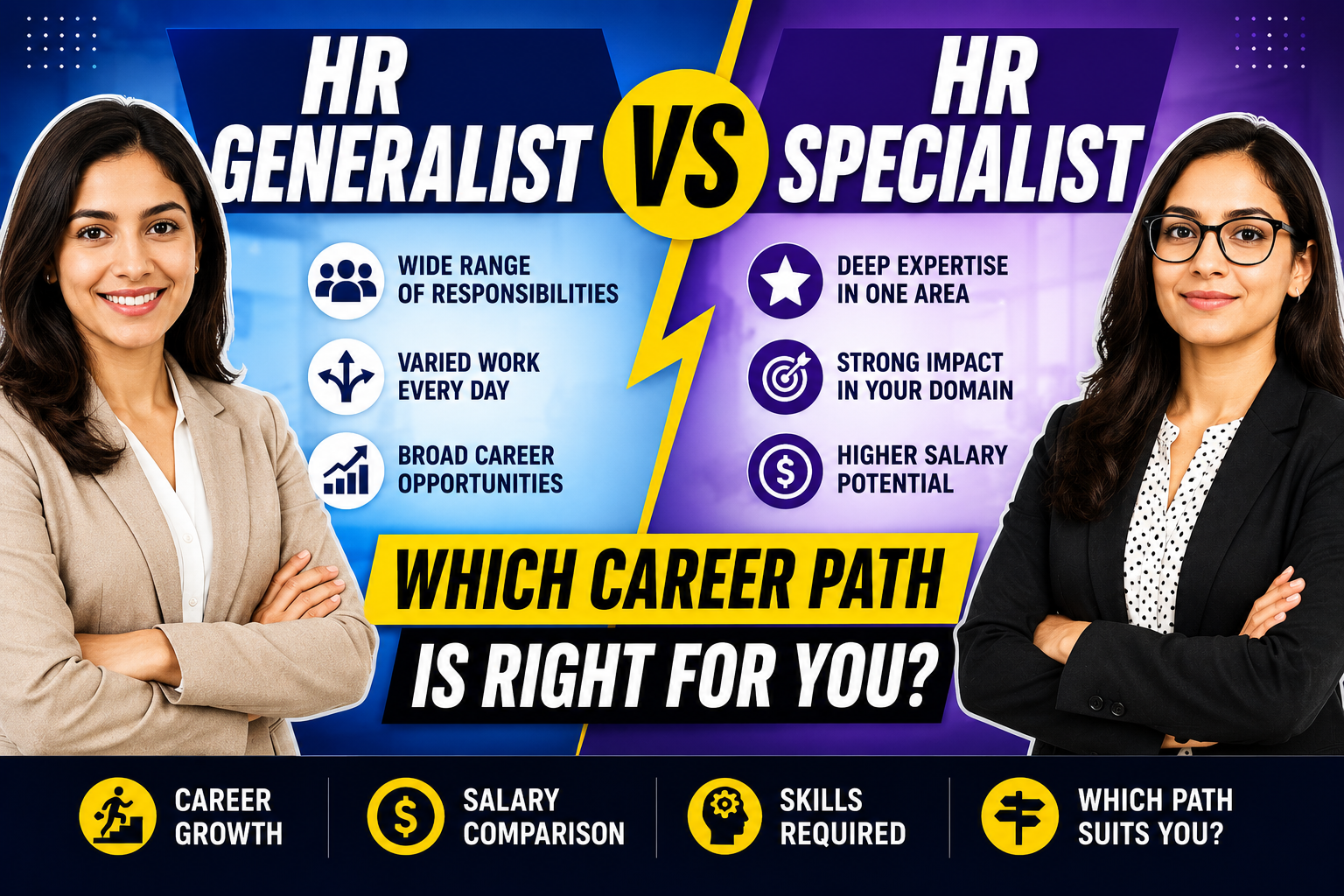
Human Resources has become one of the most important functions in modern organisations. It is no longer limited to hiring candidates, maintaining employee records, or managing paperwork. Today, HR professionals are involved in recruitment, onboarding, payroll, employee engagement, workplace culture, learning and development, performance management, compliance, HR technology, and even data-driven decision-making. For beginners who want to build a career in HR, one common question is whether they should become an HR Generalist or an HR Specialist. Both career paths can offer good growth, but they are very different in terms of daily work, skills required, and long-term opportunities.
An HR Generalist works across many areas of HR. This role is suitable for people who enjoy variety, coordination, employee interaction, and learning different parts of the HR function. On the other hand, an HR Specialist focuses deeply on one area, such as recruitment, payroll, compensation and benefits, learning and development, employee relations, or HR analytics.
What Does an HR Generalist Do?
An HR Generalist is a human resources professional who handles many different HR responsibilities instead of focusing on only one area. In simple words, an HR Generalist supports the overall employee journey, from hiring a candidate to helping them settle into the company, managing employee records, supporting payroll, coordinating performance reviews, and handling day-to-day HR queries.
Key Responsibilities of an HR Generalist
This role is common in startups, small and mid-sized companies, and growing organisations where the HR team may not have separate specialists for every function. In such companies, the HR Generalist becomes the person who keeps many HR activities running smoothly.
1. Recruitment and Hiring Support
HR Generalists often help with hiring activities. They may post job openings, screen resumes, schedule interviews, coordinate with managers, and communicate with candidates.
For example, if a company is hiring a sales executive, the HR Generalist may shortlist profiles, arrange interviews, collect feedback, and help with the offer letter process.
2. Onboarding New Employees
Once a candidate joins the company, the HR Generalist helps them understand company policies, complete documentation, set up employee records, and settle into the workplace.
This may include:
- Collecting documents
- Explaining leave and attendance rules
- Introducing the employee to the team
- Coordinating with IT or admin teams
- Sharing company policies and employee handbook
A good onboarding experience helps new employees feel comfortable and confident from the beginning.
3. Employee Records and Documentation
HR Generalists maintain important employee documents and records. This includes offer letters, appointment letters, identity documents, salary details, attendance records, leave records, and exit documents.
This responsibility requires accuracy because employee records are important for payroll, compliance, audits, and internal HR processes.
4. Attendance and Leave Management
In many companies, HR Generalists manage attendance and leave-related processes. They may track employee attendance, update leave records, answer leave-related questions, and coordinate with managers for approvals.
For example, if an employee has a question about casual leave, sick leave, or unpaid leave, the HR Generalist is usually the first person they contact.
5. Payroll Coordination
An HR Generalist may not always process payroll directly, but they often support payroll by sharing attendance, leave, joining, exit, and salary change details with the payroll team.
They may coordinate on:
- Monthly attendance inputs
- Leave without pay details
- New joinee salary details
- Full and final settlement inputs
- Reimbursement records
Payroll coordination is important because even small mistakes can affect employee salaries.
6. Employee Engagement
HR Generalists also support employee engagement activities. These may include team-building sessions, festival celebrations, feedback surveys, birthday events, recognition activities, and wellness initiatives.
The aim is to create a positive work environment where employees feel connected and valued.
7. HR Policies and Compliance Support
HR Generalists help employees understand company policies and ensure that basic HR processes are followed properly. They may support compliance related to employee documents, leave policy, workplace behaviour, code of conduct, and statutory requirements.
For example, they may help explain rules related to probation, notice period, attendance, work-from-home policy, or workplace discipline.
8. Performance Review Coordination
In many organisations, HR Generalists help coordinate performance review cycles. They may share appraisal forms, collect feedback from managers, track deadlines, and maintain review records.
They may not always decide ratings or salary hikes, but they help ensure that the process runs smoothly and fairly.
9. Employee Queries and Workplace Support
HR Generalists are often the first point of contact for employees. They answer questions related to policies, salary, leaves, documents, benefits, onboarding, and exit formalities.
This makes the role people-facing and highly interactive. A good HR Generalist needs patience, communication skills, confidentiality, and problem-solving ability.
Why the HR Generalist Role is Important?
The HR Generalist role is important because it connects employees, managers, and the organisation. While specialists focus on one area, generalists understand the complete HR function. They help ensure that employees are hired properly, supported during their journey, paid correctly, engaged at work, and guided through company processes.
For beginners, this role can be a strong starting point because it gives exposure to almost every part of HR. Over time, an HR Generalist can grow into roles such as HR Manager, HR Business Partner, People Operations Manager, or HR Head.
What Does an HR Specialist Do?
An HR Specialist is a human resources professional who focuses on one specific area of HR instead of handling many HR functions together. While an HR Generalist works across recruitment, onboarding, payroll, engagement, and policies, an HR Specialist goes deeper into one particular function and builds strong expertise in that area.
HR Specialist roles are more common in large companies, MNCs, consulting firms, HR service companies, and organisations with mature HR teams. In these companies, HR work is often divided into separate departments so that each team can focus on one important part of employee management.
Common Types of HR Specialist Roles
For example, one person may only handle recruitment, another may manage payroll, another may focus on learning and development, and another may work on compensation and benefits.
1. Talent Acquisition Specialist
A Talent Acquisition Specialist focuses on hiring the right people for the company. This role involves sourcing candidates, screening resumes, conducting initial interviews, coordinating with hiring managers, and managing the recruitment process.
This role is suitable for people who enjoy communication, networking, negotiation, and understanding job requirements.
2. Payroll Specialist
A Payroll Specialist manages employee salary processing. This role requires accuracy because even a small mistake can affect employee salaries and trust.
A Payroll Specialist may handle:
- Salary calculations
- Attendance and leave inputs
- Deductions and reimbursements
- Tax-related salary inputs
- Payslip generation
- Full and final settlement
This role is suitable for people who are detail-oriented and comfortable working with numbers and systems.
3. Learning and Development Specialist
A Learning and Development Specialist focuses on employee training and skill development. They identify training needs, coordinate workshops, create learning programs, and help employees improve their performance.
This role is suitable for people who enjoy teaching, communication, employee development, and planning learning activities.
4. Compensation and Benefits Specialist
A Compensation and Benefits Specialist manages salary structures, incentives, bonuses, insurance, benefits, and rewards policies. This role often requires knowledge of market salary trends, company budgets, and employee benefits.
This path is suitable for people who like data, compensation planning, benchmarking, and structured decision-making.
5. Employee Relations Specialist
An Employee Relations Specialist manages workplace issues, employee concerns, conflict resolution, and policy-related matters. They help maintain a healthy relationship between employees and the organisation.
This role requires strong communication, patience, confidentiality, and problem-solving skills.
6. HR Analytics Specialist
An HR Analytics Specialist works with HR data to help companies make better people decisions. They may analyse hiring trends, attrition rates, employee performance, engagement scores, workforce planning data, and productivity indicators.
This role is suitable for people who are interested in data, Excel, dashboards, reporting, and decision-making.
7. Diversity and Inclusion Specialist
A Diversity and Inclusion Specialist works on creating a fair, inclusive, and respectful workplace. They may design programs related to gender diversity, equal opportunity, inclusive hiring, accessibility, and workplace belonging.
This role is suitable for people who care about workplace culture, fairness, and employee experience.
Why the HR Specialist Role Is Important
The HR Specialist role is important because organisations need deep expertise in different HR areas. As companies grow, HR work becomes more complex. Recruitment, payroll, benefits, learning, compliance, and analytics all require specialised knowledge.
For beginners, choosing a specialist path can be useful if they already know which HR area interests them the most. For example, someone who enjoys hiring may choose talent acquisition, while someone who likes numbers and accuracy may choose payroll or compensation and benefits.
The main advantage of becoming an HR Specialist is depth. Over time, specialists can become experts in their domain and move into roles such as Talent Acquisition Lead, Payroll Manager, L&D Manager, Compensation and Benefits Manager, HR Analytics Manager, or Centre of Excellence roles.

HR Generalist vs HR Specialist: Key Differences
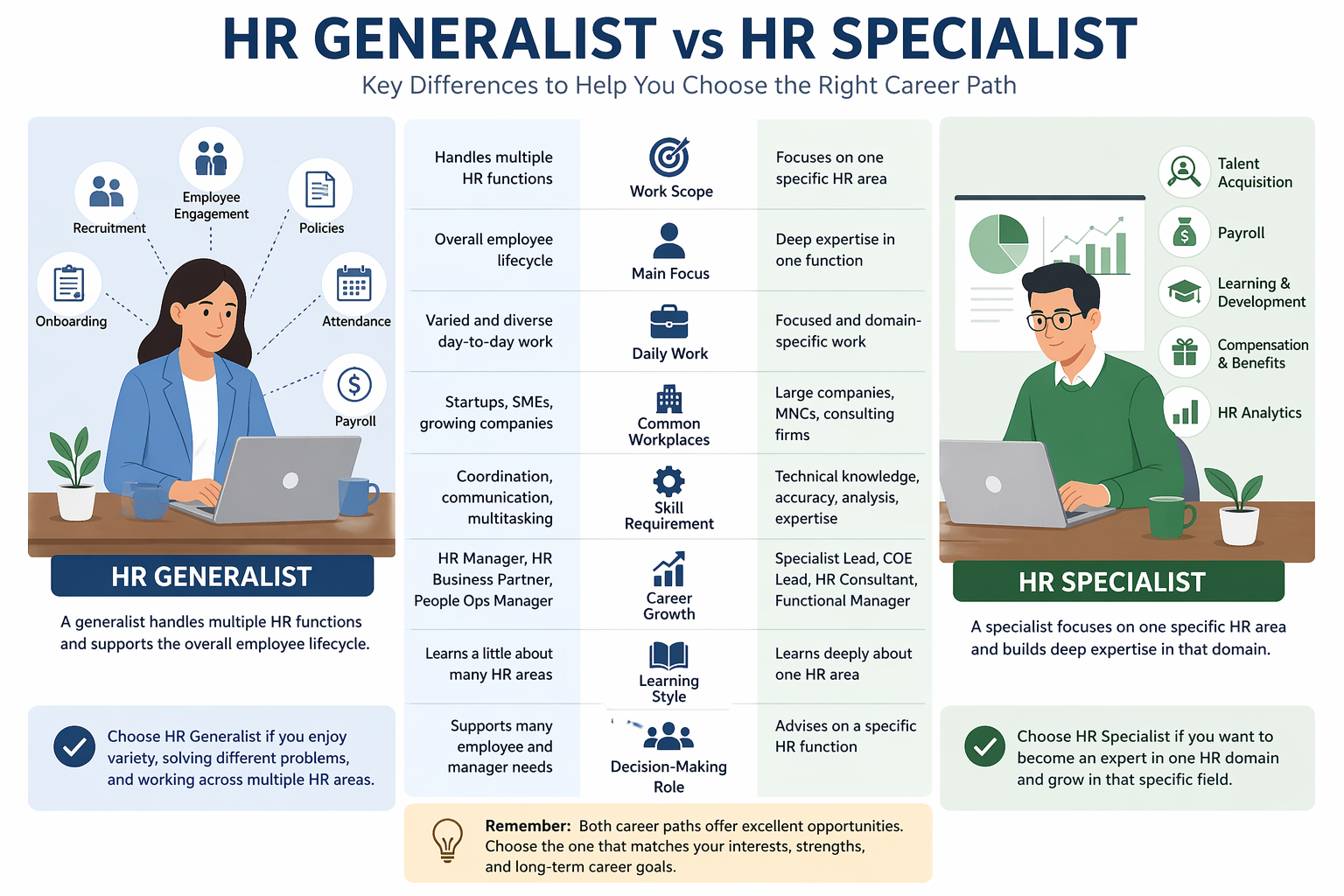
HR Generalist and HR Specialist roles both belong to the human resources field, but they are different in terms of work style, responsibilities, skills, and career growth. An HR Generalist works across many HR functions, while an HR Specialist focuses deeply on one specific area. If you are confused between the two, the easiest way to understand the difference is this: an HR Generalist is like an all-rounder, while an HR Specialist is like a subject expert.
| Factor | HR Generalist | HR Specialist |
| Work Scope | Handles multiple HR functions | Focuses on one specific HR area |
| Main Focus | Overall employee lifecycle | Deep expertise in one function |
| Daily Work | Recruitment, onboarding, payroll coordination, employee queries, engagement, policies | Recruitment, payroll, L&D, HR analytics, compensation, or employee relations |
| Best Suited For | People who like variety and multitasking | People who like depth and specialisation |
| Common Workplaces | Startups, SMEs, growing companies | Large companies, MNCs, consulting firms |
| Skill Requirement | Coordination, communication, problem-solving, multitasking | Technical knowledge, domain expertise, accuracy, analysis |
| Career Growth | HR Manager, HR Business Partner, People Operations Manager | Specialist Lead, COE Lead, HR Consultant, Functional Manager |
| Learning Style | Learns a little about many HR areas | Learns deeply about one HR area |
| Decision-Making Role | Supports many employee and manager needs | Advises on a specific HR function |
| Flexibility | Easier to shift across HR functions | Stronger expertise in one selected domain |
1. Difference in Work Style
An HR Generalist has a more varied workday. One day they may coordinate interviews, and the next day they may handle onboarding, attendance, employee engagement, or policy-related questions.
An HR Specialist usually has a more focused workday. For example, a Talent Acquisition Specialist may spend most of their time sourcing candidates, scheduling interviews, and closing hiring requirements. A Payroll Specialist may spend most of their time working on salary inputs, deductions, compliance, and payroll systems.
2. Difference in Skills
An HR Generalist needs broad HR knowledge and strong people management skills. They should be able to handle different tasks, communicate with employees, solve daily HR issues, and coordinate with different teams.
An HR Specialist needs deeper knowledge in one area. For example, an HR Analytics Specialist should be good with Excel, dashboards, data interpretation, and reporting. A Compensation and Benefits Specialist should understand salary structures, benchmarking, incentives, and benefits planning.
3. Difference in Career Growth
An HR Generalist can grow into broader leadership roles because they understand many parts of HR. This path can lead to roles such as HR Manager, HR Business Partner, People Operations Manager, or HR Head.
An HR Specialist can grow into expert roles within one HR domain. This path can lead to roles such as Talent Acquisition Lead, Payroll Manager, L&D Manager, Rewards Lead, HR Analytics Manager, or Centre of Excellence roles.
4. Difference in Job Fit
The HR Generalist path is better for people who enjoy variety, employee interaction, coordination, and solving different types of HR problems. It is also a good option for beginners who are still exploring which HR area they like most.
The HR Specialist path is better for people who already know their interest area and want to build expertise in it. For example, if you enjoy data, HR analytics may be a better fit. If you enjoy hiring conversations, talent acquisition may suit you more. If you like accuracy and numbers, payroll or compensation and benefits may be a better choice.
In simple terms, choose HR Generalist if you want broad exposure and flexibility. Choose HR Specialist if you want focused expertise and depth in one HR function.
Which Career Path is Better for Beginners?
For most beginners, the HR Generalist path is usually a better starting point because it gives wider exposure to the HR function. As an HR Generalist, you get to understand how recruitment, onboarding, payroll coordination, employee engagement, documentation, policies, and performance review processes work together. This helps you build a strong foundation before deciding whether you want to specialise later.
However, this does not mean every beginner must start as an HR Generalist. If you already know your area of interest, you can also begin with an HR Specialist role. For example, if you enjoy talking to people, screening candidates, and closing job openings, Talent Acquisition can be a good starting point. If you like numbers, accuracy, and structured work, payroll or compensation and benefits may suit you better. If you enjoy data, reports, and dashboards, HR Analytics can be a strong career option.
Choose HR Generalist If You:
- Want to understand the full HR function
- Like variety in your daily work
- Enjoy working with employees and managers
- Are still exploring which HR area suits you
- Want to grow into HR Manager or HR Business Partner roles
- Prefer a role where every day may involve different tasks
An HR Generalist role is especially useful in the early stage of your career because it helps you understand the complete employee lifecycle. You learn how people are hired, onboarded, supported, evaluated, and retained within an organisation.
Choose an HR Specialist If You:
- Already know which HR area interests you
- Prefer depth over variety
- Want to become an expert in one function
- Like structured and focused work
- Want to build technical knowledge in areas like payroll, HR analytics, rewards, or L&D
- Prefer working in larger companies with specialised HR teams
An HR Specialist role can be a good choice if you want to build a clear niche. Over time, specialist skills can become highly valuable, especially in areas like compensation and benefits, HR analytics, talent acquisition, and learning and development.
Simple Way to Decide
| Your Interest | Better HR Path |
| You want broad HR exposure | HR Generalist |
| You like hiring and candidate interaction | Talent Acquisition Specialist |
| You like numbers and accuracy | Payroll or Compensation Specialist |
| You enjoy training and employee development | L&D Specialist |
| You like reports, dashboards, and data | HR Analytics Specialist |
| You enjoy solving employee concerns | Employee Relations Specialist |
| You are still unsure | Start as an HR Generalist |
For beginners, the safest approach is to first understand the basics of HR and then choose a direction. You can start as an HR Generalist and later move into a specialist role, or you can begin with a specialist function and grow deeper in that domain. The right path depends on your personality, skills, and long-term career goals.
Salary, Growth, and Future Career Opportunities
Salary and growth in HR depend on your experience, company size, industry, location, and the kind of HR skills you build. In general, HR Generalist roles give you wider exposure, while HR Specialist roles can offer stronger salary growth when you build expertise in high-demand areas like HR analytics, compensation and benefits, talent acquisition, payroll, or learning and development.
For India, Glassdoor salary estimates as of April 2026 show that HR Generalists earn an average of around ₹5.5 lakh per year, while HR Specialists earn around ₹7.1 lakh per year. Talent Acquisition Specialists average around ₹6 lakh per year, and HR Business Partners, which are usually more senior generalist-strategic roles, average around ₹11.83 lakh per year. These numbers are only indicative and may vary depending on company, city, experience, and skill level.
| Career Stage | HR Generalist Path | HR Specialist Path | Approximate Salary Range in India |
| Entry Level | HR Executive, HR Coordinator | Recruitment Executive, Payroll Associate, L&D Assistant | ₹2.5 lakh to ₹5 lakh per year |
| Early Career | HR Generalist, People Operations Executive | Talent Acquisition Specialist, Payroll Specialist, HR Operations Specialist | ₹4 lakh to ₹8 lakh per year |
| Mid Level | HR Manager, Senior HR Generalist | C&B Specialist, L&D Specialist, HR Analytics Specialist | ₹7 lakh to ₹15 lakh per year |
| Senior Level | HR Business Partner, People Operations Manager | TA Lead, Rewards Lead, L&D Manager, HR Analytics Manager | ₹12 lakh to ₹25 lakh+ per year |
| Leadership Level | HR Head, CHRO Track | COE Lead, HR Consultant, Functional HR Leader | ₹20 lakh+ per year |
The HR Generalist path can grow into broader leadership roles. A person who starts as an HR Executive or HR Generalist can later become an HR Manager, HR Business Partner, People Operations Manager, HR Head, or even CHRO in the long run. This path is useful for people who want to understand the full employee lifecycle and take up people-management responsibilities.
The HR Specialist path can grow into expert roles. A person who starts in recruitment can become a Talent Acquisition Lead. Someone in payroll can move into payroll management or HR operations leadership. Someone in compensation and benefits can move into rewards strategy. Someone in HR analytics can grow into workforce planning, people analytics, or HR consulting roles.
What are the skills that Can Improve Your Salary?
To grow faster in either path, HR professionals should build practical and technical skills along with people skills. Companies are increasingly rewarding specific skill sets and performance-based capabilities, with salary increase surveys for India in 2026 pointing to around 9% average salary growth across companies.
Important skills include:
- HRMS and payroll software knowledge
- Excel and HR reporting
- Recruitment platforms and applicant tracking systems
- Labour law and compliance basics
- Employee engagement and communication skills
- HR analytics and dashboarding
- Compensation benchmarking
- Performance management process knowledge
- Conflict resolution and employee relations skills
In simple terms, the HR Generalist path gives you flexibility and leadership exposure, while the HR Specialist path gives you depth and domain expertise. If you are still exploring, starting as an HR Generalist can be useful. But if you already know your interest area, specialising early in recruitment, payroll, HR analytics, L&D, or compensation can also lead to strong career growth.
Final Thoughts: How to Decide the Right HR Career Path
There is no single “better” career path between HR Generalist and HR Specialist. The right choice depends on your interests, strengths, and long-term goals. If you enjoy variety, employee interaction, coordination, and learning different parts of HR, the HR Generalist path can be a good fit. It gives you broad exposure and can help you grow into roles like HR Manager, HR Business Partner, or People Operations Manager. But if you prefer becoming an expert in one specific area, the HR Specialist path may suit you better. Specialisations like talent acquisition, payroll, compensation and benefits, learning and development, employee relations, and HR analytics can offer strong career growth when you build great skills. For beginners, the best approach is to first understand the basics of HR, identify what type of work you enjoy, and then choose a path that matches your personality and career goals.