Artificial Intelligence has become one of the most important skills for professionals across industries. From banking and healthcare to marketing, education, software development, and business operations, AI is now changing how work is done. However, as AI has grown, it has also become more specialised. Earlier, most AI learning focused on traditional areas such as machine learning, data analysis, prediction models, automation, and decision-making systems. Today, generative AI has created an entirely new learning path based on tools that can write, create, code, summarise, design, and assist with complex tasks.
This is where many learners feel confused. Should they choose a traditional AI certification that focuses on machine learning and data science? Or should they go for a generative AI certification that teaches prompt engineering, large language models, chatbots, AI agents, and automation? The answer depends on your career goal, current skill level, and the kind of work you want to do in the future.
Traditional AI is still highly valuable for those who want to build technical careers in data science, machine learning engineering, analytics, computer vision, and predictive modelling. Generative AI, on the other hand, is becoming useful for a much wider group of professionals, including business analysts, marketers, HR professionals, developers, consultants, teachers, and managers. It allows people to use AI in practical workplace tasks without always needing deep coding or mathematical expertise.
Choosing the right certification path is therefore not just about following the latest trend. It is about understanding where each type of AI fits, what skills it builds, and how it can support your career growth. This blog will help you understand the difference between generative AI and traditional AI, compare their career opportunities, and choose the certification path that best matches your goals.
What is Traditional AI?: Understanding Usage and Application
Traditional AI refers to the older and more established branch of artificial intelligence that is mainly used to analyse data, recognise patterns, make predictions, classify information, and support decision-making. It does not usually create completely new content like generative AI. Instead, it works by learning from existing data and then using that learning to produce a specific result.
For example, when a bank uses AI to detect suspicious transactions, it is using traditional AI. When an e-commerce website recommends products based on your past searches, that is also traditional AI. Similarly, when a company uses AI to forecast sales, identify customer behaviour, predict machine failure, or classify images, it is mostly working with traditional AI systems.
Traditional AI is built on concepts such as machine learning, deep learning, natural language processing, computer vision, statistics, algorithms, and data modelling. These systems are usually trained on structured or semi-structured data and are designed to solve a clearly defined problem. For instance, a traditional AI model may be trained to answer questions like:
- Which customers are likely to leave the company?
- Is this email spam or genuine?
- Will demand for a product increase next month?
- Does this medical scan show signs of disease?
This type of AI is extremely important because it powers many real-world systems that businesses already use. It helps organisations become more efficient, reduce errors, improve forecasting, automate repetitive decisions, and make better use of data.
A traditional AI certification usually focuses on the technical foundation of AI. It may include topics such as machine learning algorithms, Python programming, data preprocessing, model training, model testing, supervised learning, unsupervised learning, neural networks, and AI deployment. This path is especially useful for learners who want to build careers in data science, machine learning engineering, AI development, analytics, or automation.
In simple terms, traditional AI is best suited for people who want to understand how AI models work behind the scenes. It is more technical, data-driven, and model-focused. If your goal is to build predictive systems, work with datasets, train models, or enter roles such as data scientist or machine learning engineer, then a traditional AI certification can be a strong starting point.
What is Generative AI?: Usage and Application
Generative AI is a newer and fast-growing branch of artificial intelligence that can create new content based on the data and instructions it receives. Unlike traditional AI, which mainly predicts, classifies, or detects patterns, generative AI can produce text, images, code, summaries, designs, audio, videos, presentations, reports, and even business ideas.
A simple example is a chatbot that writes an email, a tool that creates an image from a text prompt, or an AI assistant that summarises a long report within seconds. Generative AI is also used in coding tools, customer support bots, marketing content creation, resume writing, research assistance, document automation, and knowledge management systems.
Generative AI works mainly through advanced models such as large language models, image generation models, and multimodal AI systems. These models are trained on large amounts of data and can understand patterns in language, visuals, code, and other formats. When a user gives an instruction, also called a prompt, the model generates a new response based on that input.
For example, generative AI can help answer questions like:
- How can I write a professional email for a client?
- Can you summarise this 30-page report?
- Can you generate Python code for this task?
- Can you create a learning plan for a beginner?
- Can you build a chatbot that answers questions from company documents?
This is why generative AI has become useful not only for technical professionals but also for people from business, marketing, HR, education, finance, consulting, and operations. Many professionals now use generative AI to save time, improve productivity, automate repetitive tasks, create first drafts, brainstorm ideas, and make better decisions.
A generative AI certification usually focuses on practical and applied skills. It may include prompt engineering, large language models, AI tools, chatbots, responsible AI, generative AI workflows, automation, RAG applications, AI agents, and business use cases. Some advanced certifications may also include Python, APIs, LangChain, vector databases, and model deployment.
In simple terms, generative AI is best suited for people who want to use AI as a productivity, creativity, and automation tool. If your goal is to apply AI in business workflows, content creation, software development, research, customer service, or everyday professional tasks, then a generative AI certification can be a very useful choice.
Generative AI vs Traditional AI: Key Differences
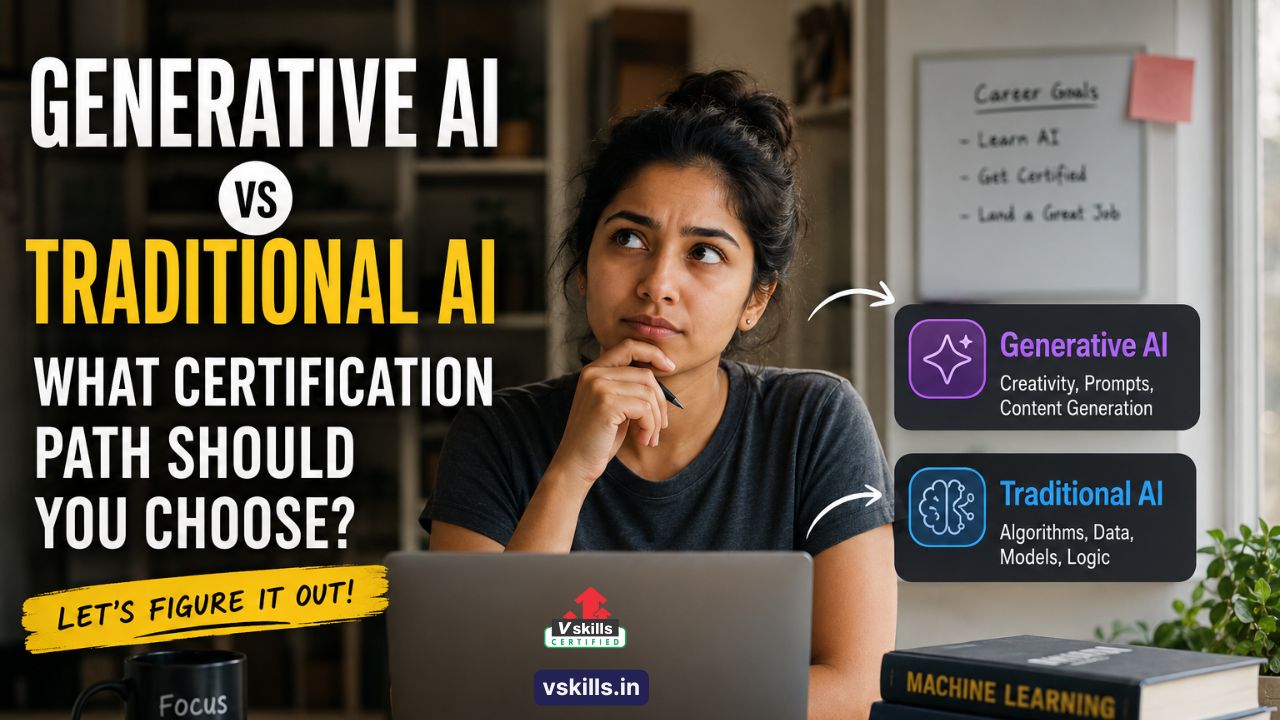
Generative AI and traditional AI both belong to the broader field of artificial intelligence, but they are not the same. They differ in how they work, what they produce, and what kind of skills they require. Understanding this difference is important before choosing any certification path, because the right course depends on the kind of AI career or workplace skill you want to build.
Traditional AI is mainly focused on analysing existing data and producing a specific result. It is useful when the goal is to predict, classify, detect, or recommend something. For example, a traditional AI model can predict whether a customer may leave a company, classify an email as spam, detect fraud in a banking transaction, or recommend a product on an online shopping platform.
Generative AI, on the other hand, focuses on creating new outputs. It can write text, generate images, create code, summarise documents, build chatbot responses, design workflows, and assist with creative or professional tasks. Instead of only giving a prediction or category, it produces content that looks new and useful for the user.
| Basis of Difference | Traditional AI | Generative AI |
| Main purpose | Predicts, classifies, detects, or recommends | Creates, writes, summarises, designs, or generates |
| Type of output | Labels, scores, predictions, alerts, recommendations | Text, images, code, reports, chatbot replies, designs |
| Common use cases | Fraud detection, sales forecasting, credit scoring, product recommendations | Chatbots, content creation, coding help, report writing, AI assistants |
| Skills required | Machine learning, statistics, Python, data modelling, algorithms | Prompt engineering, LLMs, AI tools, RAG, automation, AI workflows |
| Technical depth | Usually more technical and data-heavy | Can be beginner-friendly, but advanced paths can be technical |
| Best suited for | Data scientists, ML engineers, AI developers, analysts | Business professionals, marketers, developers, consultants, product teams |
| Career focus | Building and improving AI models | Applying AI tools and building AI-powered workflows |
| Certification focus | Machine learning, deep learning, NLP, computer vision, model deployment | Prompting, large language models, chatbots, AI agents, responsible AI |
The main difference can be understood in a simple way: traditional AI helps machines make decisions, while generative AI helps machines create. Traditional AI is stronger when the problem is clearly defined and data-driven. Generative AI is stronger when the task involves language, creativity, content, communication, coding, or knowledge-based assistance.
However, this does not mean that one is better than the other. Both are important. Traditional AI forms the foundation of many intelligent systems, while generative AI is making AI more accessible to everyday professionals. In many modern jobs, the strongest skill set may come from understanding both: traditional AI for the technical foundation and generative AI for practical workplace application.

Choose Traditional AI Certification: For a Technical AI Career
A traditional AI certification is a strong choice if you want to build a more technical career in artificial intelligence. This path is best suited for learners who want to understand how AI models are built, trained, tested, improved, and deployed in real-world systems. It is not just about using AI tools; it is about understanding the logic behind them.
Traditional AI certifications are especially useful for people who want to work in roles such as data scientist, machine learning engineer, AI engineer, data analyst, NLP engineer, computer vision specialist, or automation engineer. These roles usually require a deeper understanding of data, algorithms, mathematics, statistics, and programming.
This path is a good fit if you enjoy working with datasets and solving business problems through data. For example, you may want to build a model that predicts customer churn, detects fraud, forecasts sales, recommends products, or classifies medical images. These tasks require more than just prompt writing. They need knowledge of machine learning models, data preparation, feature engineering, model evaluation, and deployment.
A traditional AI certification usually covers topics such as:
| Skill Area | What You Learn |
| Machine Learning | How models learn from data and make predictions |
| Statistics | How to understand patterns, probability, and uncertainty |
| Python Programming | How to write code for data analysis and model building |
| Data Preprocessing | How to clean and prepare raw data for AI models |
| Supervised Learning | How to train models using labelled data |
| Unsupervised Learning | How to find patterns in unlabelled data |
| Deep Learning | How neural networks solve complex problems |
| Model Evaluation | How to test whether a model is accurate and reliable |
| AI Deployment | How to put AI models into real business applications |
The biggest advantage of choosing a traditional AI certification is that it builds a strong foundation. Once you understand machine learning and data science, it becomes easier to understand advanced AI systems, including generative AI. Many generative AI applications also use traditional AI concepts such as embeddings, classification, recommendation systems, model evaluation, and data pipelines.
However, this path may take more time and effort. It often requires coding practice, mathematical understanding, and hands-on projects. Beginners may find it slightly challenging in the beginning, especially if they do not have a background in programming or statistics. But for learners who want a long-term technical career in AI, this investment can be highly rewarding.
You should choose a traditional AI certification if:
- You want to become a data scientist or machine learning engineer.
- You are comfortable learning Python, statistics, and algorithms.
- You want to build AI models instead of only using AI tools.
- You enjoy working with data and solving analytical problems.
- You want a strong technical foundation for future AI roles.
In simple terms, traditional AI certification is the right path for those who want to go deeper into the technology behind artificial intelligence. It is ideal for learners who do not just want to ask AI for answers, but want to understand how intelligent systems are created, trained, and improved.
Choose Generative AI Certification: For Fast-Growing Applied AI Skills
A generative AI certification is a strong choice if you want to learn how to use AI tools for real-world professional tasks. This path is especially useful for learners who may not want to become full-time data scientists but still want to use AI effectively in their work. It focuses more on practical application, workplace productivity, automation, content generation, and AI-assisted problem-solving.
Generative AI has become popular because it is easier for many professionals to start with. You do not always need deep coding, advanced mathematics, or machine learning knowledge in the beginning. Instead, you learn how to communicate with AI tools, design better prompts, evaluate AI-generated outputs, and use AI responsibly in business workflows.
A generative AI certification is useful for professionals in many fields, such as:
| Professional Role | How Generative AI Helps |
| Business Analyst | Creates reports, summaries, dashboards, and business insights |
| Marketing Professional | Writes campaigns, blogs, captions, ad copies, and content plans |
| HR Professional | Drafts job descriptions, training material, and employee communication |
| Software Developer | Generates code, explains errors, writes documentation, and supports debugging |
| Consultant | Prepares research briefs, presentations, proposals, and client notes |
| Teacher or Trainer | Creates lesson plans, quizzes, study material, and learning content |
| Product Manager | Builds user stories, feature ideas, product documents, and market research |
| Operations Professional | Automates repetitive tasks and improves workflow efficiency |
A good generative AI certification usually teaches topics such as prompt engineering, large language models, AI tools, chatbots, responsible AI, workflow automation, RAG applications, AI agents, and AI use cases across industries. More advanced courses may also include APIs, vector databases, LangChain, Python, and deployment of generative AI applications.
This path is especially suitable for learners who want to quickly apply AI in their current job. For example, a business analyst can use generative AI to summarise large reports and prepare insights. A marketer can use it to create campaign ideas. A developer can use it to write code faster. A manager can use it to prepare meeting notes, proposals, and strategy documents.
You should choose a generative AI certification if:
- You want to use AI tools in your current job.
- You are interested in prompt engineering, chatbots, and AI automation.
- You want a beginner-friendly entry into AI.
- You work in business, marketing, HR, consulting, education, content, or product roles.
- You want to improve productivity without immediately going deep into machine learning.
The biggest advantage of generative AI certification is that it offers quick practical value. Learners can start applying the skills almost immediately in daily work. However, the limitation is that basic generative AI skills may not be enough for highly technical AI roles. If you want to build advanced AI systems, you may eventually need to learn traditional AI concepts as well.
In simple terms, generative AI certification is the right path for professionals who want to become AI-enabled in their existing roles. It helps you use AI as a powerful assistant for writing, research, coding, communication, automation, and decision-making. For many learners in 2026, this may be the fastest way to enter the AI space and stay relevant in a changing job market.
Best Certification Path Based on Your Career Goal
The best AI certification path depends on what kind of role you want to enter. Some learners want to become technical AI professionals who build models, work with data, and develop machine learning systems. Others want to use AI tools to become more productive in their current job. This is why it is important to choose a certification based on your career goal rather than simply choosing the most popular course.
If you are a beginner, the best approach is to start with AI fundamentals. This gives you a basic understanding of what artificial intelligence is, how machine learning works, what generative AI can do, and where AI is used in business. After that, you can choose a specialised path depending on whether you want a technical, business, or applied AI career.
| Career Goal | Best Certification Path | Why It Fits |
| Data Scientist | Traditional AI + Machine Learning Certification | Helps you learn data analysis, model building, statistics, and prediction techniques |
| Machine Learning Engineer | Traditional AI + Deep Learning + Cloud AI Certification | Builds strong technical skills for training, deploying, and managing AI models |
| AI Engineer | Traditional AI + Generative AI Engineering Certification | Useful for building both predictive models and modern GenAI applications |
| Business Analyst | Generative AI + Data Analytics Certification | Helps in report writing, insight generation, dashboard interpretation, and business decision-making |
| Software Developer | Generative AI Engineering + API/Cloud Certification | Useful for building chatbots, AI assistants, automation tools, and AI-powered applications |
| Marketing Professional | Prompt Engineering + Generative AI Certification | Helps in content creation, campaign planning, customer research, and brand communication |
| HR Professional | Generative AI for Business + Automation Certification | Helps in recruitment, training content, policy drafting, and employee communication |
| Product Manager | Generative AI Strategy + AI Fundamentals | Helps in understanding AI products, user needs, product roadmaps, and AI-based features |
| Consultant or Manager | Generative AI Leadership + Responsible AI Certification | Useful for AI strategy, business transformation, productivity improvement, and risk management |
| Beginner with No Coding Background | AI Fundamentals + Generative AI Basics | Gives an easy entry point into AI without heavy programming or mathematics |
For learners who want a technical AI career, the traditional AI path is usually better. It builds deeper knowledge of machine learning, data science, algorithms, and model deployment. This path may take more time, but it gives a stronger foundation for long-term roles in AI development and data science.
For professionals who want to use AI in their existing work, the generative AI path is more practical. It helps them use AI tools for writing, research, coding support, workflow automation, report creation, customer communication, and productivity improvement. This is especially useful for people in business, marketing, HR, consulting, education, product management, and operations.
For software developers and AI engineers, a hybrid path is often the strongest choice. They can begin with traditional AI concepts to understand how models work and then move into generative AI engineering to build chatbots, AI agents, RAG applications, and intelligent business tools.
A simple way to decide is this:
| If You Want To | Choose This Path |
| Build AI models | Traditional AI certification |
| Use AI tools at work | Generative AI certification |
| Become a data scientist | Machine learning and data science certification |
| Build chatbots or AI apps | Generative AI engineering certification |
| Lead AI projects in business | Generative AI strategy certification |
| Enter AI with no technical background | AI fundamentals followed by generative AI basics |
In short, there is no single best certification for everyone. The right certification is the one that matches your career direction. If you want depth, choose traditional AI. If you want practical workplace use, choose generative AI. If you want to stay future-ready, combine both over time.
The Smartest Path is Layered Learning
The choice between generative AI and traditional AI should not be seen as a competition. Both fields are important, but they serve different purposes. Traditional AI is best for learners who want to build a strong technical foundation in machine learning, data science, predictive modelling, and AI development. Generative AI is best for professionals who want to use AI tools for writing, research, automation, coding support, content creation, business workflows, and productivity improvement.
If your goal is to become a data scientist, machine learning engineer, AI developer, or computer vision specialist, a traditional AI certification will be more useful. It will help you understand how models are trained, how data is prepared, how algorithms work, and how AI systems are evaluated. This path may take more time, but it builds deeper technical expertise.
If your goal is to become more productive in your current job or enter AI through a practical route, a generative AI certification may be the better starting point. It is especially useful for business analysts, marketers, HR professionals, consultants, teachers, software developers, product managers, and working professionals who want to apply AI quickly in real workplace tasks.
The smartest approach, however, is layered learning. Start with AI fundamentals to understand the basic concepts. Then choose a specialised certification based on your career goal. After that, build small projects to show your skills. For example, you can create a chatbot, automate a reporting task, build a simple prediction model, design an AI workflow, or prepare a portfolio of AI use cases. In 2026, employers will not only look for certificates. They will look for people who can apply AI meaningfully. A certificate can open the door, but practical projects, problem-solving ability, and responsible AI usage will make you stand out. The best certification path is therefore the one that helps you move from learning AI to actually using AI with confidence.