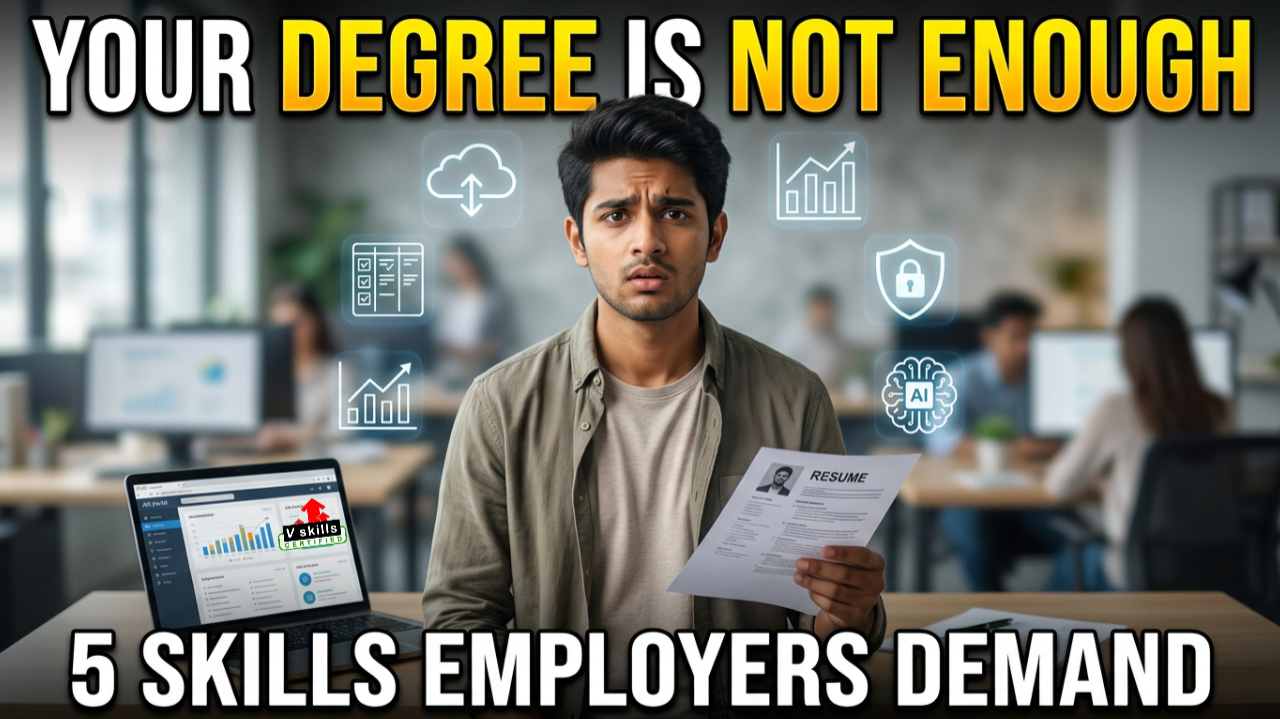
The moment you walked across that graduation stage, you believed something: that the degree in your hand was a ticket. A promise. Proof that you had done what was needed to compete for the kind of career you wanted. That belief was not wrong. It was just incomplete. Something fundamental has shifted in the global hiring landscape. Across industries, in companies of every size, in markets from Mumbai to Manchester, employers are asking a different question. They are no longer asking only where you have studied. They are asking what you can do? And increasingly, the clearest answer to that question is not a transcript — it is Skills-Based Learning.
The rules of hiring have changed.
Degree-based hiring is giving way to skills-based hiring. LinkedIn reported that job postings that do not require a degree have increased by over 30% in the past three years. IBM, Google, Apple, and Accenture have formally removed degree requirements from large categories of roles. In India, a wave of digital transformation across BFSI, e-commerce, government, and technology sectors is creating urgent demand for specific, verifiable, up-to-date capabilities — and employers are increasingly using certifications as the filter.
A degree gets you in the room. Certifications get you the job — and keep you in it.
This guide identifies the five skill domains that are most consistently in demand across modern employers. For each one, we have gone beyond listing certification names to explain what the skill actually means, what it looks like in practice, what career doors it opens, and which certifications — including Vskills government-recognised credentials — will make employers take notice.
What has changed?
A college degree still holds value, but it is no longer the complete ticket to employment that it once was. In today’s job market, employers are looking beyond formal education and paying closer attention to whether candidates have practical, industry-relevant skills. A degree may show that you have completed academic training, but it does not always prove that you are ready to handle the tools, technologies, and real-world challenges of a modern workplace.
This shift is happening across industries. Companies want people who can work with data, understand digital systems, adapt to new technologies, manage projects efficiently, and contribute from day one. As a result, hiring decisions are increasingly influenced by the skill domains a candidate understands, not just the subject written on their degree certificate.
That does not mean degrees have become unimportant. Instead, it means that degrees now need to be supported by specialised knowledge that matches changing employer expectations. Candidates who build expertise in the right domains often have a stronger chance of standing out in competitive job markets and showing that they are ready for the demands of current roles.
Why a Degree alone is No Longer Enough?
There was a time when earning a degree was enough to give candidates a clear advantage in the job market. It reflected educational achievement, subject knowledge, and a certain level of discipline and commitment. While that still holds value, the reality of hiring has changed. Today, a degree is often seen as the foundation of a profile, not the full proof of career readiness.
- One of the biggest reasons for this shift is that employers are no longer hiring only for academic knowledge. They are hiring for an application. A candidate may understand concepts well in theory, but companies also want to know whether that person can use tools, solve practical problems, work with teams, adapt to workplace systems, and contribute to business goals from the beginning. In many cases, traditional degree programmes do not fully bridge this gap between education and execution.
- The modern workplace has also become more dynamic. Technology is reshaping industries at a rapid pace, and job roles are evolving much faster than before. Skills that were optional a few years ago are now becoming basic expectations in many professions. Employers want people who can work with digital platforms, interpret information, learn new systems quickly, and stay relevant as industries change. A degree alone may show academic preparation, but it does not always signal readiness for this fast-moving environment.
- Another important factor is competition. More candidates than ever before hold degrees, which means academic qualifications alone do not help applicants stand out in the same way they once did. When employers are choosing between candidates with similar educational backgrounds, they often look for something more. That “something more” is usually practical capability, specialised knowledge, and evidence that the candidate has developed expertise beyond the classroom.
This does not mean degrees have lost their importance. They still matter and continue to play a major role in shaping a person’s academic and professional foundation. However, they are no longer enough on their own in a market that values relevance, adaptability, and applied skills. Employers increasingly want candidates who can show not only what they have studied, but also what they are prepared to do with that knowledge in real work settings.
Why Skill Domains Matter More Than Ever?
Employers today are not only looking at qualifications. They are also looking at whether a candidate understands the areas that are shaping modern work. This is why skill domains have become so important in hiring decisions. They help employers judge whether a person is prepared for the needs of a real job, not just the academic side of it.
A skill domain refers to a practical area of expertise that is relevant to current industry demand. It could be data analytics, digital marketing, cloud computing, project management, artificial intelligence, or another fast-growing field. These domains matter because they reflect where businesses are investing, how industries are changing, and what kind of talent companies now need.
Here are some key reasons skill domains matter more than ever:
- They align with current industry needs
Employers want candidates whose skills match the direction in which the market is moving. Domain knowledge shows that you understand the tools, systems, and methods that are becoming important in the workplace. - They make candidates more job-ready
A degree may prove academic learning, but domain expertise suggests that a candidate is better prepared to handle actual work responsibilities. It gives employers more confidence in a person’s practical readiness. - They help candidates stand out in a crowded market
Since many applicants may have similar degrees, domain-specific knowledge can become the factor that makes one profile stronger than another. It gives your resume more relevance and depth. - They show adaptability and continuous learning
Building expertise in a domain signals that you are willing to grow with industry changes. Employers value candidates who are proactive about updating their knowledge and staying relevant. - They are useful across multiple career stages
Skill domains are not only helpful for fresh graduates. They are equally valuable for professionals who want to switch careers, move into better roles, or stay competitive in their existing field. - They connect education with employability
Domain knowledge helps bridge the gap between what students learn in academic institutions and what employers expect in professional settings. It adds a practical layer to formal education.
In today’s hiring landscape, employers want more than general academic achievement. They want focused, relevant, and applicable knowledge. This is exactly why developing expertise in the right skill domains can make a profile stronger, more competitive, and far more attractive to recruiters.
The 5 Skills Employers Now Demand
These aren’t just buzzwords on a job listing. Each of these skill sets represents a fundamental shift in how modern organisations operate — and how professionals create value within them. The good news? Every single one is learnable, certifiable, and immediately marketable.
1. Cloud Computing & Infrastructure
The backbone of every modern business — and almost no one is truly fluent in it. Think about the last time your team worked on a shared document, accessed a dashboard from home, or used a SaaS tool. All of that lived in the cloud. Cloud computing is not just a technical concept — it is the operating environment of every modern organisation. Understanding it means knowing how businesses store and process data, deploy applications, and manage costs — not in server rooms, but on distributed platforms like AWS, Microsoft Azure, and Google Cloud.
What employers are discovering is that even non-technical professionals who understand cloud basics — how a virtual machine works, what a data pipeline is, how access permissions function — make dramatically better decisions, communicate more effectively with technical teams, and avoid the kind of expensive mistakes that come from total ignorance of the infrastructure underpinning the business.
A marketing lead who can query a cloud database independently is faster. A finance analyst who understands cloud cost structures prevents budget overruns. A product manager who understands deployment environments ships better products. Cloud literacy is a force multiplier across every function.
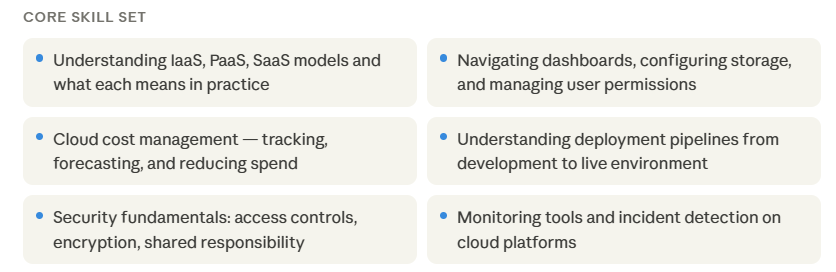
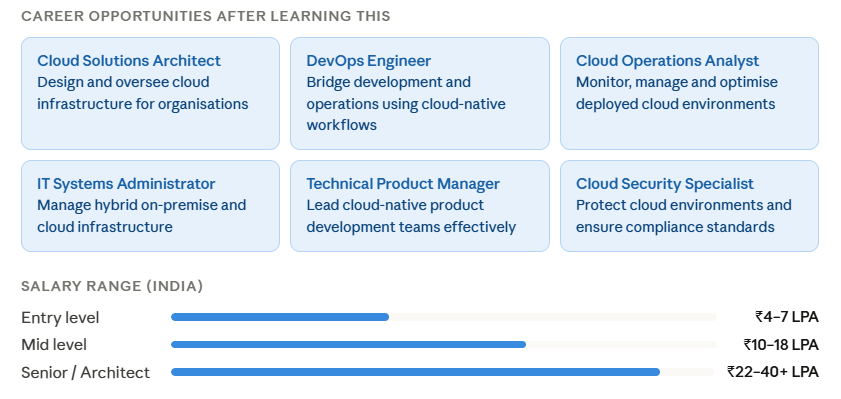
Vskills Cloud Computing Certification is a government-certified credential (Ministry of Skill Development & Entrepreneurship) that is widely recognised by Indian employers across IT, BFSI, and consulting sectors. It covers cloud fundamentals, deployment models, security, and virtualisation — making it an excellent complement to vendor-specific AWS or Azure certifications, especially for those starting their cloud journey or seeking government and PSU roles.
2. Project & Workflow Management
The rarest skill in any room: the ability to actually get things done.
Every company has goals. Almost none of them have enough people who know how to execute them. Project management is the skill of converting ambition into outcomes — breaking big goals into structured workstreams, assigning ownership, managing timelines, anticipating blockers, and delivering results without drama. It sounds simple. In practice, it is one of the highest-leverage skills you can develop.
Modern project management has evolved well beyond Gantt charts and status meetings. Today it encompasses agile and scrum methodologies, digital collaboration tools like Jira, Asana, Notion, and Monday.com, and a deep understanding of how cross-functional teams operate under pressure. The best project managers don’t just track progress — they create the conditions for progress to happen.
This skill translates across industries and seniority levels. A junior analyst who can manage their own workstreams with clarity stands out immediately. A mid-career professional who can run a product launch or a systems migration without constant escalation is invaluable. A senior leader who can orchestrate multiple workstreams simultaneously is irreplaceable.
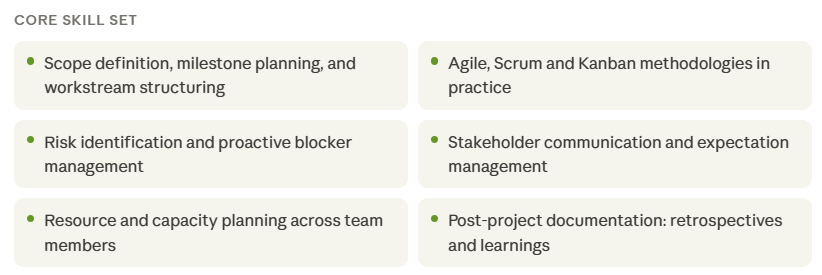
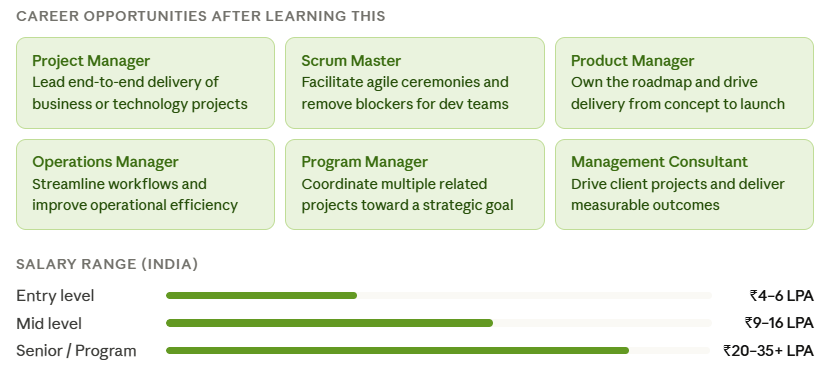
Vskills Certificate in Project Management covers the full spectrum of PM methodology — initiation, planning, execution, monitoring, and closure — alongside risk management and agile principles. It is government-certified and particularly valued in Indian IT services, consulting, and infrastructure sectors. For candidates pursuing roles in mid-sized organisations or government contracts, it offers strong credibility at a fraction of the cost of PMP.
3. Data Literacy & Analytical Thinking
The world is drowning in data. Professionals who can turn it into decisions are worth their weight in gold. Data literacy does not mean becoming a data scientist. It means being the person in the room who can look at a spreadsheet, a dashboard, or a database query result — and extract a story that drives a decision. In 2026, this is no longer optional. The World Economic Forum’s Future of Jobs report ranks analytical thinking as the single most in-demand skill across industries through 2027.
What this looks like in practice depends on your role. A sales manager building a Power BI dashboard that shows pipeline conversion by region is data-literate. A human resources professional who can query an employee database to identify attrition risk before it becomes a crisis is data literate. A founder who can model three pricing scenarios in a Google Sheet before making a product decision is data literate. None of these people needs a statistics degree — they need the skills to ask the right questions of their data and communicate the answers clearly.
The gap between companies that use data well and those that don’t is enormous — and it’s largely a talent gap, not a technology gap. Most organisations already have the tools. What they desperately need are people who know how to use them.

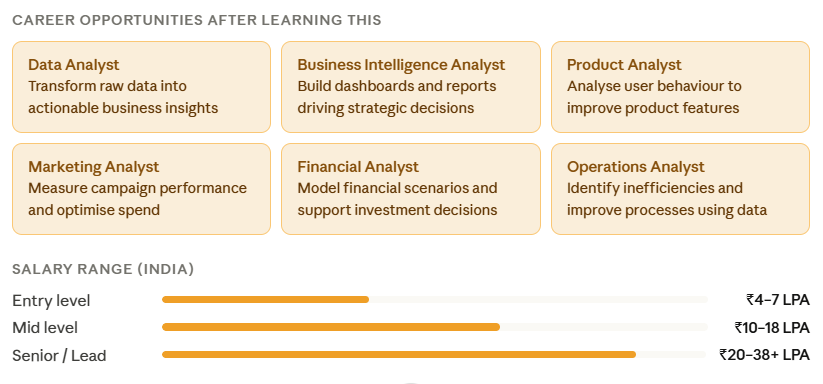
Vskills Master in Business Analysis covers business analysis fundamentals, requirements engineering, data modelling, process improvement, and communication with stakeholders — exactly the blend of analytical and business skills modern employers want. It’s widely recognised in Indian IT, e-commerce, and consulting firms, and serves as a strong credential for professionals transitioning into data-adjacent roles from non-technical backgrounds.
4. Cybersecurity & Digital Risk Awareness
One uninformed employee can bring down an entire organisation. This is no longer just the IT department’s problem. In 2023, cyberattacks cost the global economy over $8 trillion. By 2025, that number is projected to exceed $10 trillion. And the uncomfortable truth is that the vast majority of breaches don’t start with sophisticated hacking — they start with human error. A phishing email. An unsecured Wi-Fi connection. A password reused across accounts. A vendor has been given too much access to the company systems.
This is why cybersecurity is no longer purely a technical domain. Employers increasingly expect every professional — from accountants to copywriters — to carry a baseline security mindset. Understanding how threats work, recognising the warning signs of an attack, and knowing what to do when something looks wrong are now fundamental job skills.
At the professional level, this skill extends into risk assessment, security architecture, compliance frameworks, and incident response. Organisations are desperate for people who can build security into processes from the ground up, not just bolt it on after the fact. The demand for cybersecurity professionals is growing faster than almost any other field — and the talent gap remains enormous.
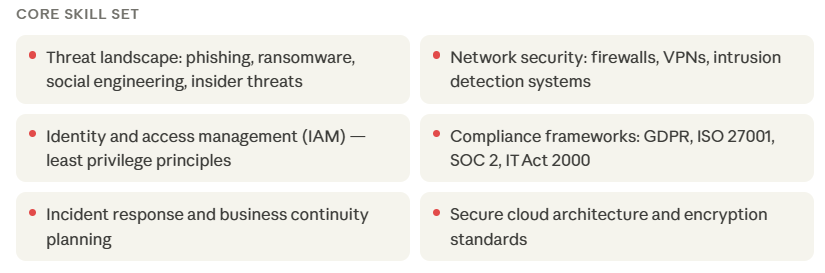

Vskills Certificate in Cybersecurity Architecture covers network security, ethical hacking fundamentals, cryptography, risk management, and Indian compliance frameworks, including IT Act 2000 and CERT-In guidelines. This government-recognised certification is particularly relevant for professionals targeting roles in Indian banking, fintech, government IT, and defence sectors — areas where domestic regulatory compliance knowledge gives Vskills an edge over purely international credentials.
5. AI Fluency & Human-AI Collaboration
AI fluency is not about building machine learning models or writing neural networks from scratch. It is about understanding what AI tools can and cannot do — and developing the judgment to deploy them effectively, critically, and responsibly in your day-to-day work. In 2025, this has become the most decisive differentiator between professionals who are thriving and those who are being left behind.
McKinsey estimates that generative AI could add up to $4.4 trillion annually to the global economy. Companies across every sector are racing to integrate AI into their operations — but they need people who can actually work with these tools strategically, not just experiment with them casually. A content strategist who uses AI to research, draft, and repurpose content at three times the speed of their peers is not working harder — they’re working smarter. A financial analyst who uses AI to summarise hundreds of earnings reports and flag anomalies is not just faster — they’re catching things that human-only analysis would miss.
The professionals who will define the next decade of work are not those who fear AI, or those who blindly trust it — but those who have developed a mature, practised fluency with it. They know when to use it, how to guide it, when to question its outputs, and how to build workflows that amplify their uniquely human capabilities rather than replace them.
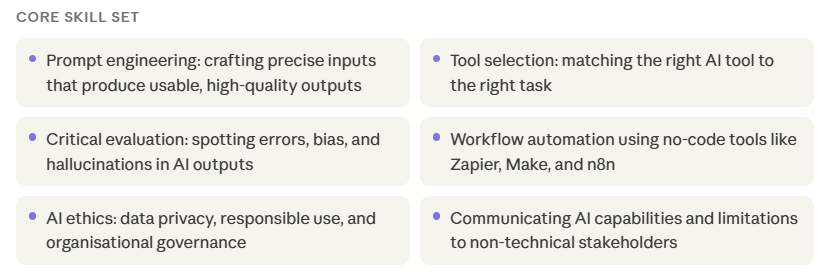

Vskills Artificial Intelligence Certification covers AI fundamentals, machine learning concepts, natural language processing, neural networks, and real-world AI applications — providing a solid conceptual and practical foundation for professionals who want to work intelligently alongside AI systems rather than just use them superficially. The government recognition adds credibility with Indian enterprises and public sector organisations that are rapidly building AI adoption strategies.
Suggested Certifications
How to Choose the Right Domain for Your Career?
Not every skill domain will be equally useful for every person. The right choice depends on your background, your interests, and the kind of career you want to build. This is why it is important to choose a domain carefully instead of simply following trends. A domain may be popular in the market, but it will only help you in the long run if it also fits your strengths and career direction. Choosing the right domain becomes easier when you look at your profile in a practical way.
Here are a few important factors to consider:
- Look at your educational background
Your degree can still help guide your choice. For example, someone from commerce or economics may find data analytics, business intelligence, or financial technology more relevant, while someone from a technical background may find cloud computing or AI more suitable. - Think about your career goals
Ask yourself what kind of role you want in the future. If you want to work in marketing, digital growth skills may be more useful. If you want to move into operations or product roles, project management and Agile collaboration may be a stronger fit. - Consider your natural strengths
Some people enjoy working with numbers and structured analysis, while others are better at communication, creativity, or coordination. Choosing a domain that matches your strengths can make learning easier and more rewarding. - Pay attention to industry demand
It is important to choose a domain that has real value in the job market. Try to focus on areas that are growing across industries and are likely to remain relevant over time. - Evaluate learning accessibility
Some domains are easier to begin with than others. You should consider whether you can realistically build skills in that area through courses, projects, internships, or practical experience. - Think about long-term flexibility
A good domain should not only help you get a job now, but also support growth in the future. Domains such as data, digital systems, AI, and project management often create opportunities across multiple industries and roles.
A smart approach is to choose one primary domain and then gradually build supporting skills around it. For example:
- A person interested in business roles may start with data analytics and later learn project management
- A marketing professional may begin with digital growth and later explore AI tools for content and automation
- A technical candidate may start with cloud computing and then move towards cybersecurity or infrastructure management
The goal is not to master everything at once. The goal is to choose a domain that aligns with your profile and then build depth in that area over time. In a competitive job market, clarity is often more powerful than trying to learn too many unrelated skills at once.
How to Build Skills in These Domains?
Once you identify the right domain for your career, the next step is to build practical skills in a structured way. Employers do not only want to see that you are interested in a field. They want evidence that you have actually learned something useful and can apply it in real situations. This is why skill-building should go beyond theory and focus on both knowledge and practice.
The good part is that building skills in these domains is now more accessible than ever. You do not always need another full degree to become career-ready in a high-demand area. With the right learning approach, you can gradually strengthen your profile and become more competitive in the job market.
Here are some effective ways to build skills in these domains:
- Start with foundational learning
Begin by understanding the basics of the domain you want to enter. This helps you develop clarity before moving to advanced tools or applications. A strong foundation makes later learning much easier and more meaningful. - Take relevant online courses
Online learning platforms have made domain-based education more practical and flexible. Courses can help you understand concepts, tools, workflows, and current industry expectations in a structured format. - Work on practical projects
Projects are one of the best ways to convert learning into visible proof of skill. Whether it is a dashboard, marketing campaign plan, cloud setup simulation, automation workflow, or project timeline exercise, practical work shows employers that you can apply what you have learned. - Build a small portfolio
A portfolio can help you present your work clearly, especially when you are applying for internships, entry-level jobs, or freelance work. It does not have to be large. Even a few strong examples can make your profile more convincing. - Gain hands-on exposure wherever possible
Internships, freelance assignments, part-time work, volunteering, and simulation-based learning can all help you develop real experience. Even small practical opportunities can make a big difference when you are trying to enter a competitive field. - Learn the tools commonly used in that domain
Every domain has certain tools or platforms that are widely used in the workplace. Familiarity with these tools can make your learning more job-oriented and improve your confidence. - Stay updated with industry trends
Since these domains continue to evolve, regular learning is important. Reading articles, following industry updates, joining professional communities, and observing market changes can help you stay relevant. - Combine learning with consistency
It is better to learn one domain steadily over time than to begin multiple domains without real progress. Consistency helps build depth, which employers often value more than scattered knowledge.
In the end, skill-building is not about collecting random knowledge. It is about developing competence that can be seen, tested, and applied. When you combine learning with practice, projects, and real exposure, your profile becomes much stronger and far more aligned with what employers are actually looking for.
Can These Domains Really Improve Your Job Prospects?
The short answer is yes, but not in isolation. Skill domains can significantly improve your job prospects because they make your profile more relevant to what employers are currently looking for. In a competitive hiring market, relevance matters just as much as qualification. When a candidate shows knowledge in a high-demand domain, it gives employers more confidence that the person can adapt to modern work requirements and contribute more effectively in the role.
However, it is also important to understand that skill domains do not replace everything else. They do not make degrees meaningless, and they do not automatically guarantee a job. What they do is strengthen your profile by adding practical value to your educational background. They help employers see that you have moved beyond theory and invested in learning something that connects directly with workplace needs.
Here is how these domains can improve job prospects:
- They make your profile more relevant
Employers prefer candidates whose skills match current business needs. Domain knowledge helps your resume feel more aligned with the role. - They improve employability
Practical knowledge in a growing field makes you more attractive to recruiters, especially when many candidates have similar academic qualifications. - They help you stand out during shortlisting
When recruiters compare multiple resumes, domain-based expertise can make one profile look stronger and more job-ready than another. - They show initiative and seriousness
Learning a high-demand domain reflects effort, curiosity, and a willingness to grow beyond formal education. These qualities are valued by employers. - They support career flexibility
Many of these domains are useful across industries, which means they can open opportunities in different sectors and roles. - They strengthen interview performance
Candidates with practical exposure often speak with more clarity and confidence in interviews because they understand how their knowledge applies in real settings.
At the same time, the strongest profiles usually combine several things together:
- A solid educational foundation
- Domain-based skills
- Practical projects or work samples
- Communication and problem-solving ability
- A willingness to keep learning
In other words, these domains can absolutely improve your job prospects, but their impact becomes much stronger when they are supported by real effort and application. Employers are not only asking what you studied. They are increasingly asking what you can do, how relevant your skills are, and whether you are prepared for the demands of the current workplace. That is exactly where these domains can make a meaningful difference.
Continuous Skills Learning is the New Degree
The shelf life of skills is shrinking — fast
The World Economic Forum estimates that 50% of all employees will need reskilling by 2025 — not because they are failing at their jobs, but because the jobs themselves are changing underneath them. A skill that was cutting-edge five years ago may be table-stakes today. One that does not exist yet may define hiring in two years. This is not a crisis. It is a call to build a different kind of relationship with learning.
| 1990s (20–30 years) Learn a skill in your 20s, use it your whole career | 2010s (5–10 years) Expect to refresh skills every few years to stay relevant | NOW (2–4 years) Some AI-adjacent skills are evolving within months |
This is not meant to be frightening. If skills have a shorter shelf life, it means you can get relevant quickly. A credential that took three years to earn in 1995 can now be achieved in three months. The barriers to transformation are lower than they have ever been.
Employers want learners, not just the learned
Here is a distinction most candidates completely miss. When a hiring manager reviews your profile, they are not just tallying credentials — they are trying to answer one question: Is this person going to be better at their job in two years than they are today? A degree tells them what you learned. A recent certification tells them that you are still learning. That is an entirely different signal.
LinkedIn’s Global Talent Trends research consistently finds that learning agility — the demonstrated willingness and ability to develop new skills — is among the top traits hiring managers cite when choosing between otherwise comparable candidates. Companies are no longer looking for people who have arrived. They are looking for people who are always on the way.
| The ‘Learned’ Professional | The ‘Learner’ Professional |
| — Relies on credentials earned 5+ years ago | + Holds a mix of established and recent credentials |
| — Waits for employer to provide training | + Invests personal time in skill development consistently |
| — Views learning as a phase of life, now complete | + Views learning as a permanent professional practice |
| — Feels threatened by new tools and technologies | + Explores new tools early and builds fluency quickly |
| — Justifies gaps in knowledge with years of experience | + Uses experience to contextualise new knowledge better |
The most common barrier to starting is not a lack of time, money, or intelligence. It is the paralysis of not knowing where to begin. So here is the simplest possible answer: pick one skill from this article that connects to where you want to go, and take one concrete action today. Not this week. Today.
- Step 1 — Identify your target skill — Use the career path guide in Section IV to find the one that moves the needle most for your field.
- Step 2 — Choose your entry credential — Start with a Vskills certification or a free Google/Coursera course to validate your interest before committing to a premium exam.
- Step 3 — Block 30 minutes daily — Not an hour, not a weekend. Thirty consistent minutes beats sporadic marathons every single time.
- Step 4 — Make it visible — Add it to your LinkedIn, your email signature, your resume. Accountability accelerates completion dramatically.
Expert Corner
We are living through the most significant reshaping of professional expectations in a generation. The rules about what qualifies someone for a job, what makes a candidate stand out, and what earns a seat at the table are being rewritten. Degree-based hiring is giving way to skills-based hiring — and that is, ultimately, a more democratic and meritocratic system. It means that where you went to college matters less than what you can demonstrably do.
The five skill domains in this guide — cloud computing, project management, data analytics, cybersecurity, and AI fluency are not arbitrary trends. They represent the foundational capabilities of how modern businesses operate and create value. Professionals who command even two or three of them, credibly and verifiably, are consistently in demand regardless of sector, geography, or economic conditions.
You do not need to earn every certification listed here. You need to earn the right ones — aligned to where you are going, validated by credentials that employers in your industry actually recognise, and pursued with enough consistency to build genuine competence, not just paper. That is a very achievable goal.
And it starts with a single decision.
Your degree opened the door. Certifications keep it open — and build you a bigger room