
As financial crime risks continue to grow in complexity, AML and KYC roles have become far more important across banking, fintech, insurance, payments, and other financial services. Employers in 2026 are not only looking for candidates who understand the basic meaning of Anti-Money Laundering and Know Your Customer, but also for professionals who can apply compliance principles in real situations. This includes customer due diligence, document verification, sanctions screening, transaction monitoring, risk classification, and escalation of suspicious activity. That is why AML KYC interviews now go beyond simple definitions. Recruiters often test whether a candidate can identify red flags, understand regulatory expectations, handle onboarding challenges, and make sound decisions in high-risk scenarios. Whether you are a fresher preparing for your first compliance role or an experienced professional aiming for a better opportunity, strong AML KYC interview preparation can make a major difference.
This guide on the 50 Best AML KYC interview questions and answers for 2026 is designed to help you prepare in a practical and structured way. It covers basic concepts, operational questions, documentation checks, scenario-based problems, and advanced interview topics that frequently come up in hiring processes. By the end of this guide, you will have a clearer understanding of what interviewers expect and how to answer with confidence, clarity, and compliance-focused thinking.
What is AML and KYC?
Before preparing for AML KYC interview questions, it is important to understand what AML and KYC actually mean and why they are so central to financial services. These are not just compliance terms used in banking manuals. They are core systems that help institutions protect themselves from financial crime, regulatory breaches, reputational damage, and operational risk.
AML stands for Anti-Money Laundering. It refers to the laws, controls, and internal processes used to detect, prevent, and report money laundering and related financial crimes. This includes identifying suspicious transactions, monitoring unusual account activity, screening customers against sanctions and watchlists, and escalating cases that may involve illegal movement of funds. In practice, AML is about making sure that financial institutions are not knowingly or unknowingly used to clean illicit money or support criminal activity.
KYC stands for Know Your Customer. It is the process through which institutions verify the identity of their customers and understand who they are, what they do, where their funds come from, and whether they present any compliance risk. KYC usually begins during customer onboarding, but it does not end there. It also includes periodic reviews, document refresh, risk reassessment, and ongoing monitoring to ensure that the customer profile remains accurate over time.
- Although AML and KYC are closely connected, they are not exactly the same. KYC is one part of the broader AML framework. KYC focuses on identifying and understanding the customer, while AML covers the wider system of controls designed to detect and prevent suspicious activity throughout the customer relationship. In simple terms, KYC helps an institution know who the customer is, while AML helps it assess what the customer is doing and whether that activity poses a risk.
- These functions matter because financial institutions face increasing pressure from regulators to strengthen compliance standards. A weak KYC process can allow fake identities, shell entities, sanctioned individuals, or high-risk customers to enter the system unchecked. Poor AML controls can lead to missed suspicious activity, delayed escalation, heavy penalties, and serious reputational harm. In many cases, institutions are judged not only on whether financial crime occurred, but also on whether they had strong enough systems to detect and prevent it.
- For job candidates, this distinction is especially important in interviews. Employers want to see that you understand AML and KYC not as isolated definitions, but as part of a risk-based compliance process. They want candidates who can connect customer onboarding, due diligence, screening, transaction review, and escalation into one clear framework. That is why having a strong grasp of these basics is the first step toward answering interview questions confidently and correctly.
In 2026, this knowledge matters even more because compliance teams are expected to work with greater speed, better accuracy, and stronger judgment. The role is no longer limited to checking documents. It requires attention to detail, awareness of red flags, and the ability to make decisions that protect both the institution and the financial system as a whole.
Basic AML KYC Interview Questions
1. What is AML?
Answer: AML stands for Anti-Money Laundering. It refers to the laws, regulations, policies, and internal controls that financial institutions use to prevent criminals from disguising illegally obtained money as legitimate income. AML frameworks help institutions detect suspicious activity, monitor transactions, screen customers, and report concerns to the appropriate authorities. In simple terms, AML is about stopping the financial system from being used for money laundering, terrorist financing, and other financial crimes.
2. What is KYC?
Answer: KYC stands for Know Your Customer. It is the process of verifying a customer’s identity and understanding their background before and during the business relationship. KYC helps institutions confirm who the customer is, what their occupation or business is, where their money comes from, and whether they pose any compliance risk. It is a key part of financial crime prevention because institutions cannot assess risk properly unless they first know who the customer is.
3. What is the difference between AML and KYC?
Answer: KYC is one part of the broader AML framework. KYC focuses mainly on identifying and verifying the customer, understanding their profile, and assessing their risk at onboarding and during periodic review. AML is wider in scope. It includes KYC, but it also covers transaction monitoring, sanctions screening, suspicious activity reporting, internal controls, regulatory compliance, and ongoing detection of financial crime. In simple terms, KYC helps an institution know the customer, while AML helps it monitor and manage the risks linked to that customer.
4. What is Customer Due Diligence?
Answer: Customer Due Diligence, or CDD, is the process of collecting and reviewing customer information to verify identity and understand the nature of the relationship. It usually includes checking identity documents, address proof, occupation or business details, source of funds, and expected account activity. The purpose of CDD is to ensure that the institution has enough information to assess the customer’s risk level and decide whether the relationship is acceptable from a compliance perspective.
5. What is Enhanced Due Diligence?
Answer: Enhanced Due Diligence, or EDD, is a deeper level of review applied to higher-risk customers. These may include politically exposed persons, customers from high-risk jurisdictions, complex business structures, or clients whose transaction patterns appear unusual. EDD involves gathering more information than standard CDD, such as a more detailed understanding of source of wealth, source of funds, ownership structure, and purpose of the relationship. The aim is to reduce the risk of onboarding or continuing relationships that could expose the institution to financial crime.
6. Who is a beneficial owner?
Answer: A beneficial owner is the natural person who ultimately owns or controls a company, account, or legal arrangement, even if the ownership is held through layers of entities or nominees. Identifying the beneficial owner is important because the person using or controlling the account may not always be the same as the person whose name appears in the documents. AML compliance requires institutions to look beyond the immediate legal structure and understand who ultimately benefits from or controls the relationship.
7. Who is a Politically Exposed Person?
Answer: A Politically Exposed Person, or PEP, is an individual who holds or has held a prominent public position, such as a senior politician, judge, military officer, state-owned enterprise executive, or high-ranking government official. Family members and close associates of PEPs may also be treated as higher risk in many compliance frameworks. This is because such individuals may be more exposed to bribery, corruption, or misuse of public funds. Being a PEP does not mean the person is involved in wrongdoing, but it does mean that the institution should apply stronger monitoring and due diligence.
8. What is sanctions screening?
Answer: Sanctions screening is the process of checking customers, counterparties, and sometimes transactions against official sanctions lists, watchlists, or restricted party lists. These lists may include individuals, companies, vessels, or countries subject to legal or regulatory restrictions. The purpose of sanctions screening is to make sure the institution does not do business with prohibited persons or entities. If a potential match is found, the case must be reviewed carefully to determine whether it is a true match or a false positive.
9. What is a suspicious transaction?
Answer: A suspicious transaction is any transaction that appears unusual, inconsistent with the customer’s known profile, or potentially linked to illegal activity. This may include sudden large cash deposits, frequent transfers with no clear economic purpose, activity that does not match the customer’s occupation, or transactions involving high-risk regions without a valid explanation. A transaction does not need to be proven illegal to be considered suspicious. If there is reasonable concern, it should be reviewed and escalated according to internal AML procedures.
10. What is the risk-based approach in AML KYC?
Answer: The risk-based approach means that customers are not all treated in the same way. Instead, the level of due diligence, monitoring, and review depends on the level of risk they present. A low-risk customer may go through standard checks, while a high-risk customer may require enhanced review, more documentation, and closer monitoring. This approach helps institutions use their compliance resources more effectively by focusing greater attention on the relationships and activities that create higher financial crime risk.
Customer Onboarding and Documentation: AML KYC Interview Questions
11. What documents are usually required for KYC of an individual customer?
Answer: The documents required for an individual customer usually include proof of identity and proof of address. Common examples are a passport, a driving licence, a national ID, an Aadhaar, a voter ID, a utility bill, a bank statement, or similar officially accepted documents, depending on the institution and jurisdiction. In many cases, institutions may also collect PAN, date of birth, occupation details, photographs, and tax-related information. The purpose is to verify that the customer is real, identifiable, and traceable.
12. What documents are required for KYC of a corporate or business customer?
Answer: For a corporate or business customer, KYC usually requires documents such as certificate of incorporation, memorandum and articles of association, partnership deed if applicable, business registration details, tax registration number, proof of business address, board resolution, and identification documents of directors, authorised signatories, and beneficial owners. The institution must also understand the ownership and control structure of the entity. This is important because corporate customers may have layered structures that can hide the real owner or controller.
13. What is the purpose of customer onboarding in AML KYC?
Answer: Customer onboarding is the stage at which the institution first evaluates whether a customer can be accepted from a compliance perspective. During onboarding, the institution verifies identity, collects required documents, screens the customer against sanctions and watchlists, understands the nature of the relationship, and assigns a risk rating. This stage is critical because weak onboarding controls can allow high-risk or fraudulent customers to enter the system and create future compliance problems.
14. What is the source of funds?
Answer: Source of funds refers to the immediate origin of the money involved in a particular transaction or relationship. It answers the question of where the money being used right now has come from. For example, it may come from salary, business income, sale of property, inheritance, investments, or savings. Understanding the source of funds helps the institution assess whether the money is consistent with the customer’s profile and whether there are any financial crime concerns.
15. What is the source of wealth?
Answer: Source of wealth refers to how a customer has accumulated their overall net worth over time. It is broader than source of funds. For example, a person’s wealth may have been built through business ownership, long-term employment, inheritance, family assets, or investments. Institutions often ask for source of wealth information in higher-risk cases, especially for politically exposed persons or wealthy clients, because it helps assess whether the customer’s overall financial position appears legitimate.
16. Why is beneficial ownership identification important during onboarding?
Answer: Identifying beneficial ownership is important because the named customer may not always be the person who truly owns or controls the account or business. Criminals may use shell companies, nominees, or layered ownership structures to hide their identity. By identifying the ultimate beneficial owner, the institution can better understand who is behind the relationship and assess the real risk. This is a key part of preventing misuse of legal entities for money laundering or sanctions evasion.
17. What is a periodic KYC review or KYC refresh?
Answer: Periodic KYC review, also called KYC refresh, is the process of updating customer information at regular intervals to make sure the profile remains accurate and complete. It may involve refreshing documents, reviewing customer activity, confirming changes in occupation or business, reassessing risk level, and updating screening results. This is important because customer risk does not remain static. A customer who was low risk at onboarding may become higher risk later due to changes in activity, geography, ownership, or behaviour.
18. What is a trigger event in KYC?
Answer: A trigger event is a change or incident that causes the institution to review a customer’s profile outside the normal review cycle. Examples include a change in ownership, a change in authorised signatory, unusual transaction activity, adverse media, change in address to a high-risk location, or a sudden inconsistency between the declared profile and actual account behaviour. Trigger events are important because they help institutions respond quickly to new risks instead of waiting for the next scheduled review.
19. What would you do if a customer submits incomplete KYC documents?
Answer: If a customer submits incomplete KYC documents, the first step is to identify exactly what is missing and request the required information clearly and professionally. The case should not be approved until the mandatory documents and details are received and verified. If the customer delays, refuses, or provides inconsistent information, the case may need to be placed on hold, rejected, or escalated according to internal policy. The key point is that compliance requirements cannot be bypassed for convenience or speed.
20. Why is customer risk categorisation important?
Answer: Customer risk categorisation helps institutions decide how much due diligence and monitoring a customer requires. Customers are generally classified into categories such as low, medium, or high risk based on factors like occupation, geography, product type, transaction pattern, ownership structure, and screening results. This matters because a risk-based approach allows the institution to apply stronger controls where the exposure is greater. It improves both compliance effectiveness and resource allocation.
Transaction Monitoring and Red Flag: AML KYC Interview Questions
21. What is transaction monitoring in AML?
Answer: Transaction monitoring is the process of reviewing customer transactions to identify unusual, suspicious, or potentially high-risk activity. It helps financial institutions detect behaviour that may indicate money laundering, terrorist financing, fraud, or other financial crime. This may be done through automated systems, manual review, or a combination of both. The main purpose is to compare actual transaction behaviour with the customer’s known profile and expected activity.
22. Why is transaction monitoring important?
Answer: Transaction monitoring is important because customer risk does not end after onboarding. A customer may appear normal at the start of the relationship but later begin to carry out unusual or suspicious transactions. Monitoring helps institutions detect these changes in behaviour, investigate red flags, and escalate concerns in time. Without proper transaction monitoring, suspicious activity may go unnoticed, which can expose the institution to regulatory, financial, and reputational risk.
23. What is a red flag in AML?
Answer: A red flag in AML is any sign, pattern, or behaviour that suggests possible financial crime risk. It does not automatically prove wrongdoing, but it indicates that the activity should be reviewed more carefully. Red flags can arise from customer behaviour, transaction patterns, ownership structures, geography, or screening results. The key point is that a red flag is a warning signal that may require further investigation or escalation.
24. Can you give examples of common AML red flags?
Answer: Yes, common AML red flags include sudden large transactions that do not match the customer’s profile, frequent cash deposits with no clear explanation, multiple small transactions structured to avoid reporting thresholds, transfers to or from high-risk jurisdictions, activity inconsistent with the customer’s occupation or business, frequent movement of funds through multiple accounts, and reluctance to provide information when asked. These patterns may indicate higher risk and should be reviewed carefully.
25. What does it mean when a transaction is inconsistent with a customer’s profile?
Answer: It means that the transaction behaviour does not match what the institution knows about the customer. For example, a salaried employee with modest declared income suddenly receiving very large international transfers, or a small local business making frequent transactions with unrelated overseas entities, may indicate inconsistency. Such mismatches are important in AML because they can suggest hidden business activity, misuse of the account, or possible laundering of funds.
26. What is structuring or smurfing?
Answer: Structuring, also called smurfing, is the practice of breaking up a large transaction into many smaller transactions in order to avoid reporting thresholds or detection controls. For example, instead of depositing one large amount, a person may make several smaller deposits over a short period. This is considered a common money laundering technique because it is designed to avoid attention while still moving significant funds through the financial system.
27. Why are high-risk geographies important in AML review?
Answer: High-risk geographies are important because some countries or regions may have weaker AML controls, higher corruption risk, sanctions exposure, or greater links to organised crime and terrorist financing. Transactions involving such locations may require closer scrutiny, especially if the customer has no clear business or personal reason for dealing with them. Geography alone does not prove suspicion, but it is an important risk factor in customer review and transaction monitoring.
28. Why are shell companies considered risky in AML?
Answer: Shell companies are considered risky because they may exist only on paper and may not have real business operations, employees, or genuine economic activity. Although not all shell companies are illegal, they can be misused to hide beneficial ownership, move funds across jurisdictions, layer transactions, or disguise the origin of money. That is why institutions need to understand the ownership structure, purpose, and expected activity of such entities before accepting or continuing the relationship.
29. What would you do if you noticed unusual transaction activity?
Answer: The first step would be to review the activity carefully in the context of the customer’s profile, expected behaviour, and available documentation. I would check whether there is a reasonable explanation, look for related patterns, and gather all relevant details before making a judgment. If the activity still appears suspicious or inconsistent, I would escalate the case according to internal AML procedures. It is important not to ignore unusual behaviour, but also not to make assumptions without proper review.
30. What is the difference between unusual and suspicious activity?
Answer: Unusual activity is behaviour that appears out of the ordinary when compared with the customer’s normal profile or transaction history. Suspicious activity is a step further. It means that, after review, there is a reasonable concern that the activity may be linked to money laundering, fraud, sanctions evasion, or another financial crime. In simple terms, unusual activity may trigger review, while suspicious activity may lead to escalation and possible reporting.
Scenario-Based AML KYC Interview Questions
31. What would you do if a customer refuses to provide mandatory KYC documents?
Answer: If a customer refuses to provide mandatory KYC documents, the onboarding or review process cannot be completed. I would explain clearly and professionally that the documents are required under the institution’s compliance policy and regulatory obligations. If the customer still refuses, I would not proceed with approval and would escalate or reject the case according to internal policy. The key point is that no customer relationship should continue without satisfying minimum KYC requirements.
32. What would you do if you found a partial name match on a sanctions list?
Answer: A partial match should never be ignored, but it should also not be treated as a confirmed hit without review. I would compare additional identifiers such as date of birth, nationality, address, passport number, and other available details to determine whether it is a true match or a false positive. If the match remains unclear or appears strong, I would escalate it immediately according to the sanctions review process. The right approach is careful investigation, not automatic clearance or automatic rejection.
33. A customer’s transactions are much higher than their declared income. How would you handle it?
Answer: I would first review the customer’s profile, occupation, account history, and declared source of funds to see whether there is any valid explanation for the higher transaction volume. I would also check whether the activity is recent, recurring, linked to a known event such as sale of property, or completely inconsistent with the profile. If the transactions still appear unjustified, I would escalate the case for further review. A mismatch between income and activity is a major red flag and should be handled with proper documentation and escalation.
34. What would you do if adverse media is found on a customer during onboarding?
Answer: Adverse media does not automatically mean the customer must be rejected, but it is an important risk factor. I would review the nature, credibility, and recency of the media report, as well as whether it relates to allegations of fraud, corruption, financial crime, or other serious misconduct. Based on the findings, I would reassess the customer’s risk level and escalate the case if required. The decision should be based on both the seriousness of the information and internal compliance policy.
35. What would you do if the beneficial ownership structure of a company is unclear?
Answer: If the beneficial ownership structure is unclear, I would not proceed until sufficient clarity is obtained. I would request additional ownership documents, organisation charts, shareholder details, and any other relevant supporting information needed to identify the ultimate beneficial owner. If the structure remains opaque, overly complex, or intentionally unclear, I would escalate the case as higher risk. In AML KYC, lack of transparency in ownership is itself a red flag.
36. A high-risk customer needs urgent onboarding for business reasons. What would you do?
Answer: Business urgency should not override compliance requirements. I would follow the required enhanced due diligence process, collect all necessary information, and ensure that approvals are taken from the appropriate compliance or senior review team before proceeding. If the required checks are incomplete, I would not recommend onboarding just to meet a business deadline. The correct approach is to balance commercial needs with regulatory responsibility, but compliance cannot be compromised.
37. What would you do if a customer becomes a Politically Exposed Person after onboarding?
Answer: If an existing customer becomes a Politically Exposed Person, I would ensure that the customer profile is updated immediately and the risk rating is reassessed. Additional due diligence may be required, including a review of the source of wealth, the source of funds, and account activity, along with enhanced ongoing monitoring. I would also make sure the case is escalated and handled according to internal policy for PEP relationships. Risk can change over time, so ongoing monitoring is just as important as onboarding.
38. During periodic review, you notice a major change in transaction pattern. What would you do?
Answer: I would compare the new activity with the customer’s previous profile, expected account use, and any recent updates in occupation, business, or ownership. If there is no clear and documented explanation for the change, I would treat it as a potential trigger event and investigate further. If concerns remain after review, I would escalate the matter according to AML procedures. Periodic review is not just a formality. It is meant to capture exactly these kinds of changes in risk.
39. What would you do if a colleague suggested clearing a case quickly despite missing information?
Answer: I would not clear the case without the required information. I would explain that compliance decisions must be based on complete and verified documentation, not speed or convenience. If there is pressure to bypass process, I would follow internal escalation channels and ensure the case is handled properly. In AML KYC roles, integrity and adherence to policy are essential, even when there is operational pressure.
40. If you are unsure whether an activity is suspicious, what would you do?
Answer: If I am unsure, I would not ignore the activity or make assumptions. I would gather more information, review the customer profile and transaction history, check for related alerts or red flags, and consult internal procedures or senior colleagues if needed. If concern remains after review, I would escalate the case. In AML work, it is always better to review and escalate responsibly than to overlook a potentially suspicious pattern.
AML KYC Interview Questions for Experienced Professionals
41. What is the difference between a false positive and a true match in sanctions screening?
Answer: A false positive occurs when the screening system flags a customer or transaction as a possible sanctions match, but further review shows that it is not actually the sanctioned person or entity. A true match means the flagged party is genuinely the same person, entity, or vessel listed on the sanctions database. The distinction is important because compliance teams must avoid both unnecessary business disruption and the serious risk of dealing with a sanctioned party. Proper review of identifiers such as date of birth, nationality, address, and document details is essential.
42. What is the purpose of suspicious activity reporting in AML?
Answer: Suspicious activity reporting is meant to ensure that potentially illegal or high-risk financial behaviour is formally documented and escalated to the relevant internal team or external authority, depending on the jurisdiction and process. Its purpose is not to prove guilt, but to alert the appropriate channel when there is reasonable suspicion. This helps institutions meet regulatory obligations and supports the broader effort to prevent money laundering, terrorist financing, fraud, and related crimes.
43. What factors would you consider while assigning a customer risk rating?
Answer: Customer risk rating should be based on a combination of factors rather than one single element. These usually include customer type, occupation or business activity, geography, product or service used, transaction pattern, ownership structure, source of funds, source of wealth, sanctions or PEP exposure, and adverse media. A sound risk rating framework should reflect the overall level of financial crime risk and help determine the intensity of due diligence, review frequency, and monitoring required.
44. What is the role of quality assurance in AML KYC operations?
Answer: Quality assurance helps ensure that AML KYC reviews are accurate, complete, consistent, and in line with internal policy and regulatory expectations. It involves checking whether analysts have collected the right documents, applied the correct risk rating, identified red flags properly, and documented their decisions clearly. Quality assurance is important because even a well-designed compliance process can fail if execution is weak or inconsistent. It also helps identify training gaps, recurring errors, and process weaknesses.
45. How would you handle a case where the customer is commercially important but presents high compliance risk?
Answer: A commercially important customer should still be assessed objectively under the same compliance standards as any other customer. I would ensure that the full due diligence process is completed, that the risk is clearly documented, and that any enhanced review and approvals required for high-risk cases are obtained. The decision should be based on policy, evidence, and risk appetite, not only on business value. In AML KYC, strong governance is especially important in cases where commercial pressure may influence judgment.
46. What is escalation in AML KYC, and when should it happen?
Answer: Escalation is the process of referring a case to a higher level of review when the analyst identifies risk, uncertainty, missing clarity, or a potential breach of policy. It should happen when there are sanctions concerns, suspicious activity indicators, unresolved adverse media, unclear beneficial ownership, significant mismatch in customer information, or any case that exceeds the analyst’s approval authority. Timely escalation is important because it ensures that the appropriate team or decision-maker handles higher-risk or more complex matters.
47. How do AML controls help protect a financial institution?
Answer: AML controls protect a financial institution by reducing the risk of being used for money laundering, terrorist financing, sanctions evasion, fraud, or other illicit activity. These controls include KYC, due diligence, sanctions screening, transaction monitoring, alert review, escalation processes, staff training, audit trails, and regulatory reporting. Strong AML controls protect not only against legal penalties, but also against reputational damage, financial loss, and loss of trust from regulators and customers.
48. What would you expect during an AML audit or regulatory review?
Answer: During an AML audit or regulatory review, I would expect scrutiny of policies, procedures, customer files, risk rating decisions, screening controls, transaction monitoring processes, escalation records, and suspicious activity handling. Auditors or regulators usually want to see whether the institution’s framework is not only well documented, but also properly implemented in practice. Clear documentation, consistent decision-making, evidence of review, and strong governance are all critical in demonstrating compliance readiness.
49. How do you balance customer experience with compliance requirements?
Answer: The right balance comes from being efficient, clear, and consistent without compromising regulatory obligations. Good customer experience does not mean weakening controls. It means requesting the right information at the right time, communicating requirements clearly, avoiding unnecessary repetition, and resolving cases promptly once complete information is available. Compliance and customer service should support each other through well-designed processes, but when there is a conflict, regulatory requirements must take priority.
50. What skills are most important for success in an AML KYC role?
Answer: The most important skills include attention to detail, analytical thinking, documentation ability, regulatory awareness, sound judgment, and integrity. Strong communication is also important because analysts often need to request information, explain issues, and escalate concerns clearly. In addition, successful AML KYC professionals need to stay alert to red flags, work carefully under pressure, and apply policy consistently. Technical knowledge matters, but so do discipline and professional ethics.
AML KYC Interview Preparation Tips
Preparing for an AML KYC interview in 2026 requires more than memorising definitions. Interviewers want to see whether you understand compliance in practice, can identify financial crime risks, and are able to make careful, policy-based decisions in real situations. That is why strong preparation should combine conceptual clarity with practical judgment.
Step 1. Revise the core concepts thoroughly
Before any interview, make sure you are fully clear on the basics. You should be able to explain AML, KYC, CDD, EDD, sanctions screening, beneficial ownership, PEPs, source of funds, source of wealth, transaction monitoring, and suspicious activity in simple and confident language. Many candidates lose marks not because they do not know the terms, but because they explain them vaguely or confuse one concept with another.
Step 2. Prepare for scenario-based questions
In many AML KYC interviews, the most important questions are not theoretical. Interviewers often ask what you would do if a customer refuses documents, if there is a sanctions hit, if ownership is unclear, or if transactions do not match the declared profile. In such questions, your answer should show a clear approach: review the facts, check the available information, compare with policy, document the findings, and escalate where required. This shows both compliance awareness and professional maturity.
Step 3. Understand the end-to-end process
It is important to understand how the AML KYC function works as a full process rather than as isolated tasks. You should know how customer onboarding, document verification, screening, risk classification, periodic review, trigger events, transaction monitoring, and escalation connect to each other. Candidates who understand this end-to-end flow usually perform better because they show a broader operational understanding.
Step 4. Focus on accuracy, judgment, and integrity
AML KYC is a field where attention to detail matters greatly. A small oversight can become a major compliance issue. During the interview, your answers should reflect accuracy, caution, and integrity. Avoid sounding casual about missing documents, incomplete information, or risk concerns. Employers want to know that you will follow procedure properly, not take shortcuts under pressure.
Step 5. Communicate in a structured way
Even when you know the answer, the way you present it matters. Try to keep your answers structured. First explain the issue, then describe the review or action you would take, and finally mention escalation or documentation if necessary. This makes your response sound clear, professional, and easy for the interviewer to follow.
AML KYC Job Roadmap 2026: AML KYC Interview Preparation
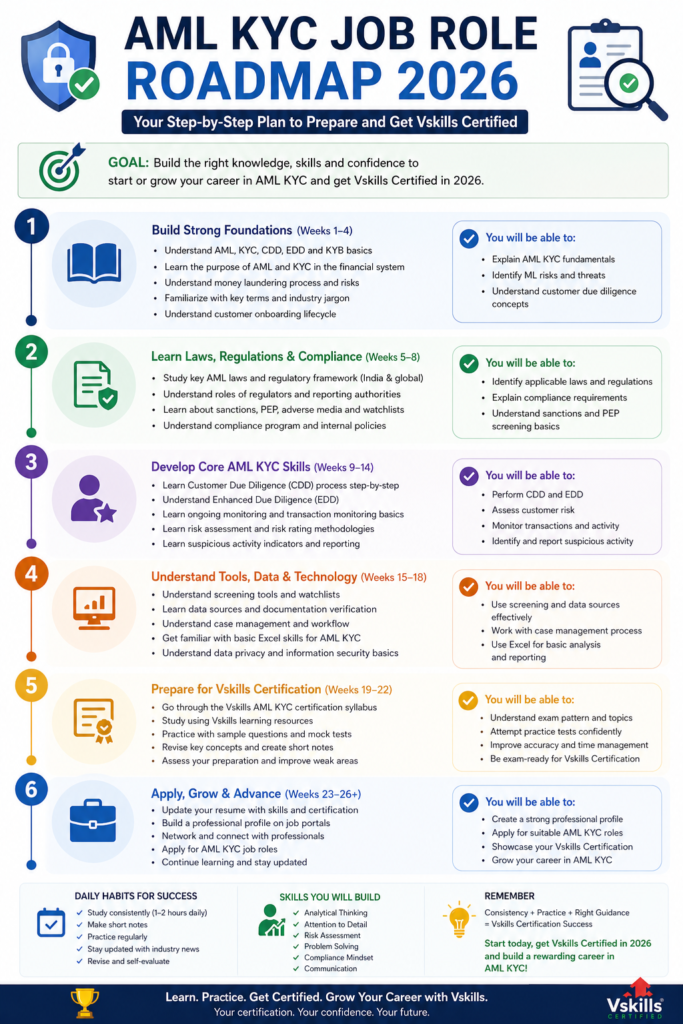
Do you have a curious mind, an eye for detail, and a desire to do meaningful work?
Then AML/KYC world might just be your calling!
Study Resource: AML KYC Interview Practice Test
After understanding and learning about the Certified AML-KYC Compliance Officer exam topics, it is time for practice tests. That is to say, practice tests are important for better preparation as by assessing yourself with these tests you will know about your weak and strong areas. Moreover, you improve your answering skills for getting better results. So, make sure to find the best practice sources.

Best AML KYC Interview Questions
Go through these latest Online interview questions to prepare for the AML/KYC compliance role in the Banking industry as well as in corporates. The questions are based on recent interviews conducted. Prepare now!

AML KYC Interview Domain Experts – Beyond the Resume!
Final thoughts
AML KYC interviews are not only about testing knowledge. They are also about testing how you think, how carefully you work, and how responsibly you handle risk. A strong candidate is someone who can combine regulatory understanding with practical decision-making and professional discipline.
By preparing these 50 AML KYC interview questions and answers for 2026, you can approach your interview with much greater confidence. Whether you are applying as a fresher, analyst, senior analyst, or compliance professional, the key is to show that you understand both the rules and the responsibility that comes with the role.