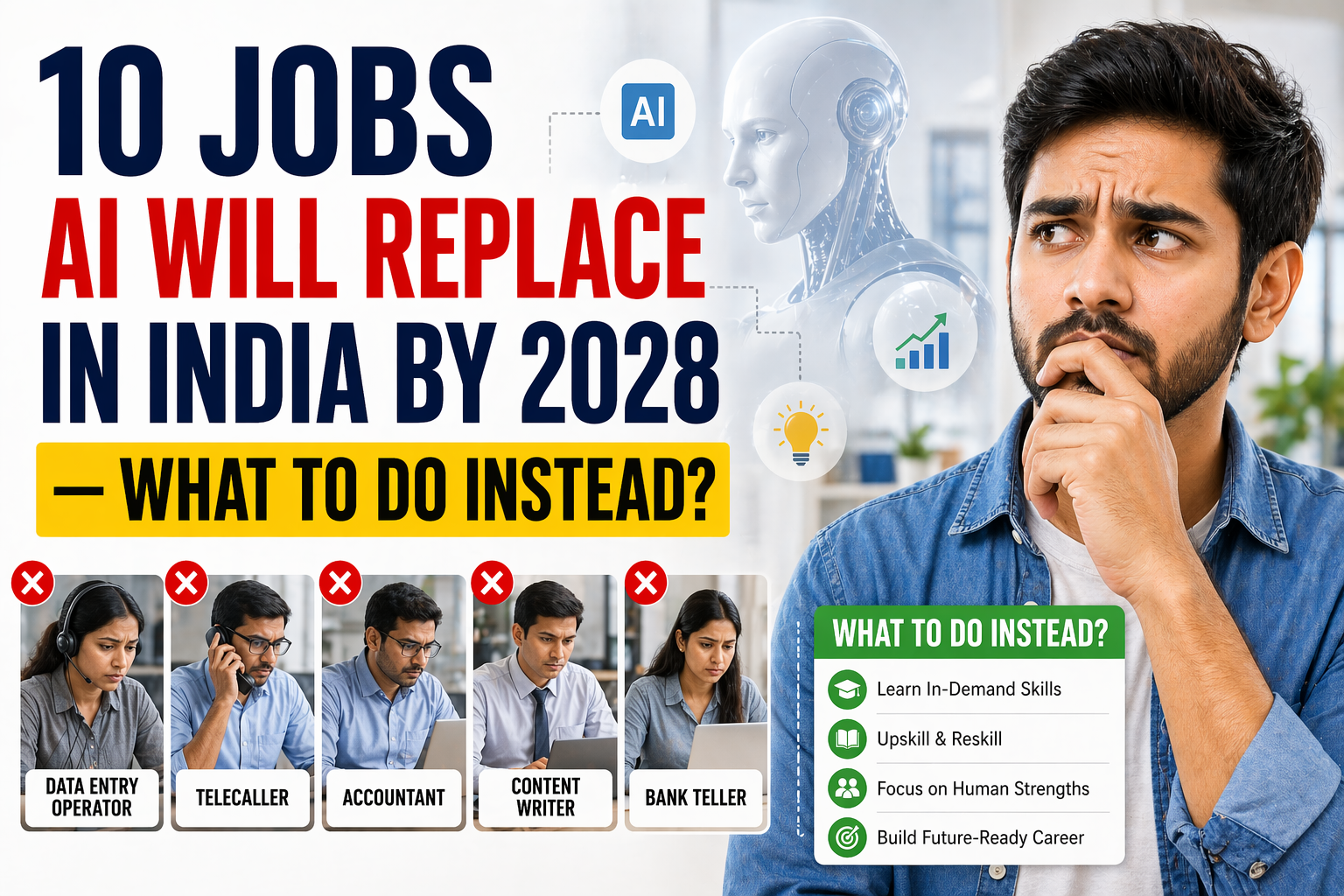
Artificial intelligence is no longer a future possibility in India’s job market. It is already changing how companies hire, operate, and decide which roles they still need humans to perform. Across sectors such as customer service, banking, retail, content, administration, and back-office operations, businesses are increasingly using AI tools to automate repetitive work, reduce costs, and improve speed. This shift is creating new opportunities, but it is also putting pressure on jobs built around routine and predictable tasks.
By 2028, this transformation is likely to become even more visible. Many professionals may not lose their careers entirely, but they may find that the tasks they were once paid for are now being handled by software, chatbots, automation tools, and AI assistants. This is especially important in India, where millions of workers are employed in roles that depend heavily on standardised processes, manual data handling, basic communication, and low-complexity decision-making.
However, this is not a story of panic. It is a story of adjustment. While AI may replace certain jobs or reduce demand for them, it is also creating space for new roles that require human judgment, digital adaptability, creativity, problem-solving, and the ability to work alongside intelligent tools. The real challenge is not simply whether AI will replace jobs, but whether workers can prepare in time for what comes next.
Why AI Is Replacing Some Jobs Faster Than Others?
AI does not affect every job in the same way. Some roles are far more exposed than others because the work is easier to standardise, automate, and scale through software. In most cases, AI replaces tasks before it replaces entire roles. But when most of a job is made up of repetitive tasks, the role itself becomes vulnerable very quickly.
Jobs are at higher risk when they involve routine work
The jobs most likely to be disrupted are usually built around processes that follow a fixed pattern. These are roles where employees repeat the same actions, use the same scripts, or make decisions based on a limited set of rules.
Examples include:
- entering data into systems
- answering common customer queries
- processing standard documents
- creating basic reports
- scheduling, sorting, or screening repetitive inputs
When work follows a predictable structure, AI tools can often perform it faster and at a lower cost.
AI performs best in rule-based environments
AI is especially effective in jobs where success depends on speed, consistency, and handling large volumes of similar tasks. This is why many administrative, support, and back-office roles are already changing.
These roles are easier to automate because they usually involve:
- clear workflows
- limited need for original thinking
- low complexity decision-making
- minimal human interaction beyond standard responses
- measurable outputs that machines can optimise
For employers, this makes automation attractive. A business can reduce turnaround time, lower errors, and operate with fewer people on routine processes.
Jobs are safer when they depend on human strengths
On the other hand, jobs are harder to replace when they require qualities that AI still struggles to replicate in a meaningful way.
These include:
- judgment in uncertain situations
- empathy and emotional understanding
- creativity with context
- negotiation and persuasion
- leadership and team management
- relationship-building
- complex problem-solving
This is why AI is more likely to assist doctors, managers, teachers, consultants, sales professionals, and analysts rather than fully replace them.
The real shift is from task-based work to value-based work
The biggest career lesson is this: jobs built only around execution are becoming weaker, while jobs built around judgment, creativity, and decision-making are becoming more valuable. In the coming years, workers who only do what a system tells them may face growing pressure. Workers who can interpret, improve, explain, manage, or strategically use AI will be in a much stronger position.
That is why the question is not just which jobs AI will replace. The more important question is which skills will still make a worker valuable when machines can handle the routine part. Let us get deeper into the details of certain jobs that are at risk of getting replaced.
Role 1 – Data Entry Operators
Data entry roles are among the most exposed to AI-led disruption. The World Economic Forum’s Future of Jobs Report 2025 lists data entry clerks among the fastest-declining roles globally, and its India outlook also identifies data entry clerks as a role expected to decline as automation reshapes work in the country.
Why is this job vulnerable?
Most data entry work is built around repetitive, rules-based tasks such as entering records, updating databases, checking standard fields, and moving information from one format to another. These are exactly the kinds of tasks that automation tools, OCR systems, AI assistants, and workflow software are becoming better at handling. This fits the broader pattern identified by employers globally: clerical and secretarial occupations are expected to see some of the largest declines, while technology-linked roles continue to grow.
What to do instead
The better move is not to leave data work entirely, but to move upward from data entry into roles that require more judgment and analysis. Safer alternatives include:
- data quality analyst
- MIS executive
- operations analyst
- reporting analyst
- CRM or ERP support roles
These roles are more resilient because they involve checking patterns, interpreting information, solving process issues, and supporting decision-making rather than just typing or transferring data. That direction also aligns with the roles employers expect to grow more strongly, including data- and technology-related positions.
Skills to learn first
To make that shift, a professional in data entry should start with:
- advanced Excel
- basic SQL
- dashboard tools such as Power BI or Tableau
- data cleaning and validation
- AI tool usage for reporting and workflow support
- analytical thinking and technology literacy
These skill areas line up with what employers increasingly value. The World Economic Forum identifies analytical thinking, AI and big data, and technology literacy among the most in-demand capabilities over the next five years.
Role 2 – Telecallers and Basic Customer Support Executives
Basic customer support roles are also becoming highly vulnerable to AI, especially where the work depends on scripts, standard queries, and repetitive issue handling. This is not because customer service will disappear, but because a large share of first-level support is now being shifted to chatbots, voice AI, self-service systems, and AI copilots that can answer common questions much faster. In India, this shift is already visible. ServiceNow’s India 2025 Customer Experience Report found that 80% of Indian consumers now use AI chatbots for tasks such as checking complaint status, getting product recommendations, and accessing self-help guides. It also found that 82% said new AI tools have increased their expectations of customer service.
Why is this job vulnerable?
Telecalling and basic customer support are most at risk when the work is repetitive and process-driven. If the role mainly involves answering FAQs, checking order status, sharing standard policy information, or routing complaints, AI systems can increasingly handle that work at scale. Broader industry research also points in the same direction. Salesforce’s State of Service says that 50% of service cases are expected to be resolved by AI by 2027, up from 30% in 2025. Its report also notes that AI agents are increasingly being used for FAQs, order inquiries, and support assistance.
What is changing in India
The Indian market is not rejecting AI-led customer service. In fact, customers are becoming more comfortable with it. Zendesk’s India-focused CX findings show that 81% of Indian consumers would engage more with AI if it felt more human-like, while 69% want personal AI assistants for smoother company interactions. The same report notes that 69% of Indian consumers have already interacted with Voice AI. This means companies are not only experimenting with automation, but are also responding to a customer base that is increasingly open to AI-led service channels.
What to do instead
The safer move is to shift from basic support into higher-value service roles that require judgment, relationship management, or problem-solving. Better alternatives include:
- customer success executive
- escalation specialist
- client relationship executive
- inside sales or account support roles
- service operations analyst
- quality and training roles in support teams
These roles are harder to automate because they require handling unusual situations, calming unhappy customers, understanding context, and improving service quality rather than just following a script. That broader shift also matches the larger labour-market pattern described by the World Economic Forum, which expects clerical roles to decline while analytical, technology-linked, and human-centred skills become more important.
Skills to learn first
Someone currently working in telecalling or basic support should focus on:
- communication and conflict resolution
- CRM tools and ticketing systems
- sales and cross-selling basics
- customer retention and account handling
- AI-assisted service tools
- analytical thinking and technology literacy
These are more durable skills because they help a worker move from routine support to roles built around trust, judgment, and business value. The World Economic Forum identifies analytical thinking, AI and big data, and technology literacy among the fastest-growing skills globally over the next five years.
Role 3 – Basic Content Writers
Basic content writing roles are becoming more vulnerable because generative AI is already being used to speed up routine content production. Adobe says generative AI is transforming content creation and management so teams can deliver content “at speed and scale,” while Adobe’s India Summit 2025 coverage notes that Indian marketers are increasingly using AI to reshape how content is created and personalized. Content Marketing Institute’s 2025 research also found that 39% of B2B marketers expected increased investment in AI for content creation in 2025, alongside 40% for AI in content optimization and performance.
Why is this job vulnerable
The most exposed writing roles are the ones built around standardised, repetitive output such as SEO blogs with little original reporting, product descriptions, social captions, basic email drafts, summaries, and low-value web copy. These are the kinds of outputs AI tools can now produce quickly, especially when companies want content at scale. That does not mean all writing jobs will disappear, but it does mean that businesses will likely need fewer people for purely formula-driven writing work.
What to do instead
The better move is to shift from volume-based writing to value-based writing. Stronger alternatives include:
- content strategist
- editor or content reviewer
- brand writer
- research-led writer
- scriptwriter for video and podcasts
- content operations or content marketing specialist
These roles are safer because they involve judgment, originality, audience understanding, brand voice, and the ability to shape content systems rather than just produce first drafts. That is a reasonable direction to infer from the way firms are investing in AI for production while still needing strategy, quality control, and performance oversight around that content.
Skills to learn first
A writer trying to stay relevant should start building:
- prompt writing and AI-assisted editing
- SEO with strategy, not just keywords
- research and interview-based writing
- content planning and audience analysis
- brand voice development
- basic analytics for content performance
The goal is to become the person who guides, improves, and differentiates content, not the person who only produces generic drafts.
The bottom line
AI is unlikely to eliminate writing as a profession, but it is very likely to reduce demand for low-complexity writing jobs. By 2028, the safer path will be for writers who can bring original thinking, stronger judgment, and sharper editing to AI-assisted workflows.
Role 4 – Transcriptionists
Transcription work is also under pressure because mainstream AI tools can now convert speech to text in real time and in batches, and many collaboration platforms are adding automatic summaries on top of transcription. Microsoft’s Azure Speech documentation highlights real-time, fast, and batch transcription use cases across meetings, customer service, healthcare, education, and media. Zoom’s AI Companion updates likewise show automatic meeting summaries and summary management features becoming part of normal workplace workflows.
Why is this job vulnerable?
A large share of traditional transcription work involved listening to recorded audio, typing it out, cleaning it up, and formatting it. AI now handles much of that first-pass work automatically. As these tools improve, employers can generate transcripts, captions, and summaries much faster than before, which reduces the need for large volumes of manual transcription work.
What to do instead
The safer move is to shift into roles where human review, domain understanding, and accuracy matter more. Better alternatives include:
- transcription quality reviewer
- captioning and accessibility specialist
- legal or medical documentation reviewer
- meeting insights or documentation coordinator
- language QA specialist
These roles are more resilient because the work is not just about typing spoken words. It is about checking meaning, correcting errors, handling domain-specific terminology, and ensuring documentation is usable and accurate. That becomes even more important when AI produces the first draft and humans are needed to verify it.
Skills to learn first
A transcription professional should focus on:
- editing and quality assurance
- subtitle and caption formatting
- domain-specific vocabulary such as medical or legal terms
- documentation standards
- AI transcription tools and workflow review
- summarization and note-structuring skills
This helps move the role from manual typing to supervised documentation and insight support.
Role 5 – Basic Bookkeeping Clerks
Basic bookkeeping roles are becoming more exposed because the most repetitive parts of the job are now heavily automated. The World Economic Forum’s Future of Jobs Report 2025 says fast-declining roles include clerical positions and also “accountants and auditors,” with AI, information-processing technologies, and broader digital access among the main drivers. At the same time, major accounting platforms are openly marketing automation for recurring finance tasks rather than manual processing.
Why is this job vulnerable?
A large share of entry-level bookkeeping work involves repetitive tasks such as categorizing transactions, reconciling accounts, checking statements, and preparing routine reports. QuickBooks says its AI handles recurring jobs like transaction categorization, reconciliation, and report preparation, while TallyPrime says automatic bank reconciliation reduces manual work and errors and can auto-create vouchers from imported bank statements. That makes basic, process-led bookkeeping one of the clearest areas where AI reduces the need for manual effort.
What to do instead
The better move is to shift from record-keeping into roles that require judgment, interpretation, and business support. Stronger alternatives include:
- accountant with analysis skills
- GST and compliance specialist
- financial reporting executive
- accounts receivable or payable analyst
- FP&A support roles
- finance operations analyst
That direction fits the broader change in the profession. Intuit says AI is moving accounting work away from routine tasks and toward more strategic and advisory work, and reports that many accountants are already using AI to support higher-value services.
Skills to learn first
Someone in bookkeeping should start building:
- advanced Excel
- Tally or ERP proficiency
- GST, TDS, and compliance basics
- financial statement reading
- reconciliation review and exception handling
- basic data analysis and dashboard skills
The idea is to move from entering transactions to interpreting what the numbers mean and spotting issues that software alone may not handle well.
The bottom line
AI is unlikely to remove finance jobs entirely, but it is steadily shrinking the value of purely manual bookkeeping work. By 2028, safer finance careers will belong to people who can review, explain, analyze, and advise rather than only process entries.
Role 6 – Travel Booking Agents
Travel booking roles are also under pressure because AI is getting better at planning trips, answering travel questions, building itineraries, and handling routine service actions. McKinsey’s 2025 travel report says agentic AI could “upend” the travel industry, and notes that AI is increasingly being used across travel planning and operations. Booking.com says travelers can already use its AI Trip Planner for destination ideas, accommodation options, and itinerary creation, while Amadeus reports that Gen AI usage in travel planning rose 64% year over year in its survey.
Why is this job vulnerable?
Basic travel booking work becomes vulnerable when it revolves around standard tasks such as searching options, comparing prices, suggesting common itineraries, making simple reservations, or processing routine changes. McKinsey notes that agentic AI can carry out tasks end to end with limited human oversight, and specifically highlights travel use cases such as rebooking during disruptions, handling refunds, and issuing vouchers. When AI can research, recommend, and execute these standard tasks, fewer people are needed for straightforward booking support.
What to do instead
The stronger move is to shift into travel roles where human context still matters more. Better alternatives include:
- travel consultant for complex itineraries
- luxury or corporate travel advisor
- visa and documentation specialist
- destination experience planner
- travel sales and partnerships roles
- customer escalation and disruption support
These roles are more resilient because they depend on judgment, relationship management, unusual case handling, and trust. Even McKinsey’s view of frontline travel work is that AI will take over routine tasks so humans can focus more on empathetic, person-to-person interactions.
Skills to learn first
A travel booking professional should build:
- itinerary design for complex travel
- destination expertise
- visa and travel policy knowledge
- upselling and client advisory skills
- CRM and travel-tech platform skills
- service recovery and communication skills
That helps move the role from simple booking execution to higher-value advisory and customer management work.
Role 7 – Retail Cashiers
Retail cashier roles are also becoming more vulnerable, especially in organized retail, transport hubs, multiplexes, and other environments where payments and checkout are becoming more digital and self-service. The World Economic Forum’s Future of Jobs Report 2025 says cashiers and ticket clerks are among the clerical roles expected to see the largest decline in absolute numbers. In India, the broader shift toward digital transactions is already very strong: the Ministry of Finance says digital payment volume rose from 2,071 crore transactions in FY 2017-18 to 22,831 crore in FY 2024-25, and UPI now accounts for 81% of retail payment transactions by volume.
Why is this job vulnerable?
The most exposed cashier roles are the ones built around scanning items, collecting payment, printing bills, and handling simple checkout queries. As more payments become digital and more checkout systems become self-service, fewer people are needed for purely transaction-based billing work. This does not mean cashier jobs will disappear overnight across all of India, especially in kirana and relationship-driven retail, but it does mean that the simplest billing-only roles are likely to come under pressure first. The same shift is visible in self-service infrastructure as well: Delhi Airport highlights large-scale common-use self-service kiosks and self-baggage-drop systems, while Razorpay notes that Indian retailers such as DMart and Decathlon have integrated self-checkout stations.
What to do instead
The better move is to shift from checkout execution into roles where human interaction and store judgment matter more. Better alternatives include:
- retail sales advisor
- customer experience associate
- visual merchandiser
- inventory and stock controller
- omni-channel fulfilment associate
- store operations executive
These roles are more resilient because they involve assisting customers, improving store operations, solving on-floor issues, managing stock movement, and supporting sales rather than only processing payments. That fits the broader labour-market pattern identified by the World Economic Forum, where routine clerical work declines while more operational, judgment-based, and technology-linked skills gain importance.
Skills to learn first
Someone currently in cashiering should start building:
- POS and digital billing systems
- Inventory Software Basics
- customer handling and upselling
- merchandising basics
- omnichannel order handling
- technology literacy and operational problem-solving
These skills make it easier to move from a billing counter to broader retail operations, where the job is less about collecting payment and more about helping the store run better. The World Economic Forum specifically highlights technology literacy, resource management and operations, and quality control among the skills that increasingly separate growing roles from declining ones.
Role 8 – Basic Graphic Production Roles
Basic graphic production work is also under pressure because AI tools are becoming faster at handling repetitive design tasks. Adobe says AI is enhancing content workflows by accelerating production, boosting efficiency, and helping teams deliver content at speed and scale. Adobe’s 2025 India AI and Digital Trends snapshot also says Indian businesses are already seeing measurable returns from generative AI, with 73% reporting greater volume and speed of content ideation and production, and 85% expecting generative AI to significantly boost content production speed and volume. Canva’s 2025 State of Marketing & AI Report similarly finds that AI investment is no longer experimental, with 94% of surveyed leaders having allocated AI budgets in 2024 and 75% expecting to increase investment in 2025.
Why is this job vulnerable?
The most exposed design jobs are the ones focused on repetitive production work such as resizing creatives, adapting templates, removing backgrounds, making basic banners, creating simple social posts, and preparing many variations of the same asset. Adobe’s own examples show how AI-enabled tools let non-designers create on-brand assets quickly, while design teams shift their time toward higher-impact work. In one Adobe case, teams used templates and AI-supported workflows to scale content much faster, cut time to market from days to hours, and create thousands of localized asset variations.
What to do instead
The stronger move is to shift from execution-heavy design work into roles where strategy, originality, and user understanding matter more. Better alternatives include:
- brand designer
- UI/UX designer
- motion graphics designer
- creative strategist
- design systems specialist
- art direction support roles
These roles are safer because they depend more on concept development, brand judgment, storytelling, interface thinking, and cross-functional collaboration. AI can speed up production, but it does not remove the need for people who decide what should be created, why it should look a certain way, and how it should connect with an audience or user journey. That is also consistent with the World Economic Forum’s view that creative thinking remains one of the most important and rising skills in the labour market.
Skills to learn first
Someone in basic graphic production should build:
- Figma or advanced Adobe workflows
- typography and layout fundamentals
- branding and visual storytelling
- motion design basics
- prompt-based image and asset generation
- creative review and editing judgment
- UI and digital design fundamentals
The goal is to stop being only the person who executes requested assets and become the person who shapes the visual system, improves the output, and uses AI as a productivity layer rather than competing with it directly. The World Economic Forum identifies AI and big data, technology literacy, and creative thinking among the fastest-growing skills for the years ahead.
Role 9 – Junior Recruiter Screening Roles
Junior recruiting roles that focus mainly on resume screening, sourcing, scheduling, and first-round filtering are becoming more vulnerable as hiring teams adopt AI for repetitive recruiting tasks. LinkedIn’s Future of Recruiting 2025 says 37% of organizations are already actively integrating or experimenting with Gen AI in hiring, up from 27% a year earlier. LinkedIn also says talent acquisition professionals using generative AI report an average 20% reduction in workload, and that AI is automating time-consuming recruiting tasks so recruiters can spend more time on strategic work such as relationship-building, candidate experience, and advising hiring managers.
Why this job is vulnerable
The most exposed part of recruiting is not the entire profession, but the routine layer of it. When a role is heavily built around scanning profiles, shortlisting against keywords, coordinating interviews, and handling repetitive outreach, AI can now take over a meaningful share of that workload. LinkedIn’s 2025 reporting shows that among talent teams already integrating or experimenting with Gen AI, 35% say the time saved goes toward candidate screening, which directly suggests that early-stage filtering is being reshaped first.
What to do instead
The safer move is to shift from process-heavy recruiting into people-heavy and judgment-heavy HR roles. Better alternatives include:
- recruiter focused on stakeholder management
- talent partner or talent advisor
- employer branding executive
- interview coordination plus candidate experience roles
- learning and development support
- HR business support roles
This direction fits LinkedIn’s broader finding that AI is pushing recruiters toward more human and strategic work, not just administrative execution. LinkedIn also notes that employers are far more likely than before to list relationship development as a required skill for recruiters.
Skills to learn first
Someone in an entry-level recruiting role should start building:
- structured interviewing
- stakeholder communication
- candidate experience management
- employer branding basics
- skills-based hiring understanding
- ATS and AI hiring tool literacy
That skill shift matters because the value in recruiting is moving away from manual filtering and toward better assessment, stronger hiring judgment, and stronger relationships. LinkedIn’s 2025 report says 93% of talent acquisition professionals believe accurately assessing a candidate’s skills is crucial for improving quality of hire, and companies with the most skills-based searches are more likely to make a quality hire.
Role 10 – Market Research and Survey Processing Roles
Basic market research and survey-processing roles are also under pressure because AI can now automate much of the repetitive work involved in coding responses, summarizing open-ended feedback, spotting patterns, and generating initial insights. Qualtrics says AI is becoming a permanent member of the modern research team, and its 2025 research trends report found that 71% of market researchers believe the majority of market research will be done using synthetic responses within three years. SurveyMonkey also says its AI analysis tools can identify themes, analyze sentiment, flag low-quality responses, and generate summaries and charts instantly.
Why is this job vulnerable?
The most vulnerable research roles are the ones built around repetitive tabulation and basic processing rather than interpretation. Qualtrics’ research guide says AI can automate transcription, sentiment analysis, pattern recognition in unstructured data, and the coding of themes, while SurveyMonkey says thematic analysis can categorize open-text responses and provide summaries without hours of manual work. That means a growing share of basic survey handling can now be done faster by software, especially when the work is large-volume and standardized.
What to do instead
The better move is to shift from basic processing into higher-value research roles such as:
- insights analyst
- consumer insights executive
- research strategist
- CX or employee experience analyst
- mixed-methods researcher
- market intelligence support roles
These roles are safer because they depend more on framing the right questions, interpreting findings, connecting evidence to business decisions, and validating what AI produces. Qualtrics itself stresses that AI should complement rather than replace human expertise, especially when interpreting sensitive or complex findings.
Skills to learn first
Someone working in survey processing or junior research support should build:
- questionnaire design
- Excel and dashboarding
- data visualization
- cross-tab and insight interpretation
- qualitative analysis and storytelling
- AI-assisted research workflows with human validation
That matters because the more durable research value now lies in deciding what the data means, what to trust, and what action should follow, not just in cleaning and sorting responses. Qualtrics says AI is helping researchers handle data collection and analysis faster, but also emphasizes human validation, transparency, and oversight in AI-powered research.
What AI Cannot Easily Replace?
AI can automate many tasks, but it still struggles with the parts of work that depend on human judgment, emotional understanding, context, and trust. That is also why the future of work is not simply about machines taking over jobs. It is about routine work shrinking, while roles built around judgment, problem-solving, leadership, and human connection become more valuable. The World Economic Forum’s Future of Jobs Report 2025 makes this clear: alongside AI and big data, employers continue to place high value on analytical thinking, creative thinking, resilience, flexibility, leadership, social influence, curiosity, and lifelong learning.
Human judgment in uncertain situations
AI works best when the task is structured and the rules are clear. But many real jobs are messy. They involve incomplete information, conflicting priorities, and decisions that need experience and common sense. That is where human judgment still matters far more than automation. Employers continue to rank analytical thinking among the most essential core skills, which shows that interpreting situations and making sound decisions remains a deeply human advantage.
Creativity with context
AI can generate drafts, ideas, and variations quickly, but it does not truly understand cultural nuance, brand depth, lived experience, or original intent in the way people do. It can assist creativity, but it does not replace the person who knows what should be said, why it matters, and how it should connect with a real audience. This is exactly why creative thinking continues to rise in importance even as AI adoption grows.
Leadership and influence
Managing people is not just about assigning tasks. It involves motivating teams, resolving tensions, building trust, and helping people perform through change. These are not simple process tasks that can be fully automated. The World Economic Forum identifies leadership and social influence as skills that have become significantly more important compared with its previous survey cycle, which suggests that human leadership is becoming more valuable, not less, in an AI-shaped workplace.
Empathy and relationship-building
Jobs that depend on calming a customer, mentoring a junior, understanding a client’s unstated concern, or earning long-term trust are much harder to automate well. AI may support these interactions, but it still does not replace genuine empathy or the credibility that comes from human relationships. This helps explain why service orientation, customer service, collaboration, and other human-centred capabilities continue to matter even as technology skills rise.
Adaptability and lifelong learning
The safest workers in the AI era will not be the ones who avoid technology. They will be the ones who keep learning and adapt faster than their roles change. The Future of Jobs Report 2025 says nearly 40% of skills required on the job are expected to change, and it highlights resilience, flexibility, agility, curiosity, and lifelong learning as increasingly important. In other words, the strongest protection against disruption is not one fixed job title. It is the ability to evolve.
What to Do Instead: Safer Career Directions in the AI Age
The smartest response to AI is not panic. It is repositioning. The workers most likely to do well by 2028 will not be the ones trying to protect every old task. They will be the ones moving toward work that combines digital fluency with judgment, communication, problem-solving, and adaptability. That shift is consistent with current labour-market signals: the World Economic Forum says AI and big data, networks and cybersecurity, and technological literacy are among the fastest-growing skills, while LinkedIn says AI literacy is one of the fastest-growing skills globally and that India’s fast-rising skills include innovative thinking, problem-solving, prescreening, and strategic thinking.
Learn to work with AI, not against it
The first and most practical move is to become comfortable using AI tools in everyday work. That does not mean everyone needs to become a machine learning engineer. It means learning how to use AI for drafting, research, summarizing, reporting, workflow support, customer handling, and productivity. Professionals who know how to use AI well are more likely to stay relevant because companies increasingly want people who can produce better outcomes with these tools, not avoid them. LinkedIn notes that AI literacy and LLM-related proficiency are rising quickly, while the World Economic Forum places AI, big data, and technological literacy among the most important growth skills for the next five years.
Move towards judgment-based roles
The second move is to shift from execution-heavy jobs into roles that require interpretation and decision-making. Safer directions include business analysis, operations analysis, compliance support, financial analysis, customer success, project coordination, and process improvement roles. These jobs are more resilient because the value comes from understanding context, identifying problems, improving systems, and making decisions, not just following repetitive steps. The World Economic Forum says analytical thinking remains the most sought-after core skill among employers, and also identifies resource management, operations, and quality control among the skills that most separate growing jobs from declining ones.
Build human-centred strengths that machines do not easily replicate
The third move is to strengthen the skills that become more valuable when routine work is automated. These include communication, relationship-building, negotiation, stakeholder management, leadership, adaptability, and creative thinking. LinkedIn’s 2025 skills analysis says strategic thinking, communication, and adaptability remain widely important across geographies and roles, while the World Economic Forum says employers continue to value analytical thinking, leadership, and social influence, resilience, flexibility, agility, and creative thinking very highly. In simple terms, AI raises the value of being more human, not less.
Shift into tech-enabled growth areas
The fourth move is to target roles where demand is expanding because of AI and digital transformation rather than shrinking because of it. Stronger directions include data analysis, cybersecurity, AI operations and implementation support, cloud-related roles, software development, digital marketing, product support, and UX-related work. The World Economic Forum says technology-related roles such as Big Data Specialists, Fintech Engineers, AI and Machine Learning Specialists, and Software and Application Developers are among the fastest-growing jobs. India-specific hiring signals point in the same direction: Naukri reported that over 35,000 AI/ML jobs were posted between April and June 2025, reflecting 38% year-on-year growth in AI roles.
Think in terms of career direction, not just job title
One of the biggest mistakes workers can make now is focusing only on job titles. The better question is whether your next role gives you more exposure to tools, analysis, communication, decision-making, and business understanding. Even if someone starts in support, bookkeeping, writing, retail, or admin work, they can still move into safer positions by building the right adjacent skills. The World Economic Forum says 39% of workers’ existing skill sets are expected to be transformed or become outdated between 2025 and 2030, and 59 out of every 100 workers will need training by 2030. That means career resilience will depend less on where you start and more on how quickly you evolve.
Best Career Alternatives for People in At-Risk Jobs
The clearest way to respond to AI-led disruption is to pivot into roles that add more judgment, customer understanding, analysis, creativity, or business context. That direction matches current labour-market signals: the World Economic Forum says clerical and routine roles are among the fastest-declining, while AI-related, analytical, and technology-linked capabilities are rising. LinkedIn’s 2025 skills data for India also shows growing demand for skills such as creativity and innovation, problem-solving, pre-screening, and strategic thinking, while its global 2025 skills report highlights AI literacy as a major driver of employability.
| Job at Risk | Why It Is Vulnerable | Better Career Alternative | Skill to Learn First |
| Data Entry Operator | Repetitive input and database updates can be automated | MIS Executive / Data Quality Analyst | Advanced Excel |
| Telecaller / Basic Customer Support | Scripted responses and FAQs are easy for AI tools to handle | Customer Success Executive / Escalation Specialist | CRM tools |
| Basic Content Writer | Generic, formula-based writing can be generated quickly by AI | Content Strategist / Editor | Research-led writing |
| Transcriptionist | Speech-to-text tools can now do first-pass transcription at scale | QA Reviewer / Captioning Specialist | Editing and accuracy review |
| Bookkeeping Clerk | Routine categorization and reconciliation are increasingly automated | Finance Analyst / Compliance Executive | Excel plus Tally or ERP |
| Travel Booking Agent | Standard itinerary planning and reservations can be automated | Travel Consultant / Visa Specialist | Complex itinerary planning |
| Retail Cashier | Digital payments and self-checkout reduce manual billing work | Retail Sales Advisor / Store Operations Executive | Customer handling |
| Basic Graphic Production Role | Template-based design work is easy to speed up with AI tools | UI/UX Designer / Brand Designer | Figma |
| Junior Recruiter Screening Role | Resume filtering and scheduling can be automated | Talent Advisor / Candidate Experience Executive | Structured interviewing |
| Basic Market Research Processor | Coding, sorting, and summarizing survey data can be automated | Insights Analyst / Research Executive | Data interpretation |
Skills Indians Should Focus on Before 2028
The strongest skills for the next few years will not be only technical skills nor only soft skills. The real advantage will come from combining both. Current hiring and employer reports point in the same direction: AI and big data, technological literacy, networks and cybersecurity, analytical thinking, creative thinking, resilience, leadership, communication, adaptability, and strategic thinking are all rising in importance. India-focused skill signals from LinkedIn also show strong momentum around creativity and innovation, problem-solving, strategic thinking, communication, adaptability, AI literacy, and large language models, while Naukri continues to report strong hiring momentum in AI-led roles.
| Skill | Why it matters before 2028 | Best suited for |
| AI literacy | Even non-tech jobs now expect people to use AI tools for drafting, research, support, analysis, and productivity | Almost everyone, especially content, HR, finance, operations, and support roles |
| Data interpretation | Companies need people who can understand dashboards, trends, reports, and business signals, not just collect data | Analysts, MIS professionals, marketers, finance teams, operations roles |
| Analytical thinking | Employers still rank this as one of the most important core skills because better decisions matter more in an automated workplace | Business analysis, consulting, finance, research, operations |
| Technological literacy | Workers increasingly need comfort with digital tools, workflows, platforms, and automation systems | All white-collar roles |
| Communication | As AI handles routine work, human value shifts more toward explaining, persuading, coordinating, and managing people | Customer success, HR, sales, management, consulting |
| Strategic thinking | The safer jobs are moving away from task execution and toward planning, prioritizing, and decision-making | Managers, analysts, founders, recruiters, marketers |
| Problem-solving | Companies increasingly need people who can handle exceptions, improve processes, and respond when systems break or fall short | Operations, customer support, product, finance, research |
| Creativity and innovation | AI can generate outputs, but people still add originality, context, brand fit, and new ideas | Content, design, marketing, product, entrepreneurship |
| Adaptability | Job roles are changing quickly, so the ability to learn new tools and adjust to new ways of working is becoming essential | Everyone |
| Leadership and social influence | As teams work with more automation, human leadership, trust-building, and influence become more valuable | Team leads, managers, client-facing roles, founders |
| Networks and cybersecurity awareness | As more work becomes digital, cyber risk becomes a business issue, not only an IT issue | IT, operations, finance, compliance, business teams |
| LLM and prompt skills | Knowing how to guide AI tools well can improve speed, quality, and output across many functions | Writers, analysts, HR teams, marketers, product and tech workers |
Conclusion
Artificial intelligence will not erase work in India. What it will do, and is already doing, is reduce the value of routine, repetitive, and rules-based tasks much faster than many workers expect. That is why the real risk by 2028 is not simply AI itself. The bigger risk is remaining in a role that adds little beyond what software can already do at speed and scale. Employers are simultaneously investing more in AI-linked capabilities and placing greater importance on skills such as analytical thinking, technological literacy, creativity, resilience, and adaptability.
For professionals in India, the message is clear. Do not focus only on protecting an old job title. Focus on moving toward work that requires judgment, communication, problem-solving, business understanding, and the ability to use AI effectively. The strongest careers over the next few years will belong to people who can work with intelligent tools, not compete with them on routine tasks. LinkedIn’s 2025 skills analysis says AI is a major catalyst behind changing skill needs, while India’s hiring data continues to show stronger momentum in higher-skill AI-related roles.