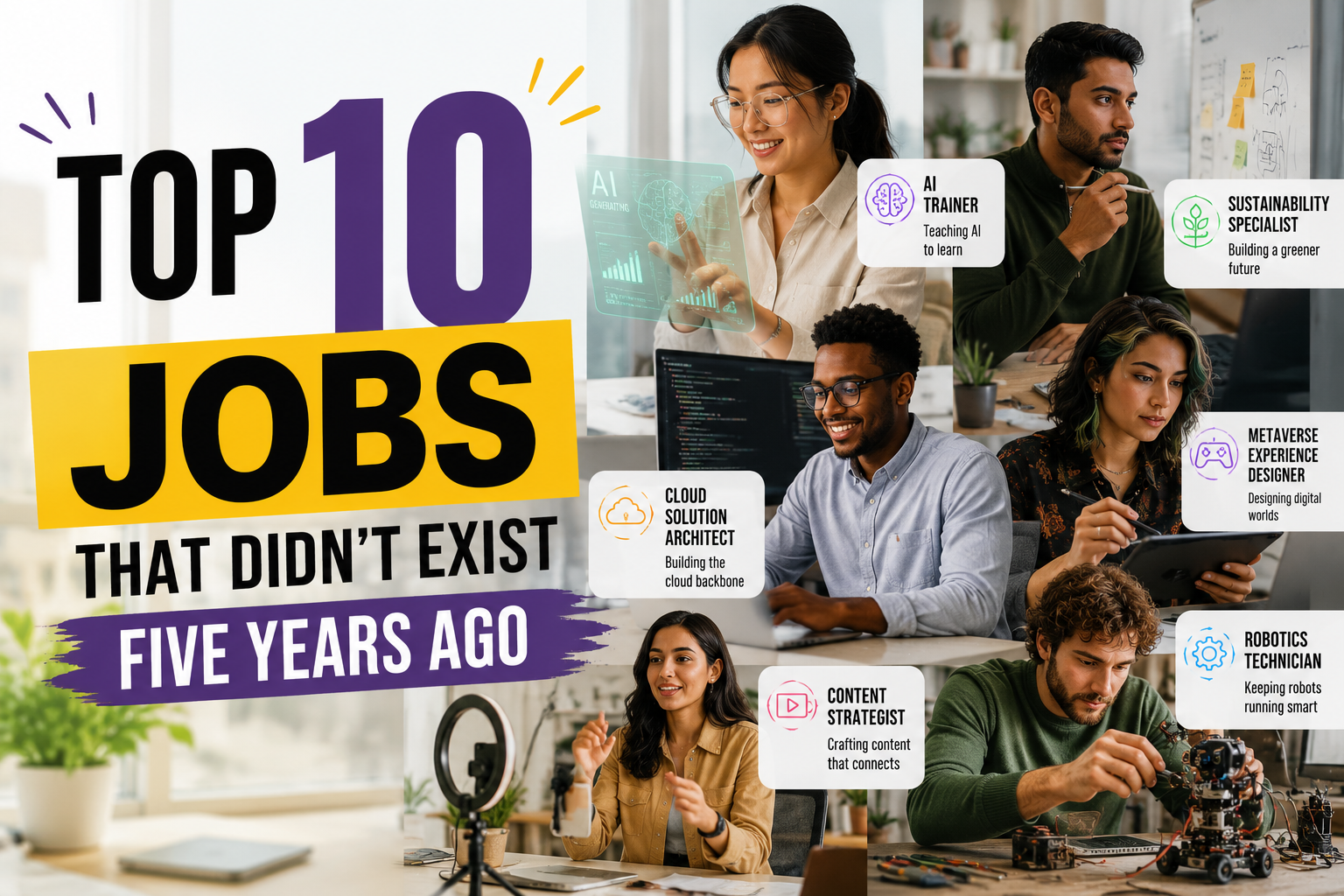
The Career and Jobs Skills you will Have in 2027 Probably Doesn’t Have a Job Description Yet
Rewind to 2021. The world was mid-pandemic, “ChatGPT” wasn’t a word in any dictionary, and if you’d walked into a campus placement drive and announced you wanted to become a “Prompt Engineer” or an “AI Trust & Safety Specialist,” the recruiter would have politely asked you to repeat that. Fast forward to today, and these are some of the fastest-growing job titles on the planet. According to the World Economic Forum’s Future of Jobs Report 2025 — a study built on responses from over 1,000 employers representing more than 14 million workers across 55 economies — the fastest-growing jobs through the rest of the decade include big data specialists, fintech engineers, and AI and machine learning specialists. The same report projects that 170 million new jobs will be created and 92 million displaced by 2030, a net gain of 78 million jobs worldwide, while 39% of the key skills employers need will change by 2030.
This isn’t a distant, futuristic forecast. It’s happening in real time, in Indian job markets specifically. Hiring platform foundit reported that India posted nearly 2.9 lakh AI-linked roles in 2025 alone, with AI hiring projected to grow another 32% year-on-year in 2026 to almost 3.8 lakh roles. Meanwhile, LinkedIn data shows Bengaluru leading India’s AI hiring boom, with Hyderabad’s AI hiring growing over 50% and even tier-2 cities like Vijayawada posting 45%+ growth. And it’s not only pure-tech roles: LinkedIn’s most recent Jobs on the Rise data shows AI-led roles like prompt engineer, AI engineer, and software engineer topping India’s hiring demand, alongside rising demand in sales, brand strategy, cybersecurity, and even non-tech fields such as renewable energy and behavioural therapy.
Here’s the uncomfortable truth hiding inside all this good news: applications per job opening in India have more than doubled since early 2022, and nearly three-quarters of Indian recruiters say it’s become harder to find qualified candidates over the past year. There are more jobs — but there’s also a widening gap between what candidates know and what these new roles actually require. That gap is exactly where this guide lives.
We’re going to walk through ten roles that simply did not exist — or existed only in a handful of Silicon Valley labs — five years ago, and are now core hiring priorities at companies from unicorn startups to Fortune 500 Global Capability Centres (GCCs) in India. For each one, you’ll get the real job description, the skills that actually matter, honest salary ranges for India and globally, a career roadmap, and where relevant, certification pathways that can help you build proof of skill fast — because in a skills-first hiring market, a credential that verifies your capability often opens doors that a degree alone cannot.
Why Did These Jobs Suddenly Appear?
Every “new” job on this list is really the offspring of five converging forces. Understanding them will help you spot the next wave of emerging roles before everyone else does.
1. Generative and Agentic AI Went From Lab to Line-of-Business
Two years ago, AI was a pilot project. Today, NASSCOM’s 2026 Strategic Review notes that India’s tech industry moved decisively from AI experimentation to industrialisation in 2025, with providers re-engineering revenue models away from staffing-based delivery toward outcome-based, AI-driven models. When AI stops being a side project and becomes the operating model, someone has to design the prompts, govern the outputs, monitor the infrastructure, and manage the risk. That “someone” is an entirely new category of employee.
2. Cloud, Cybersecurity, and “Security by Design” Became Non-Negotiable
As more of the economy — banking, healthcare, retail — moved to cloud and API-driven systems, security stopped being an IT afterthought. The WEF’s own list of fastest-growing jobs by 2030 includes security management specialists in the top five, driven by both rapid technology adoption and geopolitical risk.
3. Global Capability Centres (GCCs) Turned India Into an Innovation Hub, Not Just a Delivery Hub
This is a distinctly Indian growth story. Nasscom and Zinnov’s 2026 GCC Landscape Report found India now hosts 2,117 GCCs across 3,728 units, employing 2.36 million professionals, generating $98.4 billion in revenue, and holding the #1 position globally for AI hiring. These centres are no longer back-office cost hubs — they’re becoming architects of enterprise AI strategy, and that shift is minting entirely new job families around AI governance, data engineering, and agentic operations.
4. Skills-First Hiring Replaced Degree-First Hiring
As roles evolve faster than university curricula can keep up, employers are hiring for demonstrated skills over pedigree. The WEF found nearly 40% of job skills are expected to change, with 63% of employers citing the skills gap as their single biggest barrier to transformation, and 85% of employers naming upskilling their existing workforce as their top strategy for the next five years. This is precisely why targeted, verifiable certifications — the kind offered by bodies like Vskills — have become so valuable: they let a candidate prove a specific, current skill without waiting years for a formal degree program to catch up.
5. Sustainability and the Energy Transition Created a Whole New Green-Collar Economy
It isn’t just AI. The green transition and rising adoption of energy storage technologies have pushed roles like autonomous and electric vehicle specialists and renewable energy engineers into the WEF’s top 15 fastest-growing professions.
The pattern across all five forces is the same: technology didn’t just automate old jobs away — it created new categories of human judgment that machines still can’t replace: governance, trust, strategy, security, and design. That’s where the opportunity is.
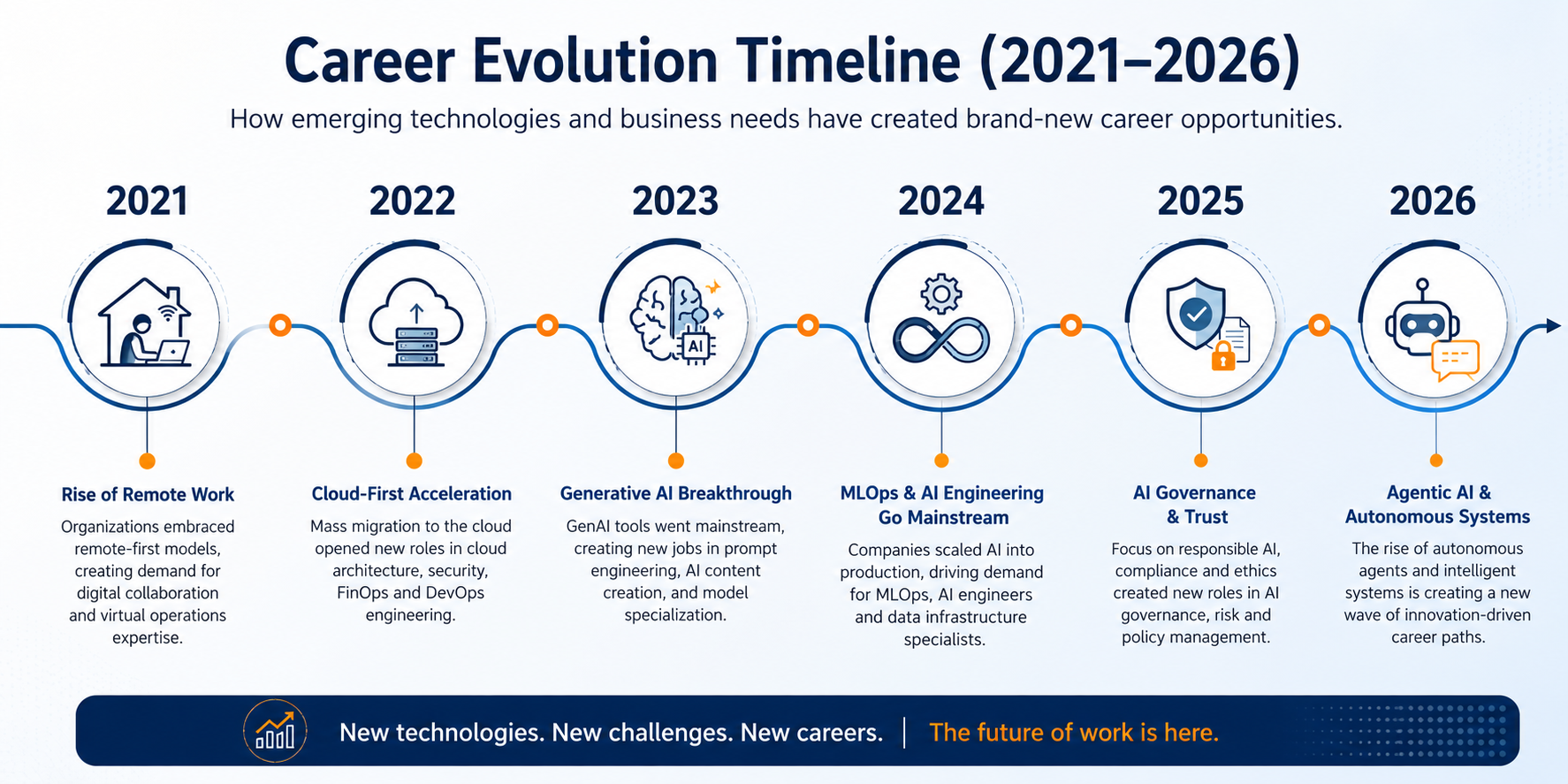
The Career Timeline: How Jobs Evolved From 2021 to 2026
| Year | What Was Happening | Jobs Emerging |
|---|---|---|
| 2021 | Pandemic-driven e-commerce and remote work boom | Delivery/gig logistics leads, remote-work culture specialists, digital wellbeing coaches |
| 2022 | Cloud-first enterprise migration accelerates | Cloud security engineers, DevOps specialists |
| 2023 | ChatGPT triggers the generative AI boom | Prompt engineers, AI content strategists |
| 2024 | Enterprises scale AI pilots into production | MLOps engineers, AI product managers, data privacy officers |
| 2025 | AI governance and regulation catch up with adoption | AI trust & safety specialists, AI ethics/governance leads, fintech engineers |
| 2026 | Agentic AI, GCC maturity, and skills-first hiring dominate | Agentic AI/digital workforce specialists, AI-augmented cybersecurity leads, sustainability & renewable energy analysts |
Top 10 Jobs That Didn’t Exist Five Years Ago
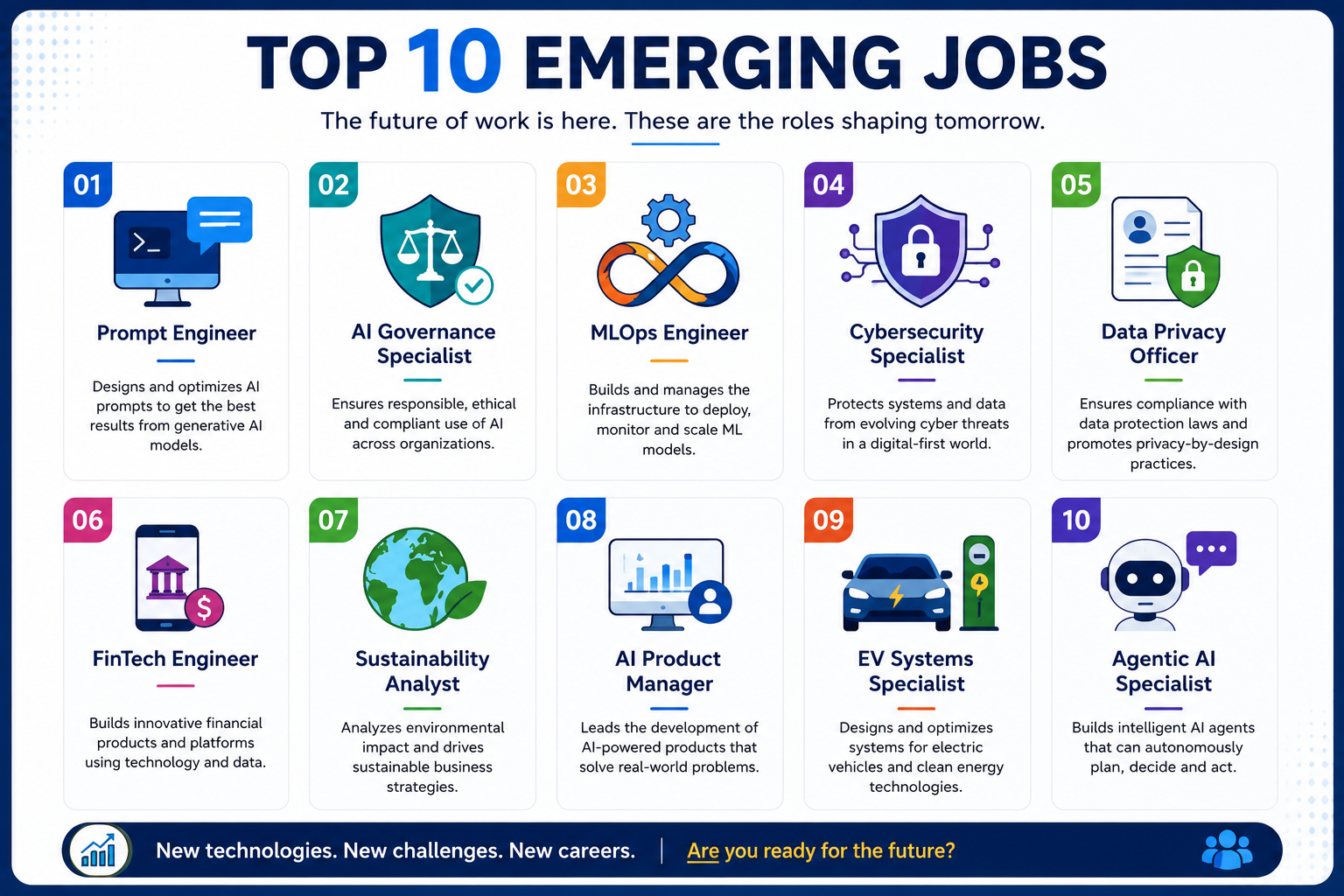
1. Prompt Engineer / Generative AI Interaction Specialist
The moment enterprises started deploying large language models into customer service, content, coding, and internal knowledge tools, someone needed to become fluent in “talking” to AI — designing, testing, and refining the instructions that shape model output quality, safety, and consistency.
Role overview: A Prompt Engineer designs prompt structures, few-shot examples, and evaluation frameworks that make AI outputs reliable, accurate, and on-brand. In mature organisations, the role blends into “Applied AI Engineer,” combining prompting with lightweight coding, retrieval-augmented generation (RAG), and evaluation pipelines.
Key responsibilities:
- Designing and testing prompt templates for chatbots, copilots, and internal tools
- Building and maintaining RAG pipelines that ground AI answers in company data
- Running systematic evaluations to catch hallucinations, bias, or inconsistent outputs
- Collaborating with product, legal, and design teams to define acceptable AI behaviour
Industries hiring: IT services and GCCs, SaaS/product companies, BFSI, e-commerce, ed-tech, healthcare
Skills needed:
- Technical: Python basics, understanding of LLM architecture, RAG, API integration, evaluation frameworks
- Soft: Precision in language, structured thinking, curiosity, patience for iterative testing
Salary insights:
- India: Entry-level roles start around ₹4–8 LPA; professionals who add Python, RAG, and evaluation skills move into ₹25–60 LPA territory, since pure prompting-only roles without coding tend to plateau at ₹10–15 LPA while prompting-plus-engineering roles unlock significantly higher pay.
- Global: US salaries range from roughly $60,000 at entry level to $250,000+ at senior/principal levels in top AI labs.
Career progression: Prompt Engineer → Applied AI Engineer → AI Solutions Architect → Head of AI Products
Future demand: Very high through 2027–2028 as more enterprises embed generative AI into daily workflows, though the pure “prompting only” version of the role is expected to merge into broader AI engineering positions — making the coding-plus-prompting combination the safer long-term bet.
Recommended certification pathway: Vskills’ Certified Prompt Engineer and Generative AI certifications are a practical way to build a portfolio of verified prompting projects that recruiters can check quickly — especially useful for career switchers without a computer science background.
💡 Did You Know? LinkedIn’s 2026 Jobs on the Rise report placed AI-related titles like prompt engineer and AI engineer at the very top of India’s hiring charts — a role category that barely existed in most job classification systems before 2023.
2. AI Trust, Safety & Governance Specialist
As AI moved into hiring decisions, credit scoring, healthcare diagnostics, and content moderation, regulators and boards started demanding proof that these systems are fair, explainable, and compliant. Someone has to own that.
Role overview: This specialist audits AI systems for bias, safety risks, and regulatory compliance, and builds the internal policies that govern how AI is built and deployed across a company.
Key responsibilities:
- Running bias and fairness audits on AI models before and after deployment
- Building AI usage policies aligned with emerging regulation (EU AI Act, India’s evolving data protection framework)
- Partnering with legal, product, and data science teams on responsible AI frameworks
- Documenting model risk assessments for audits and regulators
Industries hiring: BFSI, healthcare, HR-tech, large enterprises with in-house AI, GCCs, government-adjacent tech vendors
Skills needed:
- Technical: Understanding of ML model behaviour, bias-testing tools, basic data privacy law knowledge
- Soft: Ethical reasoning, cross-functional communication, meticulous documentation
Salary insights:
- India: Roughly ₹8–25 LPA depending on seniority and whether the role sits within a global GCC mandate
- Global: Comparable AI governance and responsible-AI roles in the US and Europe typically range from $90,000 to $160,000+, with specialised AI policy leads earning more
Career progression: AI Governance Analyst → AI Trust & Safety Lead → Head of Responsible AI → Chief AI Ethics Officer
Future demand: Set to grow sharply as global AI regulation matures — this is one of the few emerging roles where compliance pressure, not just business ambition, guarantees hiring.
Recommended certification pathway: Vskills’ Data Privacy and AI-adjacent governance certifications help build the compliance vocabulary this role demands, especially for professionals transitioning from legal, compliance, or quality-assurance backgrounds.
3. MLOps / AI Infrastructure Engineer
Building a machine learning model is one thing; running it reliably in production, at scale, without it silently degrading, is a completely different discipline — much like DevOps did for software a decade earlier.
Role overview: MLOps engineers build and maintain the pipelines that take AI models from a data scientist’s notebook into live, monitored, continuously updated production systems.
Key responsibilities:
- Automating model training, testing, and deployment pipelines
- Monitoring live models for performance drift and data quality issues
- Managing compute costs and infrastructure across cloud environments
- Collaborating with data science and platform engineering teams
Industries hiring: GCCs, SaaS companies, fintech, healthcare-tech, retail analytics
Skills needed:
- Technical: Python, Docker/Kubernetes, CI/CD pipelines, cloud platforms (AWS/Azure/GCP), model monitoring tools
- Soft: Systems thinking, reliability mindset, collaboration across data and engineering teams
Salary insights:
- India: Approximately ₹10–30 LPA depending on cloud specialisation and experience
- Global: Roughly $110,000–$180,000 in mature tech markets
Career progression: ML Engineer → MLOps Engineer → AI Platform Architect → Head of AI Infrastructure
Future demand: Very strong — as NASSCOM notes, while AI agents excel at executing defined tasks, system reliability, integration with legacy environments, and governance remain complex human-owned problems that grow more, not less, important as automation scales.
Recommended certification pathway: Vskills’ Cloud Computing and DevOps certifications provide the infrastructure foundation this role is built on, complementing hands-on ML project experience.
4. Cloud Security & AI-Augmented Cybersecurity Specialist
Every new cloud workload and AI deployment is also a new attack surface. As digital adoption broadens, so does risk — and the WEF’s employer survey ranks this among the very fastest-growing job categories globally.
Role overview: This role blends traditional cybersecurity with cloud-native security and increasingly, AI-specific threats like prompt injection, model theft, and data poisoning.
Key responsibilities:
- Securing cloud infrastructure, APIs, and CI/CD pipelines
- Monitoring for AI-specific attack vectors (prompt injection, adversarial inputs)
- Leading incident response and vulnerability management
- Building security-by-design practices into product development
Industries hiring: BFSI, GCCs, e-commerce, healthcare, government and defence-adjacent tech
Skills needed:
- Technical: Cloud security tools, SIEM platforms, penetration testing, familiarity with AI security risks
- Soft: Calm-under-pressure decision-making, cross-team influence, continuous learning mindset
Salary insights:
- India: Roughly ₹6–25 LPA for mid-level roles, rising well beyond ₹30 LPA for specialised cloud security architects
- Global: $90,000–$160,000+ depending on specialisation and region
Career progression: Security Analyst → Cloud Security Engineer → Security Management Specialist → CISO
Future demand: Security management specialists rank among the WEF’s top five fastest-growing jobs through 2030, driven by both technology adoption and geopolitical risk factors.
Recommended certification pathway: Vskills’ Information Security Management certifications, DSCI-aligned data protection training, and cloud-vendor security specialisations together form a strong, verifiable skill stack for this role.

5. Data Privacy & AI Compliance Officer
With more personal data flowing through AI systems and stricter regulation on the horizon (India’s Digital Personal Data Protection Act among them), companies need dedicated owners for how data is collected, stored, and used.
Role overview: This professional ensures that a company’s data practices — especially those feeding AI systems — comply with privacy law and internal governance standards.
Key responsibilities:
- Conducting data protection impact assessments
- Managing consent frameworks and data subject requests
- Advising product and engineering teams on privacy-by-design
- Liaising with regulators and auditors
Industries hiring: BFSI, healthcare, ed-tech, GCCs, consumer internet companies
Skills needed:
- Technical: Data mapping tools, privacy frameworks (GDPR, DPDP Act), basic understanding of data engineering
- Soft: Risk assessment, stakeholder communication, attention to detail
Salary insights:
- India: Roughly ₹8–20 LPA, higher in regulated sectors like BFSI and healthcare
- Global: $85,000–$150,000
Career progression: Privacy Analyst → Data Protection Officer → Chief Privacy Officer
Future demand: Strong and steady — regulation, not hype, drives this one, which makes it comparatively recession-resistant.
Recommended certification pathway: Vskills’ Data Privacy certification directly maps to this role’s core competencies and is a fast way for legal, compliance, or IT professionals to pivot in.
6. FinTech Engineer
The line between “bank” and “technology company” has essentially disappeared. Digital payments, embedded finance, and AI-driven credit decisioning all need engineers who understand both software and financial systems deeply.
Role overview: FinTech Engineers build the software powering digital payments, lending platforms, and embedded finance products, working at the intersection of engineering and financial regulation.
Key responsibilities:
- Building and maintaining payment gateways, lending engines, or trading systems
- Ensuring systems meet financial regulatory and security standards
- Integrating AI/ML for fraud detection and credit risk scoring
- Working closely with compliance and risk teams
Industries hiring: Banks, NBFCs, payment companies, insurtech, GCCs of global financial institutions
Skills needed:
- Technical: Backend engineering, API security, understanding of financial regulations, fraud-detection systems
- Soft: Precision, risk awareness, cross-domain communication (finance + tech)
Salary insights:
- India: Roughly ₹8–25 LPA, with senior fintech engineers in GCCs and unicorns earning well above that
- Global: $95,000–$170,000+
Career progression: Software Engineer (FinTech) → FinTech Engineer → FinTech Architect → VP of Engineering (Financial Products)
Future demand: FinTech engineers are named explicitly among the WEF’s fastest-growing occupations through 2030, reflecting the continued global shift toward digital and embedded finance.
Recommended certification pathway: Vskills’ Fintech and Banking, Financial Services and Insurance certifications help engineers build the domain fluency that pure computer-science training doesn’t cover.
7. Sustainability & Renewable Energy Analyst
ESG reporting requirements, corporate net-zero commitments, and the global energy transition have created a genuinely new “green-collar” job market that didn’t have this shape five years ago.
Role overview: This analyst tracks a company’s environmental impact, manages ESG reporting, and increasingly works alongside engineers on renewable energy and electric-vehicle infrastructure projects.
Key responsibilities:
- Compiling ESG (Environmental, Social, Governance) reports for investors and regulators
- Analysing energy consumption and carbon footprint data
- Supporting renewable energy procurement and sustainability strategy
- Coordinating with supply chain teams on sustainable sourcing
Industries hiring: Manufacturing, energy, automotive, large consulting firms (Deloitte, PwC sustainability practices), consumer goods
Skills needed:
- Technical: ESG reporting frameworks (GRI, BRSR in India), data analysis, basic energy systems knowledge
- Soft: Storytelling with data, stakeholder management, long-term strategic thinking
Salary insights:
- India: Roughly ₹6–18 LPA depending on sector and seniority
- Global: $70,000–$130,000
Career progression: Sustainability Analyst → ESG Manager → Head of Sustainability → Chief Sustainability Officer
Future demand: Sustainability specialists rank among the fastest-growing occupations globally, alongside AI/ML specialists, data analysts, and fintech engineers, as technology adoption and sustainability priorities converge.
Recommended certification pathway: Vskills’ Environment, Health & Safety and ESG-adjacent certifications give career switchers from operations or compliance backgrounds a credible entry point.
8. AI Product Manager
Why it exists: Building AI features isn’t like building traditional software features — outputs are probabilistic, not deterministic, which means product decisions now require genuine technical fluency in how models behave, fail, and improve.
Role overview: An AI Product Manager defines the roadmap for AI-powered features, balancing user needs, model capabilities and limitations, ethical considerations, and business goals.
Key responsibilities:
- Defining use cases where AI genuinely improves the product experience (and where it doesn’t)
- Working with data science teams to set success metrics for AI features
- Managing the trade-off between AI accuracy, cost, latency, and user trust
- Communicating AI capabilities and limitations to leadership and customers
Industries hiring: SaaS, e-commerce, fintech, healthcare-tech, GCCs building internal AI products
Skills needed:
- Technical: Working knowledge of ML/AI concepts, data literacy, experimentation frameworks (A/B testing)
- Soft: Prioritisation, storytelling, cross-functional leadership
Salary insights:
- India: Roughly ₹15–40 LPA, reflecting the seniority most companies expect for this hybrid role
- Global: $120,000–$220,000+
Career progression: Associate Product Manager → AI Product Manager → Group Product Manager (AI) → Chief Product Officer / Chief AI Officer
Future demand: High and rising — as LinkedIn’s data shows, a meaningful share of people moving into AI-adjacent leadership roles are transitioning from product management, making this one of the clearest “bridge” careers into AI leadership.
Recommended certification pathway: Vskills’ Product Management and Business Analytics certifications, paired with a foundational generative AI course, build the hybrid skill set this role demands.
9. Autonomous & Electric Vehicle (EV) Systems Specialist
The convergence of electrification, sensors, and autonomous driving software has created an entirely new engineering discipline that sits between traditional automotive engineering and software/AI engineering.
Role overview: These specialists design, test, and maintain the software and hardware systems inside EVs and autonomous vehicles — from battery management to sensor fusion and driver-assistance algorithms.
Key responsibilities:
- Developing and testing battery management and charging systems
- Working on sensor fusion (LIDAR, radar, cameras) for driver-assistance features
- Ensuring safety compliance for autonomous or semi-autonomous systems
- Collaborating with software teams on vehicle-to-everything (V2X) connectivity
Industries hiring: Automotive OEMs, EV startups, mobility-focused GCCs, battery and energy-storage companies
Skills needed:
- Technical: Embedded systems, sensor fusion, battery technology, basic ML for perception systems
- Soft: Cross-disciplinary collaboration (hardware + software), safety-first mindset
Salary insights:
- India: Roughly ₹6–20 LPA, with rapid growth expected as India’s EV manufacturing base scales
- Global: $85,000–$150,000
Career progression: EV Systems Engineer → Autonomous Systems Specialist → Vehicle Software Architect → Head of Autonomous Technology
Future demand: Autonomous and electric vehicle specialists are named among the WEF’s top 15 fastest-growing professions, driven by the green transition and growing adoption of energy storage technologies.
Recommended certification pathway: Vskills’ Embedded Systems and Electric Vehicle-adjacent technical certifications help mechanical and electrical engineering graduates pivot into this space.
10. Agentic AI / Digital Workforce Operations Specialist
This is the newest role on the list — and arguably the most India-specific. As enterprises move from single AI tools to autonomous “AI agents” that execute multi-step tasks independently, someone has to design, supervise, and troubleshoot these digital workers, especially inside India’s booming GCC ecosystem.
Role overview: This specialist designs workflows for AI agents, monitors their performance, intervenes when agents fail or behave unexpectedly, and manages the handoff between human and AI-executed work.
Key responsibilities:
- Designing multi-step workflows that AI agents can execute reliably
- Building “human-in-the-loop” checkpoints for high-stakes decisions
- Monitoring agent performance and troubleshooting failures
- Redesigning team structures as routine tasks shift to AI agents
Industries hiring: GCCs, IT services firms, BPM/BPO companies pivoting to AI-enabled delivery, large enterprises restructuring operations
Skills needed:
- Technical: Workflow automation tools, understanding of agentic AI architectures, basic scripting
- Soft: Process redesign thinking, change management, comfort with ambiguity
Salary insights:
- India: Roughly ₹8–25 LPA and rising quickly given the newness and scarcity of experienced talent
- Global: Comparable roles are still forming; early data points to $100,000–$180,000 in mature markets
Career progression: Automation Analyst → Agentic AI Operations Specialist → AI Transformation Lead → Head of AI-Enabled Operations
Future demand: Extremely high in India specifically. As NASSCOM puts it, the next wave of workforce transformation is characterised not by substitution of jobs but by elevation of roles through AI-enhanced productivity — and this transformation is sector-specific, role-driven, and forward-looking, with GCCs at the centre of it.
Recommended certification pathway: Vskills’ Robotic Process Automation (RPA) and Business Process Management certifications, layered with generative/agentic AI fundamentals, offer a practical entry route for operations and BPM professionals.

At-a-Glance: Comparing the Top 10 Emerging Jobs
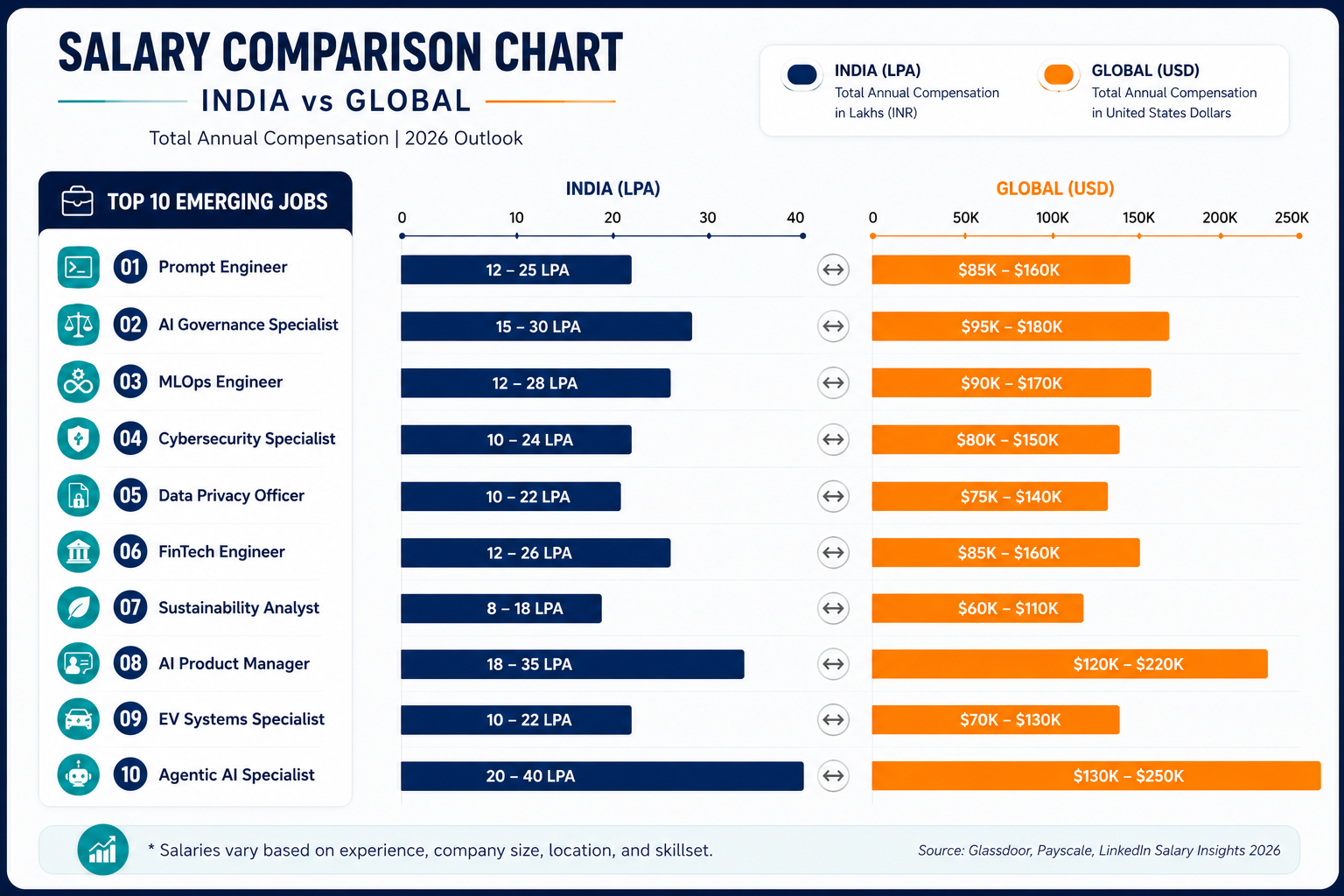
| # | Job Title | India Salary Range (LPA) | Global Salary Range | Best Fit For | Future Demand |
|---|---|---|---|---|---|
| 1 | Prompt Engineer / GenAI Specialist | ₹4–60 | $60K–$250K+ | Writers, linguists, developers | Very High |
| 2 | AI Trust, Safety & Governance Specialist | ₹8–25 | $90K–$160K+ | Legal, compliance, QA professionals | High (regulation-driven) |
| 3 | MLOps / AI Infrastructure Engineer | ₹10–30 | $110K–$180K | Software/DevOps engineers | Very High |
| 4 | Cloud Security & AI Cybersecurity Specialist | ₹6–25 | $90K–$160K+ | IT/security professionals | Very High |
| 5 | Data Privacy & AI Compliance Officer | ₹8–20 | $85K–$150K | Legal, compliance professionals | High (steady) |
| 6 | FinTech Engineer | ₹8–25 | $95K–$170K+ | Software engineers, finance grads | High |
| 7 | Sustainability & Renewable Energy Analyst | ₹6–18 | $70K–$130K | Environmental science, operations | High |
| 8 | AI Product Manager | ₹15–40 | $120K–$220K+ | Product managers, business analysts | High |
| 9 | Autonomous & EV Systems Specialist | ₹6–20 | $85K–$150K | Mechanical/electrical engineers | High (India: very high) |
| 10 | Agentic AI / Digital Workforce Specialist | ₹8–25 | $100K–$180K | Operations, BPM professionals | Extremely High (India) |
Your Career Roadmap: How to Actually Break Into One of These Job Roles
You don’t need to become an AI researcher overnight. Here’s a realistic, four-stage roadmap that applies across almost every role on this list:
Stage 1 — Orient (2–4 weeks): Pick one role from this list that overlaps with your current skills. A compliance professional is closer to “AI Trust & Safety Specialist” than they think; a mechanical engineer is closer to “EV Systems Specialist.” Map your existing skills against the “Skills Needed” section for your chosen role.
Stage 2 — Build the Foundation (2–3 months): Take a structured, verifiable certification rather than relying on scattered YouTube tutorials. This is where a focused Vskills certification is genuinely useful — it forces structured learning and gives you a credential to show, not just a claim to make.
Stage 3 — Build Proof (1–2 months): Certifications open doors; projects walk you through them. Build one small, real project — a working prompt library, a mini ESG report, a sample AI governance checklist — and document it publicly (LinkedIn, GitHub, or a portfolio site).
Stage 4 — Position and Apply (ongoing): Rewrite your resume and LinkedIn headline around the target role, not your current title. Apply to both specialised startups (faster hiring, broader exposure) and GCCs/large enterprises (structured training, scale).
Myth vs. Reality: Clearing Up the Confusion Around New-Age Jobs
| Myth | Reality |
|---|---|
| “These jobs are only for computer science graduates.” | Many roles (AI governance, sustainability, fintech, product) actively recruit from law, finance, operations, and design backgrounds. |
| “AI will make these jobs obsolete too, so why bother?” | These roles largely exist because of AI adoption — they involve judgment, oversight, and strategy that AI itself cannot perform. |
| “You need a master’s degree to qualify.” | Employers increasingly hire on demonstrated, certified skills — this is the essence of skills-first hiring highlighted by WEF and LinkedIn data. |
| “Salaries are inflated hype, not real.” | Multiple independent platforms (Glassdoor, Indeed, Naukri, LinkedIn) show consistent, sizeable salary premiums for these roles compared to equivalent traditional titles. |
| “These are Silicon Valley jobs, not really an India story.” | India’s GCCs alone employ over 2.36 million professionals and lead the world in AI hiring volume — this is very much an India story. |
Expert Tips for Landing a Role That Didn’t Exist Yet
- Don’t wait for a “perfect fit” job posting. Many of these roles are still being defined internally — apply to adjacent titles (AI Analyst, AI Coordinator, Digital Transformation Associate) and let your application shape how the company sees the role.
- Lead with outcomes, not tools. Recruiters see “knows ChatGPT” on hundreds of resumes. “Built a prompt library that reduced support response drafting time by 40%” stands out.
- Combine one hard skill with one domain skill. The highest-paid professionals in this list aren’t generalists — they’re prompt engineers who also know Python, or sustainability analysts who also understand supply chains.
- Treat certifications as proof, not decoration. A Vskills or equivalent certificate matters most when it’s tied to a project you can talk about confidently in an interview — not just listed on a resume.
- Track the reports, not just the job boards. Reading WEF, LinkedIn, NASSCOM, and Deloitte reports twice a year will help you spot the next wave of emerging roles 12–18 months before they flood the job market.
Career and Jobs Frequently Asked Questions
Q1: Are these jobs only available in big cities like Bengaluru and Hyderabad?
No. While metro hubs lead in volume, tier-2 cities such as Vijayawada are recording AI hiring growth above 45%, and remote-first companies are increasingly location-agnostic for many of these roles.
Q2: I’m a fresher — can I realistically get into any of these roles without work experience?
Yes, particularly for Prompt Engineer, Sustainability Analyst, and Data Privacy Analyst roles, which have genuine entry-level tracks. Build one strong project and a relevant certification to compensate for limited work history.
Q3: Will these jobs still exist in five years, or is this just another hype cycle?
The underlying drivers — AI adoption, cloud infrastructure, regulation, and the energy transition — are structural, not seasonal. The job titles may evolve (as “Webmaster” evolved into today’s web development roles), but the underlying skill categories are likely to remain in demand.
Q4: Do I need to know how to code for all of these roles?
No. Roles like AI Trust & Safety Specialist, Sustainability Analyst, and Data Privacy Officer prioritise domain judgment and regulatory knowledge over coding. Coding becomes important mainly in engineering-heavy roles like MLOps and FinTech Engineering.
Q5: How do I know which certification is actually worth my time and money?
Look for certifications that map directly to the “Skills Needed” for your target role, are recognised by recruiters in job postings, and include practical/applied assessment — not just video lectures.
Q6: Is it better to switch companies or upskill internally to move into one of these roles?
Both paths work. Internal moves are often easier to secure (you already have organisational trust) but may be slower to formalise; external moves can accelerate title and salary changes but require stronger proof of skill upfront.
Conclusion: The Real Skill Is Learning How to Keep Learning
Five years ago, nobody was hiring for most of the roles on this list — and five years from now, the list will look different again. That’s not a reason to feel anxious about the pace of change; it’s the strongest argument for building a habit of continuous, structured learning rather than chasing a single “future-proof” job title.
The data backs this up plainly: employers themselves expect 39% of core workplace skills to change by 2030, and the ones winning this transition aren’t necessarily the most naturally gifted — they’re the ones who treat upskilling as a routine, not a one-time event. Whether that means a focused Vskills certification, a self-built project, or simply reading the next industry report before your peers do, the direction is the same: get comfortable being a beginner again, repeatedly, on purpose.
The next job that “doesn’t exist yet” is already being shaped by the technologies, regulations, and business shifts happening right now. The best time to start preparing for it isn’t when the job posting appears — it’s today.