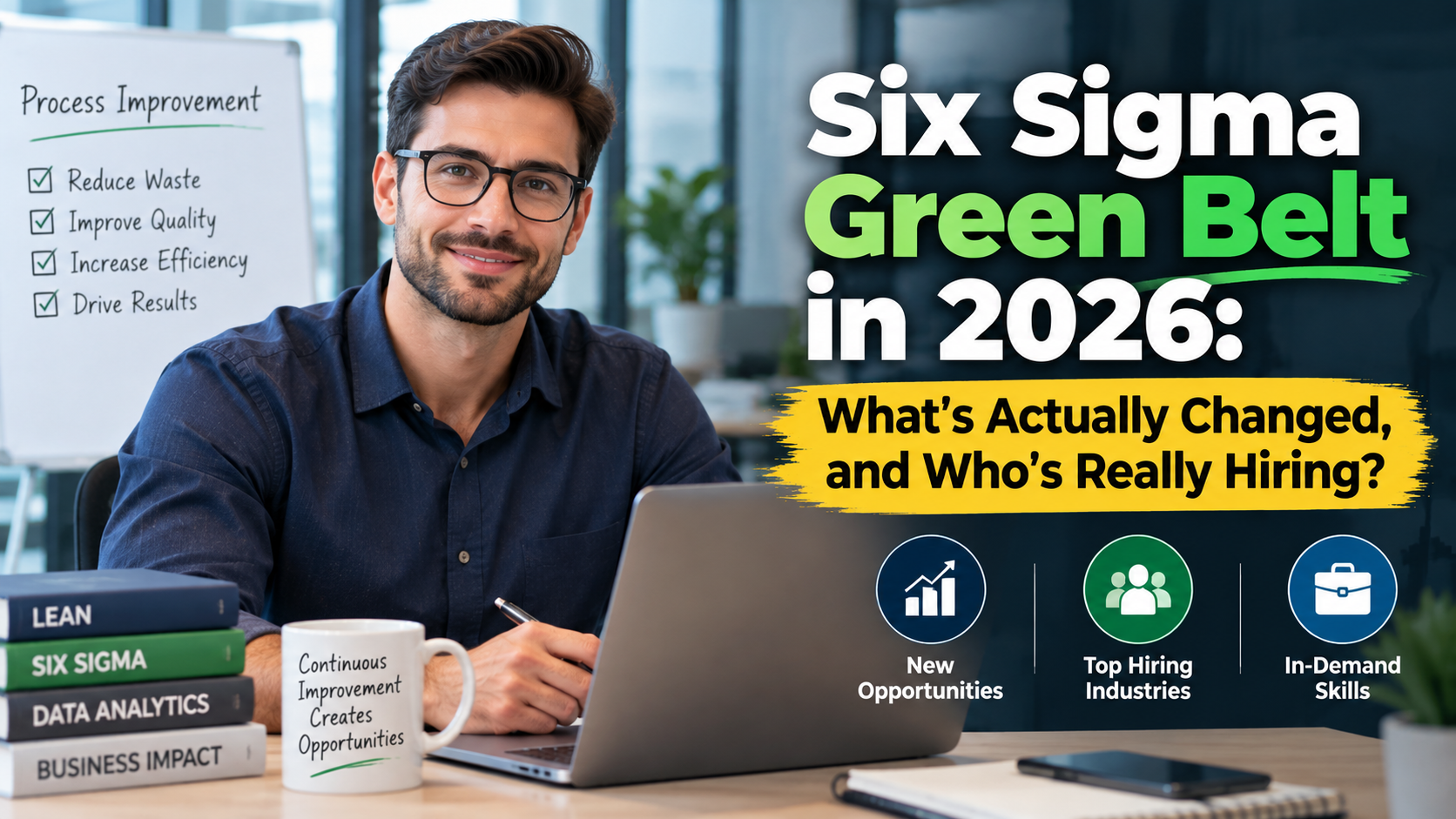
Six Sigma Green Belt used to be a straightforward signal that you knew how to reduce defects, improve processes, and solve operational problems. In 2026, that alone may no longer be enough. Companies are increasingly looking for professionals who can combine process improvement with data analytics, automation, AI, and measurable business outcomes. So what has actually changed for Six Sigma Green Belt professionals, and more importantly, who is hiring them now?
The bigger question is not whether Six Sigma is still relevant. It is where its relevance has moved. From manufacturing floors and quality teams to IT, healthcare, finance, supply chains, customer experience, and digital operations, process improvement is becoming part of a much broader set of roles. If you’re planning to earn a Six Sigma Green Belt in 2026, already hold one, or are wondering whether it can still strengthen your career, this guide breaks down the skills employers are looking for, the industries hiring, and how the Green Belt role is changing.
Six Sigma Green Belt in 2026: What’s Actually Changed, and Who’s Really Hiring
One salary survey says ₹3.7 lakh. Another says ₹42 lakh. Both claim to describe the same certification. Somewhere between “is this still relevant in the AI era” and “which number do I believe,” most Six Sigma Green Belt research stops being useful. Here’s the honest version — what changed, what didn’t, what it actually pays, and who’s genuinely hiring.
Type “Six Sigma Green Belt worth it 2026” into a search bar and you’ll get two contradictory stories back to back. One says AI is quietly making structured process-improvement methodology obsolete. The other says AI made it more valuable than ever, because someone now has to keep automated processes stable and predictable. Both stories are half right, which is precisely why this article exists: a straight, unhyped account of what genuinely changed in Green Belt work, what a Six Sigma Green Belt certification actually pays across wildly different sources, and which industries are putting real hiring budget behind it in 2026.
A quick note before we start
Salary and hiring figures in this piece are compiled from multiple 2026 sources — Knowledgehut, 6figr, Collegedunia, Indeed, PayScale, Knowvantage, and Lightcast/Burning Glass labour-market data — which vary considerably by methodology, geography, and what each counts as a “Green Belt” role. That variance is flagged explicitly throughout rather than smoothed into one misleading average.
Why “Is It Still Relevant” Is the Wrong Question
Every year since roughly 2018, someone has published a piece asking whether Six Sigma is dying. Agile killed it. Then DevOps killed it. Now, supposedly, AI is killing it. And every year, the actual hiring data quietly disagrees: job postings requiring Lean Six Sigma skills grew 33% between 2020 and 2024, and labour-market analysts project continued growth of roughly 10% over the next two years. That is not the trajectory of a dying methodology.
What actually happened is more interesting than either extreme. The core objective of Six Sigma — reducing variation, removing waste, making decisions from data rather than assumption — hasn’t moved an inch. What changed is the toolkit sitting underneath that objective, and, just as importantly, the reason employers now want it. A growing body of practitioner writing in 2026 makes a specific, non-obvious argument worth sitting with: Six Sigma is not being replaced by AI, because Six Sigma is what makes AI implementations succeed in the first place. Automating a broken process, as more than one 2026 industry analysis puts it bluntly, just gives you faster mistakes.
The genuinely useful reframe for 2026: Six Sigma isn’t competing with AI for relevance. It’s becoming the governance layer that keeps AI-driven processes stable, predictable, and within tolerance.
That reframe matters enormously for anyone deciding whether to invest three or four months in a Six Sigma Green Belt certification right now. You’re not betting on a legacy methodology holding its ground against automation. You’re betting on a specific, in-demand skill: knowing how to map a process, find where it actually breaks, and prove with data that a fix works — a skill that becomes more valuable, not less, as more of that process gets automated and the cost of an undetected failure scales with it.
What Actually Changed: AI Inside DMAIC
DMAIC — Define, Measure, Analyze, Improve, Control — is still the backbone of Green Belt work in 2026, and it hasn’t been replaced by anything. What changed is how much of the manual grind inside each phase now happens automatically, and where that shifts a Green Belt’s actual time and attention.
| DMAIC Phase | Before | Now |
|---|---|---|
| Define | Manually scoping the problem from scattered reports and interviews | Largely unchanged — still the phase that most requires human judgment and stakeholder alignment |
| Measure | Manual data collection, often over days or weeks | Connected systems and sensors collect data automatically and continuously, compressing timelines significantly |
| Analyze | Manual statistical analysis in spreadsheets, hunting for root causes by hand | AI-assisted pattern detection surfaces likely root causes faster; the Green Belt validates and interprets rather than mining raw data alone |
| Improve | Solutions designed and piloted almost entirely on human intuition plus data | Predictive analytics can simulate the likely effect of a proposed fix before it’s piloted |
| Control | Periodic manual checks to confirm a fix is holding | Real-time dashboards and automated alerts monitor control limits continuously |
One concrete, widely cited effect of this shift: the integration of high-fidelity sensors and real-time data streams has compressed traditional data-collection-and-root-cause timelines by close to 40% in some documented cases. That’s not a marginal efficiency gain — it changes what a Green Belt project actually looks like week to week, with far less time spent gathering data and far more time spent interpreting it and managing the people side of change.
The honest calibration on how much “AI skill” a Six Sigma Green Belt needs
Practically none of this requires a Green Belt to build or train an AI model. What it requires is comfort using AI-assisted tools for pattern detection and data cleaning, and — more importantly — the judgment to sanity-check what those tools produce before acting on it. The professionals thriving in this shift aren’t the ones who learned machine learning. They’re the ones who stayed excellent at root-cause thinking while getting comfortable with faster, AI-assisted inputs to it.
Two other genuine shifts are worth naming briefly, since they show up repeatedly in current industry commentary. Agile Lean Six Sigma — merging Agile’s iterative sprints with DMAIC’s structured rigor — has moved from a niche hybrid to a mainstream expectation, particularly in technology and services organisations. And remote and hybrid delivery of both the certification itself and the improvement projects it supports is now the default rather than the exception, with training providers routinely offering the identical curriculum across in-person, live-virtual, and self-paced online formats.
The Salary Reality Check
₹3.7 lakh. Also ₹42 lakh. Both are genuine, currently published Six Sigma Green Belt salary figures. Neither source made an error.
This is one of the most extreme salary-data spreads you’ll find for any single certification, and it’s worth understanding exactly why before trusting any headline number. The sources are measuring fundamentally different populations wearing the same certification badge.
| Source | Reported Figure | What It’s Likely Measuring |
|---|---|---|
| Indeed (Operations Analyst role) | ₹3.69L national average | One specific, entry-level job title that happens to list Green Belt as a preferred skill |
| Collegedunia | ₹5L – ₹8.5L | Broad national average across early-to-mid career Green Belt roles |
| 6figr / Knowledgehut | ₹16L – ₹42L | Metro-city, senior, or specialised roles where Green Belt is one credential among several held |
| Knowvantage (relative premium) | 25–40% above uncertified peers | The most consistently useful figure — measures certification’s effect on pay within the same role, not an absolute number |
The pattern underneath that spread is consistent with what shows up across nearly every widely-searched certification: the certification itself is rarely the only thing determining pay. It’s a credential layered on top of a job title, an industry, a city, and a seniority level — and those four factors move the number far more than the certification alone does.
The single most reliable number in this entire chapter
Rather than chasing an “average” that no two sources agree on, anchor on the relative premium: Six Sigma Green Belt-certified professionals in India earn 25–40% more than non-certified peers doing the same job. That figure isolates the certification’s actual effect, independent of which industry, city, or seniority level you’re starting from — which makes it a far more honest basis for deciding whether certification is worth pursuing than any single absolute salary figure.
Who’s Actually Hiring
“Manufacturing and quality” used to be the entire answer to “who hires Six Sigma people.” That’s no longer true, and the industry spread in 2026 is genuinely wider than most learners realise before they start researching seriously.
| Industry | Why They’re Hiring Six Sigma Green Belts | Representative Employers |
|---|---|---|
| Manufacturing | The original home of Six Sigma; defect reduction and yield improvement remain core to the P&L | Honeywell, Volkswagen, DuPont, CommScope |
| Healthcare | The fastest-growing hiring sector currently; reducing readmissions and improving patient-safety metrics using the same structured methodology | Hospital systems, insurers, Medtronic |
| IT / ITES & BPO | Process standardisation across large service-delivery operations, increasingly paired with Agile | TCS, Accenture, HCL, Genpact, IBM |
| BFSI | Reducing error rates and turnaround time in high-volume transactional processes | Deutsche Bank and other large financial institutions |
| Pharma & life sciences | Regulatory-grade process control where variation has direct compliance consequences | Jubilant Generics and similar manufacturers |
Common Green Belt-adjacent job titles worth searching for directly, beyond the obvious “Six Sigma” keyword, include Process Analyst, Operations Analyst, Quality Assurance Manager, Business Analyst, Supply Chain Manager, Operational Excellence Manager, Senior Consultant, and Team Leader roles across continuous-improvement functions. Very few postings are titled simply “Six Sigma Green Belt” — the certification usually appears as a required or preferred skill inside a broader operational role.
Healthcare deserves a specific callout
Multiple 2026 labour-market analyses independently flag healthcare as the fastest-growing destination for Six Sigma-certified professionals, driven by hospitals and insurers using the same DMAIC discipline to cut costs, reduce errors, and improve patient outcomes. For anyone entering the field without a manufacturing background, healthcare and BFSI are worth researching specifically — they’re less crowded with legacy Six Sigma veterans than manufacturing, and demand is growing faster there.
Green Belt vs. Yellow Belt vs. Black Belt
The belt hierarchy sounds like a marketing gimmick until you understand what actually differs between levels — scope of project ownership, depth of statistical tooling, and, correspondingly, salary ceiling. Choosing the right entry point matters more than most learners assume.
| Belt | Typical Role in a Project | Statistical Depth | Best Fit |
|---|---|---|---|
| Yellow Belt | Team member, supporting data collection and basic analysis | Foundational — basic process mapping and root-cause tools | Anyone wanting foundational exposure without a major time investment |
| Green Belt | Leads small-to-medium improvement projects, often part-time alongside a regular job | Solid statistical toolkit — hypothesis testing, process capability, control charts | Working professionals ready to own and deliver real projects |
| Black Belt | Leads complex, cross-functional projects full-time; mentors Green and Yellow Belts | Advanced statistics, multiple concurrent projects, deep DOE and regression work | Experienced Green Belts moving into dedicated continuous-improvement roles |
The near-universal advice from practitioners and training providers alike is sequential: pursue Green Belt first, build real project experience, then move to Black Belt once you have practical credibility to draw on. Black Belt programmes typically expect existing Green Belt knowledge or genuine project-leadership experience as a prerequisite, and Black Belt certification itself demands considerably more — commonly cited figures put it at 160 to 240 hours of training plus completion of multiple high-impact projects, a materially larger commitment than Green Belt’s typical 3–4 month, weekend-batch path.
Why Green Belt is the right first step for almost everyone
Green Belt transforms you from someone who can spot a problem into someone who can actually fix one and prove it with data — a genuinely different, hireable capability. It’s substantial enough to lead real projects and light enough to complete alongside a full-time job, which is exactly why it remains the most commonly held belt level and the most searched Six Sigma credential by a wide margin.
What a Six Sigma Green Belt Actually Does All Day
Job postings describe responsibilities in the abstract; they rarely convey what a week actually looks like. Here’s a realistic shape of a 2026 Green Belt’s working rhythm, reflecting the AI-assisted shift covered in Chapter 2.
The skill that hasn’t changed at all, and never will
Every version of this article, whether written in 2015 or 2026, agrees on one thing: the hardest part of a Six Sigma project was never the statistics. It was getting a team to actually change how they work, and getting a sceptical stakeholder to trust a data-driven recommendation over their own experience. AI accelerated the analysis. It did nothing to make that conversation easier, and that’s exactly why it remains the highest-value skill a Green Belt brings to the table.
The Skills Stack That Gets You Hired
A Green Belt certificate on a resume gets attention, but hiring managers in 2026 are screening for a specific, expanded skill set built around that certificate, not the paper credential alone.
| Skill | Why It Matters in 2026 Specifically |
|---|---|
| Core DMAIC and statistical tools | Hypothesis testing, process capability, control charts — the non-negotiable foundation every belt level rests on |
| Comfort with AI-assisted analytics tools | Being able to use, interpret, and sanity-check AI-surfaced patterns rather than treating them as ground truth |
| Change management and facilitation | Still the single hardest, highest-value skill; unaffected by any technology shift |
| Agile fluency | Increasingly expected alongside DMAIC in technology and services organisations running Agile Lean Six Sigma hybrids |
| Data storytelling | Translating a statistically valid finding into a business case a non-technical stakeholder will act on |
| Domain knowledge in a growth sector | Healthcare-specific or BFSI-specific process knowledge increasingly differentiates candidates beyond generic manufacturing experience |
The portfolio move that actually differentiates a Green Belt candidate
Nearly every Green Belt certification requires or strongly encourages a capstone project. Treat that project as a genuine portfolio piece, not a box to tick: document the baseline, the root-cause analysis, the fix, and the measured after-state with real numbers. A candidate who can walk an interviewer through one real project end to end, including what didn’t work initially, is dramatically more credible than one who can only recite the DMAIC acronym.
Common Myths, Corrected
A methodology this widely discussed for this many years accumulates a lot of outdated or oversimplified takes. A few are worth correcting directly.
| The Myth | The Reality |
|---|---|
| “AI is making Six Sigma obsolete.” | Job postings requiring Lean Six Sigma skills grew 33% between 2020 and 2024, and current industry analysis frames Six Sigma as the governance layer that makes AI-driven process automation stable and trustworthy, not a competitor to it. |
| “There’s one accurate average Green Belt salary.” | Reported figures range from roughly ₹3.7 lakh to ₹42 lakh depending on the specific job title, industry, and city sampled. The 25–40% certified-vs-uncertified premium is a far more reliable figure than any single average. |
| “Six Sigma is only relevant to manufacturing.” | Healthcare is currently the fastest-growing hiring sector, alongside strong and growing demand in IT/ITES, BFSI, and pharma. |
| “You need to be a statistics expert to earn a Green Belt.” | Green Belt curricula are specifically designed to build applied statistical competence — hypothesis testing, control charts, process capability — for working professionals without a math or engineering background, not to produce data scientists. |
| “Having the credential alone is what gets you hired.” | What employers actually value most consistently is evidence of a genuine, well-documented applied project and the ability to walk through it confidently in an interview — the credential opens the door, the project proves you can do the work. |
| “You should jump straight to Black Belt to maximise salary.” | Black Belt programmes typically expect Green Belt knowledge or real project-leadership experience first, and Black Belt itself requires a considerably larger time investment (160–240 training hours plus multiple completed projects) that’s hard to justify without Green Belt-level experience underneath it. |
Which Green Belt Path Fits You?
“Get a Six Sigma Green Belt” means something different depending on where you’re starting. Here’s a map across four common situations.
Already working in manufacturing or quality
This is Six Sigma’s original home turf — your context is a genuine advantage, and the competition here is also the most experienced.
- Move quickly through core DMAIC concepts you likely already apply informally, and focus study time on formalising statistical rigor
- Build genuine comfort with connected-systems and sensor-based data collection, since this is where the manufacturing floor has changed fastest
- Differentiate with a strong capstone project on a real production-line problem, since manufacturing hiring managers see this credential constantly
Working in or targeting healthcare
You’re entering the fastest-growing Six Sigma hiring segment with relatively less competition from legacy manufacturing veterans.
- Look specifically for training providers or capstone project options with healthcare-relevant case studies — readmission rates, patient wait times, sterilisation processes
- Pair Green Belt certification with your existing clinical or administrative domain knowledge; that combination is genuinely scarce and valued
- Target hospital systems and insurers directly rather than generic job boards, since much of this hiring happens through internal quality and operations teams
Working in IT, ITES, or BPO
Your process-standardisation instincts transfer directly; the main gap is formal statistical rigor and DMAIC structure.
- Look specifically for Agile Lean Six Sigma-oriented training, since this hybrid is increasingly the expected model in technology-adjacent roles
- Apply Green Belt thinking to a genuine service-delivery or support-process problem for your capstone, since that’s the context employers in this sector will actually evaluate you against
- Highlight this certification specifically when moving toward operations, service delivery, or continuous-improvement roles rather than pure technical tracks
Fresh graduate or early in your career
Green Belt is a strong, credible differentiator this early, provided you pair it with genuine applied project experience.
- Choose a training provider whose curriculum includes a real capstone project, even a small one, rather than assessment-only formats
- Target entry-level titles like Process Analyst, Operations Analyst, or Business Analyst, where Green Belt is frequently listed as a preferred, differentiating skill
- Consider healthcare or IT/ITES over manufacturing initially, since both sectors are growing faster and have less entrenched competition for entry-level Green Belt roles
Assessment: Is This Your Next Move?
Answer five quick questions honestly and this will point to your most likely next step — not just a score, an actual read on your situation.
Six Sigma Green Belt career-fit assessment
5 questions · your result updates and explains itself as you answer
Where This Career Goes Next
Everything covered in this article points to the same conclusion as most other “is this skill still relevant” stories worth taking seriously: the tooling changed, the underlying value didn’t. Knowing how to define a real problem, prove a root cause with data, and lead a team through genuine change is arguably worth more now than it was five years ago — precisely because more of the surrounding work is automated, and someone still has to be accountable for whether the automated process actually works.
The natural arc from here follows the shape covered earlier in this guide: build real project experience as a Green Belt, take on progressively larger and more cross-functional problems, and move toward Black Belt-level leadership once you have genuine outcomes to point to. Along the way, the professionals who advance fastest tend to be the ones who keep two things growing in parallel — their statistical and analytical toolkit, and their ability to lead people through change, which every source in this field agrees remains the harder of the two skills.
Where to go from here
If you’re exploring how to build toward this field — whether that’s a first structured project, a stronger grasp of DMAIC and statistical tools, or the next step after Green Belt — Vskills has learning resources built around exactly this kind of applied, career-focused progression.
Explore opportunities with Vskills
From foundational process-improvement learning to more advanced quality and operational excellence resources, Vskills offers a range of ways to build this career path further.
Frequently Asked Questions
The bottom line
Six Sigma Green Belt in 2026 isn’t a legacy credential surviving despite AI — it’s a credential whose core value proposition, structured and provable process improvement, has become more relevant as more of the surrounding work gets automated. The toolkit changed: less manual data wrangling, more AI-assisted pattern detection, faster cycles through DMAIC. The value didn’t: knowing how to define a real problem, prove a root cause with data, and get a sceptical team to actually change how they work. That skill is exactly as scarce and exactly as employable as it’s ever been.