

Online certifications have become one of the most popular ways to learn new skills in India. From data analytics and digital marketing to finance, cloud computing, and artificial intelligence, there are now thousands of online courses promising better jobs, higher salaries, and faster career growth. For students, freshers, working professionals, and career changers, these certifications often look like a convenient and affordable way to stay competitive in a fast-changing job market.
But an important question still remains: are online certifications actually worth it in India? Many people complete multiple courses and collect certificates, yet still struggle to get interviews or job offers. At the same time, others use one strong certification to switch careers, improve their resume, or gain the practical skills that employers are looking for. This creates confusion. People want to know whether companies truly value these credentials or whether they are just another trend in online learning.
The truth is that employers in India usually do not look at online certifications in a simple yes-or-no way. A certificate alone is rarely enough to impress a recruiter. What matters more is the quality of the course, the reputation of the platform or institution, the practical skills gained, and whether the candidate can apply that learning in real work situations. In many cases, a certification helps most when it supports a stronger profile rather than trying to replace one.
Why Online Certifications Have Become So Popular
Online certifications have become extremely popular in India because they fit the needs of today’s learners far better than many traditional options. People want skills that are practical, affordable, flexible, and directly linked to jobs. In a market where industries change quickly and employers often ask for updated tools and domain knowledge, online certifications appear to offer a faster way to stay relevant.
1. They are easier to access than traditional courses
One of the biggest reasons for their popularity is accessibility. A person does not need to move to another city, leave a job, or spend years in a classroom to learn a new skill. Most online certifications can be pursued from home and at a flexible pace.
This makes them attractive for:
- College students
- Fresh graduates
- Working professionals
- Homemakers returning to work
- People planning a career switch
For many learners in India, this convenience is a major advantage.
2. They are usually more affordable
Compared with full-time degrees or long professional programs, online certifications are often much cheaper. This allows people to explore a field without making a very large financial commitment.
For someone who wants to test whether they enjoy digital marketing, GST, business analytics, coding, or financial modelling, an online certification can feel like a lower-risk option.
3. The job market is becoming more skill-focused
Many industries now care more about whether a candidate can do the work than whether they only have a traditional degree title. This has increased interest in short-term, skill-based learning.
People are taking certifications to learn areas such as:
- Data analytics
- Artificial intelligence
- Cloud computing
- Finance tools
- Cybersecurity
- Digital marketing
- Project management
As a result, certifications have become closely linked with employability and career growth.
4. Career switching has become more common
A large number of professionals in India no longer want to stay in one field forever. People from sales move into digital marketing, commerce graduates enter analytics, engineers shift into product roles, and finance professionals learn compliance or data tools.
Online certifications support this kind of transition because they offer a structured starting point. They help learners build some foundation before applying for a new type of role.
5. They help fill the gap between college education and job requirements
Many students discover that their formal education does not fully prepare them for actual hiring expectations. A degree may give them theoretical knowledge, but employers often ask for specific tools, platforms, workflows, and practical exposure.
This is where online certifications become attractive. They promise to bridge the gap between what students studied and what employers expect in interviews and at work.
6. They create a feeling of progress
Another reason for their popularity is psychological. In a competitive and uncertain job market, completing a certification gives people a sense of movement. It feels like they are improving their profile, learning something useful, and doing something concrete for their future.
Even when the career impact is not immediate, the certification can make learners feel more confident and prepared.
7. Platforms market them as job-oriented solutions
The rise of edtech and online learning platforms has also played a major role. Certifications are often marketed as direct pathways to job opportunities, higher salaries, and better careers. This strong positioning has made them especially appealing to young professionals and fresh graduates who are looking for practical ways to stand out.
Online certifications have become popular in India not only because they are easy to buy or easy to complete, but because they seem to solve a real problem. People want industry-relevant skills, faster learning, and better job chances. Certifications appear to offer all three.
Are Online Certifications Really Worth It in India?
The real answer is that online certifications can be worth it in India, but not in every case and not for every person. Their value depends on why you are pursuing them, which course you choose, how seriously you learn, and whether the certification leads to actual skill development. This is where many people get disappointed. They expect the certificate itself to change their career, when in reality employers usually care more about what the certification helped them learn and apply.
So the better question is not simply whether online certifications are worth it. The better question is: under what conditions are they worth it?
When online certifications are worth it
Online certifications can be genuinely useful when they help you gain a skill that employers actively value. This usually happens when the course is practical, relevant to your target role, and supported by assignments, projects, tools, or assessments.
They are often worth it when:
- You want to learn a job-relevant skill
- You are trying to enter a new domain
- You need to strengthen your resume for a specific role
- You want structured learning instead of random free content
- You already have a degree but need practical exposure
- You are a working professional trying to stay updated
In these cases, a certification can add real value because it becomes part of a bigger career strategy.
When they are not worth it
Online certifications are usually not worth much when people collect them without a clear purpose. Many learners complete course after course but do not build projects, improve practical understanding, or connect the certification to an actual job path.
They often fail to create value when:
- The course is taken only for the certificate
- The content is too basic or outdated
- The platform has little credibility
- There is no practical application
- The learner cannot explain or use the skill in interviews
- The certification has no connection to the target role
In such situations, the certificate may end up being only a line on the resume with very little impact.
A certificate is not a replacement for competence
This is one of the most important points. In India, many employers may appreciate a good certification, but very few will hire someone only because they completed one. A certificate may help you get noticed, but it usually does not replace skill, communication, problem-solving ability, or proof of work.
That is why certifications work best as a supporting signal, not as the whole profile.
For example:
- A digital marketing certification works better when you can show campaign understanding or content work
- A data analytics certification becomes stronger when you can show dashboards, Excel work, SQL queries, or projects
- A finance certification matters more when you can explain concepts clearly and apply them to business situations
The real value comes from the combination of certification and capability.
Their value also depends on your career stage
Online certifications do not help everyone in exactly the same way.
For students and freshers
They can help fill the gap between academic learning and job skills. They can also show initiative and help the candidate build direction.
For working professionals
They can be useful for upskilling, moving to a better role, or staying relevant in a changing industry.
For career changers
They can provide a starting point and a structured path into a new domain, especially when combined with projects and targeted applications.
For experienced specialists
A certification may help less if the person already has strong work experience, unless it is in a highly technical or regulated field.
The Indian job market perspective
In India, the value of online certifications is often strongest in skill-driven and fast-changing sectors. These include areas such as:
- Data analytics
- Cloud and IT support
- Digital marketing
- Cybersecurity
- Financial tools and taxation
- Project management
- Business analysis
- Artificial intelligence
In these domains, certifications can improve your profile because the market often rewards current and applicable skills. But even here, serious competition means the certificate alone is rarely enough.
So, are they worth it?
Yes, online certifications can be worth it in India when they do one or more of the following:
- Help you build real, usable skills
- Make your profile more job-relevant
- Support a career switch
- Improve your confidence and clarity
- Give structure to your learning
- Add proof of initiative to your resume
But they are not worth it if you treat them as a shortcut to employment without putting in the work to understand and apply the skill.
What Employers in India Actually Think About Online Certifications?
Employers in India are not rejecting online certifications, but they are also not treating them as a shortcut to hiring. The broader hiring environment is becoming more skill-focused because job requirements are changing quickly. LinkedIn’s 2025 Work Change report says the skills required for jobs in India are projected to change by 64% by 2030, which is much faster than the global average. That helps explain why recruiters are paying more attention to current, applied skills than to credentials alone.
1. Employers value skills more than certificate collection
The biggest thing employers care about is whether the certification reflects a real, usable skill. LinkedIn reports that 66% of leaders globally say they would not hire someone without AI skills, and 71% say they would choose a less experienced candidate with AI skills over a more experienced one without them. While that is not a statement about India alone, it strongly supports the same hiring logic now visible in India’s skill-driven market: employers care less about how many certificates you have and more about whether you can actually do the work.
2. A good certification can strengthen your profile
Online certifications do help when they come from a credible platform and match the job role you are targeting. Coursera’s 2025 micro-credentials employer survey found that 93% of employers are more likely to hire a candidate with a GenAI micro-credential than one without, and 95% say such credentials strengthen a candidate’s application. This suggests that employers do see value in certifications, especially when the credential signals updated, job-relevant learning rather than generic course completion.
3. Employers still do not see certificates as a substitute for proof
This is the most important practical point. A certification may help your resume get attention, but employers usually still want evidence that you understand the skill in practice. Inference from the hiring and skills reports is clear: the certificate works best when it is backed by projects, internships, work samples, problem-solving ability, or at least the confidence to explain what you learned and how you would apply it. That is especially true in India, where competition is high and many candidates may list similar online courses.
4. Relevance matters more than prestige alone
Employers are generally more impressed when a certification is closely tied to the job. A business analyst certification makes more sense for a business analyst role than a random general course added only to fill space on a resume. In a market where skills are changing quickly and companies are under pressure to hire job-ready talent, relevance becomes more important than simply collecting certificates from multiple platforms.
5. What usually impresses employers most
In practical terms, employers are more likely to respond positively when an online certification is accompanied by things like:
- A clear connection to the target job
- Practical assignments or portfolio work
- Tool-based learning
- Recent and industry-relevant content
- The ability to explain the learning confidently in interviews
This is also consistent with the way recent employer surveys frame credentials: the certificate strengthens the application, but it is strongest when it signals capability rather than passive course completion.
So, what do employers actually think? They generally see online certifications as a positive supporting signal, not as a complete hiring reason. A strong certification can improve your credibility, show initiative, and make your profile more relevant. But in most cases, it works best when it is combined with practical proof, role fit, and actual skill.
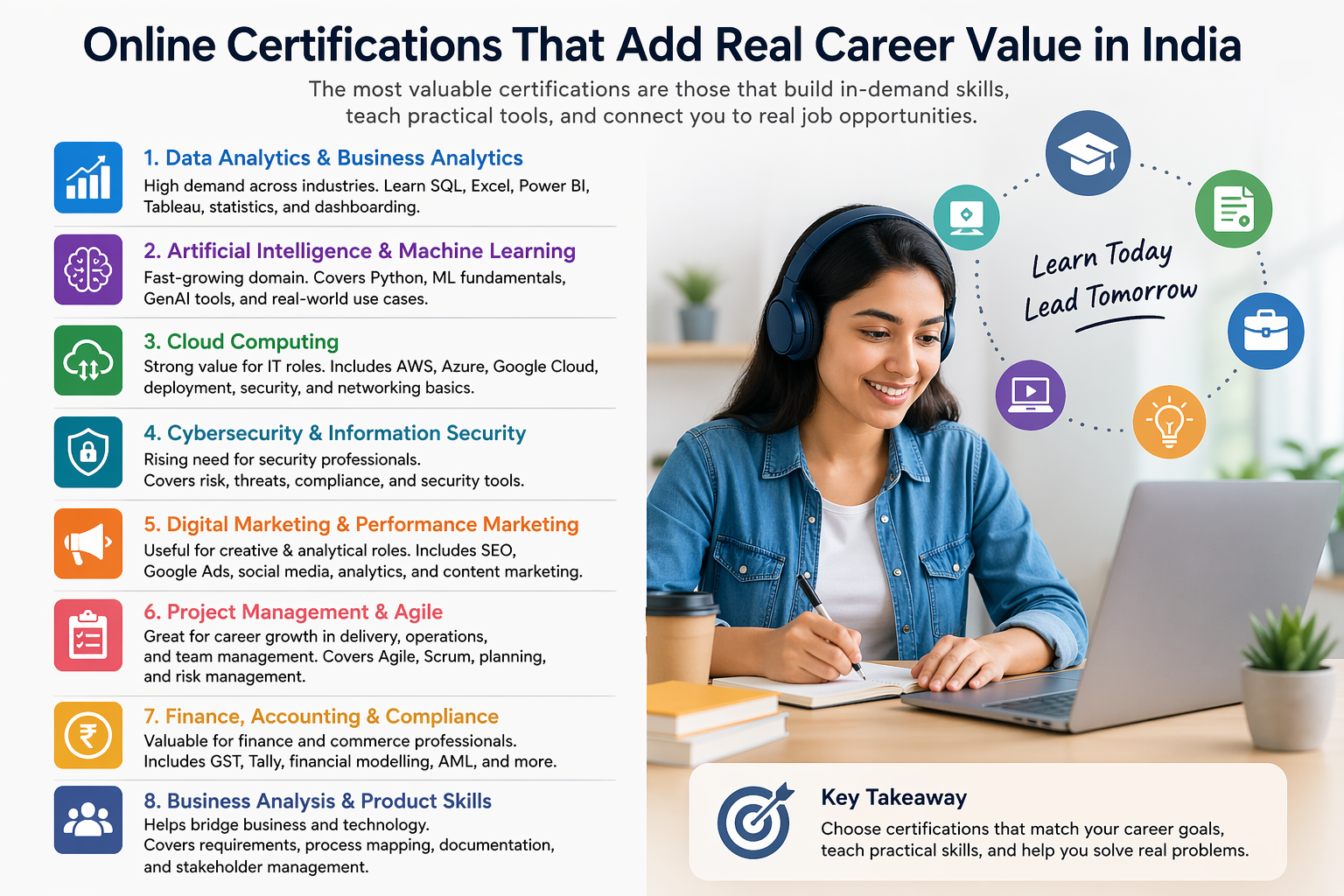
Which Online Certifications Add Real Career Value
Not all online certifications create the same impact. In India, the ones that usually add the most value are those linked to fast-changing, job-relevant skills. That matters even more now because LinkedIn’s 2025 Work Change report says job skills in India are projected to change by 64% by 2030, and the World Economic Forum’s Future of Jobs Report 2025 identifies areas such as AI and big data, networks and cybersecurity, and technological literacy among the fastest-growing skill clusters.
So, if someone is going to invest time and money in an online certification, it makes more sense to choose domains where hiring value is clearer and skills can be demonstrated in real work.
1. Data Analytics and Business Analytics
This is one of the strongest areas for online certifications because it sits at the intersection of business and technology. Certifications in this space tend to add value when they teach practical tools and not just concepts.
These certifications are especially useful when they include:
- Excel
- SQL
- Power BI or Tableau
- Data cleaning
- Dashboard building
- Basic statistics
- Business case interpretation
They are a good fit for students, commerce graduates, engineers, finance professionals, and career changers who want to move into analyst roles.
2. Artificial Intelligence, Machine Learning, and Generative AI
AI-related certifications are gaining serious value because employers are increasingly prioritising AI capability. LinkedIn reports that many leaders now prefer candidates with AI skills over more experienced candidates without them, and WEF also places AI- and data-related roles among the fastest-growing globally.
These certifications are most useful when they cover:
- Prompting and GenAI use cases
- Python basics
- Machine learning fundamentals
- Model workflows
- AI tools for productivity
- Real business applications
This domain can be valuable for both technical and non-technical professionals, but the course should match the learner’s background.
3. Cloud Computing and IT Infrastructure
Cloud certifications continue to carry strong market value because businesses increasingly rely on cloud-based systems, storage, and deployment environments. These certifications are especially useful for people targeting technical roles in IT, support, DevOps, infrastructure, and software operations.
Good cloud certifications usually focus on:
- Cloud fundamentals
- AWS, Azure, or Google Cloud basics
- Deployment concepts
- Security basics
- Networking basics
- Practical cloud services use
For technology-focused careers, this is one of the more employable certification categories.
4. Cybersecurity and Information Security
Cybersecurity certifications have become more important as digital systems grow and security risks increase. WEF’s 2025 report highlights networks and cybersecurity among the fastest-growing skill areas, which supports the rising value of this domain.
These certifications are especially useful when they teach:
- Security fundamentals
- Risk awareness
- Network security basics
- Compliance concepts
- Threat detection
- Security tools and best practices
This area is particularly relevant for IT students, technical professionals, and people interested in specialised, high-responsibility roles.
5. Digital Marketing and Performance Marketing
Digital marketing certifications can still be very useful in India, especially because hiring in this field often values skills over formal degree background. However, this is also a domain where low-quality courses are very common.
The best certifications here are the ones that include:
- SEO
- Google Ads
- Social media strategy
- Content marketing
- Email marketing
- Analytics
- Campaign reporting
Their value rises sharply when the learner can also show practical work, even if it is through sample campaigns, internships, or freelance projects.
6. Project Management and Agile Roles
Project management certifications can add strong career value for professionals who already have some work experience and want to move into coordination, delivery, operations, or team management roles.
These are useful when they cover:
- Agile basics
- Scrum concepts
- Project planning
- Stakeholder management
- Workflow tracking
- Risk and timeline management
For freshers, these certifications may not create immediate hiring power on their own. But for working professionals, they can strengthen career progression.
7. Finance, Accounting, Taxation, and Compliance
In India, certifications in finance and compliance can be valuable when they are practical and role-linked. This includes areas such as:
- Financial modelling
- GST
- Tally and accounting software
- Banking operations
- AML and KYC
- Investment research
- Credit analysis
These certifications are most effective for commerce graduates and finance aspirants when they support a clear target role rather than being pursued randomly.
8. Business Analysis and Product-Related Skills
Business analysis certifications can add value for candidates who want to work between business teams and technical teams. These are especially useful for people with strong communication, problem-solving, and process understanding.
The stronger certifications here usually include:
- Requirement gathering
- Process mapping
- Documentation
- Stakeholder communication
- User stories
- Basic data interpretation
This category can be particularly useful for graduates moving into structured corporate roles.
Which certifications usually add the least value?
Online certifications tend to have weak impact when they are:
- Too generic
- Not linked to a job role
- Purely theory-based
- Extremely easy to complete
- Issued by platforms with little credibility
- Not backed by practical assignments or proof of work
In simple terms, a certification adds real value when it improves employability, not just resume length.
If someone wants the highest return from an online certification in India, the safest direction is to choose a certification that sits in a growing skills domain, teaches practical tools, and connects clearly to a real job path. Right now, areas linked to analytics, AI, cloud, cybersecurity, digital operations, and role-specific business skills look especially relevant because both Indian hiring trends and global jobs data point toward stronger demand in those kinds of capabilities.
How to Tell If a Certification Will Help You Get Hired?
This is where most people make the right or wrong decision. The internet is full of courses that look impressive on the surface, but not all of them improve employability. Before paying for any certification, it is important to ask one simple question: will this course make my profile stronger for a real job, or will it only give me another certificate to add to my resume?
A good certification should do more than teach theory. It should improve your understanding, make your skills more practical, and help you look more job-ready in the eyes of recruiters.
1. Check whether it matches your target role
The first test is relevance. A certification is far more useful when it is directly connected to the type of job you want.
For example:
- A data analytics certification makes sense if you are targeting analyst roles
- A GST certification is useful if you want to work in taxation or compliance
- A digital marketing certification is relevant if you want performance marketing, SEO, or social media roles
- A cloud certification is more useful for technical and IT-based jobs
If the course has no clear link to your target role, it is less likely to help you get hired.
2. Look at the credibility of the platform or institution
The name behind the certification matters. Employers are more likely to take a course seriously when it comes from a recognised learning platform, university, professional body, or well-known industry brand.
A credible certification usually gives confidence that:
- The curriculum is structured
- The content is reasonably updated
- The assessments have some quality standard
- The certificate has at least some market recognition
This does not mean only famous platforms matter, but low-credibility providers usually add much less value.
3. Review the curriculum carefully
Many people buy a course without checking what it actually teaches. This is a mistake. A certification is only useful if the curriculum covers skills that are actually needed in the job market.
Ask these questions:
- Does it teach practical tools or only theory?
- Does it cover current workflows?
- Is the course too basic for your level?
- Does it include case studies, projects, or assignments?
- Will you finish the course with something you can discuss in an interview?
A good curriculum should feel job-oriented, not just content-heavy.
4. Check whether it includes practical work
This is one of the strongest indicators of value. Courses that include projects, simulations, assignments, dashboards, reports, campaigns, or portfolio work are much more useful than those that only offer recorded lectures and a final certificate.
Practical components help you:
- Build confidence
- Remember concepts better
- Show proof of work
- Speak more convincingly in interviews
A certification becomes much stronger when it gives you something you can actually show.
5. See whether the skill is in demand
A certification is more likely to help when it is built around a skill that employers are actively looking for. This is why some domains offer better returns than others.
Skills that usually have stronger hiring value are those linked to:
- Analytics
- AI and automation
- Cloud tools
- Cybersecurity
- Compliance
- Finance tools
- Performance marketing
- Business analysis
The stronger the market demand, the more useful the certification can become.
6. Ask whether it strengthens your resume story
A good certification should fit naturally into your profile. It should make your career direction look clearer, not more confusing.
For example:
- A commerce graduate learning GST, Tally, or financial modelling creates a logical profile
- A marketing aspirant learning SEO and Google Ads creates a focused profile
- A working analyst learning Power BI or SQL strengthens an existing path
But if your certifications are random and unrelated, employers may see them as unfocused effort rather than serious preparation.
7. Check if you can explain it in an interview
This is a simple but powerful test. If you complete a certification and still cannot explain what you learned, what tools you used, what problem you solved, or how the skill applies to work, then the certification probably has limited value.
A useful certification should help you answer questions like:
- What did you learn?
- What projects did you complete?
- What tools did you use?
- How would you apply this in a job?
- What was the most important concept you understood?
If you can answer these well, the certification is probably helping your employability.
8. Look beyond placement claims
Many online courses advertise job assistance, placement support, or interview opportunities. These things may be helpful, but they should not be the main reason for choosing a certification.
You should focus more on:
- Skill quality
- Curriculum relevance
- Practical learning
- Industry fit
- Portfolio value
Placement promises can sound attractive, but employability ultimately depends more on what you can do than on marketing claims.
9. Compare cost with expected value
Not every expensive certification is good, and not every affordable one is weak. What matters is whether the return feels justified.
Before enrolling, ask:
- Will this help me move closer to a job?
- Will I gain practical skill from it?
- Can I use this knowledge in projects or work?
- Is this better than learning the same thing elsewhere?
A course is worth the money only when the learning outcome is strong enough to improve your profile meaningfully.
A simple hiring-value checklist
Before buying any certification, use this quick checklist:
- Is it relevant to the role I want?
- Is the provider credible?
- Does the curriculum teach practical skills?
- Does it include projects or assessments?
- Is the skill in demand?
- Will it make my profile stronger and more focused?
- Can I explain the learning clearly in an interview?
If the answer is yes to most of these questions, the certification is likely to be helpful.
A certification helps you get hired when it acts as evidence of job readiness. It should make you more skilled, more confident, and more relevant to the role you want. If it only gives you a document but does not improve your real capability, then its value will be limited.
Final Verdict: Should You Invest in Online Certifications in 2026?
Yes, online certifications can be worth investing in India in 2026, but only when they are chosen with a clear purpose. They are not magic credentials that automatically lead to jobs, promotions, or career breakthroughs. Their real value depends on whether they help you build a skill that employers actually need and whether you can apply that skill in a practical setting.
For many people, a good certification can absolutely make a difference. It can help a fresher become more job-ready, support a working professional in upskilling, or give a career changer a structured entry point into a new domain. It can also improve confidence, make a resume more focused, and show employers that the candidate is willing to learn. But this only works when the certification is relevant, credible, and supported by practical learning.
At the same time, people should not overestimate what a certificate alone can do. Employers usually do not hire someone just because they completed an online course. They look for skill, clarity, problem-solving ability, and proof of work. That is why certifications create the most value when they are combined with projects, internships, portfolio work, interview preparation, or actual work experience.
Who should invest in online certifications?
Online certifications usually make the most sense for:
- Students who want job-relevant skills beyond their degree
- Freshers trying to strengthen their resume
- Working professionals looking to upskill
- Career changers entering a new field
- People targeting skill-based roles in areas such as analytics, AI, cloud, digital marketing, finance, compliance, or business analysis
They are usually less useful for people who collect them randomly, follow trends without a career goal, or expect the certificate alone to create results.
Conclusion
So, are online certifications worth it in India? The honest answer is yes, but only when they are treated as a tool for real learning and career alignment, not as a shortcut. The best certifications do not just give you a badge. They make you more employable, more capable, and more confident in a competitive market.
If you choose wisely, learn seriously, and connect the certification to actual skill-building, an online course can be a smart investment in 2026. But if you chase certificates without direction, the result may be very little beyond a longer resume. In the end, employers may notice a certification, but they will remember the skill behind it.