

Artificial intelligence is no longer limited to coding teams or technology companies. In India, AI is now being used in banking, healthcare, insurance, education, hiring, customer support, fintech, e-commerce, and even public service delivery. From chatbots answering customer queries to AI tools screening resumes, detecting fraud, approving loans, analysing medical data, and supporting business decisions, AI is slowly becoming a part of everyday work.
But as AI becomes more powerful, the risks around it are also becoming more serious. An AI system can make biased decisions, use personal data without proper consent, give wrong recommendations, or create legal and ethical problems for companies. This is where AI governance becomes important. It ensures that AI systems are used in a responsible, transparent, fair, and legally compliant manner.
In 2026, AI governance is expected to become one of the most important career areas in India’s AI ecosystem. Companies will not only need AI engineers and data scientists, but also professionals who can manage AI risks, check compliance, create responsible AI policies, review model decisions, and ensure that AI is safe for users and businesses. This creates strong career opportunities for people from technology, law, compliance, business, data analytics, public policy, economics, and management backgrounds.
What Is AI Governance?
AI governance means creating clear rules, processes, and responsibilities for how artificial intelligence should be used. In simple words, it helps companies make sure that AI systems are safe, fair, legal, transparent, and useful.
For example, imagine a bank using AI to decide whether a person should get a loan. The AI system may check income, repayment history, credit score, employment status, and other details. But if the system is not properly governed, it may reject some applicants unfairly, use personal data without proper consent, or make decisions that even the bank cannot clearly explain. AI governance helps prevent such problems.
It answers important questions such as:
- What data is the AI system using?
- Was the data collected legally and with consent?
- Is the AI system making biased decisions?
- Can the company explain how the AI reached a decision?
- Who is responsible if the AI gives a wrong result?
- Is the system protected from misuse or cyber threats?
- Is the AI tool following company policies and government regulations?
AI governance is not only about stopping risks. It is also about building trust. When customers, employees, regulators, and businesses know that an AI system is being used responsibly, they are more likely to trust its results.
This is why AI governance is becoming a career field of its own. It brings together different areas such as technology, law, ethics, cybersecurity, compliance, risk management, business strategy, and public policy. A person working in AI governance may not always build the AI model, but they help decide whether the model is safe, reliable, explainable, and fit for real-world use.
Why AI Governance Jobs Will Grow in India in 2026?
AI governance jobs are expected to grow in India because companies are using AI faster than before. AI is no longer being used only for experiments or small automation tasks. It is now being used for customer service, fraud detection, credit scoring, hiring, marketing, legal research, healthcare support, content creation, and business decision-making.
As AI enters these sensitive areas, companies cannot afford to use it without proper checks. A wrong AI decision can affect customers, damage a company’s reputation, create legal problems, or lead to financial losses. This is why organisations will need trained professionals who can review AI systems before and after they are used.
There are several reasons why this field will create new career opportunities in India.
1. Companies Need to Reduce AI Risks
AI tools can make mistakes. They can produce inaccurate answers, show bias, misuse personal data, or make decisions that are difficult to explain. Companies need AI governance professionals to identify these risks early and create safeguards.
For example, if a company uses AI for recruitment, it must ensure that the tool is not unfairly rejecting candidates based on gender, location, college background, or language. An AI governance professional can help test such risks and recommend corrections.
2. Data Privacy Rules Are Becoming More Important
AI systems depend heavily on data. In sectors such as banking, insurance, healthcare, education, and e-commerce, this data can include sensitive personal information. Companies will need people who understand privacy, consent, data protection, and responsible data use.
This creates opportunities for professionals from law, compliance, risk management, and cybersecurity backgrounds.
3. Banks, Fintech, and Insurance Firms Will Need Stronger Model Checks
The BFSI sector is one of the biggest users of AI. Banks and fintech companies use AI for fraud detection, loan approvals, credit risk analysis, customer profiling, and investment recommendations.
Since these decisions can directly affect people’s money and financial access, companies will need model risk analysts, AI audit professionals, and responsible AI specialists to ensure that AI systems are accurate, fair, and explainable.
4. Consulting Firms Will Hire AI Governance Talent
Consulting firms are already helping companies adopt AI. In 2026, they will also need professionals who can help clients create AI policies, risk frameworks, compliance checklists, and audit systems.
This can open career opportunities for management graduates, business analysts, legal professionals, public policy students, and people with experience in compliance or risk advisory.
5. AI Governance Will Become Important Beyond Tech Companies
The demand for AI governance professionals will not be limited to IT firms. Healthcare companies, edtech platforms, HR-tech firms, retail companies, logistics firms, and government projects will also need responsible AI systems.
This means AI governance can become a cross-sector career path. A person can work in technology, finance, healthcare, policy, consulting, law, or business operations while still being part of the AI economy.
Overall, the growth of AI governance jobs in India will come from a simple reality: as AI becomes more useful, it also becomes more risky. Companies that want to use AI at scale will need professionals who can make sure that these systems are responsible, trustworthy, and legally safe.

Top AI Governance Job Roles in India
AI governance is not a single job title. It is a growing career area with different roles across compliance, risk, technology, law, audit, public policy, and consulting. Some roles are more technical, while others focus more on regulation, documentation, ethics, and business risk.
Here are some of the most important AI governance job roles that can become relevant in India in 2026.
| Job Role | What the Role Involves | Best Suited For |
| AI Governance Analyst | Reviews how AI tools are being used inside an organisation and checks whether they follow internal policies, legal rules, and ethical standards. | Freshers, business analysts, policy graduates, compliance professionals |
| Responsible AI Specialist | Helps companies build AI systems that are fair, explainable, safe, and transparent. This role often involves creating responsible AI frameworks and guidelines. | Data professionals, ethics researchers, policy professionals, AI practitioners |
| AI Risk Analyst | Identifies risks linked to AI systems, such as bias, inaccurate outputs, privacy issues, operational failure, and reputational damage. | Risk management, consulting, finance, business analytics professionals |
| Model Risk Analyst | Tests AI and machine learning models for accuracy, bias, performance, explainability, and model drift. This role is common in banking, fintech, and insurance. | Data science, statistics, economics, finance, analytics graduates |
| AI Compliance Officer | Ensures that AI tools follow data protection laws, company policies, industry regulations, and documentation requirements. | Legal, compliance, audit, governance, and risk professionals |
| AI Audit Consultant | Conducts audits of AI systems to check whether they are being used responsibly and whether the organisation has proper controls in place. | Internal audit, consulting, risk advisory, compliance professionals |
| AI Policy Researcher | Studies AI regulations, governance models, ethical risks, and public policy developments. This role is common in think tanks, research firms, government projects, and policy organisations. | Public policy, economics, law, research, and social science graduates |
| Data Privacy Analyst | Focuses on how personal data is collected, stored, processed, and used by AI systems. | Law, cybersecurity, compliance, data protection professionals |
| AI Ethics Consultant | Advises companies on fairness, accountability, transparency, human oversight, and ethical risks in AI systems. | Philosophy, law, policy, social science, management, and technology backgrounds |
| Trust and Safety Specialist | Works on reducing harmful AI outputs, misinformation, unsafe content, fraud, abuse, and platform risks. | Platform policy, content moderation, cybersecurity, legal, and risk professionals |
What makes AI governance interesting is that it allows people from different educational backgrounds to enter the AI job market. A person from a coding background can move into model governance or AI risk. A law graduate can enter AI compliance or data protection. A management graduate can work in AI policy implementation or consulting. A public policy or economics graduate can work in AI regulation, research, or responsible AI strategy.
For beginners, the most practical entry-level roles are AI Governance Analyst, AI Compliance Associate, Responsible AI Associate, AI Policy Research Associate, Model Governance Analyst, and Data Privacy Analyst. These roles help professionals build a strong foundation before moving into senior positions such as AI Risk Manager, Responsible AI Lead, AI Governance Manager, or AI Policy Advisor.
Skills Required for AI Governance Careers
AI governance is a multidisciplinary career field. This means you do not need to come only from a coding or data science background. However, you do need a balanced understanding of AI, risk, law, ethics, business, and communication. The best AI governance professionals are those who can understand both the technical side of AI and the real-world impact of AI decisions.
1. Basic Understanding of AI and Machine Learning
You do not need to become an AI engineer, but you should understand how AI systems work at a basic level. This includes:
- What machine learning is
- How AI models are trained
- What training data means
- What model accuracy means
- Why AI systems can make mistakes
- What generative AI tools can and cannot do
For example, if a company uses AI to approve loan applications, an AI governance professional should understand how the model uses data, what factors influence the result, and where errors or bias may enter the process.
2. Knowledge of Data Privacy and Compliance
AI systems depend heavily on data. This makes privacy and compliance very important. Professionals in this field should understand concepts such as:
- Data consent
- Personal data protection
- Data minimisation
- Purpose limitation
- User rights
- Data security
- Responsible data sharing
In India, knowledge of the Digital Personal Data Protection Act will be useful for many AI governance roles. Since AI tools often process personal information, companies will need professionals who can ensure that data is used legally and responsibly.
3. Risk Management Skills
AI governance is closely connected with risk management. Professionals must be able to identify what can go wrong when an AI system is used in a real business setting.
Common AI risks include:
- Bias in decision-making
- Wrong or misleading outputs
- Lack of explainability
- Privacy violations
- Cybersecurity risks
- Legal non-compliance
- Reputational damage
- Overdependence on automated decisions
A good AI governance professional should be able to assess these risks and suggest practical safeguards.
4. Understanding of Ethics and Fairness
AI can affect people’s access to jobs, loans, healthcare, education, insurance, and public services. This makes fairness very important. AI governance professionals should be able to ask questions such as:
- Is the AI system treating different groups fairly?
- Is it excluding people unfairly?
- Is there human review for important decisions?
- Can users challenge or question an AI-based decision?
- Is the system transparent enough for users and regulators?
This skill is especially useful in sectors like banking, HR, insurance, healthcare, and education.
5. Documentation and Communication Skills
AI governance involves a lot of writing and reporting. Professionals may need to prepare:
- AI risk assessment reports
- Model documentation
- Compliance checklists
- Internal AI policies
- Audit reports
- Data protection notes
- Responsible AI guidelines
This is why communication skills are extremely important. You should be able to explain complex AI risks in simple language to managers, legal teams, technology teams, and business leaders.
6. Domain Knowledge
AI governance becomes more powerful when combined with domain knowledge. For example, a person with finance knowledge can work in AI model risk for banks. A law graduate can work in AI compliance. A healthcare professional can work on responsible AI in medical technology. A public policy graduate can work on AI regulation and governance research.
Some useful domains include:
- Banking and fintech
- Insurance
- Healthcare
- Edtech
- HR technology
- Cybersecurity
- E-commerce
- Public policy
- Legal and compliance
- Consulting
Overall, AI governance careers require a mix of technical awareness, legal understanding, ethical judgement, business thinking, and clear communication. This is what makes the field suitable for both technical and non-technical professionals.
Career Opportunities, Industries, and Salary Outlook in India
AI governance jobs in India will not be limited to technology companies alone. As more organisations start using AI in decision-making, customer service, finance, hiring, healthcare, legal work, and business operations, the need for responsible AI professionals will increase across many industries.
- One of the biggest opportunities will come from the banking, financial services, and insurance sector. Banks and fintech companies already use AI for fraud detection, loan approvals, credit scoring, customer profiling, risk assessment, and investment recommendations. Since these decisions directly affect people’s money and financial access, companies will need professionals who can check whether AI models are accurate, fair, explainable, and compliant with regulations.
- Consulting firms will also become major employers in this space. Many companies want to use AI but do not know how to create proper governance systems around it. Consulting firms can help them build AI policies, risk frameworks, audit processes, compliance checklists, and responsible AI roadmaps. This creates strong opportunities for people from management, law, public policy, data analytics, business analysis, and risk advisory backgrounds.
- Healthcare, edtech, HR-tech, e-commerce, legal-tech, and cybersecurity companies will also need AI governance professionals. For example, a healthcare company using AI for diagnosis support must ensure that the system is safe and reliable. An HR-tech company using AI for resume screening must ensure that the tool is not biased. An edtech company using AI for personalised learning must make sure student data is protected.
Here is a simple salary outlook for AI governance roles in India:
| Career Level | Common Job Roles | Expected Salary Range |
| Entry Level | AI Governance Analyst, AI Compliance Associate, AI Policy Associate, Data Privacy Analyst | ₹5 LPA to ₹10 LPA |
| Mid Level | Responsible AI Specialist, AI Risk Consultant, Model Governance Analyst, AI Audit Consultant | ₹10 LPA to ₹22 LPA |
| Senior Level | AI Governance Manager, AI Risk Manager, Responsible AI Lead, Model Risk Lead | ₹22 LPA to ₹45 LPA |
| Expert/Advisory Level | AI Policy Advisor, AI Ethics Consultant, AI Governance Lead, AI Audit Partner | ₹45 LPA and above, depending on experience and firm |
These salary ranges can vary depending on the company, city, industry, and the candidate’s skills. A professional with only policy knowledge may start at a moderate level, while someone who combines AI knowledge with law, data privacy, model risk, cybersecurity, or BFSI experience can earn much higher salaries.
For beginners, the best approach is to enter through roles such as compliance analyst, AI policy associate, data privacy analyst, model governance analyst, or risk analyst. Over time, they can move into specialised roles such as responsible AI specialist, AI risk manager, or AI governance lead.
Overall, AI governance can become a strong career path for professionals who want to be part of the AI industry without necessarily becoming full-time coders. It offers opportunities in consulting, finance, law, policy, technology, healthcare, and business strategy, making it one of the most flexible AI-related career options in 2026.
How to Start a Career in AI Governance in 2026
Starting a career in AI governance does not mean that you must become an expert coder from day one. This field is suitable for people from different backgrounds, including law, management, economics, public policy, compliance, cybersecurity, data analytics, and computer science. What matters most is your ability to understand AI risks and explain how AI systems can be used responsibly.
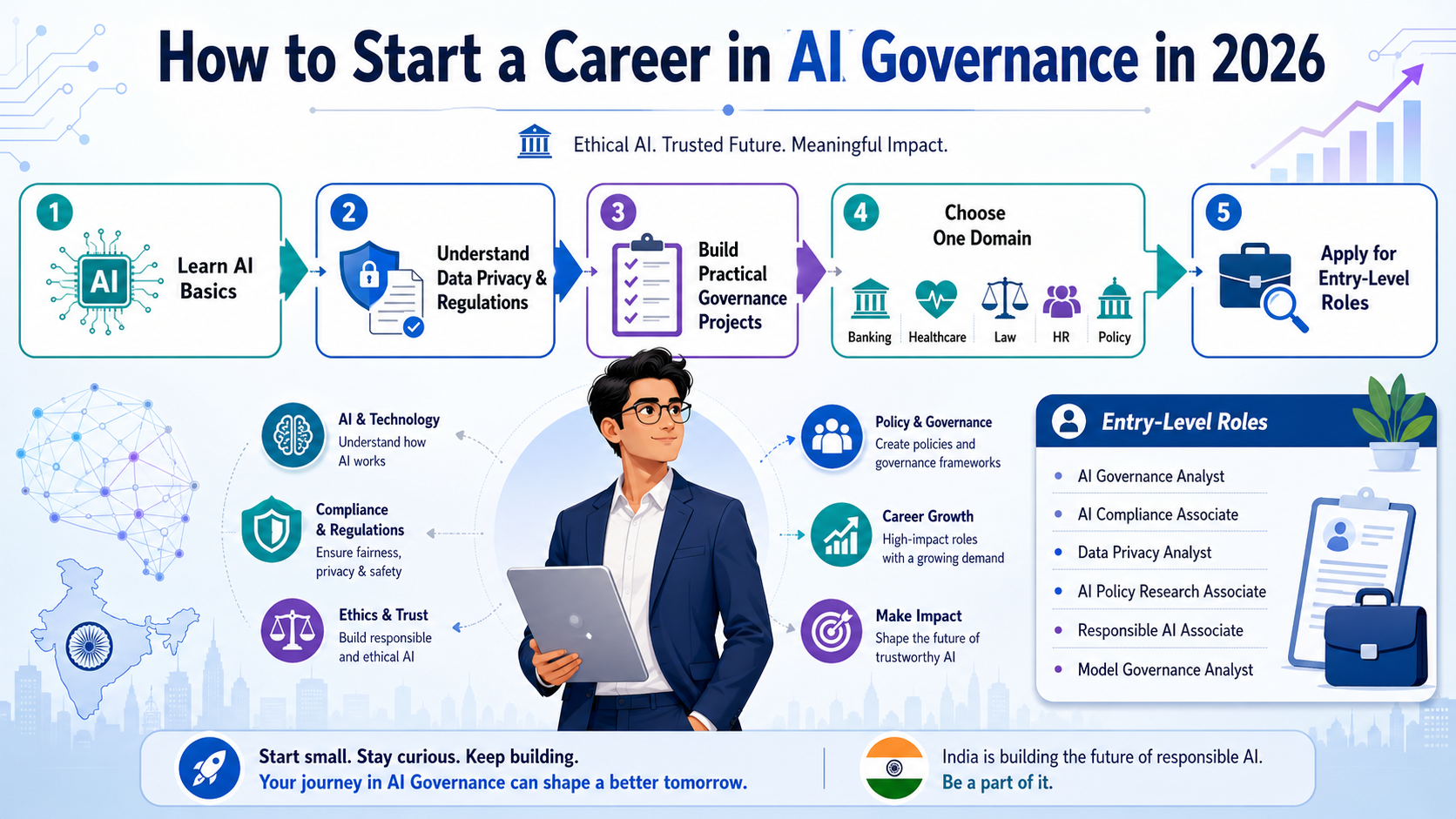
Step 1: Learn the Basics of AI
Begin with the fundamentals of artificial intelligence and machine learning. You should understand how AI models work, how they are trained, what data they use, and why they sometimes make mistakes.
Focus on basic concepts such as:
- Machine learning
- Generative AI
- Training data
- Bias in algorithms
- Model accuracy
- Model explainability
- AI hallucination
- Human oversight
You do not need to go too deep into coding in the beginning. Your first goal should be to understand how AI systems make decisions and where risks can appear.
Step 2: Understand Data Privacy and AI Regulations
AI governance is closely linked to data protection and compliance. Since AI systems use large amounts of data, professionals in this field must understand how personal data should be collected, stored, processed, and protected.
You should learn about:
- Digital Personal Data Protection Act
- Consent and data usage
- Data security
- AI risk management
- Responsible AI principles
- Global AI governance frameworks
- Sector-specific rules in banking, healthcare, insurance, and fintech
This knowledge is especially useful for people who want to work in AI compliance, AI audit, model risk, or data privacy roles.
Step 3: Build Practical Governance Projects
To stand out in this field, create sample projects that show your understanding of AI governance. These projects do not need to be very technical, but they should look practical and industry-relevant.
You can create:
- An AI risk assessment report for a chatbot
- A bias audit checklist for a hiring tool
- A privacy impact assessment for an AI app
- A responsible AI policy for a company
- A model governance checklist for a fintech firm
- A case study on AI use in banking, healthcare, or education
These projects can be added to your resume or LinkedIn profile to show that you understand real-world AI governance problems.
Step 4: Choose One Domain
AI governance becomes more valuable when you combine it with domain knowledge. Instead of trying to learn everything, choose one industry where you want to build expertise.
For example:
| Domain | Suitable AI Governance Career Path |
| Banking and Fintech | Model risk, AI audit, fraud detection governance |
| Law and Compliance | AI compliance, data privacy, policy advisory |
| Healthcare | Responsible AI, patient data protection, clinical AI safety |
| HR Tech | Bias testing, recruitment AI governance, fairness audits |
| Public Policy | AI regulation, policy research, digital governance |
| Cybersecurity | AI safety, threat detection, data protection |
Choosing a domain helps you build a clearer career direction and makes your profile more attractive to employers.
Step 5: Apply for Entry-Level Roles
Once you have basic AI knowledge, regulatory understanding, and a few practical projects, start applying for beginner-friendly roles.
Some suitable job titles include:
- AI Governance Analyst
- AI Compliance Associate
- Data Privacy Analyst
- AI Policy Research Associate
- Responsible AI Associate
- Model Governance Analyst
- Risk and Compliance Analyst
- AI Audit Associate
Freshers can also enter through related roles such as business analyst, compliance analyst, policy researcher, data analyst, or risk analyst, and then gradually move toward AI governance.
Conclusion
AI governance is becoming one of the most promising career paths in India’s AI economy. As more companies adopt AI, they will need professionals who can make sure these systems are fair, safe, transparent, explainable, and legally compliant.
For students and working professionals, this field offers a strong opportunity because it combines technology with law, policy, ethics, business, and risk management. It is especially useful for people who want to work in the AI industry but do not want a purely coding-based role.
In 2026, companies will not only ask who can build AI systems. They will also ask who can govern them responsibly. That is where AI governance professionals will become increasingly important.