Green jobs are no longer limited to environmental activists, researchers, or people working in conservation. In India, they are slowly becoming part of mainstream career choices across energy, transport, finance, construction, manufacturing, agriculture, consulting, and technology. As companies, governments, and consumers become more serious about climate change, clean energy, pollution control, and responsible business practices, the demand for professionals who understand sustainability is also increasing.
For students and working professionals, this shift creates a new career opportunity. A green job can mean working as a solar technician, EV engineer, ESG analyst, sustainability consultant, waste management specialist, climate finance professional, or environmental data analyst. These roles may look very different from each other, but they are connected by one common goal: helping businesses and economies grow in a cleaner, more resource-efficient, and more sustainable way.
In India, the green jobs market is especially important because the country is balancing two major goals at the same time. On one hand, India needs rapid economic growth, more infrastructure, better industries, and more employment opportunities. On the other hand, it also needs cleaner air, better waste systems, energy security, climate-resilient cities, and lower dependence on fossil fuels. This is where green careers become important. They are not just about protecting the environment; they are also about building the future of work.
What are Green Jobs?
Green jobs are jobs that help protect the environment, reduce pollution, save energy, or support a more sustainable economy. These jobs may directly involve the environment, such as working in solar energy or waste management, or they may support businesses in becoming more climate-friendly, such as ESG reporting, carbon accounting, or sustainable supply chain management.
In simple words, a green job is any job that helps reduce the negative impact of human activity on the planet. For example, a solar panel installer helps people and businesses use clean energy. An EV technician supports the shift from petrol and diesel vehicles to electric mobility. An ESG analyst helps companies measure their environmental and social performance. A waste management professional helps cities and companies recycle more and reduce landfill waste. Green jobs are also not limited to one type of qualification. Some roles require engineering or technical training, while others need knowledge of finance, policy, data, business, or communication. This is why the green job market is becoming attractive for students from different educational backgrounds.
A useful way to understand green jobs is through the table below:
| Green Job Area | What It Means | Example Roles |
| Renewable Energy | Jobs that support clean power generation | Solar technician, wind energy engineer, renewable energy project manager |
| Electric Vehicles | Jobs linked to EV manufacturing, battery systems, and charging networks | EV technician, battery engineer, charging infrastructure planner |
| ESG and Sustainability | Jobs that help companies track and improve their environmental and social impact | ESG analyst, sustainability consultant, ESG reporting executive |
| Waste Management | Jobs that reduce waste and improve recycling systems | Waste management officer, circular economy specialist |
| Green Buildings | Jobs that make buildings more energy-efficient and sustainable | Green building consultant, energy auditor |
| Climate Finance | Jobs that connect finance with climate-friendly projects | Climate finance analyst, carbon market specialist |
| Environmental Data | Jobs that use data to track pollution, emissions, energy use, or climate risks | Environmental data analyst, climate risk analyst |
This makes green jobs a broad career category rather than a single profession. The right path depends on your education, interests, and the kind of work you want to do. For someone who likes machines and fieldwork, renewable energy or EV roles may be suitable. For someone who enjoys research, data, and business reporting, ESG, climate finance, or environmental analytics may be a better fit.
Top Green Sectors Hiring in India in 2026
Green jobs in India are growing across many sectors, but some areas are likely to offer stronger opportunities in 2026 because they are linked to policy support, private investment, new technology, and rising business demand. These sectors are not only creating technical jobs, but also roles in project management, finance, research, sales, consulting, compliance, and data analysis.
| Green Sector | Why It Is Growing | Common Career Options |
| Renewable Energy | India is expanding solar, wind, and hybrid energy projects to reduce dependence on fossil fuels | Solar technician, renewable energy engineer, project manager |
| Electric Vehicles | EV adoption is increasing in two-wheelers, three-wheelers, buses, and commercial fleets | EV technician, battery specialist, charging infrastructure executive |
| Green Hydrogen | India is trying to build a green hydrogen ecosystem for industries such as steel, fertilisers, and transport | Hydrogen project analyst, process engineer, energy policy researcher |
| ESG and Sustainability Consulting | Companies need to measure emissions, improve sustainability performance, and prepare ESG reports | ESG analyst, sustainability consultant, carbon accounting executive |
| Green Buildings | Offices, malls, housing projects, and public infrastructure are focusing more on energy efficiency | Green building consultant, energy auditor, sustainable design associate |
| Waste Management and Circular Economy | Cities and companies are under pressure to reduce waste, recycle materials, and manage resources better | Waste management specialist, recycling operations manager |
| Climate Finance | Banks, investors, and development institutions are funding climate-friendly projects | Climate finance analyst, sustainable investment associate |
| Climate Tech Startups | Startups are solving problems in energy, agriculture, water, mobility, and carbon tracking | Product analyst, climate data analyst, operations manager |
Among these, renewable energy and electric vehicles are expected to remain two of the most visible green career sectors in India. Solar parks, rooftop solar, wind energy, storage systems, EV batteries, charging stations, and clean mobility solutions are creating demand for both skilled technicians and specialized professionals.
At the same time, ESG and sustainability roles are becoming important for non-engineering students. Companies are increasingly expected to track their carbon emissions, energy use, waste generation, labour practices, and supply chain impact. This has created demand for people who can understand business, data, sustainability frameworks, and reporting standards. Climate finance is another promising area. As India needs large investments for clean energy, resilient infrastructure, and low-carbon industries, financial institutions will need professionals who can evaluate green projects, assess risks, and understand sustainable investment opportunities.
So, green jobs in 2026 should not be seen as one narrow career path. They are spread across India’s energy transition, manufacturing shift, urban development, financial system, and startup ecosystem. This means students and professionals can enter the green economy from different backgrounds, depending on their skills and interests.
Top Green Jobs in India in 2026
The green job market in India is not limited to one type of role. Some jobs are technical and require engineering, ITI, diploma, or science backgrounds. Others are more suitable for commerce, economics, management, finance, public policy, architecture, or data analytics students. This makes green careers flexible and accessible for different kinds of learners.
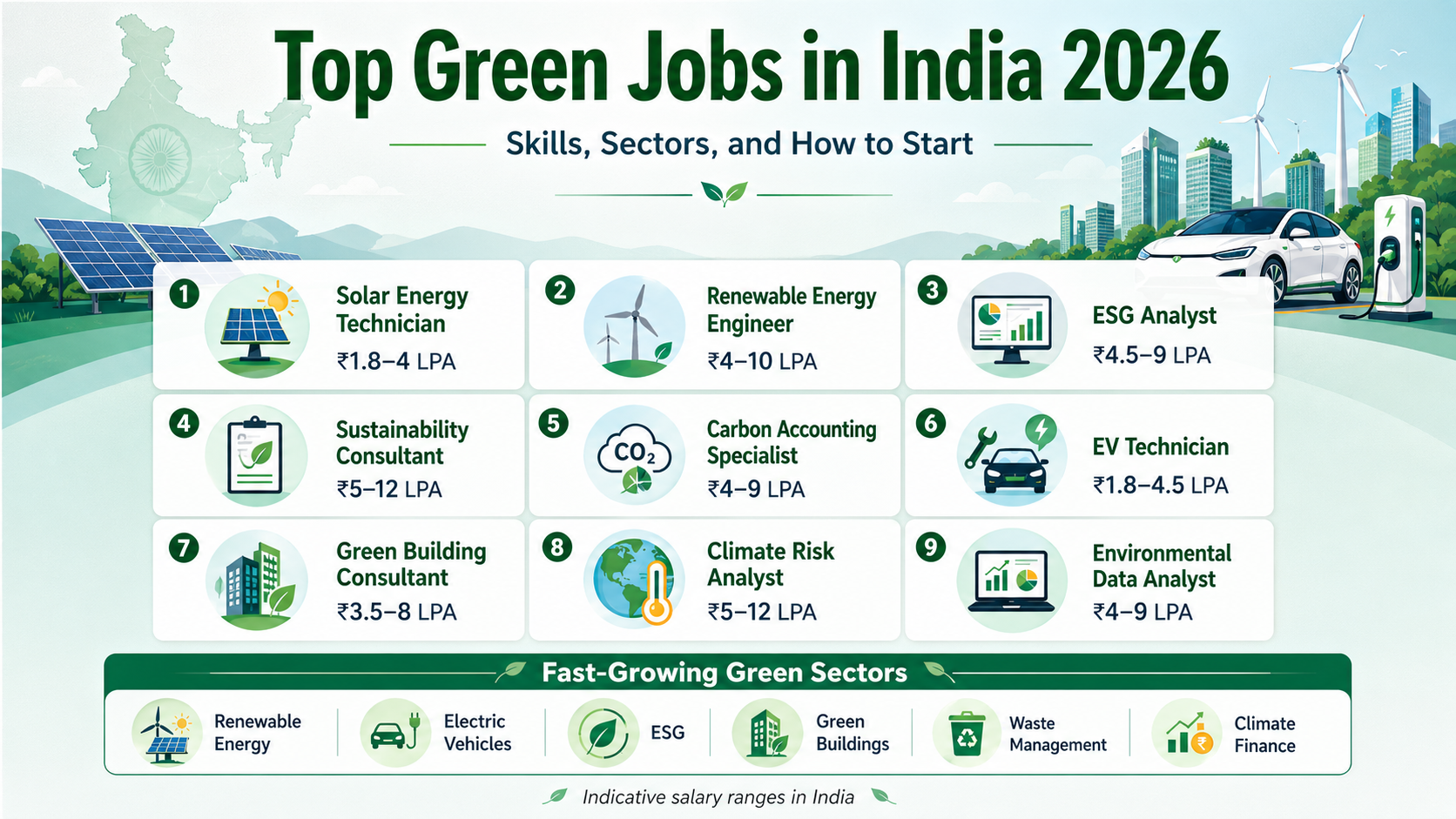
Here are some of the top green jobs to watch in India in 2026:
| Green Job Role | What You Will Do | Who Can Apply | Estimated Salary Range in India |
| Solar Energy Technician | Install, repair, and maintain solar panels and rooftop solar systems | ITI, diploma holders, engineering students | ₹1.8–4 LPA |
| Renewable Energy Engineer | Work on solar, wind, battery storage, and grid-connected clean energy projects | Electrical, mechanical, energy engineering graduates | ₹4–10 LPA |
| ESG Analyst | Track company performance on environment, social, and governance indicators | Management, environment, economics, and public policy graduates | ₹4.5–9 LPA |
| Sustainability Consultant | Help companies reduce emissions, improve resource use, and prepare sustainability strategies | Management, environment, economics, public policy graduates | ₹5–12 LPA |
| Carbon Accounting Specialist | Measure greenhouse gas emissions and prepare carbon footprint reports | Finance, data, sustainability, and science backgrounds | ₹4–9 LPA |
| EV Technician | Work on electric vehicle maintenance, battery systems, and charging infrastructure | ITI, diploma, automobile and electrical students | ₹1.8–4.5 LPA |
| Battery Management Specialist | Support battery testing, safety, charging, performance, and recycling systems | Electrical, electronics, mechanical engineering students | ₹4–10 LPA |
| Green Building Consultant | Help design buildings that use less energy, water, and materials | Civil engineering, architecture, urban planning students | ₹3.5–8 LPA |
| Energy Auditor | Study how much energy a building or factory uses and suggest ways to reduce wastage | Engineering, energy management, technical backgrounds | ₹3–8 LPA |
| Waste Management Specialist | Design systems for recycling, composting, waste segregation, and landfill reduction | Environment, urban studies, operations, public policy graduates | ₹3–7 LPA |
| Climate Risk Analyst | Study how climate change can affect businesses, banks, cities, and infrastructure | Economics, finance, data analytics, policy backgrounds | ₹5–12 LPA |
| Environmental Data Analyst | Use data to track pollution, emissions, resource use, weather risks, or sustainability performance | Statistics, data science, economics, environmental science students | ₹4–9 LPA |
One of the most popular career options in this space is ESG analysis. Many companies now need professionals who can prepare sustainability reports, collect emissions data, understand ESG frameworks, and communicate performance to investors or regulators. This makes ESG a good option for students from commerce, economics, finance, management, or public policy backgrounds.
- For technical students, renewable energy, EVs, battery technology, and energy auditing are strong options. These roles are likely to grow as India expands clean energy projects, builds EV infrastructure, and improves energy efficiency in industries and buildings.
- For students who enjoy research and numbers, climate risk analysis, environmental data analytics, and carbon accounting can be strong career choices. These jobs require analytical thinking, data handling, and an understanding of how climate issues affect business and policy decisions.
The best part about green jobs is that they are not restricted to one industry. A sustainability professional can work in a consulting firm, manufacturing company, bank, startup, real estate firm, energy company, government project, or international development organisation. This makes green careers both future-oriented and highly cross-sectoral.
Skills Needed for Green Jobs in India
To build a career in green jobs, you do not always need a specialized environmental degree. What matters more is whether you understand the sector, can work with sustainability-related data, and can apply the right technical or business skills to real-world problems. Since green jobs are spread across energy, finance, construction, mobility, consulting, and technology, the skill requirements also differ from one role to another.
A student who wants to enter solar energy or EVs will need more technical skills. A student interested in ESG, climate finance, or sustainability consulting will need stronger analytical, reporting, and business skills. This makes it important to choose your career direction first and then build the right skill set.
| Skill Area | Skills to Learn | Useful For |
| Renewable Energy Skills | Solar PV basics, wind energy systems, battery storage, grid connection, energy efficiency | Solar technician, renewable energy engineer, energy auditor |
| EV and Battery Skills | EV components, battery management systems, charging infrastructure, battery safety, EV maintenance | EV technician, battery specialist, EV project executive |
| ESG and Sustainability Skills | ESG frameworks, sustainability reporting, carbon footprinting, materiality assessment, corporate sustainability strategy | ESG analyst, sustainability consultant, carbon accounting specialist |
| Data and Digital Skills | Excel, Power BI, Python, climate datasets, emissions tracking, dashboard creation | Environmental data analyst, climate risk analyst, ESG data analyst |
| Finance and Policy Skills | Climate finance, carbon markets, green bonds, renewable energy policy, and environmental regulations | Climate finance analyst, policy researcher, sustainability associate |
| Communication Skills | Report writing, presentation skills, stakeholder coordination, research writing | ESG roles, consulting roles, policy roles, project management roles |
- For beginners, Excel and report writing are two of the most useful starting skills. Many green jobs, especially in ESG and sustainability, involve collecting data, cleaning it, preparing tables, tracking indicators, and writing clear reports. If you can combine basic sustainability knowledge with good data handling and communication skills, you can become suitable for entry-level roles faster.
- For technical roles, practical exposure matters a lot. For example, solar and EV jobs often require hands-on understanding of equipment, installation, maintenance, testing, and safety standards. This is why ITI courses, diploma programmes, apprenticeships, and short-term technical certifications can be very useful.
- For non-technical roles, the most important skill is the ability to connect sustainability with business decisions. Companies do not only want people who understand climate change in theory. They need professionals who can answer practical questions: How much energy is the company using? Where are emissions coming from? How can costs be reduced? What should be reported to investors? What risks can climate change create for the business?
So, the best way to prepare for green jobs is to build a combination of three things: sector knowledge, practical skills, and communication ability. This combination will help you stand out whether you are applying for a technical role, an analyst role, or a consulting position.
How to Start a Career in Green Jobs?
Starting a career in green jobs can feel confusing because the field is very broad. One person may enter through solar energy, another through ESG reporting, another through electric vehicles, and someone else through climate finance or data analytics. The best approach is not to try everything at once. Instead, choose one green career track and then build skills, projects, and experience around that track.
Here is a simple step-by-step roadmap for beginners:
| Step | What You Should Do | Example |
| Step 1 | Choose one green career area | Renewable energy, ESG, EVs, green buildings, climate finance, or waste management |
| Step 2 | Learn the basic concepts | Understand solar energy, carbon emissions, ESG reporting, EV batteries, or climate risk |
| Step 3 | Build one small project | Create a carbon footprint report, solar feasibility study, ESG profile, or EV market analysis |
| Step 4 | Learn useful tools | Excel, Power BI, Python, sustainability reporting templates, energy audit tools |
| Step 5 | Apply for internships or entry-level roles | Target startups, consulting firms, renewable energy companies, NGOs, banks, and manufacturing firms |
| Step 6 | Add certifications carefully | Choose courses that give practical assignments, case studies, or tool-based learning |
| Step 7 | Keep building a portfolio | Add reports, dashboards, project summaries, and case studies to your resume or LinkedIn |
- For students from technical backgrounds, the easiest entry points may be solar energy, electric vehicles, battery systems, energy auditing, and green buildings. These areas value practical training, field exposure, and knowledge of equipment, installation, safety, maintenance, and project execution. A diploma, ITI, or engineering background can be useful here, especially when combined with internships or apprenticeships.
- For students from commerce, economics, finance, management, or public policy backgrounds, ESG, sustainability consulting, climate finance, carbon accounting, and climate risk analysis can be better entry points. These roles require strong research, data handling, business understanding, and report-writing skills. Even a simple project, such as preparing an ESG profile of a listed company or calculating the carbon footprint of a small business activity, can help show practical interest.
- Beginners should also avoid depending only on certificates. A certificate can help, but it is stronger when combined with visible work. For example, instead of only writing “completed ESG course” on your resume, you can add a small ESG dashboard, a sustainability report summary, or a carbon emissions calculation project. This shows recruiters that you can apply what you have learned.
The most important thing is to start small but stay consistent. Green careers are still developing in India, which means employers often look for people who are curious, adaptable, and willing to learn. If you can show that you understand the sector and have built even one or two practical projects, you can make your profile much stronger for green job opportunities in 2026.
Green Jobs are Not Just for Environmental Experts
Green jobs in India are no longer a small career category meant only for environmental science students. They are now becoming part of some of the fastest-growing sectors, including renewable energy, electric vehicles, ESG reporting, climate finance, green buildings, waste management, and sustainability consulting. This means students and professionals from many backgrounds can find a place in the green economy.
For engineering and technical students, opportunities are growing in solar energy, wind power, EV maintenance, battery systems, energy auditing, and green building design. For commerce, economics, management, finance, and public policy students, roles in ESG analysis, carbon accounting, climate risk, sustainable finance, and sustainability consulting are becoming more relevant. For data-focused learners, environmental analytics, emissions tracking, climate dashboards, and sustainability reporting can open new career paths.
The most important step is to choose a clear direction and begin building practical skills. A beginner does not need to know everything about climate change or sustainability from day one. Starting with one field, one tool, and one project is enough to move forward. For example, you can begin with an ESG analysis of a company, a basic carbon footprint calculation, a solar feasibility report, or a Power BI dashboard on renewable energy data.
Get certified with the latest certifications