Technology is no longer limited to the IT department. It has become a core part of almost every job, every industry, and every business function. From banking and healthcare to education, retail, manufacturing, consulting, and government services, organisations are using technology to work faster, reduce costs, improve customer experience, and make better decisions. This means that tech skills are no longer useful only for software engineers. They are becoming important for students, fresh graduates, working professionals, managers, entrepreneurs, and even non-technical employees.
The job market in 2026 is expected to be shaped by rapid changes in artificial intelligence, automation, cloud computing, cybersecurity, data analytics, and digital platforms. Many routine tasks are being automated, while new roles are being created around AI tools, data systems, security, product development, and digital transformation. As a result, employers are looking for professionals who can not only use technology but also understand how it can solve real business problems.
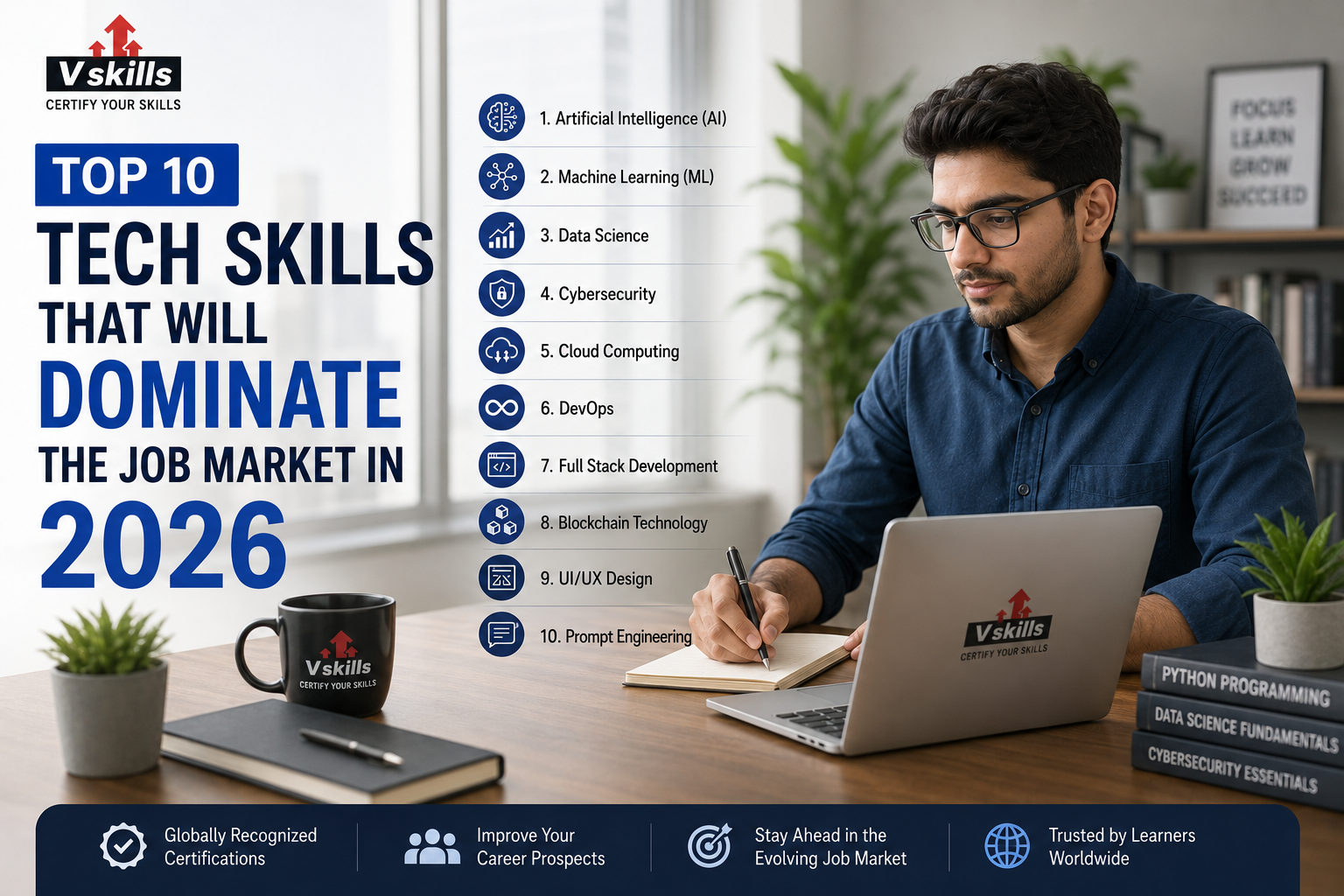
This blog explores the top 10 tech skills that are expected to dominate the job market in 2026. It will help you understand what each skill means, why it matters, where it is used, and who should learn it. Whether you are a beginner planning your career or a working professional looking to upgrade your skills, this guide will help you choose the right direction for the future.
The 2026 Skill Shift: From Pure Coding to Problem-Solving with Technology
For a long time, tech careers were mainly associated with coding. If someone wanted to enter the technology field, the usual advice was to learn programming languages such as Python, Java, JavaScript, or C++. Coding is still an important skill, but the job market in 2026 is moving in a much broader direction. Employers are no longer looking only for people who can write code. They are looking for professionals who can use technology to solve real problems.
This shift is happening because technology itself has become more advanced and more accessible. AI tools can now help with coding, debugging, content creation, data analysis, research, documentation, and automation. Cloud platforms have made it easier for companies to build and scale digital products. Data tools have made business decision-making faster. Cybersecurity tools have become essential for protecting digital systems. As a result, the most valuable professionals are those who can understand these tools and apply them effectively.
In 2026, the strongest tech professionals will not be the ones who only know one programming language. They will be the ones who can connect technical skills with business needs. For example, a data analyst should not only know how to create a dashboard but also understand what the data means for business decisions. A software developer should not only build features but also understand user experience, security, and performance. A cloud professional should not only manage servers but also help companies reduce costs and improve scalability.
This is why problem-solving has become the centre of modern tech careers. Companies want people who can ask the right questions, choose the right tools, and create practical solutions. A professional who understands AI, data, automation, and business workflows can become valuable even without being an expert coder. Similarly, a coder who understands product thinking and customer needs can grow faster than someone who only focuses on technical syntax.
The 2026 skill shift can be understood in this way:
| Earlier Tech Skill Focus | 2026 Tech Skill Focus |
| Learning one programming language | Learning how to solve problems using multiple tools |
| Writing code manually | Using AI-assisted coding and automation |
| Working only on technical tasks | Connecting technology with business outcomes |
| Focusing only on software development | Understanding AI, data, cloud, security, and user experience |
| Building systems in isolation | Building solutions that are scalable, secure, and user-friendly |
This does not mean that coding is becoming useless. In fact, coding is still one of the strongest foundations for a tech career. However, coding alone may not be enough. Professionals who combine coding with AI, data analytics, cloud computing, cybersecurity, or product thinking will have more opportunities.
For beginners, this means they should not feel pressured to learn everything at once. They can start with one core skill, such as data analytics, AI, web development, or cybersecurity, and then slowly add related skills. For working professionals, the focus should be on upgrading existing knowledge with new tools and technologies.
In simple terms, the future of tech jobs will belong to people who are adaptable. The best career strategy for 2026 is not just to learn a tool, but to learn how technology creates value. Professionals who can think critically, learn continuously, and apply tech skills in real workplace situations will have a clear advantage in the changing job market.
Skill 1: Artificial Intelligence and Machine Learning
Artificial Intelligence and Machine Learning will continue to be among the most powerful tech skills in 2026. Almost every major industry is using AI in some form, whether it is for customer service, fraud detection, healthcare diagnosis, product recommendations, financial forecasting, quality control, or business automation. This makes AI and ML highly valuable for learners who want to enter future-ready technology careers.
Artificial Intelligence is the broader field that allows machines to perform tasks that normally require human intelligence. Machine Learning is a part of AI where systems learn from data and improve their performance over time. For example, when a streaming platform recommends shows based on your viewing history or when a bank detects unusual transactions, machine learning is working in the background.
In 2026, companies will need professionals who can build, train, test, and improve AI models. These professionals help businesses make better predictions, automate decisions, and identify patterns that humans may miss. AI is also becoming important in sectors such as manufacturing, logistics, education, agriculture, insurance, and public services.
Some of the most important areas to learn in AI and Machine Learning include:
| Skill Area | Why It Matters |
| Python Programming | Used widely for AI, data science, and automation |
| Machine Learning Algorithms | Helps models make predictions and decisions |
| Statistics and Probability | Builds understanding of data patterns and uncertainty |
| Data Preprocessing | Helps clean and prepare raw data for models |
| Deep Learning | Used for complex tasks like image, speech, and language processing |
| Natural Language Processing | Helps machines understand and work with human language |
| Model Evaluation | Checks whether an AI model is accurate and reliable |
| AI Deployment | Helps put AI models into real business applications |
This skill is especially useful for students and professionals who want to become data scientists, machine learning engineers, AI engineers, research analysts, automation specialists, or business intelligence professionals. It is also useful for people working in finance, healthcare, retail, education, and consulting, where data-based decision-making is becoming more important.
However, AI and ML require consistent learning. Beginners should start with Python, basic statistics, and simple machine learning concepts before moving to advanced areas like neural networks, deep learning, and model deployment. The goal should not be to learn everything at once, but to build a strong foundation step by step.
In simple terms, Artificial Intelligence and Machine Learning will dominate the job market because they help companies become smarter, faster, and more efficient. Professionals who understand how AI works and how to apply it to real problems will have a strong advantage in 2026 and beyond.
Skill 2: Generative AI and Prompt Engineering
Generative AI has quickly become one of the most important tech skills for 2026. Unlike traditional AI, which mostly predicts, classifies, or detects patterns, generative AI can create new content. It can write text, generate images, produce code, summarise documents, create presentations, draft emails, support research, and automate many workplace tasks.
This is why generative AI is no longer limited to technical professionals. It is useful for almost everyone, including marketers, HR professionals, business analysts, teachers, consultants, software developers, content creators, managers, and entrepreneurs. A person who knows how to use generative AI well can save time, improve productivity, and produce better-quality work.
Prompt engineering is one of the most important skills within generative AI. It means giving clear, structured, and specific instructions to AI tools so that they produce better results. A weak prompt may give a generic answer, while a strong prompt can produce a detailed, useful, and professional output. This makes prompt writing a practical skill for the modern workplace.
For example, instead of asking an AI tool to “write a report,” a better prompt would mention the topic, audience, tone, structure, word limit, data points, and expected output. This helps the AI generate a much more relevant answer.
Some important areas to learn in generative AI include:
| Skill Area | Why It Matters |
| Prompt Engineering | Helps generate better and more accurate AI outputs |
| Large Language Models | Builds understanding of tools like ChatGPT and other AI assistants |
| AI Content Creation | Useful for blogs, emails, reports, social media, and presentations |
| AI-Assisted Coding | Helps developers write, debug, and explain code faster |
| RAG Applications | Helps build AI systems that answer from specific documents or databases |
| AI Agents | Supports task automation and multi-step workflows |
| Responsible AI | Helps users check accuracy, bias, privacy, and ethical risks |
| Workflow Automation | Helps connect AI tools with daily business processes |
Generative AI is especially powerful because it can improve both technical and non-technical work. A software developer can use it for coding support. A marketer can use it for campaign ideas. A business analyst can use it for summarising reports. An HR professional can use it for drafting job descriptions. A teacher can use it for creating quizzes and lesson plans.
However, users should not blindly depend on AI-generated outputs. Generative AI can sometimes produce incorrect, biased, or incomplete information. This is why human judgement is still important. Professionals should learn how to verify AI outputs, refine prompts, protect sensitive data, and use AI responsibly.
In simple terms, generative AI and prompt engineering will dominate the job market because they make work faster, smarter, and more creative. In 2026, professionals who know how to use AI tools effectively will have a clear advantage, even if they are not from a technical background.

Skill 3: Data Analytics and Data Visualization
Data analytics will continue to be one of the most important tech skills in 2026 because every organisation today depends on data. Businesses collect data from websites, apps, customers, sales teams, social media, financial systems, and internal operations. However, raw data has limited value unless someone can clean it, analyse it, and convert it into useful insights. This is where data analytics becomes important.
Data analytics is the process of studying data to understand patterns, trends, problems, and opportunities. It helps companies answer important questions such as:
- Which product is selling the most?
- Why are customers leaving?
- Which marketing campaign is performing better?
- Where are costs increasing?
- What will demand look like next month?
- Which business area needs improvement?
In 2026, companies will need professionals who can not only work with data but also explain it clearly. This is why data visualization is equally important. Data visualization means presenting data through charts, dashboards, graphs, and reports so that decision-makers can understand it quickly. A good dashboard can help managers see performance, compare results, identify risks, and take action faster.
Some of the most important tools and skills in data analytics include:
| Skill Area | Why It Matters |
| Excel | Useful for basic analysis, cleaning, formulas, and reporting |
| SQL | Helps extract and manage data from databases |
| Power BI | Used to create dashboards and business reports |
| Tableau | Helps build interactive data visualizations |
| Python | Useful for advanced data analysis and automation |
| Statistics | Helps understand patterns, averages, trends, and relationships |
| Data Cleaning | Makes raw data accurate and usable |
| Storytelling with Data | Helps explain insights in a clear and meaningful way |
Data analytics is useful across almost every industry. In finance, it helps track revenue, costs, risks, and investments. In marketing, it helps understand customer behaviour and campaign performance. In HR, it helps analyse hiring, attrition, employee performance, and workforce planning. In healthcare, it supports patient data analysis and service improvement. In government and policy work, it helps evaluate development indicators and public programmes.
This skill is especially suitable for students, fresh graduates, business analysts, finance professionals, marketing professionals, HR professionals, researchers, consultants, and anyone who wants to work with data but may not want to become a full-time programmer.
The best part about data analytics is that beginners can start with simple tools like Excel and then move to SQL, Power BI, Tableau, and Python. They do not need to learn everything at once. A step-by-step approach can help them build confidence and gradually move towards more advanced analytics roles.
In simple terms, data analytics and data visualization will dominate the job market because businesses need people who can turn numbers into decisions. Professionals who can understand data, create dashboards, and explain insights clearly will remain highly valuable in 2026.
Skill 4: Cybersecurity
Cybersecurity is one of the most critical tech skills for 2026 because digital risks are increasing rapidly. As more companies use online platforms, cloud systems, digital payments, AI tools, and remote work technologies, they also become more exposed to cyber threats. These threats can include hacking, phishing, ransomware, data theft, identity fraud, malware attacks, and system breaches.
Cybersecurity is the practice of protecting computers, networks, applications, data, and digital systems from unauthorised access or damage. It is not only important for large technology companies. Banks, hospitals, schools, government departments, e-commerce firms, startups, and even small businesses need cybersecurity to protect their systems and users.
For example, a bank needs cybersecurity to protect customer accounts and financial transactions. A hospital needs it to protect patient records. An e-commerce company needs it to secure payment information. A company using cloud storage needs it to prevent data leaks. This is why cybersecurity professionals are becoming essential across sectors.
Some important areas to learn in cybersecurity include:
| Skill Area | Why It Matters |
| Network Security | Protects company networks from attacks |
| Ethical Hacking | Helps identify weaknesses before attackers find them |
| Threat Detection | Tracks suspicious activity and possible risks |
| Cloud Security | Protects data and applications stored on cloud platforms |
| Identity and Access Management | Ensures only authorised users can access systems |
| Risk Management | Helps organisations understand and reduce security risks |
| Security Compliance | Ensures companies follow data protection and security rules |
| Incident Response | Helps respond quickly when a cyberattack happens |
Cybersecurity is a good career path for learners who are curious, detail-oriented, and interested in problem-solving. It is suitable for roles such as cybersecurity analyst, security engineer, ethical hacker, penetration tester, cloud security specialist, risk analyst, and information security manager.
Beginners can start by learning the basics of computer networks, operating systems, security concepts, passwords, phishing, and malware. After that, they can move to tools and certifications related to ethical hacking, security operations, cloud security, and risk management.
One important thing to remember is that cybersecurity is not just a technical skill. It also requires awareness, responsibility, and continuous learning. Cyber threats keep changing, so professionals in this field need to stay updated with new attack methods, tools, and security practices.
In simple terms, cybersecurity will dominate the job market because every digital business needs protection. As technology grows, cyber risks will also grow. Professionals who can secure systems, protect data, and reduce digital threats will be in high demand in 2026 and beyond.
Skill 5: Cloud Computing
Cloud computing will remain one of the strongest tech skills in 2026 because most modern businesses now depend on cloud platforms to run their digital operations. Earlier, companies had to maintain their own physical servers, storage systems, and IT infrastructure. Today, many organisations use cloud services to store data, run applications, host websites, deploy AI models, manage databases, and scale their systems quickly.
Cloud computing simply means using computing services such as servers, storage, databases, networking, software, and analytics over the internet. Instead of buying and maintaining expensive hardware, companies can use cloud platforms and pay based on their requirements. This makes cloud computing flexible, cost-effective, and highly useful for businesses of all sizes.
The most popular cloud platforms include Amazon Web Services, Microsoft Azure, and Google Cloud Platform. Many companies use these platforms to build applications, manage customer data, run machine learning models, support remote work, and improve business continuity. This is why professionals who understand cloud systems are in high demand.
Some important areas to learn in cloud computing include:
| Skill Area | Why It Matters |
| Cloud Fundamentals | Helps understand how cloud platforms work |
| AWS, Azure, or Google Cloud | Builds platform-specific cloud skills |
| Cloud Storage | Helps manage and store business data securely |
| Cloud Networking | Connects applications, servers, and users efficiently |
| Serverless Computing | Allows applications to run without managing physical servers |
| Cloud Security | Protects cloud data, accounts, and applications |
| DevOps on Cloud | Helps automate software deployment and system updates |
| Cost Optimisation | Helps companies reduce unnecessary cloud spending |
Cloud computing is useful for many career paths. Software developers need cloud knowledge to deploy applications. Data engineers use cloud platforms to manage large datasets. AI engineers use cloud services to train and deploy models. Cybersecurity professionals work on cloud security. DevOps engineers use cloud tools for automation and infrastructure management.
This skill is especially suitable for learners who want to become cloud engineers, cloud architects, DevOps engineers, site reliability engineers, system administrators, data engineers, or AI deployment specialists. Even business and project managers can benefit from understanding cloud basics because many digital transformation projects depend on cloud infrastructure.
In simple terms, cloud computing will dominate the job market because businesses need scalable, secure, and reliable digital infrastructure. Professionals who can manage cloud systems, deploy applications, protect data, and optimise costs will continue to have strong career opportunities in 2026.
Certification in Cloud Computing
Skill 6: Software Development and Full-Stack Development
Software development will continue to be one of the most important tech skills in 2026 because every digital product needs developers. From mobile apps and websites to business platforms, banking systems, e-commerce portals, learning apps, healthcare tools, and AI-powered products, software is at the centre of the modern economy.
Software development is the process of designing, building, testing, and maintaining applications or systems. Full-stack development goes one step further. It means working on both the front-end and back-end of an application. The front-end is the part users see and interact with, while the back-end handles databases, servers, logic, APIs, and security.
For example, when you use an online shopping app, the product page, search bar, cart, and payment screen are part of the front-end. The system that stores product data, processes payments, checks inventory, and manages user accounts works in the back-end. A full-stack developer understands both sides and can build complete applications.
Some important areas to learn in software and full-stack development include:
| Skill Area | Why It Matters |
| HTML, CSS, and JavaScript | Builds the foundation of web development |
| React or Angular | Helps create modern and interactive front-end applications |
| Node.js, Python, Java, or PHP | Useful for back-end development |
| APIs | Helps different software systems communicate with each other |
| Databases | Stores and manages application data |
| Git and GitHub | Helps track code changes and collaborate with teams |
| Testing and Debugging | Ensures the application works properly |
| Deployment | Helps publish applications on servers or cloud platforms |
Even though AI tools can now help with coding, software development is not becoming less important. In fact, developers who know how to use AI coding assistants may become more productive. AI can help generate code, explain errors, write documentation, and suggest improvements, but human developers are still needed to understand user needs, design logic, test systems, fix complex problems, and build reliable products.
Software development is a good career path for students, fresh graduates, and professionals who enjoy building things. It is suitable for roles such as front-end developer, back-end developer, full-stack developer, mobile app developer, software engineer, web developer, and application developer.
Beginners can start with HTML, CSS, and JavaScript before moving to frameworks like React. After that, they can learn back-end development, databases, APIs, and deployment. A strong portfolio is very important in this field. Learners should build small projects such as a portfolio website, task manager, blog platform, weather app, expense tracker, or e-commerce demo.
In simple terms, software development and full-stack development will remain powerful skills because companies will always need digital products. Professionals who can build useful, secure, and user-friendly applications will continue to have strong opportunities in the job market.
Certification in Web Development
Skill 7: DevOps and Automation
DevOps and automation will be among the most valuable tech skills in 2026 because companies want to build software faster, release updates smoothly, and reduce system failures. In today’s digital world, users expect apps and websites to work all the time. Even a small technical issue can affect customer experience, sales, and brand trust. This is why companies need professionals who can connect software development with IT operations.
DevOps is a combination of development and operations. It focuses on improving the way software is built, tested, deployed, monitored, and maintained. Instead of developers writing code and then handing it over separately to operations teams, DevOps encourages both teams to work together. This helps companies release better software in less time.
Automation is a major part of DevOps. It reduces manual work and helps teams avoid repeated errors. For example, instead of manually testing and deploying every update, DevOps teams can create automated pipelines that test the code, identify errors, and push updates to production in a controlled way.
Some important areas to learn in DevOps and automation include:
| Skill Area | Why It Matters |
| CI/CD Pipelines | Helps automate software testing and deployment |
| Git and GitHub | Supports code collaboration and version control |
| Docker | Helps package applications so they run smoothly anywhere |
| Kubernetes | Manages containerised applications at scale |
| Jenkins or GitHub Actions | Automates development and deployment workflows |
| Infrastructure as Code | Helps manage infrastructure through code |
| Monitoring Tools | Tracks system performance and detects issues |
| Scripting | Automates repetitive tasks using Bash, Python, or PowerShell |
DevOps is useful for companies that release software frequently. E-commerce platforms, fintech companies, SaaS businesses, cloud-based products, mobile apps, and large enterprise systems all need DevOps professionals to keep their systems reliable and scalable.
This skill is especially useful for learners who want to become DevOps engineers, cloud engineers, site reliability engineers, automation engineers, system administrators, or release managers. It is also useful for software developers who want to move beyond coding and understand how applications are deployed and managed in real environments.
Beginners can start by learning Linux basics, Git, cloud fundamentals, and scripting. After that, they can move to Docker, CI/CD tools, Kubernetes, and monitoring systems. Since DevOps connects with cloud computing, cybersecurity, and software development, it is a powerful skill for long-term career growth.
In simple terms, DevOps and automation will dominate the job market because companies want faster, safer, and more reliable software delivery. Professionals who can automate workflows, manage deployments, and keep systems running smoothly will remain highly valuable in 2026.
Skill 8: Data Engineering
Data engineering will be a major tech skill in 2026 because data analytics, artificial intelligence, and machine learning all depend on strong data systems. Before a company can analyse data or train AI models, it needs clean, organised, reliable, and accessible data. Data engineers make this possible.
Data engineering is the process of collecting, storing, cleaning, transforming, and managing large volumes of data. While data analysts focus on finding insights from data, data engineers focus on building the systems and pipelines that make the data usable in the first place.
For example, a retail company may collect data from online sales, customer accounts, payment systems, warehouses, and marketing campaigns. A data engineer helps bring all this data together, clean it, organise it, and store it in a way that analysts, data scientists, and business teams can use.
Some important areas to learn in data engineering include:
| Skill Area | Why It Matters |
| SQL | Helps manage and query structured data |
| Python | Useful for data processing and automation |
| ETL Pipelines | Helps extract, transform, and load data from different sources |
| Data Warehouses | Stores organised business data for analysis |
| Data Lakes | Stores large volumes of raw and semi-structured data |
| Apache Spark | Processes large datasets quickly |
| Cloud Databases | Supports scalable data storage and access |
| Data Governance | Ensures data quality, security, and proper usage |
Data engineering is becoming important because companies are dealing with more data than ever before. Customer behaviour, digital payments, app usage, website traffic, supply chains, sensors, social media, and business operations all generate huge amounts of information. Without data engineers, this information remains scattered and difficult to use.
This skill is especially useful for learners who want to become data engineers, big data engineers, cloud data engineers, analytics engineers, data platform engineers, or AI infrastructure professionals. It is also a strong career path for people who enjoy working with databases, systems, logic, and large-scale problem-solving.
Beginners can start with SQL and Python, then learn databases, ETL concepts, cloud platforms, and data warehousing. After that, they can move to tools like Apache Spark, Airflow, Snowflake, BigQuery, Redshift, or Databricks. Building practical projects is very important in this field, such as creating a data pipeline, cleaning large datasets, or building a small data warehouse.
In simple terms, data engineering will dominate the job market because every AI and analytics system needs strong data foundations. Companies do not just need data; they need usable data. Professionals who can build reliable data pipelines and organise information for decision-making will have strong career opportunities in 2026.
Certifications in Data Science
Skill 9: UI/UX Design and Product Thinking
UI/UX design will be an important tech skill in 2026 because companies are not only competing on technology, but also on user experience. A product may have advanced features, but if users find it confusing, slow, or difficult to use, they may stop using it. This is why businesses need professionals who can design digital products that are simple, useful, attractive, and easy to navigate.
UI stands for User Interface. It focuses on how a digital product looks. This includes colours, buttons, icons, layouts, typography, spacing, menus, and screens. UX stands for User Experience. It focuses on how users feel while using the product. It includes ease of use, speed, accessibility, clarity, and the overall journey of the user.
For example, when you use a food delivery app, the placement of the search bar, the restaurant filters, the cart button, the payment page, and the order tracking screen are all part of UI/UX design. A good design helps users complete their task smoothly. A poor design makes the same task frustrating.
Some important areas to learn in UI/UX design include:
| Skill Area | Why It Matters |
| User Research | Helps understand what users need and where they face problems |
| Wireframing | Helps create the basic structure of a webpage or app screen |
| Prototyping | Helps test how a product will work before full development |
| Figma | Used widely for creating UI designs and prototypes |
| Design Thinking | Helps solve user problems in a structured way |
| Usability Testing | Checks whether users can easily use the product |
| Accessibility | Ensures products can be used by people with different needs |
| Product Thinking | Helps connect design decisions with business goals |
UI/UX design is useful across many industries, including fintech, edtech, healthtech, e-commerce, SaaS, gaming, media, travel, and government platforms. As more services become digital, companies will need designers who can create better websites, apps, dashboards, and software interfaces.
This skill is especially suitable for learners who are creative, observant, and interested in understanding user behaviour. It is a good career path for people who want to become UI designers, UX designers, product designers, UX researchers, interaction designers, or design strategists.
However, UI/UX is not only about making screens look beautiful. A good designer must understand users, business goals, technology limitations, and product functionality. This is where product thinking becomes important. Product thinking means understanding why a feature is needed, who will use it, what problem it solves, and how it creates value for the user and the business.
Beginners can start by learning the basics of design principles, user research, wireframes, and tools like Figma. They should also study real apps and websites to understand what makes a design successful. Building a portfolio with sample app screens, website redesigns, case studies, and user journey maps can help them showcase their skills.
In simple terms, UI/UX design and product thinking will dominate the job market because users expect digital products to be simple, fast, and pleasant to use. Professionals who can combine creativity with problem-solving and user understanding will have strong opportunities in 2026.
Certifications in Digital Media
Skill 10: Tech Literacy, Digital Adaptability, and Responsible AI
The final skill that will dominate the job market in 2026 is not one single tool or programming language. It is the ability to understand technology, adapt to new digital tools, and use them responsibly. This skill is important not only for tech professionals but also for people in non-technical roles.
Tech literacy means having a basic understanding of how modern technologies work. It includes knowing how to use AI tools, cloud-based platforms, data dashboards, digital communication tools, automation software, cybersecurity practices, and online collaboration systems. A tech-literate professional does not need to be an expert in every tool, but they should be comfortable learning and using technology in their work.
Digital adaptability means the ability to adjust when tools, platforms, and job requirements change. In 2026, many workplaces will continue to introduce new AI tools, automation systems, data platforms, and productivity software. Professionals who resist change may find it difficult to keep up. Those who can learn quickly and apply new tools confidently will stay ahead.
Responsible AI is also becoming a very important part of modern tech skills. As more professionals use AI tools for writing, research, coding, hiring, analysis, and decision-making, they must also understand the risks. AI-generated outputs can sometimes be incorrect, biased, incomplete, or misleading. This is why users must verify information, protect confidential data, and use AI ethically.
Some important areas to learn under this skill include:
| Skill Area | Why It Matters |
| Basic AI Literacy | Helps professionals understand what AI can and cannot do |
| Digital Collaboration Tools | Supports remote work, teamwork, and project management |
| Data Privacy Awareness | Helps protect personal and organisational information |
| Cyber Hygiene | Reduces risks such as phishing, weak passwords, and unsafe links |
| Automation Awareness | Helps identify tasks that can be simplified or automated |
| Responsible AI Use | Ensures AI is used ethically, safely, and accurately |
| Continuous Learning | Helps professionals stay updated as technology changes |
| Critical Thinking | Helps evaluate digital outputs instead of blindly accepting them |
This skill is useful for everyone, including students, managers, teachers, HR professionals, marketers, finance professionals, consultants, entrepreneurs, and government employees. Even if someone does not want to become a software developer or data scientist, they still need to understand how technology affects their work.
For example, an HR professional may use AI to draft job descriptions, but they must check for bias. A marketing professional may use AI to create content, but they must verify brand tone and accuracy. A finance professional may use dashboards, but they must understand the data behind them. A manager may use automation tools, but they must know how these tools affect workflows and employees.
In simple terms, tech literacy and digital adaptability will dominate the job market because technology will keep changing. The most successful professionals in 2026 will not be those who know only one tool. They will be those who can keep learning, adapt quickly, use technology responsibly, and combine digital skills with human judgement. This is what will make them future-ready in a fast-changing job market.
Build Skills That Make You Adaptable, Not Just Employable
The job market in 2026 will reward professionals who are ready to learn, adapt, and use technology in practical ways. As AI, automation, cloud computing, data systems, and cybersecurity reshape industries, companies will look for people who can do more than just use tools. They will need professionals who can solve problems, improve workflows, protect systems, analyse data, and create better digital experiences.
The top tech skills for 2026 show that the future of work is not limited to one career path. Artificial intelligence and machine learning will remain important for those who want deep technical careers. Generative AI and prompt engineering will help professionals across industries become more productive and creative. Data analytics, cloud computing, cybersecurity, software development, DevOps, data engineering, UI/UX design, and digital adaptability will also continue to create strong career opportunities.