
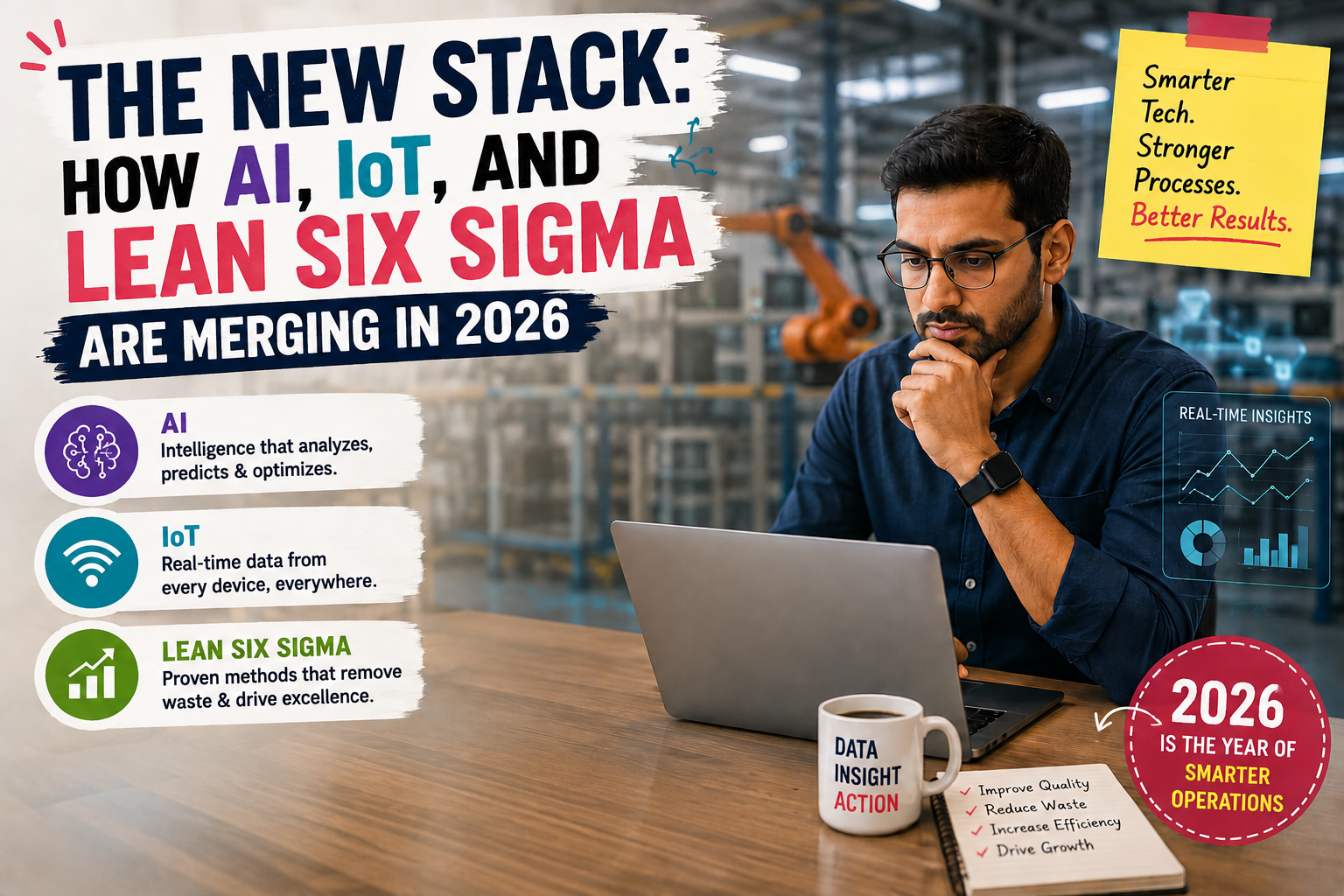
“Six Sigma is dying — AI does all of it now.” You’ve probably seen some version of that headline in the last few months. It’s wrong, and the data proves it: the Lean Six Sigma market isn’t shrinking, it’s nearly doubling by 2032. Everyone’s asking the same nervous question right now: if AI can find the pattern faster than you can, do you still matter? Ask any Black Belt who’s actually working inside a modern, AI-augmented process, and you’ll get the same answer — yes, more than ever. Sensors that predict failure. Digital twins that test ideas overnight. AI that drafts your project charter before you’ve had your coffee. So, welcome to Lean Six Sigma in 2026 — same discipline, entirely new toolkit.
The New Stack: How AI, IoT, and Lean Six Sigma Are Merging
Sensors that predict failure before it happens. Digital twins that run ten thousand experiments overnight. Large language models drafting your project charter. This is what “process improvement” actually looks like in 2026 — and why the belt on your resume matters more, not less.
For most of its forty-year history, Six Sigma ran on a clipboard, a stopwatch, and a control chart drawn by hand — or, more recently, in a Minitab file. That toolkit isn’t gone. But in 2026, it’s being wrapped inside a much bigger system: sensors that log a machine’s vital signs every second, models that flag a defect pattern before a human ever sees it, and digital twins that let a Black Belt test an “Improve” idea ten thousand times before touching the actual production line. This piece walks through exactly how that stack fits together, phase by phase, belt by belt — and why the person underneath it all is doing more work than ever, not less.
It’s worth naming the anxiety directly, because it’s the question behind most of the search traffic this topic generates: if a model can find a pattern faster than a person, does the person still matter? The honest answer, drawn from how organisations are actually deploying these tools rather than how they’re marketed, is that the person matters differently — not less. A model finds correlations. It doesn’t know which ones are worth acting on, what they’ll cost to fix, or what they might break elsewhere in the system. That judgment is still squarely a human skill, and it’s exactly the skill structured Six Sigma training builds.
A quick note before we start
Some of the tooling and case examples referenced here reflect early-stage industry adoption as of 2026 — implementations vary widely by sector and organisation size. This article is an awareness piece, not a vendor recommendation or implementation guide.
From Six Sigma to “Lean Six Sigma 4.0”
Six Sigma was built at Motorola in the mid-1980s around a simple, powerful idea: variation is the enemy of quality, and you can find and remove it with rigorous statistical analysis. Lean, developed separately out of the Toyota Production System, added a second idea — that most of what happens inside a process is waste, and cutting it is often more valuable than perfecting what remains. Merged together as Lean Six Sigma, these two disciplines became the default operating language for quality and efficiency across manufacturing, and later healthcare, financial services, logistics, and IT.
What’s changed is the environment the methodology now operates in. Industry 4.0 — the wave of connected sensors, cloud computing, and machine learning that’s reshaped modern factories and back offices alike — has given Lean Six Sigma access to a volume and speed of data that simply didn’t exist even a decade ago. The result is what a growing number of practitioners now call Lean Six Sigma 4.0: the same core discipline of Define, Measure, Analyze, Improve, Control, but running on top of real-time sensor feeds, predictive models, and simulated environments instead of quarterly audits and static spreadsheets.
The framework hasn’t changed. What changed is how fast you can move through it, and how much of the guesswork it removes.
The market data backs up how quickly this is being absorbed rather than resisted. The global Lean and Six Sigma services market was valued at roughly $6.8 billion in 2024 and is projected to nearly double to $13.25 billion by 2032, growing at a compound annual rate of close to 8.7%. That’s not a methodology in decline — it’s one being actively re-platformed, with organisations across healthcare, financial services, logistics, and technology reporting that pairing Lean Six Sigma with AI and IoT tooling produces faster cycle times and materially higher project returns than either approach alone.
The short version
Six Sigma isn’t being replaced by AI. It’s becoming the guardrail that keeps AI-driven process changes from making a fast decision that’s also a wrong one — the discipline that asks “is this correlation actually causal, and does it hold up under real operating constraints?”
It also helps to be specific about what “4.0” actually means here, because the label gets used loosely. Industry 4.0 broadly refers to the fusion of cyber-physical systems, IoT, AI, big data analytics, and cloud computing into manufacturing and operational environments — the shift from conventional automation, where a machine does a fixed task, to predictive and increasingly autonomous systems that adjust based on real-time conditions. Layering Lean Six Sigma on top of that shift isn’t a rebrand; it’s a genuine methodological evolution, with academic and industry research now treating it as a distinct area of study — how to embed digital technologies into the structured DMAIC cycle without losing the statistical rigor that made Six Sigma effective in the first place.
There’s an emerging Industry 5.0 layer to this conversation too, worth flagging even briefly: a growing body of work argues that human-centric design has to stay part of the equation as automation deepens, not get pushed out by it. A smart factory that optimises purely for machine efficiency while ignoring the people operating alongside it tends to create new failure modes — burnout, skill erosion, brittle systems that break when a human has to intervene unexpectedly. The organisations getting the most value from this convergence tend to be the ones treating AI and IoT as tools that extend a trained team’s judgment, not tools meant to remove judgment from the process entirely.
AI Inside DMAIC: Phase by Phase
DMAIC hasn’t been discarded. Every phase has simply picked up a digital co-pilot.
The most useful way to understand what’s actually changed is to walk through DMAIC’s five phases and look at what a well-equipped team now has access to at each stage that a team five years ago didn’t. Define and Control remain the phases where human judgment, stakeholder alignment, and organisational context still dominate — a model can’t decide what problem is worth solving, or what “acceptable risk” means for a given business. Measure, Analyze, and Improve, by contrast, are where the acceleration is most visible.
| DMAIC Phase | Traditional Approach | 2026 Augmentation |
|---|---|---|
| Define | Manually drafted project charter, stakeholder interviews, Voice of Customer surveys | Large language models help structure the charter and synthesise VOC data faster — but scope and business context still require human sign-off |
| Measure | Manual sampling, periodic data pulls, static baseline charts | IoT sensors stream continuous data; process mining tools reconstruct the “as-is” process automatically from system logs |
| Analyze | Fishbone diagrams, manual hypothesis testing, control charts built by hand | Predictive analytics surface correlations across variables a team might never think to test; statistical tests trigger automatically when variance shifts |
| Improve | Physical pilots on one line, weeks of waiting to see results | Digital twins simulate thousands of variations of a proposed change before a single physical pilot is run |
| Control | Periodic audits, manually maintained control charts | Real-time dashboards and automated alerts flag drift the moment a process exceeds control limits, not weeks later |
It’s worth being direct about the limits here, because a fair amount of 2026 commentary overstates how automatic this has become. AI is genuinely good at finding patterns in large, messy datasets faster than a human ever could — but it has no inherent sense of business context. It doesn’t know that an “efficiency gain” it identified might quietly violate a regulatory requirement, damage a customer relationship, or shift cost from one department to another in a way leadership never approved. That’s precisely the gap Lean Six Sigma’s classic tools — root cause analysis, Voice of the Customer, project scoping — are built to fill. Feeding AI output into a process without that discipline tends to produce a faster version of a poorly scoped project, not a better one.
The trap: treating AI output as automatically correct
A predictive model can flag a correlation with high statistical confidence and still be wrong about causation. Experienced practitioners still validate AI-surfaced insights against domain knowledge before acting on them — the model finds candidates, the human (and the classic Six Sigma toolkit) decides what’s actually worth pursuing.
Two specific tools are worth calling out because they show up repeatedly in how teams describe their day-to-day work now. The first is process mining — software that reconstructs how a process actually runs, step by step, by analysing the digital footprints it leaves in enterprise systems (timestamps, approvals, handoffs) rather than relying on someone’s memory of how it’s “supposed” to work. This tends to surface a version of the Measure phase that’s both faster and more honest than manual process mapping, since it’s built from what actually happened rather than what a process document says should happen. The second is large language models being used to help structure project documentation — turning a scattered set of notes and interview transcripts into a coherent project charter or root-cause narrative. That’s a genuine time-saver in the Define and Analyze phases, but it comes with the same caveat as any AI output: the model can organise information fluently without knowing whether the underlying reasoning is actually sound, which is exactly why a trained reviewer still needs to check its work.
IoT and the New Control Chart
The statistical process control chart — the X-bar and R chart tracking a process’s mean and variation over time — has been Six Sigma’s signature tool since the beginning. What’s changed isn’t the chart itself; it’s where the data feeding it comes from, and how fast it arrives. A traditional SPC setup relied on periodic manual sampling: pull a part off the line every so often, measure it, plot the point. An IoT-instrumented process instead streams continuous sensor data — often three to five sensors per critical parameter — directly into the same chart in near real time.
The payoff of catching that drift early is well documented in industry analysis: manufacturers using predictive, sensor-driven quality control report scrap-rate reductions in the range of 35% to 65% compared with reactive inspection methods, where a defect is only discovered after it’s already been produced. Broader industry surveys on active Six Sigma programmes report average annual savings in the low millions of dollars per facility, with top-performing sites well above that. The mechanism behind both numbers is the same: the earlier a process signals it’s drifting out of control, the cheaper and less disruptive the fix.
| Capability | Reactive (Traditional) | Predictive (IoT-Augmented) |
|---|---|---|
| When a defect is caught | After production, during inspection | Before production, as the process begins to drift |
| Data frequency | Periodic manual sampling | Continuous streaming, often multiple readings per second |
| Root cause visibility | Inferred after the fact from batch records | Traceable to the exact parameter and timestamp that shifted |
| Maintenance model | Scheduled or reactive repair | Predictive maintenance — servicing equipment before failure |
None of this removes the need for a trained practitioner. Someone still has to decide which parameters are worth instrumenting, what an acceptable control limit actually is for a given process, and how to interpret a flagged signal without either ignoring a real problem or chasing statistical noise. The sensors generate the data; Six Sigma training is still what turns that data into a defensible decision.
Predictive maintenance is one of the clearest, most widely adopted expressions of this shift, and it’s worth understanding on its own terms because it reframes what “Control” means. Under a traditional scheduled-maintenance model, equipment gets serviced on a fixed calendar regardless of its actual condition — sometimes too early, wasting resources, and sometimes too late, after a failure has already disrupted production. IoT-fed predictive maintenance instead tracks the actual condition of a machine — vibration patterns, temperature trends, power draw — and flags the point at which its behaviour starts to resemble the early signature of a known failure mode, well before a breakdown. Reported outcomes from this kind of implementation include significantly reduced unplanned downtime and longer effective equipment life, both of which compound directly into the scrap-rate and cost figures cited above.
What’s easy to miss in a purely technical description is how much this changes the day-to-day rhythm of a Control-phase team. Instead of a monthly or quarterly audit cycle, the job becomes closer to continuous monitoring — reviewing flagged anomalies as they arrive, deciding which ones warrant intervention, and periodically retraining or recalibrating the models generating those flags as the underlying process evolves. That’s a genuinely different skill set from the audit-checklist version of Control that most legacy Six Sigma training still describes, and it’s one of the clearer signals that training content needs to keep pace with how the job is actually being done.
Digital Twins: Improve Without Touching the Line
The Improve phase of DMAIC has traditionally been the slowest and riskiest part of the cycle. A team develops a hypothesis for a fix, pilots it on a single line or a limited sample, and then waits — often weeks — to see whether the change actually worked, all while risking disruption to a live process if the pilot goes badly. Digital twin technology is changing that calculus directly. A digital twin is a virtual, continuously updated replica of a physical process, built from the same sensor data feeding the control chart, that lets a team simulate a proposed change before it ever touches the real line.
In practice, this means a Black Belt can run a proposed process change not once, but thousands of times in simulation — varying temperature, speed, staffing, or input quality across a wide range of conditions — and see the projected effect on downstream outcomes before committing resources to a physical pilot. One frequently cited example is a major industrial equipment manufacturer’s use of IoT and predictive analytics to anticipate unplanned equipment downtime, allowing maintenance teams to intervene before a failure occurred rather than after — a direct extension of digital-twin thinking into the Control phase as well as Improve.
Why this doesn’t remove the pilot entirely
A simulation is only as good as the model behind it. Experienced teams still run a smaller, faster physical pilot after simulation to validate that the digital twin’s predictions hold up under real-world conditions the model may not have captured — supplier variability, human factors, and equipment quirks that don’t always show up cleanly in sensor data.
What digital twins genuinely compress is the cost of being wrong. Under the old model, a failed pilot meant weeks of disrupted production and a team back at the whiteboard. Under a digital-twin-augmented model, most of the bad ideas get filtered out in simulation, long before they ever reach a live process — leaving the physical pilot to confirm a much stronger hypothesis rather than test a rough guess.
Digital twins are also starting to extend beyond single processes into entire supply chains — a genuinely newer development worth flagging separately. Rather than modelling one production line, a supply-chain-level digital twin models the interactions between suppliers, logistics routes, inventory buffers, and demand signals as a connected system, letting a team simulate the ripple effects of a single supplier disruption before it actually happens. That capability is closely related to what’s often called prescriptive analytics — going a step beyond predicting what will happen to recommending what to do about it — and it’s an area where causal AI methods, which try to distinguish genuine cause-and-effect from mere correlation, are increasingly being paired with digital twin frameworks to make those recommendations more trustworthy.
For a working practitioner, the practical takeaway isn’t “go build a digital twin” — that’s a significant undertaking requiring real infrastructure investment. It’s that the Improve phase increasingly rewards teams who think in terms of testable, simulate-able hypotheses rather than a single best guess. Even without full digital twin infrastructure, structuring an improvement idea as a set of variables and expected relationships — the same discipline a simulation would require — tends to produce sharper, more defensible pilots than an unstructured trial-and-error approach.
This is a good place to flag a distinction that gets blurred in a lot of vendor material: a digital twin is not the same thing as a dashboard. A dashboard visualises what’s already happened, however recently. A digital twin models what would happen under conditions that haven’t occurred yet — that forward-looking, hypothesis-testing quality is what actually maps onto the Improve phase. An organisation that has invested in impressive real-time dashboards but has no way to simulate a proposed change is still, functionally, running Improve the old way; it just has better data feeding the same slow pilot-and-wait cycle.
Case File: A Supply Chain Under Stress
Abstract capability lists are useful, but a concrete scenario makes the stack easier to picture. One case documented in 2026 industry reporting describes a European automotive supplier whose on-time delivery rates dropped sharply after its supply chain fragmented under geopolitical and logistics pressure — the kind of multi-variable disruption that’s genuinely difficult to diagnose with spreadsheets alone. The team applied an AI-augmented version of DMAIC to rebuild resilience, following roughly this sequence.
The team first identified high-risk suppliers by combining real-time geopolitical and financial data feeds — the kind of continuous external monitoring that would be impractical to do manually at scale. They then quantified the potential impact of various disruption scenarios using Monte Carlo simulation, effectively running thousands of “what if a key supplier fails” scenarios to see which risks actually mattered most. From there, they established alternative routing protocols grounded in historical performance variability rather than guesswork, and reviewed outcomes monthly to keep refining the predictive models as new data came in.
The reported result was a 22% improvement in supply chain resilience and a meaningful reduction in premium freight costs within six months. What’s instructive about the case isn’t the specific numbers — results like this vary enormously by industry, starting point, and execution quality — it’s the sequence. Every step maps directly onto a classic DMAIC structure: define the risk, measure and quantify it, analyze which levers matter, improve through rerouting, and control through a recurring review cycle. The AI didn’t replace that structure; it made each phase run against live data instead of a quarterly snapshot.
It’s also worth noting what this kind of case doesn’t show: a team that skipped the fundamentals and let an algorithm run the supply chain unsupervised. The monthly review cycle in step four is doing quiet but essential work — it’s the human checkpoint that catches a model drifting away from reality as conditions change, the same function a Control-phase audit has always served, just running on a faster and more data-rich cycle than before. Strip that checkpoint out, and what looks like an AI success story quickly becomes a cautionary tale about unmonitored automation instead.
The Belt System Is Being Rewritten
The belt hierarchy — White, Yellow, Green, Black, and Master Black Belt — hasn’t been discarded in this shift. But what each belt is actually expected to do on the job has moved noticeably, especially at the Green and Black Belt levels, where most working professionals sit.
| Belt | Traditional Focus | 2026 Addition |
|---|---|---|
| Yellow Belt | Basic process awareness, supports project teams | Comfort reading dashboard outputs and IoT-fed status indicators |
| Green Belt | Runs smaller improvement projects using core DMAIC tools | Uses process mining to spot bottlenecks and validates that data fed into AI tools is clean and unbiased before trusting its output |
| Black Belt | Leads complex cross-functional projects, mentors Green Belts | Acts as an “AI orchestrator” — leading teams through predictive-model deployment and ensuring AI initiatives stay aligned with organisational strategy |
| Master Black Belt | Sets organisational strategy, trains other belts | Owns the framework for how AI, IoT, and digital-twin tools get standardised across the enterprise, not just one project team |
The throughline across every level is that manual calculation is becoming less central to the job, while judgment about what a model’s output actually means is becoming more central. A Black Belt in 2026 spends less time hand-computing a hypothesis test and more time deciding whether an AI-flagged correlation deserves a full investigation, whether a proposed digital-twin-validated change accounts for real-world constraints the model didn’t capture, and how to keep a distributed, hybrid project team aligned on a shared set of facts rather than competing dashboards.
A note on salary claims circulating online
Some 2026 industry commentary claims a widening salary gap between practitioners fluent in “AI-augmented DMAIC” and those who aren’t, citing figures well above $200,000 for the former. Treat specific numbers like this as directional and highly context-dependent — they vary enormously by industry, region, and seniority — rather than a guaranteed outcome of certification alone.
There’s also a growing recognition that Agile and Lean Six Sigma are converging rather than competing, particularly for Black Belts operating in tech-adjacent or fast-moving business environments. Agile’s short iteration cycles and emphasis on rapid feedback pair naturally with AI-accelerated DMAIC — a sprint-based improvement cadence, informed by continuously updated sensor and model data, rather than the slower quarterly project cycles Six Sigma has traditionally run on. Practitioners describe this hybrid as “Agile Lean Six Sigma,” and it’s increasingly treated as a distinct, in-demand skill set rather than a niche crossover — a useful signal for anyone deciding what to specialise in beyond the belt itself.
Common Myths, Corrected
The rapid pace of AI adoption has produced a lot of noise around what it means for process-improvement careers — some of it useful signal, a fair amount of it clickbait dressed up as forecasting. A few misconceptions come up often enough, across forums, LinkedIn posts, and vendor marketing alike, to be worth addressing directly.
| The Myth | The Reality |
|---|---|
| “AI will replace the need for Six Sigma-trained people entirely.” | Organisations are integrating Six Sigma with AI, not replacing it — the methodology provides the business context and validation discipline that raw AI output lacks. |
| “DMAIC is obsolete now that we have predictive models.” | The five-phase structure still organises the work; what’s changed is the speed and data volume available within each phase, not the phases themselves. |
| “Digital twins remove the need for physical piloting.” | Simulation filters out weak ideas early, but real-world validation still matters — human factors and supplier variability don’t always show up cleanly in sensor data. |
| “Only manufacturing needs this stack — my industry doesn’t use IoT.” | IoT-and-AI-augmented Lean Six Sigma is increasingly used in healthcare, financial services, and logistics, not just factory floors. |
| “A Green Belt doesn’t need to understand AI tooling — that’s a Black Belt’s job.” | Current guidance places Green Belts squarely in the loop — using process mining and validating the data quality that AI models depend on. |
Underneath most of these myths is the same overcorrection: treating a genuinely useful new tool as if it replaces the discipline it’s being added to, rather than as an accelerant for it. That pattern isn’t unique to Six Sigma — it shows up whenever a new technology arrives fast enough to outpace the conversation about how to use it well. The organisations avoiding that trap tend to be the ones that invested in getting their people properly trained on the fundamentals first, then layered the new tools on top with a clear sense of what each one is actually for.
There’s a useful test for separating hype from genuine capability whenever a new “AI does X automatically” claim shows up in a vendor pitch or a conference talk: ask what happens when the underlying data is messy, incomplete, or subtly biased — because in a real production environment, it usually is. A tool that only works cleanly on tidy demo data isn’t ready for a live process; one that’s been built (or is being operated by people trained) to catch and correct for that messiness is a much safer bet. That diagnostic question is itself a very Six Sigma habit of mind — skepticism toward an unvalidated claim of improvement — and it’s exactly the instinct formal training is designed to build.
Which Skills Should You Build Next?
What you should focus on learning next depends heavily on where you currently sit. There’s no single “AI skill” that applies uniformly across a career — a Green Belt just starting out needs something different from a Black Belt already leading cross-functional projects. Here’s a rough map across four common starting points.
Building the foundation the right way
Starting in 2026 doesn’t mean skipping the fundamentals — it means learning them alongside the tools that now sit on top of them.
- Core DMAIC structure and the classic statistical tools — control charts, hypothesis testing, root cause analysis
- Basic data literacy: reading a dashboard, understanding what a control limit actually represents
- Voice of the Customer and project scoping — the skills that keep any AI-assisted project pointed at a real business problem
Becoming the bridge between data and decisions
Green Belts increasingly sit at the intersection of raw process data and the models built on top of it.
- Process mining fundamentals — reconstructing an “as-is” process from system logs rather than manual observation
- How to spot dirty or biased data before it feeds into a predictive model
- Working knowledge of how large language models can help structure a DMAIC narrative, without over-trusting their output
Moving from calculation to orchestration
Black Belts are increasingly evaluated on how well they lead AI-augmented initiatives, not just how well they can run a t-test by hand.
- Enough data science fundamentals to sanity-check the output of automated predictive models
- Change management for hybrid, distributed teams working across cloud-based process-mapping tools
- Digital twin literacy — knowing what a simulation can and can’t tell you before committing to a physical pilot
Adding process discipline to technical skill
Analysts who already understand data pipelines often lack the structured framework that keeps a technically sound insight from becoming a scope-creep project.
- DMAIC as a project structure — turning an interesting correlation into a properly scoped improvement initiative
- Statistical process control fundamentals — the discipline behind separating real signal from noise
- How to translate a model’s output into a business case a non-technical stakeholder will actually approve
Is Your Process AI-Ready?
Tick off what’s actually true for your process or organisation today — a quick directional gauge, not a formal maturity audit. If most of these feel aspirational rather than current, that’s useful information too — it points to exactly where a training investment would do the most good.
AI-readiness self-check
8 questions · updates as you check each box
The Career Case for Certification
It would be easy to read all of this and conclude that AI is doing the hard part now, and that formal Six Sigma training matters less as a result. The evidence points the other way. As more of the raw analytical grind gets automated, the scarce and valuable skill shifts from “can you run the calculation” to “can you tell whether the calculation’s output is actually worth acting on.” That judgment doesn’t come from using an AI tool a few times — it comes from understanding the statistical and process-improvement logic underneath it well enough to know when the model is right, when it’s missing context, and when it’s confidently wrong.
This also explains why job postings for quality, operations, and process-excellence roles increasingly list familiarity with data analytics or automation tooling as a plus, layered on top of — not instead of — a Six Sigma belt. Organisations building out AI-augmented process-improvement programmes need people who can bridge both worlds: fluent enough in the statistical fundamentals to validate a model’s output, and fluent enough in the business context to know which projects are actually worth automating in the first place.
There’s a structural reason this pattern is likely to hold rather than fade. AI tools are, by design, general-purpose — the same predictive model architecture can be pointed at fraud detection, customer churn, or equipment failure with relatively little modification. What makes any of those applications actually valuable inside a specific organisation is the process-improvement discipline that scopes the problem correctly, defines success in terms the business agrees with, and validates that a “win” in the model is a real win on the factory floor or in the call centre. That layer of judgment doesn’t automate away just because the layer beneath it got faster — if anything, it becomes more valuable, because more automated output now needs to be filtered through it.
| Vskills Six Sigma Certifications | Detail |
|---|---|
| Belt levels offered | Yellow Belt, Green Belt, and Black Belt tracks, covering DMAIC fundamentals through advanced project leadership |
| Format | Self-study, online learning via LMS, video and text-based content with a proctored assessment |
| Who it’s designed for | Quality professionals, operations managers, process analysts, and those transitioning into process-improvement roles |
| Validity | Certificate issued on qualifying the assessment, with lifetime access noted for the underlying learning material |
Build the credential the AI-augmented process world now expects
Vskills’ Six Sigma certifications cover the DMAIC framework, statistical fundamentals, and project leadership skills that remain the foundation underneath every AI and IoT tool layered on top — self-paced, online.
Frequently Asked Questions
The bottom line
AI and IoT haven’t replaced Lean Six Sigma — they’ve given it more data, faster feedback loops, and a much shorter distance between a hypothesis and a validated answer. The people who benefit most from that shift are the ones who understand the framework underneath it well enough to tell a genuine improvement from a fast, confident, and wrong one.