What if a factory could have the best machines, skilled workers and plenty of orders—but still fail to deliver on time? A missing component, an overloaded machine, poor scheduling, or a last-minute change in demand can throw an entire production plan off track. And someone has to bring that plan back on course. That someone could be a Production Planning and Control (PPC) professional.
PPC is where manufacturing, data, problem-solving and decision-making come together. From deciding what should be produced and when, to ensuring materials are available and production targets are met, PPC professionals play a crucial role in keeping manufacturing operations moving. And here’s what makes this career interesting: you are not simply planning production—you are solving real business problems every day. As manufacturing becomes more digital, professionals who understand MRP, ERP, production scheduling, inventory, capacity planning and analytics are finding their roles evolving beyond traditional factory planning.
So, is PPC a career worth exploring? What does a PPC professional actually do? How much can you earn? Which skills and tools can help you get hired—and where can this career take you in the long run? Let’s uncover the complete PPC career journey, from your first job to the skills, salary, opportunities and career growth that can take you much further.
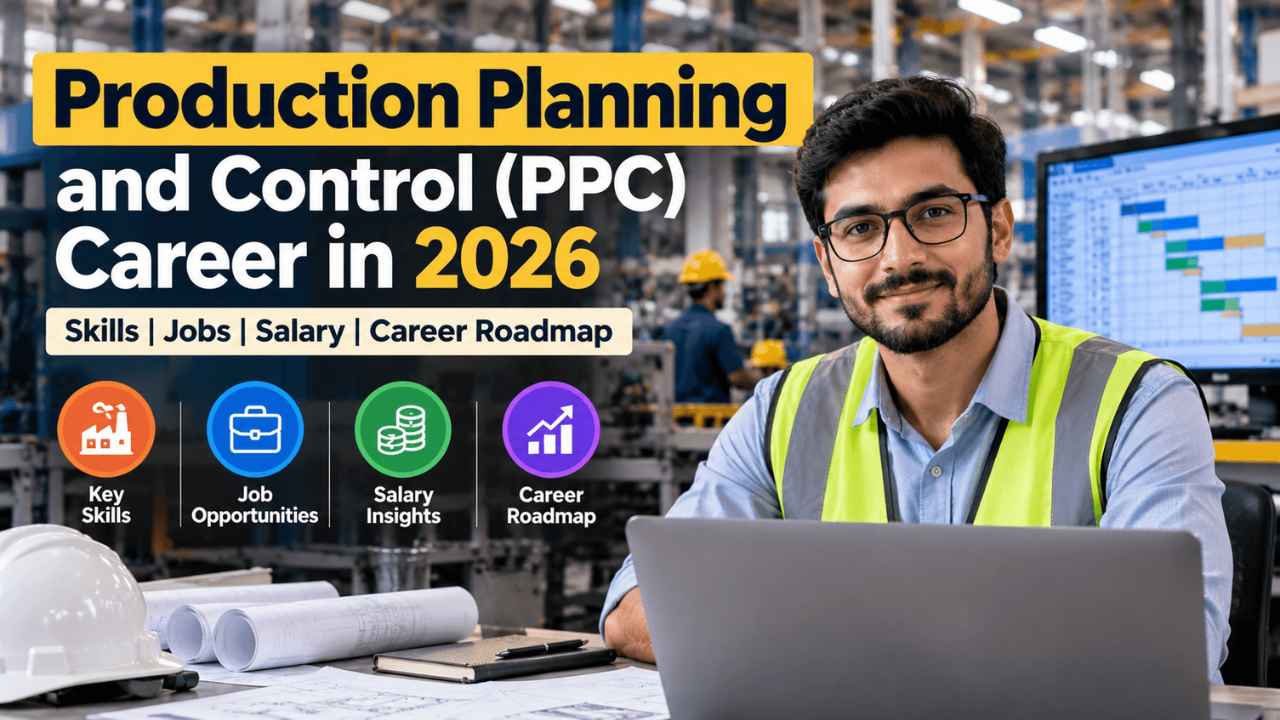
Production Planning and Control Career in 2026: Skills, Jobs, Salary & Career Roadmap
Want to build a career where planning, problem-solving and manufacturing come together? Production Planning and Control (PPC) could be the path you are looking for.
A factory may have excellent machines, skilled people and strong demand—but if the right material is not available at the right time, capacity is poorly scheduled, or production priorities keep changing, everything can slow down. That is where Production Planning and Control becomes critical. PPC connects demand, materials, machines, manpower, schedules and shop-floor execution so production can move toward the required quantity, quality, cost and delivery goals.
For professionals looking at manufacturing, operations, supply chain or planning careers, PPC offers a practical route into a field where your decisions can directly affect productivity and customer delivery. This guide explores what PPC professionals actually do, the skills employers look for, career progression, salary expectations, tools to learn and how to build your journey from beginner to experienced professional.
What is Production Planning and Control?
Production Planning decides what needs to be produced, how much, when, and with which resources. Production Control then helps keep the actual production process aligned with the plan by monitoring progress, resolving bottlenecks and coordinating the release and movement of work.
In practical terms, a PPC professional sits at the intersection of planning, manufacturing, inventory, procurement, quality, maintenance, logistics and customer requirements. The job is not simply to create a schedule. It is to keep that schedule workable when reality changes.
Planning
Translate demand and orders into production plans, priorities and schedules.
Capacity
Balance machines, labour, materials and available production capacity.
Materials
Coordinate material requirements, inventory and supply timing to avoid shortages.
Shop-floor Control
Track production progress and react to delays, bottlenecks and priority changes.
Performance
Use production data and KPIs to identify gaps and improve execution.
Coordination
Keep production, procurement, quality, stores, maintenance and dispatch aligned.
What Does a Production Planning Professional Do?
A PPC role can vary by industry and company size, but the core objective remains the same: keep production flowing while making the best possible use of available resources. A planner may begin the day by reviewing open orders, available materials, machine capacity and yesterday’s production performance, then adjust schedules as conditions change. The role connects procurement, stores, production, quality, maintenance, logistics and customer requirements, so the planner often becomes the link between what the business has promised and what the factory can realistically deliver.
| Area | Typical Work | What You Need to Understand |
|---|---|---|
| Demand & Orders | Review customer orders, forecasts and priorities. | Demand, lead time, order priorities |
| Production Scheduling | Create and update production schedules. | Routing, sequencing, capacity |
| Material Planning | Check material availability and requirements. | MRP, BOM, inventory, lead times |
| Capacity Planning | Compare workload with machine and labour capacity. | Capacity, loading, bottlenecks |
| Shop-floor Monitoring | Track actual output against the plan. | WIP, downtime, output, delays |
| Reporting | Prepare production reports and KPI dashboards. | Excel, ERP, analytics, KPIs |
Skills You Need to Build a Career in PPC
The strongest PPC professionals combine manufacturing knowledge with analytical and coordination skills. Technical knowledge helps you create a workable plan, while analytical thinking helps you identify why the plan is slipping. Communication matters just as much because material shortages, machine downtime, urgent orders and quality issues usually require action from more than one department. Build this skill stack progressively rather than trying to learn every tool at once.
Production Planning
Understand how customer demand becomes a practical production plan. Learn scheduling, routing, sequencing and dispatching, and how priorities change when capacity or delivery dates shift.
CoreManufacturingMRP & Inventory
Learn how BOMs, demand, stock levels and lead times interact. You should be able to identify a material shortage before it becomes a production stoppage.
MRPInventoryExcel & Analytics
Use Excel to compare plan versus actual, identify variances and build useful production reports. Advanced formulas, PivotTables and dashboards can become a strong career advantage.
ExcelDataERP Knowledge
Understand how production orders, BOMs, routings, inventory, MRP and planning data are represented inside ERP systems such as SAP. Focus on the business process, not only screen navigation.
ERPSAPProblem Solving
PPC rarely runs exactly according to plan. Develop a structured approach to shortages, machine downtime, bottlenecks, delayed inputs and sudden priority changes.
AnalyticalDecision-makingCommunication
A good schedule is useful only when everyone understands it. Learn to communicate priorities, risks, shortages and recovery plans clearly across production and support functions.
CoordinationLeadershipWhy PPC Is Becoming More Data-Driven
Modern planning increasingly depends on connected ERP data, inventory information, production status and analytics. Current PPC job listings in India commonly mention combinations of Excel, SAP/ERP, MRP, capacity planning, scheduling, inventory management and shop-floor control. Some roles also ask for reporting, Power BI or automation skills. A planner who can read production data, understand the reason behind a variance and communicate a practical corrective action can contribute far beyond routine schedule preparation.
That creates an opportunity for professionals: start with core manufacturing planning and then add analytics and digital tools to become a stronger planning professional.
Production Planning Career Path: Where Can You Go?
PPC does not have to be a narrow “planner” career. With experience, professionals can move toward production management, operations, supply chain, materials planning, manufacturing excellence or ERP/SAP-focused roles. Someone who enjoys systems and data may move toward SAP or manufacturing analytics, while someone who enjoys shop-floor execution and team coordination may progress toward production or operations management.
At senior levels, PPC work can expand into capacity planning, inventory optimisation, KPI reviews, cross-functional coordination and continuous improvement. That makes the early years of PPC valuable not only for becoming a better planner, but also for understanding how manufacturing decisions affect the wider supply chain.
| Career Direction | Useful Additional Skills |
|---|---|
| Production Planning | Advanced scheduling, MRP, capacity planning, ERP |
| Production / Operations | Lean, Six Sigma, OEE, people management |
| Supply Chain Planning | Demand planning, inventory, S&OP, procurement |
| SAP PP / ERP | SAP PP, master data, BOM, routing, integration |
| Manufacturing Analytics | Excel, Power BI, SQL, dashboards, automation |
Production Planning and Control Salary in India
Salary varies with experience, industry, location, company, manufacturing complexity and technical skills. Current salary data is an indicator, not a guarantee.
Recent salary submissions show significant variation by experience and location. Glassdoor’s September 2026 data includes recent Production Planner submissions ranging from approximately ₹5 lakh to ₹10 lakh annually among several experienced professionals, with some individual submissions outside that band.
Which Tools Should a PPC Professional Know?
You do not need to master every platform. Build a practical toolkit around the manufacturing environment you want to enter. Start with Excel and core planning concepts, then add ERP/MRP knowledge and a reporting tool. The objective is not to collect software names on your resume; it is to show that you can use production information to make a better planning decision.
Microsoft Excel
Learn formulas, sorting/filtering, PivotTables, lookups, charts, dashboards and automation.
SAP / ERP
Understand BOMs, routings, material requirements, production orders, inventory and planning.
Power BI
Useful for production dashboards, KPI reporting, trend analysis and management visibility.
MRP Concepts
Understand the planning logic behind material requirements, lead times, inventory and production.
Planning Techniques
Learn capacity planning, sequencing, scheduling, aggregate planning and bottleneck management.
Improvement Methods
Lean, Kaizen, 5S, Six Sigma and root-cause analysis can strengthen your operational profile.
How to Start Your PPC Career: 6-Step Roadmap
Learn production systems, process flow, BOM, routing, work centres, capacity, inventory and lead time.
Study production planning, production control, programming, ordering, dispatching, scheduling and performance measurement.
Practise material requirement calculations and understand how demand, stock, lead times and BOMs affect production plans.
Create a simple planning workbook with orders, capacity, material status, schedule, actual output and variance.
Learn SAP PP or another ERP environment and build a simple production KPI dashboard.
Create 2–3 practical projects and explain the decisions behind your schedule, capacity plan, inventory assumptions and KPIs.
What Should a PPC Project Look Like?
Instead of putting only “Production Planning knowledge” on your resume, demonstrate how you would solve a planning problem.
Project 1: Production Schedule
Take sample customer orders and create a weekly production schedule considering capacity and due dates.
Project 2: Material Planning
Create a BOM-based MRP sheet showing gross requirements, available inventory, net requirements and planned orders.
Project 3: KPI Dashboard
Track plan vs actual, schedule adherence, downtime, output, WIP and inventory indicators.
What Jobs Can You Target After Learning PPC?
Depending on your qualification and experience, relevant titles can include:
Entry-Level
Production Planning Executive, PPC Executive, Production Coordinator, Planning Trainee, Production Scheduler.
Mid-Level
Production Planner, Senior Planner, PPC Engineer, Material Planner, Production Control Specialist.
Experienced
PPC Manager, Production Planning Manager, Operations Manager, Supply Chain Planning Manager, SAP PP Consultant.
Current job listings in India show PPC roles across automotive, aerospace, pharmaceuticals, engineering and other manufacturing environments. Common requirements include SAP/ERP, MRP, Excel, capacity planning, inventory, scheduling and shop-floor control.
Is PPC a Good Career Option for You?
PPC can suit professionals who enjoy a combination of numbers, operations, coordination and problem-solving. It is particularly relevant for candidates from engineering, manufacturing, industrial engineering, operations, supply chain and related backgrounds.
You may enjoy PPC if you like asking: Can we meet this delivery date? Do we have enough material? Which machine is becoming the bottleneck? What happens if this order is prioritised? Why did actual production fall below the plan?
Can a PPC Certification Help Your Career?
A certification can help structure your learning and demonstrate focused knowledge, especially when transitioning into the domain or strengthening existing production experience. The important part is to combine certification with practical understanding of planning, control, forecasting, scheduling, MRP, inventory and production systems.
Vskills offers a Certified Production Planning and Control (PPC) Professional certification covering production planning and control, forecasting, Sales and Operations Planning (S&OP), master production planning and scheduling.
For someone starting from scratch, use the certification syllabus as a structured learning framework and reinforce it with Excel/ERP practice and practical planning projects.
Ready to Build Your PPC Career?
Explore the Vskills Production Planning and Control (PPC) Professional certification and start building structured knowledge for a career in production planning and operations.
Explore Vskills PPC CertificationProduction Planning and Control Career FAQs
Career Readiness Checklist