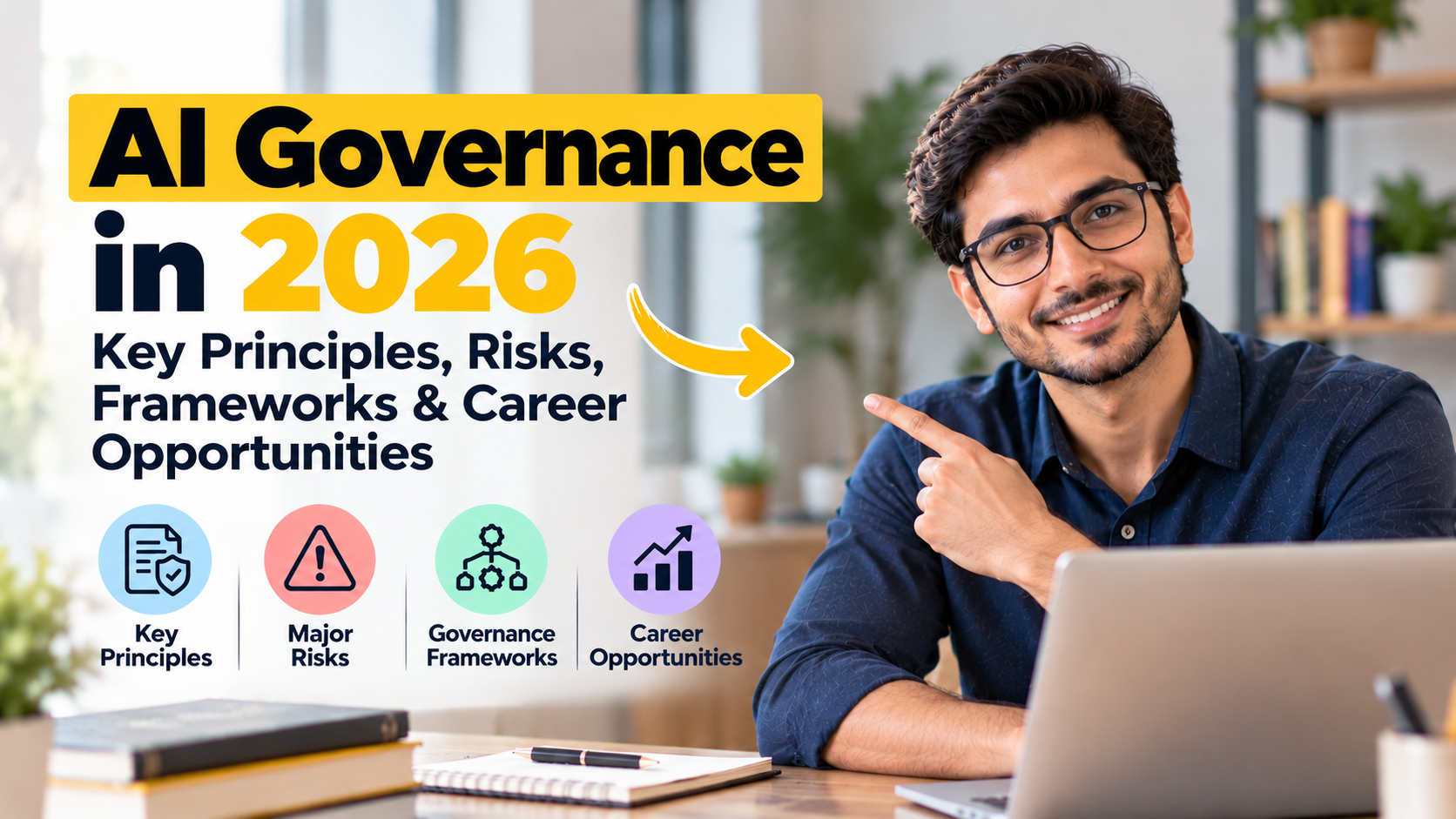
What happens when an AI system makes a wrong decision—and no one knows who is responsible? What if an AI tool exposes sensitive data, produces biased results, gives misleading information to customers, or takes an action that was never intended? As organizations race to adopt AI, these questions are becoming impossible to ignore. AI is no longer sitting quietly inside research labs. It is writing code, screening applications, analyzing data, supporting financial decisions, interacting with customers and increasingly taking actions through AI-powered agents. The bigger AI becomes, the bigger the need for rules, accountability and control. This is where AI governance enters the picture.
But AI governance is much more than creating a policy that says “use AI responsibly.” It brings together AI risk management, data privacy, cybersecurity, transparency, fairness, human oversight, compliance and accountability to answer one critical question: How can organizations use AI confidently without losing control of what it does?
And this is where things get interesting for professionals. As AI adoption accelerates, organizations need people who can understand both AI and governance—people who can identify risks, evaluate AI systems, build policies, assess compliance and help businesses adopt AI responsibly. So, what exactly is AI governance, why is it becoming essential in 2026, which frameworks and principles matter, and what career opportunities are emerging in this space? Let’s explore.
AI Governance in 2026: Why AI Needs Rules Before It Needs More Speed
AI can write, recommend, predict, automate and influence decisions at a scale humans cannot match. But who decides what AI is allowed to do, what data it can use, who checks its output, and who is accountable when something goes wrong?
What Is AI Governance?
AI governance is the system of policies, roles, processes, controls and oversight used to make sure AI is developed and used responsibly, securely, legally and in line with an organization’s objectives.
Think of AI governance as the operating system around AI. The model is only one part of the picture. Governance determines who can approve an AI use case, what information can enter the system, how risk is assessed, what testing is required, how outputs are monitored, when humans must intervene, how incidents are reported and what evidence should be retained.
This becomes especially important when AI moves from experimentation into business-critical workflows. A chatbot answering an internal question and an AI system influencing recruitment, credit, healthcare, customer eligibility or safety decisions do not carry the same consequences. Governance helps organizations distinguish those contexts instead of treating every AI system as if it had the same risk profile.
Why Does AI Governance Matter So Much Now?
AI is no longer confined to specialist data-science teams. It can appear in customer service, software development, marketing, HR, finance, fraud detection, operations, analytics and decision support. Generative AI has also made AI accessible to employees who may not consider themselves AI specialists. That changes the governance problem.
The question is no longer only “Can we build this?” It is increasingly “Should we deploy it, under what conditions, with which controls, and who owns the outcome?”
01. AI Can Scale Mistakes
A human error may affect one decision. An automated system can reproduce the same flawed pattern across thousands of interactions. Governance introduces testing, monitoring and escalation before small problems become systemic.
02. Data Is Part of the Risk
AI systems can depend on training data, prompts, retrieved documents, customer information and third-party datasets. Governance defines what data may be used, for what purpose, with what controls and documentation.
03. AI Decisions Need Accountability
“The model decided” is not an adequate ownership structure. Organizations need responsibilities for business owners, developers, data teams, security, legal, risk and human reviewers.
04. Regulation Is Becoming Operational
Different jurisdictions are developing or applying AI-related rules and guidance. The EU AI Act has a phased application timeline, while NIST and OECD provide widely used risk and governance approaches.
05. Generative AI Changes the Threat Surface
Prompt injection, data leakage, hallucinations, unsafe outputs, model misuse, copyright questions and over-reliance create governance challenges that traditional software controls may not fully address.
06. Trust Is a Business Asset
Customers, employees, regulators and partners may ask how an AI system works, what data it uses and how harmful outcomes are handled. Governance creates evidence and processes to support responsible deployment.
The AI Risk Map: What Exactly Are Organizations Trying to Control?
AI risk is not one single category. A useful governance program looks across technical, operational, legal, human and business dimensions.
| Risk area | What can go wrong? | Typical governance response |
|---|---|---|
| Bias & fairness | Systematically different or inappropriate outcomes for groups of people. | Dataset review, bias testing, impact assessment, human oversight and monitoring. |
| Privacy & data protection | Personal or sensitive information may be exposed, retained or reused improperly. | Data classification, minimization, access controls, privacy review and retention rules. |
| Security | Models and AI applications can be attacked, manipulated or exploited. | Threat modelling, access controls, red teaming, monitoring and incident response. |
| Accuracy & reliability | AI can generate incorrect, incomplete or inconsistent outputs. | Evaluation datasets, thresholds, validation, human review and monitoring. |
| Transparency | Users may not understand that AI is involved or how a significant output was produced. | Disclosure, documentation, explainability and appropriate user communication. |
| Accountability | No clear person or team owns the AI system or consequences. | Defined roles, approval gates, decision records, escalation and audit trails. |
| Third-party AI | Vendors, APIs or foundation models introduce risks outside direct control. | Vendor due diligence, contractual controls, documentation and review. |
| Model drift & change | Data, users, models or business conditions change after deployment. | Change management, periodic reassessment, monitoring and reapproval triggers. |
10 Core Principles of Practical AI Governance
There is no single universal checklist that fits every AI system. These principles provide a practical foundation.
1. Accountability
Assign clear ownership for AI systems, decisions, risks, controls and outcomes.
2. Transparency
Document intended purpose, limitations, important data sources and material changes.
3. Explainability
Where decisions significantly affect people, consider how meaningful explanations can be provided.
4. Fairness
Identify and manage harmful bias and discriminatory outcomes through testing and monitoring.
5. Privacy
Apply privacy and data-protection controls across collection, training, retrieval, inference and storage.
6. Safety & Security
Design controls for foreseeable misuse, attacks, unsafe outputs and unauthorized access.
7. Human Oversight
Define when a human must review, approve, challenge, override or stop an AI-assisted action.
8. Traceability
Maintain enough records to understand how an AI system was designed, evaluated, deployed and changed.
9. Continuous Monitoring
Governance does not end at launch. Monitor performance, incidents, feedback and environmental changes.
10. Proportionality
Controls should reflect the use case and potential impact rather than applying identical controls everywhere.
AI Governance Frameworks You Should Know
Professionals do not need to memorize every framework. They do need to understand what each is designed to accomplish and how it can complement organizational policies and legal requirements.
| Framework / approach | What it brings | Why professionals should know it |
|---|---|---|
| NIST AI RMF | A voluntary risk-management framework organized around Govern, Map, Measure and Manage. | Useful for turning trustworthy-AI concepts into repeatable risk-management activities. |
| EU AI Act | A risk-based legal framework with obligations that apply progressively depending on the system and role in the AI value chain. | Important for organizations operating in or serving the EU and for AI compliance professionals. |
| OECD AI Principles | Values-based principles covering inclusive growth, human rights and fairness, transparency, robustness/security/safety and accountability. | Provides an international reference point for trustworthy and human-centred AI. |
| IndiaAI Responsible AI work | Materials address themes including transparency, explainability, accountability and human oversight. | Relevant for professionals working with AI deployment and governance in India. |
AI Governance in India: Why Professionals Should Pay Attention
India’s AI ecosystem is expanding across enterprises, startups, public services and research. The governance discussion is therefore moving beyond abstract ethics toward practical questions about safety, accountability, transparency, testing, bias, privacy and responsible deployment.
IndiaAI’s responsible-AI materials identify areas such as transparency, explainability and accountability, including organizational structures and policies that clarify responsibility for AI outcomes. The IndiaAI Mission has also supported work around safe and trusted AI, including projects related to bias mitigation, explainability, privacy-enhancing technologies, AI governance testing and algorithm auditing.
For professionals in India, AI governance can sit at the intersection of technology, compliance, risk, cybersecurity, data protection, internal audit and business operations. It is not limited to lawyers or data scientists.
How Can an Organization Build an AI Governance Program?
The biggest mistake is to begin with a giant policy document that nobody uses. A practical program starts by understanding where AI is actually being used and then introduces controls proportionate to the risk.
Step 1: Build an AI inventory
Ask: Where is AI already being used? Include approved tools, employee-selected tools, embedded vendor functionality, machine-learning models, generative AI applications and automated decision systems. Capture owner, purpose, data, vendor/model, users and business process.
Step 2: Create a risk classification
Consider data sensitivity, impact on people, degree of automation, security exposure, business criticality, regulatory context and whether an AI-assisted decision can be reversed.
Step 3: Establish approval gates
Define who can approve experimentation, production deployment, major model changes and high-impact uses. A governance committee may include business, technology, data, security, legal, risk and compliance.
Step 4: Document the AI system
Useful records can include intended purpose, users, limitations, data sources, evaluation results, known risks, human oversight, security controls, vendor information, monitoring metrics, incident history and material changes.
Step 5: Test before and after launch
Testing can include accuracy, robustness, security, bias, privacy, harmful-output testing and adversarial evaluation. After deployment, monitoring should continue because model behavior, data and context can change.
Step 6: Plan for incidents and shutdown
Before an incident, decide who receives an alert, who can pause the system, how affected users are handled, what evidence is preserved, who investigates and what conditions are required for restoration.
AI Governance vs AI Ethics vs AI Risk Management
| Concept | Core question | Typical focus |
|---|---|---|
| AI Ethics | What should responsible AI look like? | Values, human dignity, fairness, autonomy, societal impact and responsible behaviour. |
| AI Risk Management | What could go wrong, and how can we manage it? | Risk identification, assessment, measurement, mitigation and monitoring. |
| AI Governance | Who decides, who is accountable, and what controls operate across the lifecycle? | Policies, roles, approvals, documentation, oversight, compliance, monitoring and escalation. |
A strong organization connects all three. Ethics can shape principles, risk management can operationalize risk decisions, and governance can establish the organizational structure through which those decisions are made and maintained.
Who Works in AI Governance?
AI governance is a multidisciplinary field. Organizations may distribute responsibilities across existing teams or create dedicated roles depending on size, industry and AI maturity.
AI Governance Specialist
Develops policies, governance processes, inventories, assessments, documentation and cross-functional controls.
Responsible AI Professional
Focuses on responsible-AI principles, impact assessments, fairness, transparency and human oversight.
AI Risk Analyst
Identifies AI-related risks, evaluates controls and helps business teams understand potential impacts.
AI Compliance Professional
Maps applicable requirements to organizational processes, evidence, controls and compliance activities.
AI Auditor
Reviews governance arrangements, documentation, controls, testing evidence and operational practices.
AI Policy Professional
Works on policies, standards, regulatory analysis, governance models and organizational guidance.
Skills You Need to Build an AI Governance Career
You do not have to become a machine-learning engineer. What matters is understanding AI well enough to identify where technology, business objectives, people and risk intersect.
AI Fundamentals
Understand machine learning, generative AI, foundation models, embeddings, RAG, agents, evaluation and common limitations.
Risk Management
Learn risk identification, impact assessment, control design, risk registers, residual risk and monitoring.
Data Governance
Build knowledge of data quality, classification, lineage, access, privacy, retention and responsible data use.
Cybersecurity
Understand prompt injection, data leakage, adversarial manipulation, unauthorized access and AI attack surfaces.
Compliance & Policy
Learn how laws, regulations, standards, policies and internal controls translate into operational requirements.
Audit & Documentation
Develop the ability to review evidence, test controls, maintain documentation and communicate findings clearly.
AI Governance Career Roadmap: From Beginner to Specialist
Think of the journey as a combination of AI literacy and governance expertise rather than a single technical skill.
| Stage | What to learn | What to build |
|---|---|---|
| Stage 1 — AI Foundation | AI/ML basics, generative AI, models, data and lifecycle. | A personal AI glossary and simple AI risk map for common business use cases. |
| Stage 2 — Governance Foundation | AI ethics, accountability, transparency, human oversight and risk management. | A sample AI policy, inventory and risk-classification matrix. |
| Stage 3 — Framework Knowledge | NIST AI RMF, OECD principles, applicable regulations and relevant standards. | A framework crosswalk for a chosen AI use case. |
| Stage 4 — Practical Controls | Impact assessments, model documentation, testing, monitoring, vendor governance and incident management. | A governance pack for a fictional chatbot, HR AI or customer-support assistant. |
| Stage 5 — Specialization | Choose AI compliance, AI audit, responsible AI, AI risk, AI security, policy or model governance. | A portfolio of assessments, policies, audit observations and control recommendations. |
A Simple AI Governance Checklist
The Future of AI Governance: What Changes with Agentic AI?
Traditional AI governance often focuses on a model producing an output. Agentic AI can add another layer: systems that plan tasks, call tools, interact with software, retrieve information and take actions based on goals.
That means governance may need to ask: What actions can the agent take? What permissions does it have? Which tools can it call? What requires human approval? How are actions logged? What happens if the agent enters an unexpected loop?
As AI systems become more capable, governance is likely to move further toward continuous controls rather than one-time approval. Identity, permissions, observability, evaluation, action boundaries, human intervention and auditability can become as important as the underlying model.
Why AI Governance Can Become a Strong Career Opportunity
AI governance sits at an unusual intersection. It needs people who can understand technology without losing sight of business impact, compliance without treating it as paperwork, and risk without blocking useful innovation.
That makes the field relevant to professionals from IT, cybersecurity, data governance, compliance, internal audit, legal operations, risk management, project management and business analysis. The most useful professionals can translate between technical teams and decision-makers.
If you already work in one of these areas, AI governance does not necessarily require starting from zero. You can add AI literacy, responsible-AI concepts, AI risk methods, governance frameworks and practical assessment skills to your existing professional foundation.
AI Governance FAQs
What is AI governance in simple words?
AI governance is the set of rules, responsibilities, processes and controls that help an organization develop and use AI responsibly. It answers who owns an AI system, what it is allowed to do, how it is tested and monitored, and what happens when something goes wrong.
Why is AI governance needed?
It helps organizations manage risks involving accuracy, bias, privacy, security, transparency, accountability, compliance and unintended impacts while creating a structured way to scale AI.
Is AI governance only for large companies?
No. The depth should match the organization’s size, AI use cases and risk. Even a small organization can benefit from an AI inventory, acceptable-use policy, risk assessment, vendor review and incident process.
Is NIST AI RMF a law?
NIST AI RMF is a voluntary risk-management framework. Organizations should separately determine which laws and regulations apply to their activities.
What is the EU AI Act?
The EU AI Act is a European Union legal framework for artificial intelligence using a risk-based approach. It entered into force in 2024 and has a phased application timeline.
What skills are required for an AI governance job?
Useful skills include AI fundamentals, risk management, data governance, privacy, cybersecurity, compliance, auditing, documentation, policy analysis and stakeholder communication.
Can someone from a non-technical background enter AI governance?
Yes. Professionals from compliance, audit, risk, legal operations, business analysis and cybersecurity can add AI literacy and governance skills to their existing expertise.
Will AI governance stop innovation?
Governance is not inherently about preventing AI use. A well-designed program can define acceptable uses, set boundaries and create repeatable approval and monitoring processes.
Ready to Build Your AI Governance Skills?
AI governance is becoming a practical business capability—not just a discussion about AI ethics. If you want to build structured knowledge of responsible AI, governance, risk, compliance and the evolving AI ecosystem, focused learning can help you organize your knowledge and demonstrate your skills.
Explore relevant Vskills AI Governance and responsible-AI learning options and build a career-ready foundation for the next phase of AI adoption.
Explore Vskills Certifications© Vskills • AI Governance Knowledge Guide • 2026