Picture two rooms. In the first, a brilliant model sits idle. It can draft a market-entry strategy in ninety seconds, summarize eight thousand pages of regulatory filings before your coffee cools, write working code, generate a financial model, or produce a first-pass performance review. It has no ego, doesn’t get tired, and never storms out of a meeting. It is also, in this moment, doing absolutely nothing because nobody has exercised the leadership to decide what problem is worth solving, whose interests should be weighed, which trade-offs are acceptable, or what “good” actually looks like for this particular organization, in this particular market, this particular week.
In the second room, a manager is trying to tell a talented engineer, gently but clearly, that the project she’s been pouring herself into for six months is being shelved. The manager has to hold three things at once: the business reality, the engineer’s dignity, and the team’s morale, for the eighteen people watching how this gets handled. No model, however capable, is being asked to do this. The org chart says the manager owns it.
This is the actual shape of leadership in 2026 — not a battle between humans and machines, but a widening gap between what AI can execute and what still requires someone to decide, weigh, say out loud, and own. The tools have never been more powerful. And that, counterintuitively, is exactly why the human standing next to the tools has never mattered more.
This isn’t a hopeful platitude offered to soften the anxiety of a disrupted workforce. It’s a pattern showing up consistently in the data. Microsoft’s 2026 Work Trend Index, drawn from a 20,000-person survey of AI-using knowledge workers across ten countries plus trillions of Microsoft 365 productivity signals, found that organizational factors — culture, manager support, and talent practices — account for 67% of the variance in whether AI actually creates value for a company, versus 32% for individual mindset and skill. Read that number again. Two-thirds of whether AI pays off has nothing to do with which model you licensed. It comes down to whether the humans around the tool — starting with the manager — built the conditions for it to matter.
Key factors: Organizational factors (culture, manager support, talent practices) explain 67% of AI's real-world business impact — more than double the 32% explained by individual employee skill and mindset.
This single finding reframes the entire conversation your organization is probably having about AI. If you’ve been asking “which tool should we buy” or “how do we train people to prompt better,” you have been asking a real but secondary question. The primary question is a leadership question: are the people running teams building an environment where AI-augmented judgment can actually flourish — or are they, often without meaning to, building a culture where employees quietly use AI to survive an unchanged system that still rewards the old way of working?
Microsoft has a name for this tension: the Transformation Paradox. In its 2026 research, 65% of AI users say they fear falling behind if they don’t adapt quickly — yet 45% say it still feels safer to focus on familiar goals than to redesign how they work, and a mere 13% say they’re actually rewarded for reinvention when the results aren’t immediate. Only 26% of AI users believe their leadership is clearly and consistently aligned on AI. The tools have arrived faster than the management systems built to make sense of them.
That gap — between what technology enables and what organizations are structurally able to absorb — is not a technology problem. It is, without exaggeration, the defining management challenge of this decade. And closing it requires precisely the capabilities that a spreadsheet-era MBA treated as “soft”: judgment under ambiguity, the ability to build trust, the discipline to hold people accountable while treating them with dignity, and the emotional intelligence to read a room a model will never sit in.
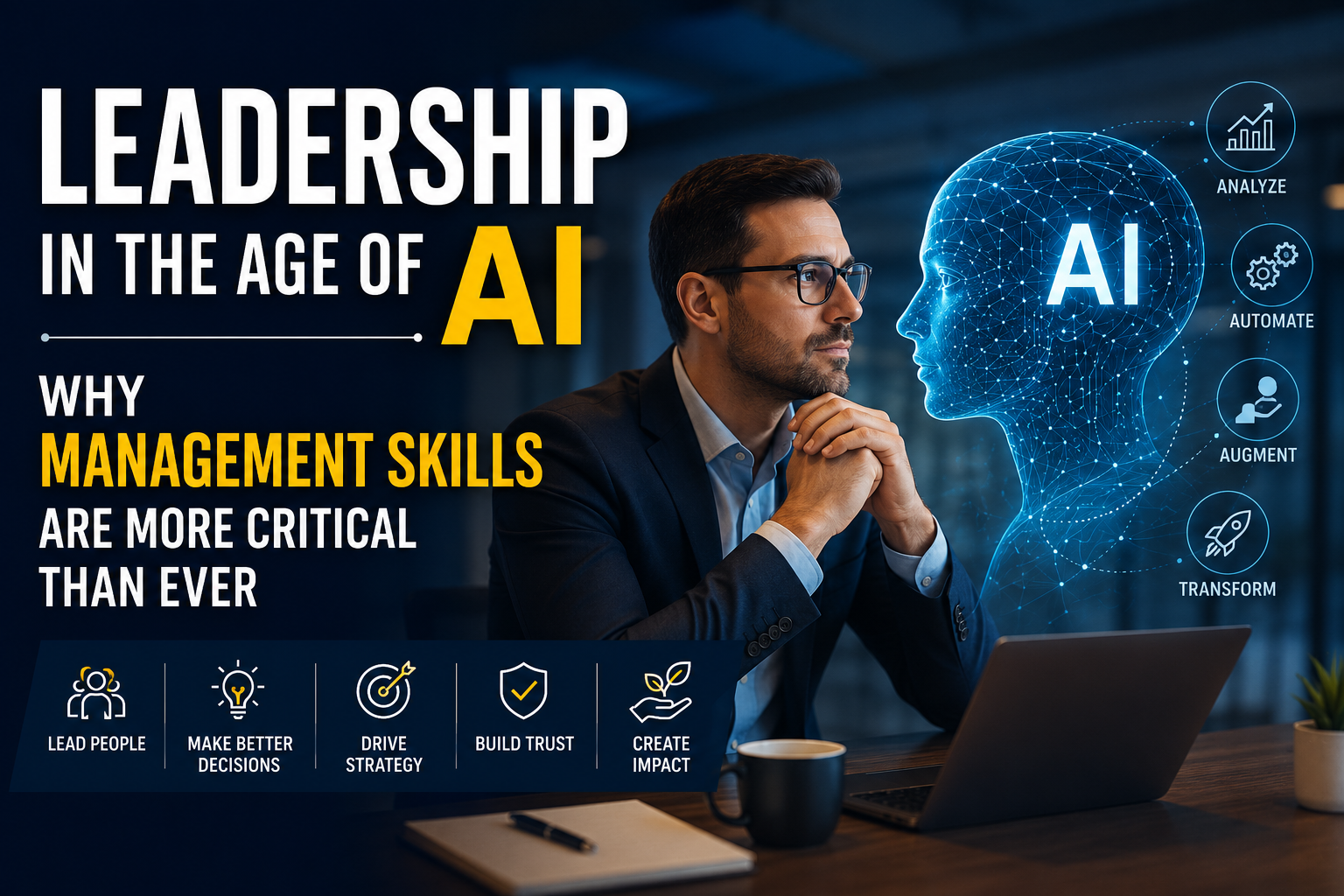
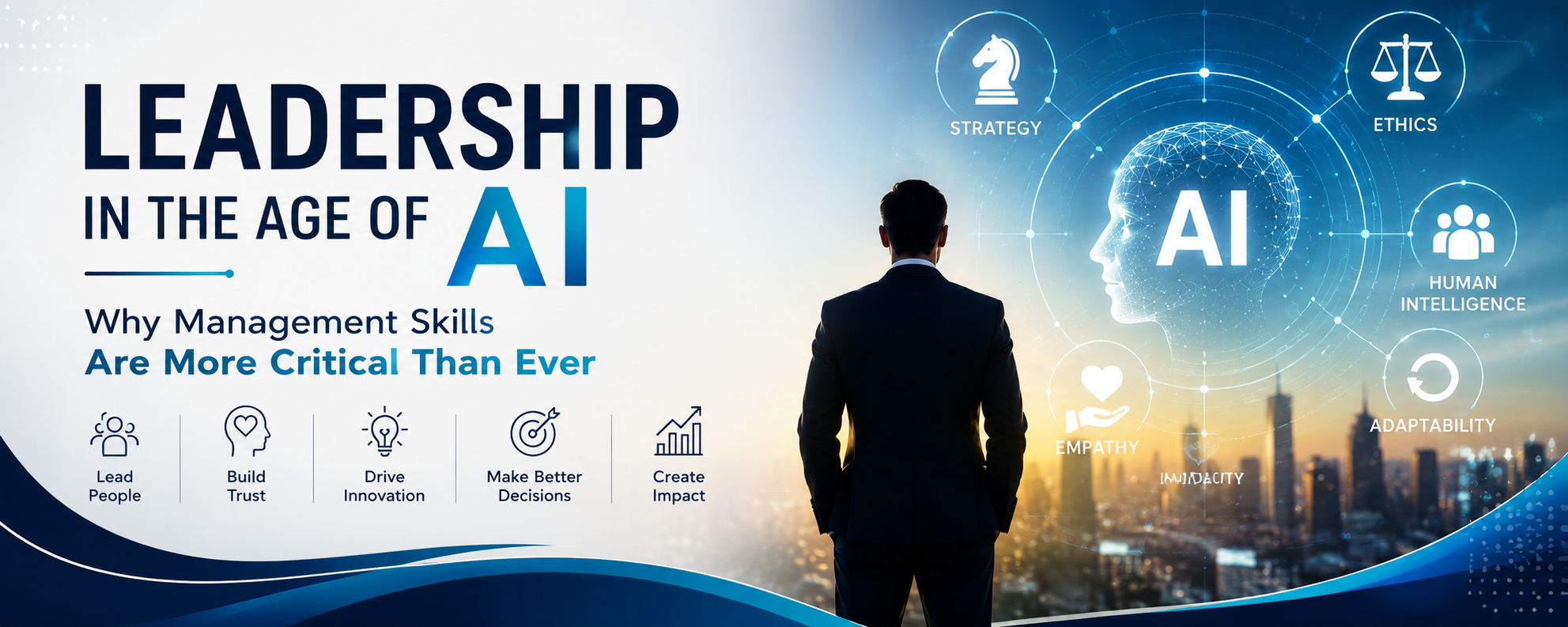
This manuscript is built around a simple, evidence-backed claim: as AI absorbs more of the executional, analytical, and even creative work that used to fill a manager’s calendar, the scarce and valuable leadership skill is no longer “knowing more than your team.” It is judgment, trust, and the ability to get a group of humans (and increasingly, AI agents) rowing in the same direction toward something worth doing. Chapter by chapter, we’ll build out what that means in practice — grounded in research, not hype, and honest about what remains genuinely uncertain.
“AI is expanding human capabilities. As agents take on more execution, employees still need to set direction, evaluate output, apply critical thinking, and own the outcomes.”
Why AI Is Changing the Definition of Leadership?
For most of the last century, a large part of a manager’s authority rested on an information asymmetry: the manager knew things the team didn’t — the budget, the strategy, the political context, the technical playbook accumulated over twenty years. Command-and-control leadership was, in part, a rational response to scarce information sitting concentrated at the top of a hierarchy.
Generative AI dissolves that asymmetry at a pace no prior technology matched. A first-year analyst with a well-configured AI assistant can now produce a competitive analysis that, a decade ago, would have required a director’s institutional memory and a team of three. The World Economic Forum’s Future of Jobs Report 2025 — built from the perspectives of over 1,000 employers representing more than 14 million workers across 55 economies — found that 39% of workers’ core skills are expected to be transformed or become obsolete by 2030, even as employers plan to hire aggressively for new AI-related capabilities.
When information is no longer the scarce resource, leadership must be justified by something else. Three things step into that vacuum, and all three are irreducibly human:
- Direction-setting — deciding which problems are worth an organization’s finite attention, when a firm still has more good ideas than capacity to execute them.
- Judgment under ambiguity — weighing incomplete, sometimes contradictory signals and making a call that a model, optimizing for the most statistically likely answer, is not equipped to own.
- Trust and meaning-making — giving people a reason to bring discretionary effort to work that a machine could, in narrow technical terms, often do faster.
This is not a story about AI being “bad” at leadership-adjacent tasks. Quite the opposite — the WEF’s analysis of more than 2,800 granular occupational skills found that current-generation generative AI shows “very high capacity” to substitute for a human in exactly zero of them, with 69% rated low or very-low substitution capacity. The tools are genuinely useful, not a mirage. But usefulness and judgment are different things, and the WEF’s own employer survey ranks resilience, flexibility and agility, leadership and social influence, and analytical thinking among the fastest-growing skills employers say they need through 2030 — precisely because the technical work is increasingly commoditized.
The Judgment Gap: What AI Does Versus What Leaders Do
| Dimension | What AI Does Well | What Still Requires a Human Leader |
| Information | Synthesizes vast amounts of data in seconds | Decides which information is worth acting on, and why |
| Analysis | Runs scenarios, models, forecasts at scale | Chooses which scenario the organization should bet on, and owns the downside |
| Communication | Drafts clear, grammatically flawless messages | Reads the room, times the message, absorbs the emotional fallout |
| Feedback | Flags performance gaps against a rubric | Delivers hard feedback with enough trust that the person can actually hear it |
| Accountability | Has none — it cannot be fired, sued, or held responsible | Stands behind a decision when it goes wrong |
| Culture | Can describe a healthy culture in detail | Builds and models one, inconsistently, under pressure, over years |

Evolution of Leadership Management: Factory Floor to the Frontier Firm
Management as a formal discipline is barely 120 years old, and it has been rewritten every time the dominant constraint on production changed. Understanding that arc matters, because it shows leadership has adapted to disruptive technology before — just never at this speed.
The Industrial Era: Managing Labor as a Machine Input
Frederick Taylor’s scientific management, formalized in the early 1900s, treated the worker as a component to be optimized: break every task into its smallest motion, time it, standardize it, and remove discretion. It was extraordinarily effective at raising factory output and equally effective at treating judgment as something to be engineered out of a job, not into it.
The Human Relations Era: Discovering the Employee Has a Mind
The Hawthorne studies of the 1920s and ’30s stumbled onto an inconvenient finding for Taylorism: workers who felt observed and cared about performed better, regardless of the physical conditions being manipulated. This cracked open decades of research into motivation, group dynamics, and what would eventually become organizational psychology — the intellectual ancestor of everything we now call emotional intelligence at work.
The Knowledge-Worker Era: Managing Minds, Not Motions
Peter Drucker’s mid-century writing anticipated a workforce whose primary asset was judgment, not muscle, and argued that such workers had to be managed for effectiveness, not merely supervised for compliance. This is the era most of today’s management orthodoxy — goal-setting, delegation, coaching — was built for.
The Digital and Platform Era: Managing at the Speed of Software
The 2000s and 2010s compressed decision cycles, globalized teams, and introduced agile methodology as a direct response to a world moving faster than annual planning cycles could track. Management stopped being primarily about controlling execution and started being about enabling fast, decentralized decisions.
The AI-Augmented Era: Managing Judgment at Scale
We are now in a period where the constraint has shifted again. It is no longer labor, capital, or even information — those are increasingly abundant or automatable. The constraint is organizational absorption: the capacity of a company’s culture, incentives, and management practices to convert AI capability into real value. This is precisely what Microsoft’s research captured in the 67/32 split between organizational and individual factors, and it is why this manuscript treats management skill, not model capability, as the binding constraint on AI’s payoff.
Five Eras of Management and Leadership: A Comparative View
| Era | Core Constraint | Manager’s Primary Job | Dominant Skill |
| Industrial (1900s–1920s) | Physical labor efficiency | Standardize and supervise tasks | Process control |
| Human Relations (1930s–1950s) | Worker motivation | Understand and motivate people | Interpersonal awareness |
| Knowledge-Worker (1960s–1990s) | Access to information & expertise | Set goals, delegate, develop people | Coaching & delegation |
| Digital/Platform (2000s–2010s) | Speed of decision cycles | Enable fast, decentralized decisions | Agility & prioritization |
| AI-Augmented (2020s– ) | Organizational absorption capacity | Build judgment, trust & systems for human-AI teams | Judgment & trust-building |
Reflection Exercise

• Which era's assumptions still quietly run your team's operating rhythm — how you set goals, run meetings, or evaluate performance?
• If you designed your management practices from scratch today, assuming AI handles first-draft execution, what would you keep, and what would you throw out?
Why is Technical Skill alone no longer enough?
There is an incomplete story about AI and careers: learn to prompt well, become “AI-fluent,” and you’re safe. There’s real truth in the fluency premium — PwC’s 2025 Global AI Jobs Barometer found that workers with AI skills command an average wage premium of 56% over those without. The market is pricing AI capability in, clearly and quickly.
But fluency with the tool is table stakes, not a moat, for one structural reason: prompting skill is itself something AI is making easier to acquire and easier to commoditize. The durable premium sits one layer up, in the judgment about what to ask the tool to do, how to evaluate what it hands back, and what to do with the answer. Microsoft’s 2026 data offers a striking window into this: 86% of AI users say they treat AI output as a starting point, not a final answer, and Frontier Professionals — the report’s term for its most sophisticated AI users — are notably more likely than average to pause before starting work to decide which parts should involve AI at all (53% versus 33% of other workers), and more likely to deliberately do some work without AI to keep their own skills sharp (43% versus 30%).
That is not a technical skill. It is a judgment habit — knowing when not to delegate to the machine.
The AI-Era Skills Matrix
The World Economic Forum’s Future of Jobs Report 2025 groups the fastest-rising skills into clusters that are instructive for any leader building a team, or any professional planning a career. The following matrix synthesizes WEF’s findings into a practical view:
| Skill Cluster | Representative Skills | Why It’s Rising | AI’s Role |
| Cognitive | Analytical thinking, creative thinking, systems thinking | Complexity and ambiguity are increasing even as routine analysis is automated | Accelerant — AI extends, doesn’t replace, structured reasoning |
| Self-Efficacy | Resilience, flexibility, agility, curiosity, lifelong learning | Skill half-life is shrinking; the WEF projects 39% of core skills will change by 2030 | Largely untouched by AI — this is a human trait |
| Human-Centric / Management | Leadership and social influence, talent management | As execution automates, the coordination of people becomes the differentiator | AI cannot substitute; it can inform (data) but not decide or inspire |
| Technology | AI and big data, technological literacy, networks & cybersecurity | Baseline fluency is now a hygiene factor, not a differentiator | This is the layer AI itself is compressing and commoditizing |
Myth vs. Fact: Technical Skill and AI-Era Careers
| Myth | Fact |
| “If I master prompting, I’m future-proof.” | Prompting skill is valuable but rapidly commoditizing; WEF and PwC data both point to judgment, leadership, and adaptability as the more durable premium. |
| “Managers who don’t code or can’t build models will fall behind engineers.” | The research shows organizational and managerial factors (67%) outweigh individual technical skill (32%) in determining whether AI creates real value. |
| “AI adoption is primarily a training problem — teach people the tools and results follow.” | Training alone hasn’t produced sustained impact in data; culture, incentives, and manager modeling matter more. |
| “The safest career move is to go as technical as possible.” | WEF’s top-10 fastest-growing skills include leadership and social influence and talent management alongside AI and big data — the two categories rise together, not in competition. |
Self-Assessment: Are You Over-Indexed on Technical Skill?

• In the last month, have you coached someone through a hard decision, or only reviewed their output?
• When your team disagrees with an AI-generated recommendation, do you have a process for surfacing and weighing that disagreement — or does the AI output become the default?
• Could you explain, in one sentence, why your team's current top priority matters more than the other things it could be doing?
• If you scored honestly and found yourself leaning on task execution rather than judgment and direction-setting, that's a signal — not a failure — to invest deliberately in the human-centric skills covered in the chapters ahead.
Emotional Intelligence as a Leadership Superpower
Emotional intelligence has been discussed in management literature since the 1990s, often filed under “nice to have.” The AI era is quietly demoting that framing. When routine analysis, drafting, and even first-pass decision options can be generated by a model, the remaining differentiator in most leadership moments is how well you read people, regulate yourself under pressure, and build enough trust that your team tells you the truth.
This shows up directly in manager-effect research: when managers actively model AI use in front of their teams, employees report a 17-point improvement in perceived AI value, 22 additional points of critical thinking about how they use it, and 30 points more confidence toward agentic AI. And when managers specifically create psychological safety for experimentation — an emotional intelligence competency, not a technical one — employees show up to 20 more points of AI readiness and are 1.4 times more likely to become frequent, sophisticated users of agentic AI.
In other words: the single highest-leverage AI intervention documented in Microsoft’s 2026 research isn’t a tool rollout. It’s a manager behaving in an emotionally intelligent way — visibly, consistently, in front of the team.
A Practical EQ Framework for the AI Era
Original framework — the Four R’s of AI-Era Emotional Intelligence:
- Read — Notice what your team isn’t saying about AI: quiet resentment about job security, exhaustion from constant tool-switching, or excitement they’re not sure is safe to express.
- Regulate — Manage your own anxiety about being “behind” before it leaks into decisions; a leader who is visibly anxious about AI transmits that anxiety to the team.
- Relate — Build the kind of trust where someone will tell you an AI-generated recommendation looks wrong, rather than quietly deferring to it because it sounds confident.
- Reward — Notice and reinforce the behaviors you want repeated: thoughtful AI use, healthy skepticism of outputs, and the courage to redesign a workflow even when the near-term results are uneven.
“Only 13% of AI users say they’re rewarded for reinvention when results aren’t immediate.”
That single statistic is an emotional intelligence failure as much as an incentive-design failure. Reinvention under uncertainty is stressful; if a leader doesn’t actively and visibly reward the discomfort of trying, most people will rationally retreat to the safety of familiar workflows — even while telling themselves and their leaders that they’re “using AI.”

Leading Hybrid Human – AI Teams: Leadership Skills
Most leaders today are, whether they’ve named it or not, already running a hybrid team: a mix of human contributors and AI agents handling research, drafting, first-pass analysis, and increasingly multi-step workflows. IDC projects more than one billion actively deployed AI agents worldwide by 2029 — roughly forty times the 2025 baseline — and Microsoft’s own telemetry shows agent usage growing 15x year-over-year, 18x inside large enterprises. This is not a future scenario to plan for eventually. It is the current operating reality in a growing share of workplaces, and it is accelerating.
Yet the same research is candid about the gap between activity and value. McKinsey’s 2025 State of AI research found that 88% of organizations report regular AI use in at least one business function, but only 39% attribute any actual EBIT impact to it, and just 23% say they’re scaling an agentic AI system anywhere in the enterprise. A BCG study cited alongside this found that more than 85% of employees remain stuck in basic task-assistance and delegation with AI, while fewer than 10% have reached semi-autonomous collaboration or autonomous orchestration. Accenture’s 2026 data adds a leadership-specific version of the same gap: 86% of C-suite leaders plan to increase AI investment, yet only 32% report sustained, enterprise-wide impact, and just 27% of employees say they’re comfortable delegating tasks to AI agents at all.
Put plainly: most organizations have AI activity without AI value, and the missing ingredient — consistently, across McKinsey, BCG, Accenture, and Microsoft’s independent research — is not better technology. It’s a better management of the humans and agents working alongside it.
The Orchestration Ladder: A Maturity Model for Human-AI Teams
An original framework for assessing where a team actually sits, versus where leadership assumes it sits:
| Stage | What It Looks Like | Leader’s Job at This Stage |
| 1. Task Assistance | Individuals use AI ad hoc for drafts, summaries, and research | Model visible use; set quality standards; normalize experimentation |
| 2. Delegated Execution | AI reliably handles defined sub-tasks within a known workflow | Define what “good enough” output looks like; build review habits |
| 3. Semi-Autonomous Collaboration | AI agents handle multi-step processes with human checkpoints | Redesign roles and metrics around judgment, not task completion |
| 4. Autonomous Orchestration | Agents run end-to-end workflows; humans set intent and govern exceptions | Build governance, accountability structures, and escalation trust |
BCG’s finding that fewer than 10% of employees have reached stage 3 or 4 is, read through this ladder, mostly a management diagnosis. Reaching stage 3 requires a leader willing to redesign what “performance” means for their team — evaluating judgment and orchestration rather than volume of tasks completed. Very few organizations have done that redesign work yet, which is exactly why the ladder stalls at stage 1 and 2 almost everywhere.
SWOT: The Manager’s Position in the Hybrid-Team Era
| Opportunities | Threats |
| First-mover advantage in building “Owned Intelligence” — institutional AI know-how that’s hard to replicate | Middle management layers get cut in cost-driven restructurings before their judgment-and-orchestration value is recognized or measured |
Practical Checklist: Is Your Team Actually Ready for Agentic AI?

• Can your team articulate, in writing, which decisions AI is allowed to make unsupervised versus which require human sign-off?
• Do you have a way to capture "this worked / this didn't" from AI-assisted work so the lesson isn't lost the next time someone faces a similar problem?
• Are your performance metrics still measuring task volume, or have they shifted toward judgment, orchestration, and outcome quality?
• Is at least one senior leader visibly using AI tools themselves, in front of the team, including visible failures and corrections?
A Real Example: What This Looks Like Inside an Actual Company
Abstractions are easy to nod along to. Here’s what the theory looks like when a real, massive organization tries to put it into practice.
JPMorgan Chase, the largest bank in the United States by market capitalization, has been unusually aggressive and unusually public about its AI push. CEO Jamie Dimon has compared the technology’s likely long-term impact to “the printing press, the steam engine, electricity, computing and the Internet” — a genuinely sweeping claim from someone not prone to hyperbole about technology trends. The bank built LLM Suite, its own proprietary generative AI platform, and by mid-2026 had rolled it out to more than 200,000 employees, connecting it directly to internal databases so outputs are grounded in the bank’s own data rather than generic web knowledge.
What’s more instructive than the technology itself is what the bank chose to do around it. Rather than simply mandating adoption and measuring usage statistics, JPMorgan’s Chief Analytics Officer Derek Waldron described the training approach as deliberately segmented — different functions, different rollouts, different pacing, because, in his words, training needs vary “just like AI applications” do. The bank also extended AI tools into genuinely high-stakes, high-trust moments: private wealth advisers now use an internal tool nicknamed Coach AI to surface relevant research and market context quickly during periods of market volatility — the exact moments when clients are calling anxiously and advisers need to sound calm and informed, not scrambling.
Notably, even as JPMorgan poured roughly $18 billion into technology investment with AI as a central pillar, the bank’s total headcount didn’t collapse — it actually ticked up slightly year over year, from about 317,000 employees in 2024 to over 318,000 by the end of 2025, even as targeted reductions hit specific technology and operations teams. That’s a more complicated, more human story than either the “AI is destroying jobs” or “AI adoption is painless” narratives suggest, and it’s a useful reminder that real transformations rarely fit cleanly into either headline.
The throughline worth noticing: the technology was the easy part. Segmenting training by actual role, building tools for genuinely high-pressure human moments rather than just back-office efficiency, and being transparent about where the workforce was actually shifting — that’s the management layer doing the hard, unglamorous work that determines whether $18 billion in technology investment turns into something employees trust enough to actually use well.
Everyone’s Already Running a Hybrid Team — Most Just Haven’t Admitted It
Whether you’ve formally named it or not, you are already leading a mixed team of human contributors and AI agents handling research, drafting, and increasingly multi-step, semi-independent work. IDC projects more than one billion actively deployed AI agents worldwide by 2029 — roughly forty times the 2025 baseline, an almost unbelievable growth curve when you say it out loud. Microsoft’s own telemetry shows agent usage growing 15x year-over-year, 18x inside large enterprises specifically. This isn’t a future scenario worth planning for eventually, on some five-year roadmap. It’s the operating reality inside a growing share of workplaces right now, this quarter, and it’s accelerating rather than plateauing.
But the same research is refreshingly, almost bluntly honest about the gap between activity and value — and this is the part most breathless AI coverage conveniently skips. McKinsey’s 2025 State of AI research found 88% of organizations use AI regularly in at least one business function — an enormous number, nearly universal adoption on paper. But only 39% attribute any actual profit impact to it, and just 23% say they’re genuinely scaling an agentic AI system anywhere across the enterprise. BCG found something even starker: more than 85% of employees remain stuck in basic task-assistance and delegation with AI, while fewer than 10% have reached anything resembling real collaboration or autonomous orchestration. Accenture’s 2026 numbers tell essentially the same story, just from the top of the org chart looking down: 86% of C-suite leaders plan to increase AI investment further, yet only 32% report sustained, enterprise-wide impact from what they’ve already spent, and just 27% of employees say they’re genuinely comfortable delegating real tasks to an AI agent.
Translation, stripped of the corporate hedging: most companies currently have AI activity without AI value — and the missing piece, consistently, across every single one of these independent studies from different research firms with different methodologies, isn’t better technology. It’s better management of the humans and agents actually working alongside it, day to day.
A quick, honest way to check where your own team actually sits, rather than where leadership assumes it sits:
- Task Assistance — people use AI ad hoc for drafts and quick research, informally, on their own initiative. Your job here: model visible use yourself, set clear quality standards, and normalize experimenting out loud.
- Delegated Execution — AI reliably owns defined sub-tasks inside an already-known, well-understood workflow. Your job: define precisely what “good enough” output actually looks like, and build real review habits rather than rubber-stamping.
- Semi-Autonomous Collaboration — AI agents run multi-step processes with deliberate human checkpoints built in. Your job: redesign roles and performance metrics around judgment and orchestration, not raw task volume.
- Autonomous Orchestration — agents run entire workflows end to end; humans set intent up front and govern the exceptions that fall outside normal parameters. Your job: build the governance structures and organizational trust that make this genuinely safe, not just fast.
That BCG statistic — fewer than 10% of employees reaching stages 3 or 4 — is really a management diagnosis wearing a technology costume. Getting to stage 3 requires a leader genuinely willing to redesign what “good performance” even means for their team, which is a much harder, much more political undertaking than approving a new software license. Almost nobody has actually done that redesign work yet. That, more than any technical limitation, is the real reason most teams are still stuck at stage 1 or stage 2.
Before you assume your own team is further along than it probably is, ask yourself honestly:
- Can your team say, in one clear sentence, which decisions AI is allowed to make unsupervised versus which absolutely require a human sign-off first?
- Do you capture “this worked / this didn’t” from AI-assisted work anywhere a teammate could realistically stumble across it later, or does that lesson just evaporate?
- Are your team’s metrics still quietly measuring task volume, or have they genuinely shifted toward judgment quality and outcomes?
- Is a senior leader visibly using these tools themselves, mistakes and dead-ends included, somewhere the team can actually witness it happening?
Frequently Asked Questions
Is AI actually going to replace managers?
The evidence so far points in the other direction, at least for the layer of management that involves judgment, coaching, and accountability. What’s genuinely at risk is the portion of a manager’s job that was really just information-relay and status-checking — the parts AI is good at. The parts that remain — deciding, owning, building trust — haven’t shown meaningful substitution capacity in the WEF’s granular skills analysis.
How do I get my team past “task assistance” and into real collaboration with AI?
Based on what separates “Frontier Professionals” from everyone else, it starts with redesigning what you measure. If you’re still rewarding volume of output, people will stay in safe, shallow AI use. Reward and visibly recognize good judgment about when to use AI and when not to, and behavior follows.
Do I need to become technical to lead effectively in this environment?
Baseline literacy helps, but the data doesn’t support “go as technical as possible” as the priority move. Organizational factors outweigh individual technical skill roughly two to one in research. Your time is likely better spent on the trust-building and incentive-design work that’s actually the bottleneck.
What’s the fastest way to build trust around AI on my team?
Use it yourself, visibly, including the parts where it gets something wrong, and you catch it. The manager-modeling effect is the single largest lever documented in this research — larger than training programs, larger than tool access.

Get ready to learn and adapt. Understand Leadership in the Age of AI: Why Management Skills Are So Critical? Get Certified and Get Hired Now!