
Breaking into AML KYC can feel difficult when most job openings seem to ask for banking or financial services experience. This often makes freshers, graduates from non-finance backgrounds, and career switchers feel that the field is closed to them. In reality, that is not always the case. Many companies hiring for AML KYC roles are not only looking for prior banking exposure. They are also looking for candidates who can understand processes, pay close attention to detail, follow compliance rules, analyse documents carefully, and communicate clearly.
In 2026, AML KYC continues to be one of the most accessible entry points into the broader world of risk, compliance, and financial operations. As banks, fintech companies, consulting firms, BPOs, and global capability centres expand their compliance teams, the demand for trained entry-level talent remains strong. This has opened up opportunities for candidates who may not have worked in banking before but are willing to learn the basics and position themselves correctly.
The good news is that you do not need to come from a traditional banking background to get started. What you need is a clear understanding of the role, the right skill set, a focused job strategy, and a practical roadmap to make your profile relevant. In this guide, we will look at how AML KYC works, what recruiters expect, and the exact steps you can take to enter this field even without prior banking experience.
What AML KYC Means and Why this Career is Growing in 2026?
AML KYC is one of the most important functions in modern financial services. It helps banks, fintech companies, payment firms, insurance providers, and other institutions verify customers, assess risk, and prevent financial crime. For anyone trying to enter this field, the first step is to clearly understand what AML and KYC actually mean and why demand for these roles continues to rise.
What is AML?
AML stands for Anti-Money Laundering. It refers to the rules, systems, and processes used to detect and prevent the movement of illegal money through the financial system.
AML work usually includes:
- monitoring transactions for unusual activity
- reviewing alerts generated by compliance systems
- checking customers against sanctions lists and watchlists
- identifying suspicious patterns or red flags
- escalating risky cases for further investigation
The purpose of AML is to stop financial institutions from being used for money laundering, terrorist financing, fraud, or other unlawful activities.
What is KYC?
KYC stands for Know Your Customer. It focuses on verifying the identity of a customer before and during the business relationship.
KYC work usually includes:
- collecting identity and address documents
- verifying customer information
- understanding the nature of the customer’s business or income source
- identifying beneficial owners in business accounts
- Assessing customer risk at the onboarding stage
In simple terms, KYC helps a company confirm who the customer is, while AML helps it monitor whether the customer’s behaviour remains safe and compliant over time.
How AML and KYC Work Together?
Although AML and KYC are often mentioned together, they are not exactly the same.
A simple way to understand the difference is:
- KYC is about customer identification and verification
- AML is about ongoing monitoring and risk detection
Both functions are closely connected. A strong KYC process creates the foundation for effective AML monitoring later.
Why is this career growing in 2026?
AML KYC roles are growing because compliance is no longer optional. Financial institutions now face stricter regulations, higher reporting expectations, and greater pressure to prevent financial crime.
This demand is rising because of:
- faster digital onboarding of customers
- growth of fintech and digital payments
- increase in cross-border transactions
- stricter global compliance standards
- higher regulatory penalties for weak controls
- rising concerns around fraud, sanctions, and suspicious transactions
As more companies handle financial data and customer funds, the need for people who can review documents, follow rules, identify risks, and maintain compliance has increased.
Why AML KYC is a Good Career Starting Point?
For freshers and career switchers, AML KYC is often one of the most accessible ways to enter financial services.
This is because the field values skills such as:
- attention to detail
- process discipline
- document verification
- analytical thinking
- risk awareness
- written communication
- ability to follow regulatory guidelines
Many entry-level roles do not require deep banking experience if the candidate understands the basics and can show that they are careful, trainable, and serious about compliance work.
Long-Term Career Scope
AML KYC is not just a starting job. It can also lead to more specialised roles over time, such as:
- customer due diligence
- enhanced due diligence
- transaction monitoring
- sanctions screening
- fraud operations
- compliance review
- financial crime investigation
- risk and regulatory reporting
This makes it a practical field for candidates who want both entry-level access and long-term career growth.
Can You Start a Career in AML KYC Without Banking Experience?
Yes, you can start in AML KYC without banking experience. This is one of the biggest misconceptions around the field. Many candidates assume that unless they have already worked in a bank or a financial institution, they do not stand a chance. In reality, a large number of entry-level AML KYC roles are open to freshers, graduates from non-banking backgrounds, and people switching from other industries.
What matters most is not always prior banking experience. Employers often look for whether you can understand processes, work carefully with documents, follow rules, identify inconsistencies, and handle repetitive but important compliance tasks with accuracy. These are skills that can come from many different academic and work backgrounds.
Why Banking Experience is Not Always Mandatory
At the entry level, companies usually hire for trainability as much as experience. They know that many candidates will need to learn internal systems, compliance workflows, customer onboarding procedures, and documentation standards after joining.
That is why recruiters are often open to candidates who can demonstrate:
- strong attention to detail
- basic understanding of compliance and risk
- ability to verify and compare information
- comfort with document-heavy work
- clear written and verbal communication
- willingness to learn regulatory processes
- discipline in following standard operating procedures
If you can show these qualities, the lack of direct banking experience becomes much less of a barrier.
Who Can Enter AML KYC Without a Banking Background?
A wide range of candidates can move into AML KYC successfully.
This often includes:
- fresh graduates in commerce, business, economics, law, arts, or related fields
- candidates from BPO or back-office roles
- people with experience in documentation or operations
- customer support professionals with strong process discipline
- candidates from insurance, fintech, or administrative roles
- career switchers who want to move into compliance and risk
Even if your past role was not in finance, parts of your experience may still be relevant if your work involved accuracy, document handling, customer information, internal checks, or process compliance.
What Recruiters Usually Want Instead
Employers hiring for entry-level AML KYC roles often ask a simple question: can this candidate be trusted to review information carefully and follow rules correctly?
That is why they tend to value:
- accuracy over speed alone
- consistency over flashy experience
- process understanding over vague interest
- Seriousness over generic job applications
A candidate who has taken the time to understand KYC basics, learned common terminology, and prepared properly for interviews may perform better than someone with unrelated banking exposure but no clear understanding of compliance work.
The Real Challenge Is Positioning, Not Eligibility
For most beginners, the problem is not that they are ineligible. The real problem is that they do not present their profile in the right way.
Many applicants make mistakes such as:
- applying without understanding what AML KYC actually involves
- using a generic resume with no compliance-related keywords
- failing to connect past experience with relevant skills
- not preparing for basic interview questions on KYC, AML, CDD, and red flags
- assuming that only bankers can enter the field
Once you position your profile properly, the path becomes much more realistic.
What You Should Keep in Mind
Getting into AML KYC without banking experience is possible, but it still requires effort. You will need to prove relevance in other ways.
That usually means:
- learning the basics of AML KYC terminology
- understanding how customer verification and risk screening work
- showing transferable skills clearly on your resume
- targeting entry-level roles rather than highly specialised positions
- preparing carefully for interviews

So yes, you can absolutely start in AML KYC without banking experience. The key is to stop seeing your background as a disadvantage and instead focus on how to make your profile relevant, credible, and job-ready for compliance roles.
Step-by-Step Guide to make a career in AML KYC
Breaking into AML KYC without prior banking experience becomes much easier when you follow a clear plan. Many candidates fail not because they are incapable, but because they apply randomly without preparing their profile for the role. A structured approach helps you build relevance, improve your confidence, and present yourself as someone who is ready for compliance work.
Here is a simple 5-step path you can follow.
Step 1. Understand the basics of AML KYC before applying
Before you send out applications, make sure you understand what the role actually involves. Recruiters can quickly tell when a candidate is applying without knowing the difference between customer onboarding, due diligence, and transaction monitoring.
At a minimum, you should know:
- what AML means
- what KYC means
- the difference between KYC and AML
- what CDD and EDD are
- what sanctions screening and PEP checks mean
- why financial institutions verify customers
- what suspicious activity or red flags can look like
This first step is important because even entry-level recruiters expect some basic awareness. You do not need expert knowledge, but you do need enough understanding to speak confidently in interviews.
Your goal at this stage is simple: become familiar with the language of the field so that you stop sounding like a complete outsider.
Step 2. Identify the transferable skills in your own background
The next step is to stop focusing only on what you do not have. Instead, look at what parts of your education, internship, or work experience are already connected with AML KYC.
You may already have relevant skills such as:
- document handling
- data verification
- process discipline
- written communication
- customer information review
- record management
- accuracy and attention to detail
- issue escalation
- case handling
For example:
- if you worked in customer support, you may already know how to handle sensitive information and follow processes
- if you worked in operations, you may already have experience with documentation and workflow accuracy
- if you come from commerce, economics, law, or business studies, you may already have a foundation that supports compliance learning
- if you are a fresher, your academic work may still show analytical thinking, structure, and seriousness
This step matters because employers do not just hire direct experience. They also hire relevance.
Step 3. Make your resume look suitable for AML KYC roles
A generic resume rarely works for compliance jobs. If your resume looks too broad or too unrelated, recruiters may not see your potential even if you are capable.
Your resume should clearly reflect:
- interest in AML KYC or compliance
- relevant transferable skills
- any exposure to documentation, verification, or operations
- familiarity with basic AML KYC terminology
- strong communication and analytical ability
You should also try to align your wording with the kinds of roles you are targeting.
Useful terms to include where genuinely relevant are:
- customer due diligence
- KYC verification
- AML compliance
- document review
- onboarding support
- risk screening
- data accuracy
- regulatory process
- compliance operations
The goal is not to stuff your resume with keywords. The goal is to make your profile look connected to the work.
Step 4. Apply strategically to the right AML KYC entry-level roles
One common mistake is applying only for jobs that already require one or two years of direct AML experience. That usually leads to frustration.
Instead, focus on beginner-friendly roles such as:
- KYC Analyst
- KYC Associate
- AML KYC Executive
- Onboarding Analyst
- CDD Analyst
- Compliance Operations Analyst
- Client Verification Analyst
Also search across different employer types, not only banks.
Good places to target include:
- banks
- fintech companies
- insurance firms
- global capability centres
- BPO and KPO firms
- consulting and compliance support companies
- payment service providers
Applying strategically means two things:
- choosing roles that match your current level
- tailoring your application so it fits the job description instead of sending the same resume everywhere
A focused application strategy usually works better than mass applying without direction.
Step 5. Prepare properly for interviews and entry tests
This is where many candidates with no experience can still stand out. A well-prepared fresher often performs better than a poorly prepared experienced candidate.
Before interviews, prepare for questions such as:
- What is AML?
- What is KYC?
- What is the difference between CDD and EDD?
- Why is customer verification important?
- What are red flags in customer onboarding?
- Why do you want to work in AML KYC?
- How does your background relate to this role?
- How would you handle missing or inconsistent documents?
You should also be ready to explain:
- why you want to shift into compliance
- what you have done to understand the field
- which skills from your past background are relevant
- why you are suitable even without banking experience
This step is critical because interview performance often decides whether your non-banking background looks like a weakness or a manageable gap.
What this 5-step guide really does
If followed properly, these five steps help you move from being an outsider to looking like a realistic entry-level AML KYC candidate.
In simple terms:
- first, learn the field
- then, connect your background to it
- after that, position your resume properly
- apply only to the right starting roles
- and finally, prepare seriously for interviews
That is the practical route into AML KYC for anyone who does not have prior banking experience.
What Entry-Level AML KYC Roles Can You Apply For?
One of the best things about entering AML KYC is that you do not need to begin with a highly specialised role. There are several entry-level positions where companies hire freshers and career switchers, especially if they show basic knowledge of compliance, documentation, and customer verification.
Understanding these job titles is important because many candidates search only for “AML KYC analyst” and miss other relevant openings. In reality, the work may be similar even when the designation is different.
Common Entry-Level AML KYC Roles
Here are some of the most common roles you can target at the beginning of your career:
- KYC Analyst
- AML Analyst
- Customer Due Diligence Analyst
- KYC Associate
- AML KYC Executive
- Compliance Operations Analyst
- Onboarding Analyst
- Client Verification Analyst
- Due Diligence Associate
- Transaction Monitoring Analyst
Different companies use different titles, but many of these roles overlap in responsibilities.
1. KYC Analyst
This is one of the most common starting roles in the field. A KYC Analyst mainly works on customer onboarding and verification.
Typical responsibilities include:
- collecting and reviewing customer documents
- verifying identity and address details
- checking whether documents are valid and complete
- identifying missing or inconsistent information
- updating customer records in internal systems
- ensuring the onboarding process follows compliance standards
This role is a strong entry point for candidates who are comfortable with document review and process-driven work.
2. AML Analyst
An AML Analyst usually works more on risk monitoring than basic onboarding. In some companies, this role is still entry-level, while in others it may require some prior exposure.
Typical responsibilities include:
- reviewing transaction alerts
- checking customer activity for unusual patterns
- escalating suspicious cases
- conducting basic risk reviews
- supporting investigations into potentially suspicious behaviour
This role is suitable for candidates who enjoy analytical work and want to move toward financial crime monitoring.
3. Customer Due Diligence or CDD Analyst
CDD roles focus on understanding the customer profile and risk level before or during the relationship.
Typical responsibilities include:
- reviewing customer background information
- verifying business activities and ownership details
- assessing customer risk category
- checking whether enhanced review is needed
- supporting account opening decisions
This role can be a good fit for candidates who want to work in a slightly more risk-focused area of KYC.
4. Onboarding Analyst
This role is common in banks, fintech companies, and global capability centres. It combines customer verification with operational workflow management.
Typical responsibilities include:
- processing new customer applications
- coordinating with internal teams for approvals
- ensuring onboarding files are complete
- tracking pending documents and follow-ups
- maintaining compliance records
This is a good role for people who are organised, process-oriented, and comfortable handling multiple cases.
5. Transaction Monitoring Analyst
This role is often considered a natural next step after basic KYC, but some firms do hire at the entry level.
Typical responsibilities include:
- reviewing alerts triggered by transaction monitoring systems
- checking whether customer activity matches expected behaviour
- identifying red flags
- documenting findings clearly
- escalating potentially suspicious cases
This role suits candidates who want to move closer to the AML side of compliance.
Where These Roles Are Usually Available
You can find entry-level AML KYC roles in many types of organisations, not just traditional banks.
Common employers include:
- private banks
- multinational banks
- fintech companies
- payment service providers
- insurance firms
- consulting companies
- BPO and KPO firms
- global capability centres
- financial services operations hubs
This wider employer base is one reason why AML KYC is accessible even for candidates without direct banking experience.
How to Search for the Right Openings
When applying, do not limit yourself to only one keyword. Search using multiple job titles because companies often describe the same type of work in different ways.
Useful search terms include:
- AML KYC analyst
- KYC associate
- onboarding analyst
- customer due diligence analyst
- compliance analyst entry level
- AML operations analyst
- transaction monitoring analyst
- client onboarding analyst
This helps you find a larger number of relevant openings.
Which Roles Are Best for Beginners?
If you are completely new to the field, the easiest starting points are usually:
- KYC Analyst
- KYC Associate
- Onboarding Analyst
- CDD Analyst
- AML KYC Executive
These roles usually focus more on customer verification, documentation, and process compliance, which makes them more beginner-friendly than highly investigative roles.
A Simple Way to Think About It
At the entry level:
- KYC and onboarding roles are often the best starting point
- CDD roles help you move toward risk assessment
- AML and transaction monitoring roles take you closer to financial crime analysis
So even if your first job is not your dream designation, it can still be the right first step into the compliance field.
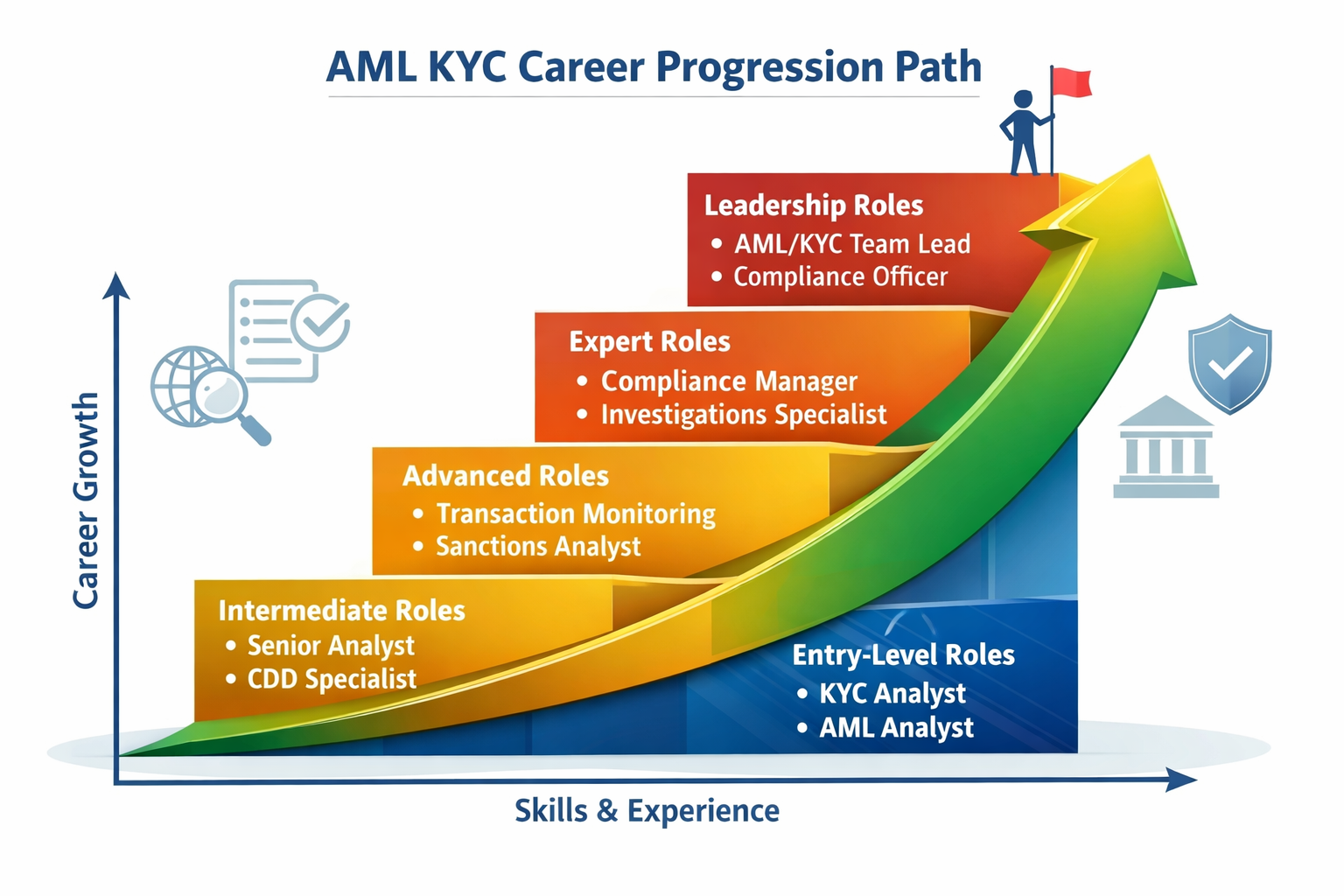
| Career stage | Role | Typical salary range in India | Average annual pay |
| Entry level | KYC Analyst | ₹3.20 lakh – ₹5.77 lakh | ₹4.35 lakh |
| Entry level | AML Analyst | ₹3.40 lakh – ₹6.50 lakh | ₹4.60 lakh |
| Intermediate | Senior AML/KYC Analyst | ₹5.57 lakh – ₹11.50 lakh | ₹7.25 lakh |
| Intermediate | CDD / KYC CDD Analyst | ₹3.49 lakh – ₹5.50 lakh | ₹4.38 lakh |
| Advanced | Transaction Monitoring Analyst | ₹3.89 lakh – ₹6.49 lakh | ₹4.80 lakh |
| Advanced | Sanction Screening Analyst | ₹3.68 lakh – ₹6.18 lakh | ₹5.00 lakh |
| Expert | Compliance Manager | ₹4.63 lakh – ₹10.00 lakh | ₹8.00 lakh |
| Expert | Financial Crime Investigator / Investigations Specialist | ₹7.20 lakh – ₹10.25 lakh | ₹7.78 lakh |
| Leadership | AML/KYC Team Lead | ₹8.46 lakh – ₹14.62 lakh | ₹11.54 lakh |
| Leadership | Compliance Officer | ₹5.30 lakh – ₹13.95 lakh | ₹7.73 lakh |
Skills Employers Look for in AML KYC Freshers and Career Switchers
If you are trying to enter AML KYC without banking experience, this is the section that matters most. Recruiters do not expect every beginner to know advanced compliance systems or complex regulations in detail. What they usually look for is whether you have the right core skills to handle customer verification, document review, risk checks, and process-based work responsibly.
That is why many freshers and career switchers still get shortlisted. Employers often hire for potential, discipline, and trainability at the entry level.
Attention to detail
This is one of the most important skills in AML KYC.
A small mistake in name matching, document verification, date checking, or customer information review can create compliance issues later. Recruiters want candidates who can notice inconsistencies and work carefully instead of rushing through tasks.
This skill matters because AML KYC work often involves:
- checking whether documents are valid, complete, and readable
- comparing information across forms, IDs, and supporting records
- spotting mismatches in names, addresses, dates of birth, or business details
- identifying missing fields or unclear customer information
If your past work involved accuracy, documentation, quality checks, or detailed review, that experience can be very relevant.
Basic analytical thinking
AML KYC is not only about collecting documents. It also involves thinking through whether the information makes sense.
Recruiters value candidates who can:
- connect pieces of information logically
- identify when a case looks unusual
- understand simple risk indicators
- apply rules consistently
- differentiate between routine cases and cases that may need escalation
You do not need to be a financial crime expert at the beginning. But you should show that you can review information with a questioning and structured mindset.
Ability to follow process and compliance rules
AML KYC roles are highly process-driven. Companies want people who can follow standard operating procedures properly and do not take shortcuts.
This is important because the work often includes:
- following onboarding and verification steps in sequence
- applying internal policies correctly
- maintaining documentation standards
- recording case notes clearly
- escalating exceptions through the right channel
Candidates who come from operations, admin, support, BPO, or documentation-heavy roles often already have this strength.
Document handling and verification ability
A large part of entry-level AML KYC work is document-based. Recruiters therefore prefer candidates who are comfortable working with forms, IDs, proofs, declarations, and supporting records.
You should be able to show that you can:
- read and review documents carefully
- identify whether something is missing or inconsistent
- organise records properly
- understand the importance of supporting evidence
- maintain accuracy while working through multiple files
Even if you have never done KYC before, experience in verification, data review, record management, or back-office processing can support your case.
Communication skills
AML KYC is not a sales role, but communication still matters a lot. You may need to write clear notes, raise queries, explain missing requirements, or coordinate with internal teams.
Employers usually look for:
- clear written communication
- professional email drafting
- ability to explain issues simply
- confidence in asking for clarification when needed
- proper documentation of observations and findings
Strong communication becomes even more valuable as you move into due diligence, escalation handling, and compliance review roles later.
Risk awareness
At the entry level, recruiters do not expect advanced risk judgement. But they do expect some basic awareness of why AML KYC exists.
You should understand that the role is meant to help organisations:
- verify customer identity
- prevent fraud and fake accounts
- reduce money laundering risk
- detect suspicious activity
- comply with regulatory obligations
A candidate who understands the purpose behind the process usually performs better in interviews than someone who only memorises definitions.
Time management and consistency
AML KYC roles often involve deadlines, case queues, pending document follow-ups, and service-level expectations. This means employers look for candidates who can stay organised and consistent.
Useful qualities include:
- handling repetitive work without becoming careless
- managing multiple cases at once
- meeting deadlines without sacrificing accuracy
- staying disciplined in routine work
- maintaining quality even under pressure
This is especially important in large operations teams where volume can be high.
Technical comfort
You do not need advanced technical knowledge to enter AML KYC, but basic comfort with systems is definitely useful.
Employers usually prefer candidates who are comfortable with:
- spreadsheets
- data entry tools
- internal workflow systems
- case management platforms
- online document review
- basic research on customer information
If you already know Excel, reporting basics, or process tools from previous roles, mention that on your resume.
A learning mindset
Perhaps the most underrated skill is the willingness to learn. Entry-level AML KYC hiring often depends on whether the company feels you can be trained successfully.
Recruiters value candidates who:
- have taken time to understand AML KYC basics
- know common terms such as CDD, EDD, sanctions, PEP, and suspicious activity
- are genuinely interested in compliance work
- show seriousness rather than casual curiosity
- are open to learning internal systems and regulatory procedures
This is what helps a fresher or career switcher compete with someone who may already have limited industry exposure.
Skills you should highlight from a non-banking background
If you do not come from banking, do not focus only on what you lack. Focus on the relevant strengths you already have.
For example:
- from BPO or support roles: process discipline, communication, case handling
- from operations roles: workflow management, accuracy, documentation
- from admin roles: record keeping, coordination, compliance with procedures
- from customer service roles: professionalism, issue resolution, information handling
- from academic backgrounds: research ability, structured thinking, analytical review
The key is to translate your background into compliance-relevant skills.
What employers really want
At the beginner level, most employers ask a simple question: Can this person be trusted to handle sensitive information carefully and follow compliance procedures?
That is why the most valuable skills in AML KYC are often:
- attention to detail
- analytical thinking
- process discipline
- documentation ability
- communication
- risk awareness
- consistency
- willingness to learn
If you can demonstrate these clearly, the lack of banking experience becomes much less important.
AML KYC Interview Preparation Tips for Freshers
Getting shortlisted is only one part of the process. The real challenge is performing well in the interview. If you do not have banking experience, your interview preparation becomes even more important, as it is where you demonstrate that you understand the role, have the right mindset, and are serious about entering the AML/KYC field.
Here are 5 practical tips that can help you prepare better.
1. Learn the basic AML KYC terms clearly
Before attending the interview, make sure you understand the basic concepts of AML KYC properly. You should be able to explain terms such as AML, KYC, CDD, EDD, PEP, sanctions screening, and suspicious activity in simple language. Interviewers often begin with these fundamentals to check whether you have a genuine interest in the field. Even if you do not have experience, clarity in basics creates a strong first impression. It shows that you have taken the effort to prepare seriously.
2. Understand the role you applied for
Do not go into the interview with only a vague idea of the job. Read the job description carefully and understand whether the role is more focused on onboarding, document verification, due diligence, or transaction monitoring. This will help you answer questions in a more relevant way. It also allows you to connect your own background with the actual work the company wants done. Candidates who understand the role usually sound more confident and better prepared.
3. Prepare your background in a relevant way
If you are coming from a non-banking background, you should be ready to explain why you are still suitable for AML KYC. Focus on transferable skills such as attention to detail, process discipline, documentation, communication, and analytical thinking. Do not apologise too much for lacking banking experience. Instead, explain how your previous education, internship, or work has prepared you for a structured compliance role. This helps the interviewer see your relevance more clearly.
4. Practice common interview questions
Most AML KYC interviews include a mix of basic technical and personal questions. You should practice answers to questions such as why you want to work in AML KYC, what red flags mean, why customer verification matters, and how you would handle missing documents. Keep your answers simple, structured, and professional. Practising beforehand helps you avoid sounding confused or unprepared. It also improves your confidence during the actual interview.
5. Show seriousness, accuracy, and willingness to learn
At the entry level, interviewers are not only judging knowledge. They are also judging. AML KYC is a field where accuracy, responsibility, and consistency matter a lot, so you should present yourself as careful and dependable. Show that you are willing to learn, open to process-based work, and comfortable handling detailed tasks. A strong learning mindset can often compensate for lack of direct experience.
Final Thoughts
Getting into AML KYC without banking experience is absolutely possible when you approach it strategically. The key is to understand the field, identify your transferable skills, target the right entry-level roles, and prepare well enough to make your profile look relevant. Employers do not always expect prior banking exposure at the beginning, but they do expect seriousness, accuracy, and a willingness to learn. If you build your knowledge step by step and position yourself properly, AML KYC can become a practical and rewarding entry point into the wider world of compliance, risk, and financial operations.