
Every few years, a new technology arrives, and people begin to fear that human creativity will lose its value. The same fear has returned with artificial intelligence. Today, AI tools can write blogs, social media captions, emails, poems, scripts, summaries, and even full articles within seconds. For many writers, this has created a genuine sense of insecurity. If a machine can produce content so quickly, what happens to the people who have spent years building their writing skills?
But the story is not as simple as “AI will replace writers.” Writing has never been only about putting words together. Good writing is about observation, emotion, judgment, imagination, and the ability to understand people. It is about turning experience into meaning. AI can generate sentences, but it does not live a human life. It does not feel heartbreak, ambition, fear, curiosity, wonder, or hope. These are the things that give writing its depth.
In reality, AI may not mark the end of writers. It may mark the beginning of a new phase in writing, where writers are no longer limited to blank pages, slow drafts, and repetitive content work. With the right approach, AI can become a creative assistant that helps writers think faster, edit better, research wider, and express ideas more clearly. The writers who learn to use AI wisely may not disappear. They may become more powerful, more productive, and more creative than ever before.
Why Writers Feel Threatened by AI?
The fear around AI is not imaginary. Writers are worried because the content industry is changing very quickly. Earlier, writing required time, research, skill, and multiple rounds of editing. Today, AI tools can create drafts, captions, emails, product descriptions, and even full blogs within seconds. This sudden speed has made many writers question where they stand in the future of work.
AI Can Create Content Very Quickly
One of the biggest reasons writers feel threatened is speed. A task that may take a writer a few hours can now be completed by AI in a few minutes. AI can quickly generate:
- Blog outlines
- Social media captions
- Product descriptions
- Email drafts
- Website content
- Ad copies
- Basic SEO articles
This makes many writers feel that their time, effort, and creative process are being undervalued.
Companies May See AI as a Cheaper Option
For businesses, AI can appear to be a low-cost solution. A company that earlier hired writers for routine content may now use AI to create first drafts. Marketing teams may use AI to generate multiple versions of headlines, captions, and campaign ideas. This creates pressure on writers because some clients may start expecting:
- Faster delivery
- Lower prices
- More content in less time
- Fewer revisions
- AI-assisted output at human-level quality
As a result, writers may feel that the value of human writing is being reduced.
Entry-Level Writers May Face More Competition
- The biggest impact may be felt by beginner writers. Most new writers start their careers by working on simple assignments such as short blogs, SEO content, captions, emails, and website pages. These are the same areas where AI is already strong.
- This means entry-level writers will now need to offer more than basic writing. They will need to show better thinking, stronger editing, audience understanding, and originality.
Generic Writing is Under Pressure
AI is especially good at producing general and repetitive content. This means that surface-level writing may become less valuable over time. The types of writing most affected may include:
- Repetitive SEO blogs
- Basic how-to articles
- Simple product descriptions
- Generic captions
- Standard email templates
- Low-research website content
This does not mean that writers will disappear. It means that writers who only produce ordinary content may find it harder to stand out.
The Real Problem is Not AI, But Average Writing
AI has raised the standard for what human writers need to bring to the table. Writers can no longer depend only on correct grammar or simple sentence formation. They need to add something that AI cannot easily produce. Human writers still matter because they bring:
- Original opinions
- Personal experience
- Emotional depth
- Cultural understanding
- Strong storytelling
- Critical thinking
- Brand voice
- Human judgment
AI can generate content, but it cannot fully understand why an idea matters to people. It can arrange words, but it cannot replace lived experience, empathy, or imagination.
The Role of Writers is Changing, Not Ending
The fear is understandable, but the future is not hopeless. AI may reduce the demand for basic, repetitive writing, but it will increase the value of writers who can think deeply, edit intelligently, and create meaningful content. In other words, AI is not ending writing. It is changing what good writing means. The writers who adapt will not only survive this shift, but may also find new opportunities to become better, faster, and more creative.

What Can AI Do Well in the Content Writing Domain?
AI may not replace the depth of human writing, but it can make the writing process much faster and smoother. Instead of seeing AI only as a threat, writers can also see it as a tool that helps them handle the more mechanical parts of writing. AI is especially useful when a writer needs help with structure, speed, clarity, or idea generation.
AI Can Help Writers Start Faster
One of the hardest parts of writing is beginning. Many writers spend a lot of time staring at a blank page, trying to decide how to start an article, blog, script, or story. AI can help by generating:
- Blog outlines
- Topic ideas
- Opening paragraphs
- Section headings
- Rough first drafts
- Different angles for the same topic
This does not mean the AI output is ready to publish. But it gives the writer a starting point. Once the basic structure is ready, the writer can improve it with original ideas, examples, emotion, and judgment.
AI Is Good at Repetitive Writing Tasks
Many writing tasks are important but repetitive. These tasks take time, but they do not always require deep creativity. AI can help writers complete such work more efficiently. For example, AI can assist with:
- Writing email drafts
- Creating meta descriptions
- Rewriting the same content in different tones
- Preparing social media captions
- Summarising long reports
- Turning a blog into LinkedIn posts
- Creating product descriptions
- Drafting FAQ sections
This allows writers to save time and focus more on the parts of writing that need human intelligence.
AI Can Improve Clarity and Flow
AI can also work like an editing assistant. Sometimes, a writer may have strong ideas but may struggle to express them clearly. AI can help simplify complex sentences, improve grammar, and make the content easier to read. It can help with:
- Grammar corrections
- Sentence restructuring
- Shortening long paragraphs
- Improving readability
- Removing repetition
- Suggesting smoother transitions
- Making content more audience-friendly
However, the final decision must still remain with the writer. AI may improve the language, but the writer must decide whether the meaning, tone, and voice are still correct.
AI Can Support Research, But Not Replace It
AI can help writers understand a topic faster by giving summaries, explanations, and possible research directions. It can break down complex ideas and suggest what areas a writer should explore. AI can be useful for:
- Understanding unfamiliar topics
- Creating research questions
- Finding possible subtopics
- Summarising long information
- Comparing different ideas
- Preparing interview questions
- Explaining technical concepts in simple language
But writers must be careful. AI can sometimes give outdated, incomplete, or incorrect information. This is why fact-checking is still very important. A responsible writer should always verify data, sources, dates, names, and claims before publishing.
AI Can Help Writers Experiment With Style
Another useful thing AI can do is help writers experiment with tone and format. The same idea can be written in many ways depending on the audience. AI can quickly show different versions of the same content. For example, a writer can ask AI to make content:
- More professional
- More conversational
- More persuasive
- More emotional
- More simple
- More detailed
- More suitable for beginners
- More suitable for experts
This gives writers more options. They can compare different styles and choose the one that best fits their audience.
AI Works Best as an Assistant, Not as the Author
The real strength of AI is not that it can replace writers. Its strength is that it can support writers. AI can create drafts, organise thoughts, suggest improvements, and reduce the time spent on routine tasks. But the writer still has to bring:
- Purpose
- Originality
- Human voice
- Personal experience
- Audience understanding
- Ethical judgment
- Emotional connection
- Final editorial control
AI can help produce words. Writers create meaning. That difference is what makes human writing valuable even in the age of artificial intelligence.
What AI still Cannot Replace?
AI can write sentences, create drafts, and generate ideas, but it still cannot replace the deeper human side of writing. Good writing is not just about correct grammar or smooth language. It is about emotion, experience, judgment, imagination, and the ability to understand people. xThis is where human writers continue to have a strong advantage.
AI Cannot Replace Personal Experience
Human writing often becomes powerful because it comes from real life. A writer may write about failure, love, ambition, grief, success, fear, or hope because they have felt these emotions personally. AI can describe these experiences, but it does not actually live them. For example:
- A travel writer brings real memories from a place.
- A journalist brings field experience and observation.
- A novelist brings emotional imagination shaped by life.
- A personal essay writer brings honesty and vulnerability.
- A brand storyteller brings understanding of real human behaviour.
AI can imitate the language of experience, but it cannot replace the truth of lived experience.
AI Cannot Fully Understand Human Emotions
- Writing connects with readers when it feels emotionally honest. A good writer knows when to be gentle, when to be bold, when to be humorous, and when to be serious.
- AI can generate emotional words, but it does not feel emotions. It does not understand pain, joy, loneliness, courage, or nostalgia in the way humans do.
- This matters because readers do not only want information. They want connection. They want to feel that someone understands them. Human writers can create that emotional bond in a way AI cannot fully achieve.
AI Cannot Replace Original Thinking
AI works by learning from existing patterns. It can combine ideas, summarise information, and produce polished content. But truly original thinking often comes from questioning the world, challenging accepted ideas, and seeing something others have missed. Human writers can:
- Build new arguments
- Take a strong position
- Offer fresh interpretations
- Challenge popular opinions
- Connect unrelated ideas
- Bring a unique worldview
AI may help organise ideas, but the strongest ideas still need human curiosity and independent thinking.
AI Cannot Replace Cultural Understanding
Writing is deeply connected to culture, language, place, and social context. A phrase that works in one culture may not work in another. A joke that sounds natural to one audience may sound insensitive to another. Human writers understand these details better because they live within society. They understand tone, timing, sensitivity, and context. This is especially important in:
- Political writing
- Social commentary
- Advertising
- Regional storytelling
- Humour writing
- Opinion pieces
- Campaign communication
- Content for specific communities
AI may understand language patterns, but human writers understand cultural meaning.
AI Cannot Replace Moral and Editorial Judgment
Writing often involves choices. A writer must decide what to include, what to leave out, what tone to use, and how an idea may affect readers. AI can suggest content, but it cannot take moral responsibility for what is written. Human writers are needed to ask important questions such as:
- Is this claim accurate?
- Is this message fair?
- Could this harm or mislead readers?
- Is the tone appropriate?
- Is the argument balanced?
- Does this content respect the audience?
- Should this even be published?
This judgment is especially important in journalism, education, healthcare, finance, law, and public communication.
AI Cannot Replace a Unique Writing Voice
- Every strong writer has a voice. Some writers are sharp and analytical. Some are warm and reflective. Some are humorous, poetic, direct, emotional, or deeply intellectual.
- A writer’s voice is built over time through reading, thinking, observing, failing, editing, and living.
- AI can copy styles, but it does not have its own lived identity. It does not have memories, values, wounds, ambitions, or personal taste. This is why the human voice will continue to matter, especially in a world where generic AI content becomes common.
Human Writers Still Create Meaning
AI can produce words, but writers create meaning. This difference is important. A machine can generate a paragraph, but a human writer can decide why that paragraph matters. The future will not reward writers who simply produce ordinary content. It will reward writers who bring something deeper to their work. That includes:
- A clear point of view
- Emotional intelligence
- Better storytelling
- Stronger research judgment
- Personal voice
- Ethical responsibility
- Fresh ideas
- Human connection
AI may change the writing process, but it cannot remove the need for human imagination. The best writing will still come from people who can think, feel, observe, and express what machines cannot truly experience.
From Content Production to Creative Direction
AI is changing the role of writers. Earlier, many writers were expected to simply produce content. The focus was often on writing more blogs, more captions, more emails, more product descriptions, and more website pages. But in the AI era, the value of a writer will not come only from producing words. It will come from guiding ideas. Writers will increasingly move from being only content creators to becoming creative directors, editors, strategists, researchers, and storytellers.
Writers Will Need to Think Beyond the First Draft
AI can create a first draft quickly, but a first draft is not the same as good writing. A draft still needs direction, depth, accuracy, emotion, and purpose. A writer’s role will be to ask:
- What is the main idea?
- Who is the audience?
- What should the reader feel or understand?
- Is the argument strong enough?
- Is the tone suitable?
- Is the content original?
- Is the information accurate?
- Does the piece have a clear flow?
This means writers will spend more time shaping the quality of content rather than simply filling pages with words.
Writers Will Become Better Editors
Editing will become one of the most important skills for writers. AI may produce content, but not all AI-generated content is useful, accurate, or emotionally powerful. A good writer will know what to keep, what to remove, and what to improve. Writers will need to edit for:
- Clarity
- Accuracy
- Tone
- Flow
- Originality
- Readability
- Emotional impact
- Brand voice
In this way, writers will act like quality controllers of content. They will make sure that AI-supported writing still feels thoughtful, human, and meaningful.
Writers Will Become Content Strategists
In the future, writers will also need to understand strategy. It will not be enough to write one good article. Writers will need to know how that article fits into a larger content plan. They may need to think about:
- What topics does the audience care about
- Which format works best
- What keywords should be targeted
- How the content supports a brand
- How one blog can become social media posts, newsletters, scripts, or videos
- What message does the brand want to build over time
This shift will make writers more valuable because they will not only create content; they will help decide why the content should exist in the first place.
Writers Will Guide the Creative Process
AI needs direction. It can generate better results when the writer gives it a clear purpose, strong instructions, and a defined tone. This makes the writer more like a creative director. A writer may guide AI by deciding:
- The angle of the article
- The structure of the content
- The emotional tone
- The examples to include
- The audience level
- The style of storytelling
- The final message
AI may help with execution, but the vision must come from the writer.
The Future Writer Will Add Meaning, Not Just Words
The biggest change is this: writers will no longer be valued only for writing more. They will be valued for thinking better. The future writer will be someone who can:
- Find the right idea
- Build a strong argument
- Create an emotional connection
- Understand the reader
- Shape a clear narrative
- Check facts carefully
- Add human insight
- Turn information into meaning
This is why AI does not have to reduce the importance of writers. Instead, it can push writers into a more powerful role. The writer of the future may not simply be a person who writes every sentence manually. The writer may become the mind that directs the message, shapes the story, and gives content its human purpose.
Why could this be a New Renaissance for Writers?
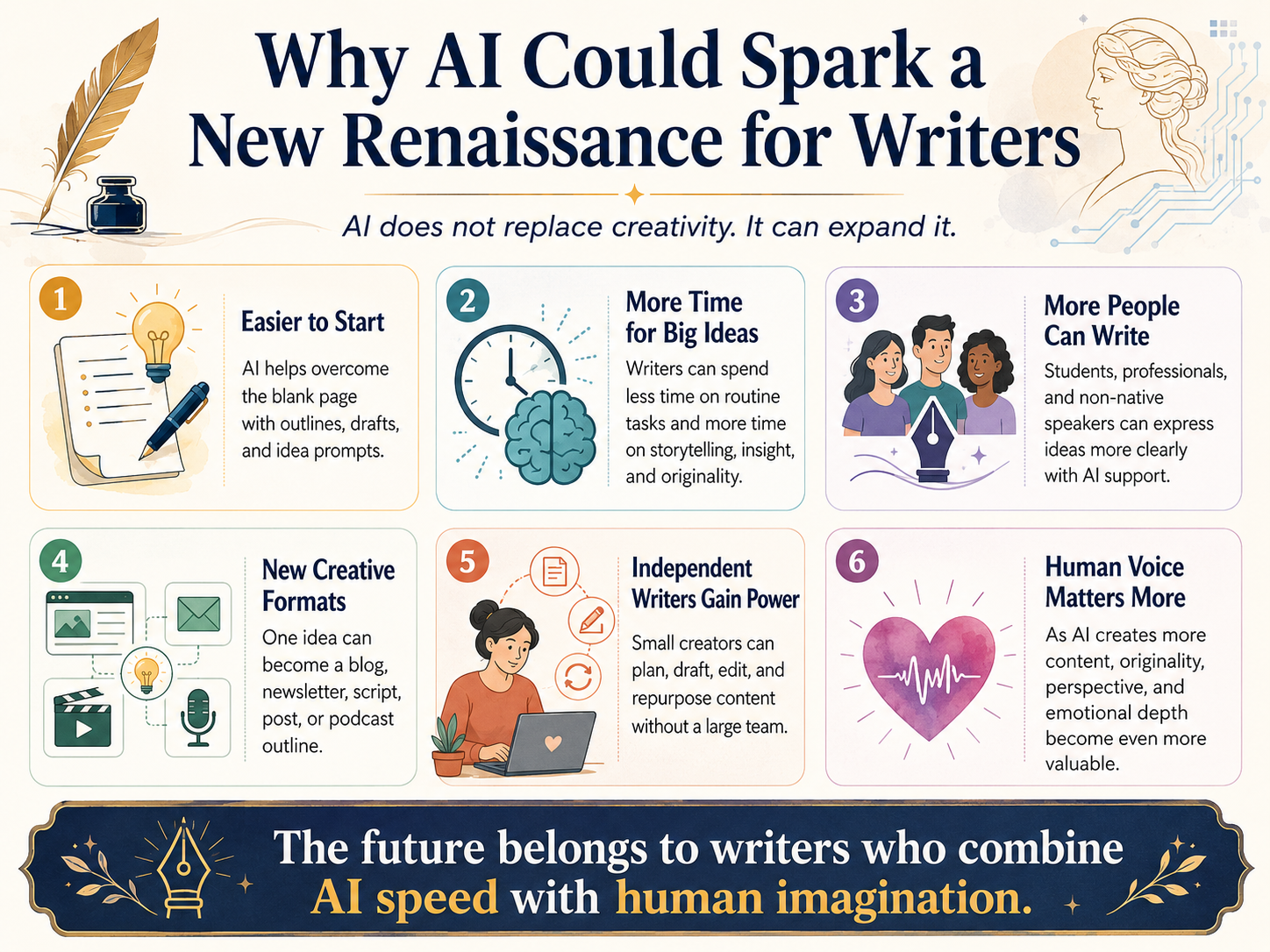
AI is often discussed as a threat to writers, but it can also be seen as a turning point. Instead of ending creativity, AI may open a new phase where more people are able to write, publish, experiment, and share ideas. This is why the future of writing may not be in decline. It may be a new renaissance.
AI Can Remove the Fear of the Blank Page
Many writers struggle with the first step: starting. A blank page can feel intimidating, especially when the topic is complex or the deadline is close. AI can help by giving a rough structure, a few opening lines, or possible angles for the topic. This does not mean AI is doing the creative work completely. It simply gives the writer something to begin with. AI can help writers start with:
- A basic outline
- A rough introduction
- Possible headings
- Different topic angles
- Sample drafts
- Ideas for examples
Once the first version is ready, the writer can improve it with their own thinking, voice, emotions, and experiences.
Writers Can Spend More Time on Better Ideas
Earlier, writers often spent a lot of time on routine tasks such as formatting, rewriting, summarising, or creating multiple versions of the same content. AI can now handle many of these tasks faster. This gives writers more time to focus on the deeper parts of writing, such as:
- Finding stronger ideas
- Building better arguments
- Creating memorable stories
- Understanding the audience
- Adding original insights
- Improving emotional depth
- Making the content more meaningful
In this way, AI can help writers move from mechanical writing to more thoughtful writing.
More People Can Become Writers
AI can also make writing more accessible. Many people have good ideas but struggle with language, structure, grammar, or confidence. AI can support them by helping them organise their thoughts and express themselves more clearly. This can help:
- Students
- Working professionals
- Small business owners
- First-time bloggers
- Researchers
- Entrepreneurs
- Non-native English speakers
- Creators who have ideas but need writing support
This means writing may become less restricted to people who are already skilled with language. More people may be able to participate in storytelling, blogging, publishing, education, and digital communication.
AI Can Support New Forms of Creativity
AI can help writers experiment with new formats and styles. A single idea can now be turned into many forms of content. For example, a blog can become a newsletter, a video script, a LinkedIn post, a podcast outline, or a short social media thread. Writers can use AI to explore:
- Different tones
- Different content formats
- Different story structures
- Different audience levels
- Different titles and hooks
- Different ways of explaining the same idea
This can make the creative process more flexible. Writers are no longer limited to one format or one version of an idea.
Small Creators Can Compete Better
Earlier, large companies had an advantage because they could hire big content teams, editors, designers, and marketing experts. AI can reduce this gap. A small creator or independent writer can now use AI to plan content, improve drafts, create summaries, and repurpose ideas. This gives more power to independent voices. A single writer can now manage:
- Blog writing
- Newsletter planning
- Social media content
- Script drafting
- Editing support
- Content calendars
- Idea generation
- Audience-focused rewriting
This can help individual writers build their own platforms and reach wider audiences without depending completely on large organisations.
The Renaissance Will Belong to Writers With a Voice
However, this new renaissance will not reward everyone equally. If AI makes basic content easy to produce, the internet will be filled with more generic writing. This means originality will become even more valuable. Writers who want to stand out will need to bring:
- A clear voice
- A strong point of view
- Personal experience
- Fresh examples
- Emotional honesty
- Better research
- Deeper thinking
- A unique way of explaining ideas
AI may increase the amount of content in the world, but human voice will decide what content is worth reading.
AI Can Expand Human Creativity
The real opportunity is not to let AI replace imagination, but to use AI to expand it. Writers can use AI to speed up the boring parts of writing and spend more energy on the meaningful parts. They can test ideas faster, edit more sharply, and reach more people. This is why AI may become the beginning of a new writing age. It can help writers become more productive, but more importantly, it can help them become more ambitious. The future of writing may belong to those who combine the speed of AI with the depth of human imagination.
Skills Writers Need in the AI Era
AI is changing writing, but it is also making strong writing skills more important. When anyone can generate basic content with a tool, the real value of a writer will come from their ability to think better, edit better, and communicate with more originality. The writers who succeed in the AI era will not be those who simply write more words. They will be those who can bring meaning, clarity, emotion, and strategy to those words.
Original Thinking
AI can generate content from existing patterns, but it cannot replace independent thinking. Writers need to develop their own opinions, arguments, and perspectives. Original thinking helps writers:
- Say something new
- Build stronger arguments
- Avoid generic content
- Bring fresh examples
- Create a clear point of view
- Make readers think differently
In the AI era, a unique idea will be more valuable than a perfectly written but ordinary paragraph.
Strong Editing Skills
AI can create a draft, but that draft still needs improvement. Writers must know how to edit content for quality, accuracy, tone, and flow. Good editing includes:
- Removing repetition
- Improving sentence clarity
- Checking the logic of the argument
- Making the content easier to read
- Strengthening weak sections
- Ensuring the writing sounds natural
- Keeping the human voice intact
Editing will become one of the most important skills because writers will often work with AI-generated drafts and turn them into polished, meaningful content.
Research and Fact-Checking
AI can help with research direction, but it can also make mistakes. It may give outdated facts, wrong data, or incomplete information. This is why writers need strong research judgment. Writers must know how to:
- Verify facts from trusted sources
- Check dates and statistics
- Identify weak claims
- Avoid misinformation
- Compare different sources
- Understand context before writing
In fields like education, finance, health, law, policy, and technology, fact-checking will be especially important.
Prompting and AI Literacy
Writers do not need to become technical experts, but they should understand how to use AI tools properly. A good prompt can help AI produce better ideas, structures, and drafts. Writers should learn how to guide AI by giving clear instructions about:
- Topic
- Audience
- Tone
- Format
- Word limit
- Purpose
- Examples
- Style preferences
Prompting is not just about asking AI to write. It is about knowing how to direct the tool so that it supports the writer’s creative goal.
Storytelling
Storytelling will remain one of the strongest human skills. Readers may forget information, but they remember stories. A good story can make even a complex topic feel simple, emotional, and relatable. Writers should learn how to use:
- Real-life examples
- Case studies
- Personal experiences
- Emotional hooks
- Strong openings
- Clear conflict and resolution
- Memorable endings
AI can help structure a story, but human writers understand what makes a story feel alive.
Personal Voice
As AI-generated content increases, many articles may start sounding similar. This is why a strong personal voice will become more important. A writer’s voice can be:
- Clear
- Warm
- Sharp
- Reflective
- Humorous
- Analytical
- Emotional
- Persuasive
Voice helps readers recognise the writer behind the words. It makes the content feel human, not mechanical.
Audience Understanding
Good writing is not just about what the writer wants to say. It is also about what the reader needs to understand. Writers must know:
- Who their readers are
- What problems they have
- What language they understand
- What examples they relate to
- What tone will connect with them
- What questions they may have
AI can suggest general audience insights, but human writers must make the final judgment about what will truly connect.
Ethical Judgment
The use of AI also brings responsibility. Writers must be honest about how they use AI and careful about what they publish. They should not blindly trust AI-generated content or use it to spread misleading information. Ethical writing means:
- Checking facts before publishing
- Avoiding plagiarism
- Giving credit where needed
- Not copying someone’s voice unfairly
- Protecting sensitive information
- Being transparent when required
- Taking responsibility for the final content
AI can help with writing, but the responsibility still belongs to the human writer.
The Future Belongs to Skilled Writers
The AI era will not reward writers who depend only on basic writing ability. It will reward writers who combine creativity with judgment. The most valuable writers will be those who can:
- Think originally
- Edit deeply
- Research carefully
- Use AI intelligently
- Tell better stories
- Develop a strong voice
- Understand their audience
- Make responsible choices
AI may make writing faster, but human skill will make writing worth reading.
Final Thoughts: AI Will Not End Writers Who Evolve
AI is changing the writing world, but it is not the end of writers. It is the end of writing that is only generic, repetitive, and surface-level. When machines can produce ordinary content in seconds, human writers will have to offer something more valuable: original thinking, emotional depth, strong judgment, and a distinct voice.
The future will not belong to writers who see AI only as an enemy. It will belong to writers who understand how to use it wisely. AI can help with outlines, first drafts, editing, research direction, summaries, and repurposing content. But it still needs a human mind to decide what is true, what is meaningful, what is ethical, and what is worth saying. In many ways, AI may push writers to become better. It can reduce the pressure of routine tasks and give writers more time to focus on ideas, storytelling, creativity, and audience connection. Instead of spending all their energy on producing more words, writers can spend more time creating better work.