
Data is now part of almost every job. Whether someone works in marketing, finance, HR, sales, operations, healthcare, education, or management, they are likely to deal with reports, dashboards, spreadsheets, customer trends, performance numbers, or AI-generated insights. In 2026, data literacy is no longer a skill only for data analysts or technical teams. It has become a basic workplace skill that helps professionals make better decisions, ask better questions, and understand what is really happening behind the numbers.
Data literacy simply means the ability to read, understand, question, analyse, and communicate data in a meaningful way. It does not mean that everyone needs to become a data scientist. Instead, it means that every professional should know how to look at data carefully, understand its context, identify patterns, avoid misleading conclusions, and use evidence to support decisions. For example, a business manager should be able to understand why sales are falling, an HR professional should be able to interpret employee attrition trends, and a marketing executive should be able to judge whether a campaign is actually performing well.
The importance of data literacy has increased further because of the rapid growth of artificial intelligence and automation. AI tools can now generate reports, summaries, charts, and predictions within seconds. However, these tools are only useful when people know how to evaluate the output. Without data literacy, professionals may blindly trust incorrect numbers, biased insights, or incomplete information. With data literacy, they can use AI more intelligently and responsibly.
What Is Data Literacy?
Data literacy is the ability to read, understand, question, analyse, and communicate data in a useful way. In simple words, it means knowing how to look at numbers, charts, reports, dashboards, or tables and understand what they are trying to tell you.
However, data literacy is not just about reading numbers. It is also about understanding the context behind those numbers. For example, if a company says its sales increased by 20%, a data-literate person will not stop at that number. They will ask: Compared to which period? Was this growth across all regions or only one market? Did profits also increase? Was the growth due to higher demand, price increases, discounts, or one-time factors?
This is what makes data literacy important. It helps people move beyond surface-level information and understand the real meaning behind data. A data-literate person can:
- Read basic charts, tables, and dashboards
- Understand common terms like average, percentage, growth rate, trend, and KPI
- Ask the right questions before trusting a number
- Identify missing, outdated, or misleading data
- Compare data across time, groups, or locations
- Explain insights in simple language
- Use data to support better decisions
Data literacy does not mean that everyone must learn advanced coding, machine learning, or complex statistics. Those are specialised skills. Basic data literacy is more practical. It helps a professional understand whether a report makes sense, whether a chart is misleading, whether a business claim is supported by evidence, and what action should be taken based on the data.
For example, a sales executive may use data literacy to understand which product is selling faster. An HR professional may use it to identify why employee attrition is increasing. A teacher may use it to track student performance. A business owner may use it to understand which customers are most profitable.
In short, data literacy is the skill of turning raw information into a better understanding. In 2026, this skill will become essential because workplaces are becoming more digital, AI-driven, and evidence-based.
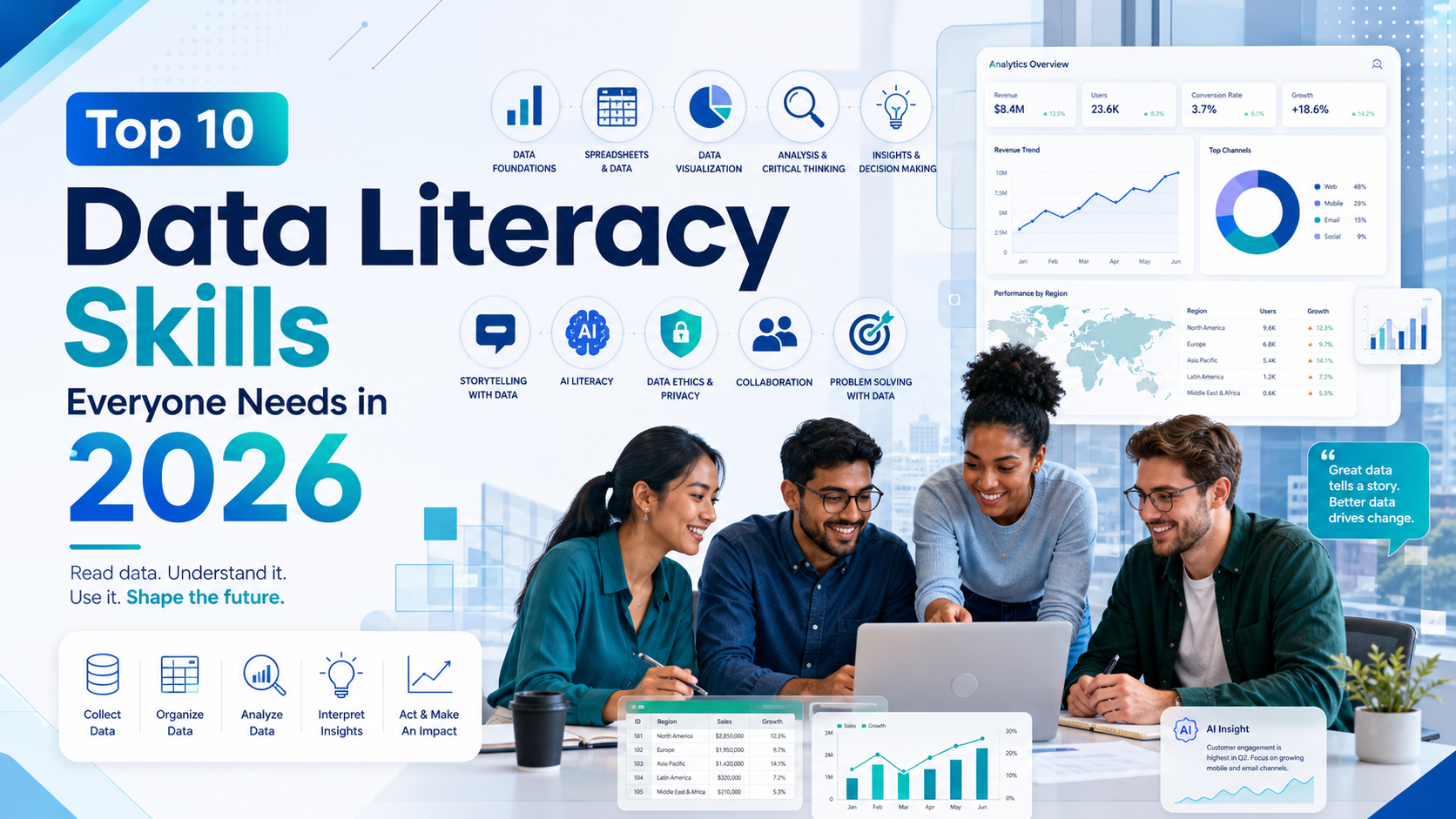
Skill 1: Understanding Basic Data Terms
The first step towards becoming data literate is understanding the basic language of data. Many people feel uncomfortable with data because reports and dashboards often use terms like KPI, metric, variable, benchmark, conversion rate, outlier, or growth rate. Once these terms become clear, data becomes much easier to read and use.
Basic data terms help professionals understand what exactly is being measured. For example, a business dashboard may show revenue, profit, customer acquisition cost, conversion rate, retention rate, and average order value. These numbers may look simple, but each one tells a different story about business performance. Some important data terms everyone should know include:
| Data Term | Simple Meaning | Example |
| Data | Raw facts, numbers, or information | Customer names, sales numbers, website visits |
| Dataset | A collection of related data | Monthly sales data of a company |
| Variable | A factor that can change | Age, income, region, product category |
| Metric | A number used to measure something | Monthly revenue, number of users |
| KPI | A key metric used to track performance | Customer retention rate, profit margin |
| Average | The total value divided by the number of items | Average monthly sales |
| Median | The middle value in a dataset | Median salary of employees |
| Percentage | A value expressed out of 100 | 25% increase in website traffic |
| Trend | A pattern over time | Sales rising every quarter |
| Benchmark | A standard used for comparison | Industry average salary |
| Outlier | A value that is very different from others | One employee earning much more than the rest |
Understanding these terms also helps people avoid wrong conclusions. For example, average and median are often confused. If a few very high salaries are included in a company’s salary data, the average salary may look high. But the median salary may show a more realistic picture of what most employees actually earn.
Similarly, a company may say that customer traffic increased by 30%. But a data-literate person will ask whether this increase also led to more sales, higher revenue, or better customer retention. This is because one metric alone rarely gives the full picture.
In 2026, professionals do not need to memorize technical definitions. But they should be comfortable with the basic vocabulary of data. Once they understand these terms, they can read reports more confidently, ask sharper questions, and participate better in data-driven discussions.
Skill 2: Asking the Right Questions Before Using Data
Good data literacy does not begin with a dashboard, spreadsheet, or AI tool. It begins with the right question. Before using any data, a person must be clear about what they are trying to understand and what decision the data will support. Many people make the mistake of looking at data without a clear purpose. They open a report, see many numbers, and start drawing conclusions too quickly. But data becomes useful only when it is connected to a specific question.
For example, instead of asking: “Why are sales bad?”
A better question would be: “Which product category, region, or customer segment has seen the sharpest fall in sales over the last three months?”
The second question is more useful because it is specific. It helps the person know what data to check and what pattern to look for.
Some important questions to ask before using data include:
| Question | Why It Matters |
| What problem are we trying to solve? | It keeps the analysis focused |
| What data do we need? | It prevents unnecessary confusion |
| Who collected the data? | It helps check reliability |
| What time period does the data cover? | It gives proper context |
| Is the data complete? | It helps avoid wrong conclusions |
| What are we comparing it with? | It makes the insight meaningful |
| What decision will this data support? | It connects analysis with action |
Asking the right questions also helps people avoid misleading conclusions. For example, if a company sees a fall in website traffic, it should not immediately assume that customers are losing interest. The fall could be due to a technical issue, seasonality, reduced advertising spend, or changes in search engine visibility.
In 2026, this skill will become even more important because professionals will increasingly use AI tools to analyse data. But AI can only give useful answers when the question is clear. A vague question will usually lead to a vague answer. A sharp question will lead to a sharper insight. Therefore, one of the most important data literacy skills is knowing how to question data before trusting it. A data-literate person does not just ask, “What does the data show?” They also ask, “Why does it show this? What is missing, and what should we do next?”
Skill 3: Understanding Data Sources and Data Quality
Not all data is equally reliable. Some data is accurate, up to date, and useful. Some data is incomplete, outdated, biased, or wrongly collected. That is why understanding data sources and data quality is one of the most important data literacy skills. A data source means where the data comes from. It could come from customer surveys, company records, government reports, website analytics, social media platforms, financial statements, research studies, or third-party databases. Before using any data, professionals should know its source.
For example, a business may use customer feedback from social media to understand customer satisfaction. But this data may not represent all customers. Unhappy people are often more likely to post online than people who are satisfied. So, while social media feedback is useful, it may not give the full picture. Good data quality usually means that the data is:
- Accurate
- Complete
- Updated
- Consistent
- Relevant
- Clearly defined
- Collected from a reliable source
Poor data quality can create serious problems. If a company has duplicate customer records, it may send the same message many times to one person. If employee data is outdated, HR may make wrong workforce decisions. If sales data is entered incorrectly, business teams may misunderstand demand. Here are some common data quality issues:
| Data Quality Issue | Example |
| Missing values | Customer age or location not recorded |
| Duplicate records | Same customer appearing multiple times |
| Outdated data | Using last year’s customer preferences |
| Inconsistent formats | Dates written in different formats |
| Wrong entries | A product price entered incorrectly |
| Biased data | Survey responses collected from only one group |
| Small sample size | Drawing conclusions from very few responses |
Understanding data quality helps professionals become more careful and responsible. It reminds them that data is not automatically correct just because it appears in a report or dashboard. In 2026, as more decisions become data-driven and AI-assisted, the quality of data will matter even more. AI tools, dashboards, and analytics systems can only produce useful insights if the data given to them is reliable. Poor data will lead to poor decisions.
This is why every professional should learn to ask: Where did this data come from? Is it complete? Is it recent? Is it relevant? Can I trust it? These simple questions can prevent many mistakes and make data-based decisions much stronger.
Skill 4: Cleaning and Organizing Data
Data is rarely perfect in its raw form. In most cases, it has spelling mistakes, duplicate entries, missing values, inconsistent formats, or unnecessary columns. This is why cleaning and organizing data is an important data literacy skill. Data cleaning means improving the quality of data before using it for analysis. If the data is not cleaned properly, the final insights may be wrong, even if the analysis looks professional. For example, imagine a company has customer location data written in different ways:
| Raw Entry | Problem |
| Delhi | Correct entry |
| New Delhi | Same place written differently |
| N. Delhi | Short form used |
| delhi | Same word in lowercase |
| Delhi NCR | The broader region mixed with the city |
If these entries are not cleaned, the system may treat them as different locations. This can affect sales analysis, customer segmentation, marketing campaigns, and regional performance reports. Some basic data cleaning tasks include:
| Cleaning Task | Why It Is Important |
| Removing duplicate entries | Prevents double counting |
| Fixing spelling mistakes | Improves consistency |
| Standardizing date formats | Makes time-based analysis easier |
| Handling missing values | Reduces gaps in analysis |
| Using clear column names | Makes the dataset easier to understand |
| Removing unnecessary spaces | Prevents matching errors |
| Checking totals | Helps identify mistakes |
| Grouping similar categories | Makes comparison easier |
Organizing data is equally important. A well-organized dataset should be easy to read, filter, sort, and analyse. In a spreadsheet, each column should represent one variable, such as name, age, city, product, date, or sales value. Each row should represent one record, such as one customer, one transaction, one employee, or one product.
For example, a messy sales sheet may have merged cells, blank rows, mixed date formats, and unclear headings. Such a sheet may look fine visually, but it will be difficult to use for pivot tables, dashboards, or automated analysis. A clean dataset, on the other hand, allows faster and more accurate decision-making.
In 2026, this skill will become even more important because more professionals will use AI tools, dashboards, and automation systems. These tools need clean and structured data to work properly. If the input data is messy, the output will also be unreliable. Cleaning and organising data may sound basic, but it is one of the most practical data literacy skills. It helps professionals avoid errors, save time, and build more confidence in their analysis.
Skill 5: Basic Statistics for Everyday Decisions
Basic statistics is one of the most useful data literacy skills because it helps people understand what numbers actually mean. Many professionals do not need advanced statistics, but they should know how to interpret common measures like averages, percentages, growth rates, and trends. Statistics helps people avoid surface-level conclusions. For example, if a company says that its average employee salary is ₹80,000 per month, that number may not show the full reality. If a few senior employees earn very high salaries, the average may look higher than what most employees actually receive. In this case, the median salary may give a better picture. Some basic statistical concepts everyone should know include:
| Statistical Concept | Simple Meaning | Example |
| Mean | The average value | Average monthly sales |
| Median | The middle value | Median salary in a company |
| Mode | The most common value | Most common customer age group |
| Percentage change | Increase or decrease in percentage terms | Sales grew by 15% |
| Growth rate | Speed of increase or decrease over time | Revenue growth over one year |
| Range | Difference between the highest and lowest value | Highest and lowest test score |
| Correlation | Relationship between two variables | More ad spending and more website traffic |
| Distribution | How values are spread | Income distribution across employees |
| Standard deviation | How much values differ from the average | Variation in monthly sales |
These concepts are useful in everyday business decisions. A marketing team may use percentage change to understand whether a campaign improved conversions. An HR team may use averages and distribution to study salary differences. A finance team may use growth rates to track revenue. A teacher may use median scores to understand student performance more accurately.
However, basic statistics should be used carefully. A rise in one number does not always mean that one thing caused another. For example, if social media followers and sales both increase in the same month, it does not automatically mean that social media caused the sales increase. There may be other reasons, such as discounts, festivals, advertising, or seasonal demand.
In 2026, professionals will increasingly work with dashboards and AI-generated summaries. These tools may quickly show trends and patterns, but a person still needs basic statistical understanding to judge whether the insight makes sense. Without this skill, it becomes easy to misread data or accept misleading claims. Basic statistics gives professionals the confidence to move beyond “the number looks good” and ask, “What does this number really mean?”
Skill 6: Spreadsheet and Dashboard Skills
Spreadsheet and dashboard skills are among the most practical data literacy skills for 2026. Even with the rise of AI tools, most workplaces still depend heavily on Excel, Google Sheets, Power BI, Tableau, Looker Studio, and internal dashboards. These tools help professionals organise data, track performance, compare results, and present insights. A person does not need to become an advanced data analyst to use these tools well. But they should know the basic functions that help them work with data confidently. Important spreadsheet skills include:
| Skill | Why It Matters |
| Sorting data | Helps arrange values from highest to lowest or alphabetically |
| Filtering data | Helps focus on selected categories, dates, or groups |
| Basic formulas | Helps calculate totals, averages, percentages, and differences |
| Pivot tables | Helps summarise large datasets quickly |
| Conditional formatting | Highlights important values, such as high sales or low performance |
| Data validation | Reduces errors during data entry |
| Removing duplicates | Prevents double counting |
| Charts | Helps present data visually |
Dashboard skills are slightly different. A dashboard usually presents data in a visual and summary form. It may include KPIs, graphs, tables, filters, and performance indicators. A data-literate professional should know how to read a dashboard properly instead of only looking at the biggest number on the screen. When using dashboards, professionals should ask:
- What time period does this dashboard cover?
- What does each KPI measure?
- Is the data updated daily, weekly, or monthly?
- Are filters applied?
- What is being compared?
- Is the chart showing numbers, percentages, or growth rates?
- Is any important category missing?
For example, an HR dashboard may show employee attrition at 12%. But a better reading would ask whether attrition is higher among new employees, specific departments, women employees, senior roles, or certain locations. This turns a simple number into a useful business insight. Similarly, a sales dashboard may show that revenue increased. But the real question is whether this growth came from more customers, higher prices, repeat purchases, or one large order. Spreadsheet and dashboard skills help people break down such numbers and understand the story behind them.
In 2026, these skills will remain essential because most organisations want employees who can work independently with data. Professionals who can clean a spreadsheet, create a pivot table, read a dashboard, and explain key insights will have a strong advantage in almost every field.
Skill 7: Data Visualization
Data visualisation is the skill of presenting data through charts, graphs, maps, dashboards, and other visual formats. It helps people understand patterns more quickly than raw numbers. A large table may take time to read, but a well-designed chart can immediately show whether sales are rising, costs are increasing, or performance is uneven across regions. In 2026, data visualisation will be an important skill because professionals are expected to explain insights clearly and quickly. Whether someone is preparing a business presentation, marketing report, HR dashboard, policy brief, or financial update, the right visual can make the message more powerful. However, good visualisation is not just about making a chart look attractive. It is about choosing the right chart for the right purpose.
| Purpose | Best Visual Format | Example |
| To compare categories | Bar chart | Sales by product category |
| To show change over time | Line chart | Monthly revenue trend |
| To show parts of a whole | Pie chart or stacked bar chart | Market share by brand |
| To show ranking | Horizontal bar chart | Top 10 performing branches |
| To show geography | Map | State-wise customer demand |
| To show intensity | Heatmap | Region-wise performance levels |
| To show relationship | Scatter plot | Ad spend and sales growth |
A data-literate person should also know how charts can mislead people. For example, a bar chart with a broken axis may make a small difference look very large. A pie chart with too many categories may become confusing. A line chart without proper labels may hide the real trend. Similarly, using percentages without showing actual numbers can create a false impression.
Good data visualisation should be:
- Simple and easy to understand
- Properly labelled
- Based on the right chart type
- Free from unnecessary decoration
- Honest in scale and proportion
- Focused on the main message
- Supported by clear explanation
For example, if a company wants to show monthly sales performance, a line chart will be more useful than a pie chart because it shows movement over time. If an HR team wants to compare attrition across departments, a bar chart will be clearer than a long table. In 2026, professionals who can create clean and meaningful visuals will stand out because they can make complex data easier for others to understand. Data visualisation turns numbers into clarity. It helps teams see what is happening, where the problem lies, and what action may be needed next.
Skill 8: Data Storytelling
Data storytelling is the ability to turn data into a clear, meaningful, and useful message. It is one of the most important data literacy skills because data alone does not create understanding. People need context, explanation, and direction. A report may say that customer churn increased from 12% to 18%. But this number becomes more useful when it is explained as a story:
“Customer churn has increased from 12% to 18% in the last six months, mainly among first-time users. This suggests that the onboarding experience may not be strong enough, and the company may need to improve customer support during the first few weeks.”
This is data storytelling. It connects the number with the reason, the impact, and the possible action. A good data story usually answers four questions:
| Question | Purpose |
| What happened? | Explains the main change or pattern |
| Why did it happen? | Identifies possible reasons |
| Why does it matter? | Shows the business or social impact |
| What should be done next? | Connects insight with action |
Data storytelling is especially useful in workplaces because decision-makers often do not have time to study every row of data. They need a clear explanation of what the data means and why it matters. A good data story helps them make faster and better decisions.
For example, instead of saying: “Website traffic declined by 20%.”
A stronger data story would be: “Website traffic declined by 20% after the advertising budget was reduced in March. The decline was highest among new visitors, while returning visitors remained stable. This means the brand is still retaining its existing audience, but new customer discovery has weakened.”
This kind of explanation is much more useful because it gives direction. Good data storytelling includes:
- A clear main message
- Relevant numbers
- Context behind the data
- Comparison with previous periods or benchmarks
- Simple visuals
- Practical interpretation
- Actionable recommendations
However, data storytelling should not become data manipulation. The goal is not to force the data to support a fixed opinion. The goal is to explain the data honestly and clearly. A responsible data storyteller also mentions limitations, missing information, or uncertainty where needed.
In 2026, data storytelling will become even more valuable because organisations will have more data than ever before. The challenge will not be only collecting data, but making sense of it. Professionals who can explain data in a simple, logical, and action-oriented way will become stronger communicators, better decision-makers, and more valuable team members.
Skill 9: AI and Data Interpretation
AI is changing the way people work with data. In 2026, many professionals are using AI tools to summarise reports, create charts, find patterns, write insights, and even generate business recommendations. This makes work faster, but it also makes data literacy more important than before.
AI can process large amounts of information quickly, but it does not always understand context perfectly. It may give an answer that looks confident but is incomplete, outdated, biased, or incorrect. This is why professionals should not blindly trust AI-generated insights. They should know how to interpret, check, and question them.
For example, if an AI tool says that sales are falling because customer demand is weak, a data-literate professional will ask whether the tool has checked all possible reasons. Sales may also fall because of supply issues, pricing changes, reduced marketing spend, seasonal patterns, or a problem in distribution. To use AI responsibly with data, professionals should know how to:
| AI Data Skill | Why It Matters |
| Write clear prompts | Helps AI give more relevant answers |
| Provide context | Improves the quality of AI-generated insights |
| Check sources | Reduces the risk of using wrong information |
| Verify numbers | Ensures that calculations are correct |
| Compare outputs | Helps identify inconsistencies |
| Question assumptions | Prevents blind trust in AI conclusions |
| Understand limitations | Helps users know when human judgement is needed |
A simple example is asking AI to analyze customer feedback. If the prompt is vague, such as “Analyze this data,” the output may be too general. A better prompt would be: “Identify the top five reasons customers are dissatisfied, group them by theme, and suggest which issues need immediate attention based on frequency and severity.”
AI can be very useful, but it works best when humans guide it properly. A person who understands the data, the business context, and the decision being made can use AI much more effectively than someone who only copies and pastes information into a tool. In 2026, AI and data literacy will go together. Professionals will not only need to know how to use AI tools, but also how to judge whether the output makes sense. The real advantage will belong to people who can combine AI speed with human reasoning, context, and responsibility.
Skill 10: Data Ethics, Privacy, and Bias Awareness
Data literacy is not only about analyzing numbers. It is also about using data in a fair, safe, and responsible way. As companies collect more information about customers, employees, students, patients, and users, professionals need to understand the ethical side of data. Data ethics means using data in a way that respects people’s privacy, avoids harm, and supports fair decisions. Just because data is available does not always mean it should be used. Professionals must think carefully about how data is collected, stored, shared, and applied. Some important areas of data ethics include:
| Ethical Area | What It Means |
| Privacy | Protecting personal information |
| Consent | Using data only when people have agreed or when it is legally allowed |
| Transparency | Being clear about how data is used |
| Fairness | Avoiding discrimination or unequal treatment |
| Security | Keeping data safe from misuse or leaks |
| Accountability | Taking responsibility for data-based decisions |
| Bias awareness | Identifying unfair patterns in data |
Bias is one of the biggest concerns in data use. Data may look neutral, but it can reflect past inequalities or incomplete information. For example, if a company uses past hiring data to train an AI recruitment tool, and past hiring was biased towards certain groups, the tool may repeat the same bias in future hiring decisions. Similarly, customer data may not represent all groups equally. If a survey is answered mostly by urban customers, the company may misunderstand the needs of rural customers. If healthcare data is collected mainly from one age group or income group, the results may not apply to everyone. Professionals should ask important ethical questions before using data:
- Does this data include personal or sensitive information?
- Was the data collected fairly?
- Do people know how their data is being used?
- Could this data harm any group?
- Are some groups missing from the dataset?
- Could the analysis create unfair decisions?
- Is the data stored securely?
In 2026, data privacy and responsible AI will become even more important because businesses, governments, and institutions are using data for major decisions. These decisions can affect jobs, loans, healthcare, education, insurance, and public services. A data-literate professional should therefore understand not only what the data says, but also whether it is being used responsibly. Good data use should be accurate, fair, transparent, and respectful of people’s rights. Data ethics is what separates smart data use from harmful data use.
Data Literacy Is the New Workplace Language
Data literacy is no longer an optional skill. In 2026, it has become one of the basic skills needed to work confidently in a digital, AI-driven, and data-heavy world. Almost every role now involves some form of data, whether it is reading a dashboard, understanding customer behaviour, tracking performance, preparing reports, using spreadsheets, or checking AI-generated insights.
The important point is that data literacy does not mean everyone must become a data scientist. It means that every professional should be able to understand data, ask the right questions, check its quality, interpret trends, explain insights, and use information responsibly. These skills help people make better decisions and avoid being misled by incomplete or poorly presented numbers.
The professionals who will stand out in 2026 are those who can combine technical awareness with critical thinking. They will not simply accept a number because it appears in a report. They will ask where the data came from, what it includes, what it excludes, and what action it supports. This ability to question, interpret, and communicate data will be valuable across industries.