Artificial intelligence is creating one of the biggest career shifts in India today. Companies across sectors are investing in AI to improve productivity, automate tasks, personalise customer experiences, and make faster business decisions. But while demand for AI adoption is growing rapidly, the supply of skilled professionals is not keeping pace. In fact, many Indian companies say they are struggling to find people with the right AI skills, creating a major talent gap in the job market.
This is exactly where a huge opportunity is opening up. When businesses cannot find enough qualified talent, job seekers who start learning the right skills early can gain a strong advantage. Whether you are a student, a fresher, a working professional, or someone planning a career switch, the current AI talent shortage in India could work in your favour. The key is to understand where the demand is rising, what skills employers actually want, and how you can position yourself to meet that need.
Why AI Talent is Suddenly in High Demand?
Artificial intelligence is no longer a niche technology used only by large tech companies or research labs. It has now become a practical business tool that companies across India are trying to adopt in order to stay competitive. From automating repetitive work and improving customer support to analysing large volumes of data and speeding up decision-making, AI is changing how organisations operate on a daily basis.
- This growing use of AI is one of the biggest reasons why the demand for skilled professionals has risen so quickly. Businesses do not just need people who can build advanced AI systems from scratch. They also need professionals who can work with AI tools, understand data, apply machine learning in real business situations, write effective prompts, and use AI to improve productivity across teams.
- Another reason for this rising demand is that AI adoption is spreading across industries. Banks are using it for fraud detection and customer insights. Healthcare organisations are using it for diagnostics and data management. Retail companies are using it for recommendations and inventory planning. Marketing teams are using AI for content creation, campaign analysis, and customer targeting. This means AI skills are becoming valuable not only for engineers and developers, but also for analysts, managers, marketers, and operations professionals.
- As more companies move from experimenting with AI to integrating it into everyday workflows, the need for job-ready talent will continue to grow. That is why AI is no longer just a future skill. It is quickly becoming a present-day career advantage.
What does the 53% Talent Gap actually mean?
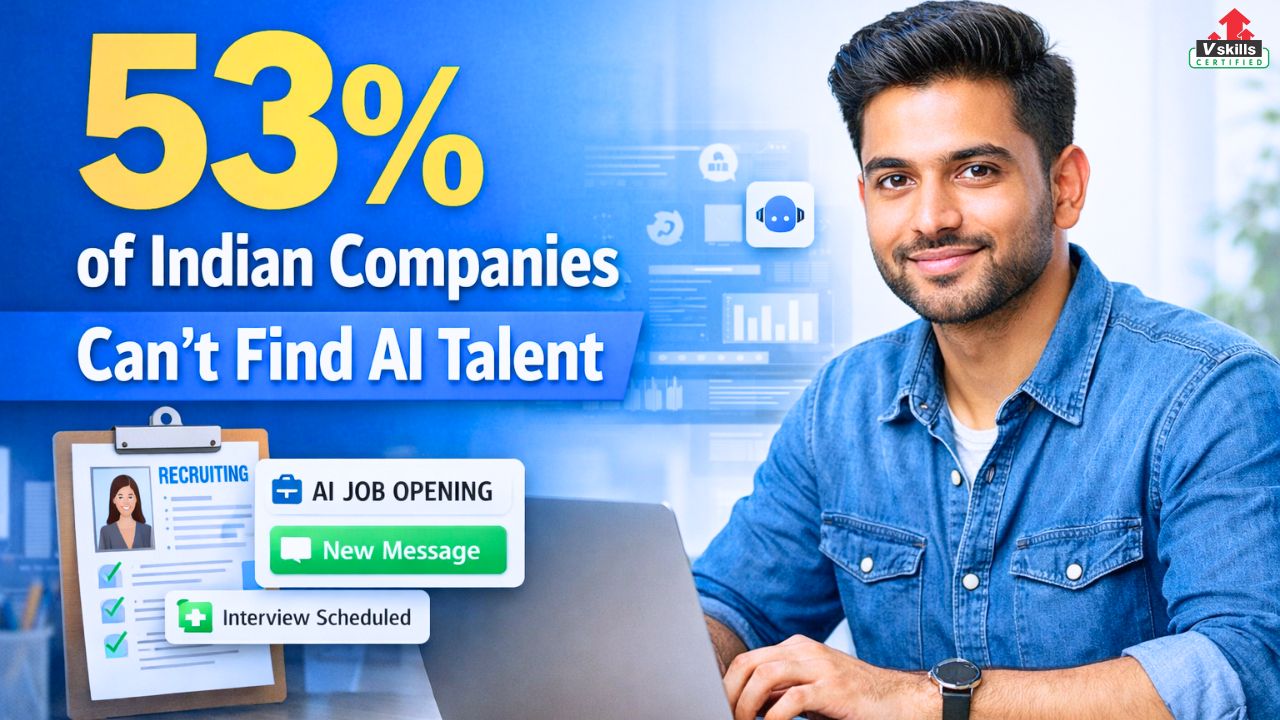
When reports say that 53% of Indian companies cannot find AI talent, it does not simply mean that hiring has become difficult. It means there is a growing mismatch between what employers need and what many job seekers currently offer. Companies are actively looking for people who understand AI tools, data, automation, and machine learning, but a large share of applicants still do not have the practical skills needed for these roles.
This gap is important because it shows that the challenge is not a lack of jobs. The real issue is a lack of job-ready talent. Many organisations want to adopt AI faster, but they are being slowed down because they cannot find enough professionals who can help them implement these technologies effectively. In some cases, companies may have the budget and the interest to hire, but the right candidates are simply not available in sufficient numbers. For job seekers, this is actually encouraging. It means the market is not yet overcrowded with AI professionals. There is still room for new learners, fresh graduates, and career switchers to enter the field. Those who begin building relevant AI skills now can stand out much more easily than in a field where talent supply is already saturated.
In simple terms, the 53% talent gap is a signal that opportunity exists. It shows that companies are ready, the demand is real, and the people who prepare themselves well can step into a market that is actively looking for them.
Who Can Take Advantage of This Opportunity?
The AI talent gap in India is creating opportunities for a wide range of people. This is not a field limited only to computer science graduates or experienced engineers. As AI becomes part of daily work across industries, companies need professionals from different backgrounds who can understand, use, and apply these tools in practical ways.
Students and Fresh Graduates
Students and fresh graduates are in a strong position because they can start building AI skills early. Learning about artificial intelligence, machine learning, data analysis, and generative AI tools before entering the job market can give them a major advantage over other candidates.
They can benefit in the following ways:
- They can enter a fast-growing field at the right time
- They can build projects and portfolios that make their resumes stronger
- They can apply for internships and entry-level roles in AI, data, and analytics
- They can stand out even without years of work experience
Working Professionals
Professionals who are already employed can also benefit by upskilling in AI. In many cases, adding AI knowledge to an existing role can make a person more valuable without requiring a complete career change.
Examples include:
- marketers using AI for content creation and campaign analysis
- finance professionals using AI for reporting and forecasting
- HR teams using AI for screening and employee support
- operations teams using AI to automate repetitive workflows
For working professionals, AI can improve both productivity and career growth.
Technical Professionals
People who already work in technical roles may find it easier to move into AI-related careers because they often already have some relevant foundation in coding, systems, or data.
This includes:
- software developers
- data analysts
- data engineers
- business analysts
- product managers with technical exposure
For these professionals, learning AI can open doors to more specialised and better-paying roles.
Non-Technical Professionals
Non-technical professionals should not assume that AI is out of reach. Many companies now need people who can use AI tools in business settings, even if they are not building complex models themselves.
This group may include:
- content writers
- digital marketers
- customer support professionals
- teachers and trainers
- sales professionals
- administrative and operations staff
In many such roles, understanding how to use AI tools effectively can become a major advantage.
Career Switchers
AI is also a promising field for people who want to change careers. Since the industry is still evolving, many employers are open to candidates who show practical skills, strong interest, and the ability to learn quickly.
Career switchers can benefit because:
- The field is still new compared to many traditional industries
- Many roles value skills over a formal background
- Online courses and projects make it easier to learn independently
- transferable skills such as communication, problem-solving, and analytical thinking still matter
The biggest takeaway is simple. AI is creating opportunities for far more people than many assume. Whether you are a student, a fresher, a working professional, or someone planning a career shift, this is a field where early effort can lead to strong rewards. The talent gap means companies are looking for people who are ready to grow, and that creates room for new entrants to build meaningful careers.

The AI Skills Companies Are Actually Looking For
A common mistake many job seekers make is assuming that companies only want highly advanced AI experts. In reality, most employers are looking for a mix of technical skills, practical problem-solving ability, and business understanding. They want professionals who can not only understand AI tools, but also use them to solve real workplace challenges.
Technical Skills That Matter
For more technical AI roles, companies usually look for candidates who have a foundation in the following areas:
- Python programming
- SQL for working with data
- Machine learning basics
- Data analysis and visualisation
- Statistics and probability
- Understanding of AI models and workflows
These skills are especially useful for roles such as data analyst, machine learning engineer, AI engineer, and data scientist.
Generative AI and Tool-Based Skills
As generative AI becomes more common in workplaces, companies are also looking for people who know how to use modern AI tools effectively. This includes the ability to work with tools for writing, research, automation, coding support, and customer interaction.
Useful skills in this area include:
- prompt writing and prompt engineering
- using AI tools for content, research, and productivity
- understanding how to evaluate AI-generated output
- knowing the strengths and limits of generative AI tools
- applying AI tools in day-to-day business tasks
These skills are becoming valuable even in non-technical roles.
Data and Business Understanding
AI is only useful when it solves a real problem. That is why companies also want people who can connect AI with business needs. A candidate who understands both the tool and the purpose behind it often becomes more valuable than someone with only theoretical knowledge.
Employers often value people who can:
- interpret data correctly
- identify patterns and trends
- understand customer or business problems
- suggest practical AI use cases
- communicate insights clearly to teams and managers
Soft Skills Still Matter
Even in AI-related roles, technical knowledge alone is not enough. Many companies want professionals who can think clearly, learn fast, and work well with others.
Important soft skills include:
- problem-solving
- logical thinking
- communication
- curiosity and willingness to learn
- adaptability
- creativity
These skills are especially important because AI tools and job requirements are changing very quickly.
What Employers Really Want?
In the end, companies are looking for people who can do three things well:
- understand the basics of AI
- apply AI tools or concepts in real situations
- keep learning as the field evolves
This means you do not need to know everything before you begin. But you do need to start building a skill set that is practical, relevant, and aligned with what employers actually need today. Here is a table for quick rationale about gaining the specific skill –
| Skill Area | Why is the skill needed? |
| Python | Useful for building, testing, and working with AI models and data. |
| SQL | Helps professionals extract, manage, and analyse data efficiently. |
| Machine Learning Basics | Shows that you understand how AI systems learn from data. |
| Data Analysis | Helps turn raw data into useful business insights. |
| Prompt Engineering | Important for getting better results from generative AI tools. |
| Generative AI Tools | Companies want people who can use AI tools for work tasks and productivity. |
| Statistics | Helps in understanding patterns, accuracy, and model performance. |
| Problem-Solving | Employers value people who can use AI to solve real business challenges. |
| Communication | Important for explaining AI insights clearly to teams and decision-makers. |
| Business Understanding | Helps connect AI tools with real company goals and needs. |
Top AI Career Roles to Explore
The AI talent gap in India is not creating just one kind of job. It is opening up a wide range of roles for people with different strengths, from coding and model building to analytics, business problem-solving, and AI tool usage. What makes this space especially attractive is that there are roles for both highly technical professionals and people who want to work with AI in practical business settings. Salary levels also show that these careers can be financially rewarding, especially as demand continues to grow.
AI Engineer
AI engineers work on building, testing, and deploying AI-powered systems that solve real business problems. They often combine programming, machine learning, and system design to turn AI concepts into usable applications. In India, the average salary for an AI Engineer is about ₹11 lakh per year, with typical pay often ranging from around ₹6.5 lakh to ₹18 lakh.
This role is well-suited for people who have:
- Strong programming skills
- An understanding of machine learning basics
- Comfort working with data and models
- Interest in building practical AI products
Data Scientist
Data scientists use data to identify patterns, generate insights, and support decision-making. In many organisations, this role overlaps closely with AI because it often includes predictive analytics, machine learning, and data-driven problem-solving. In India, the average salary for a Data Scientist is about ₹11.5 lakh per year, with common pay levels ranging from about ₹7.98 lakh to ₹20.4 lakh.
This role is a strong fit for people who enjoy:
- analysing data
- solving business problems through evidence
- working with statistics and trends
- combining technical and analytical thinking
Machine Learning Engineer
Machine learning engineers focus more specifically on designing, training, improving, and integrating machine learning models into products or workflows. This is usually a more technical role and often requires deeper coding ability. In India, the average salary for a Machine Learning Engineer is about ₹11.5 lakh per year, with a typical range of roughly ₹7.58 lakh to ₹19.5 lakh.
Companies often look for professionals who can:
- train and optimise models
- work with large datasets
- improve model performance
- deploy machine learning into real applications
Prompt Engineer
Prompt engineering has become one of the most talked-about AI career paths, especially with the rise of generative AI tools. Prompt engineers focus on writing structured instructions that help AI systems produce useful, accurate, and relevant outputs. Salary estimates for this role are still developing because it is relatively new, but current India estimates suggest an average of about ₹7 lakh per year on Glassdoor, while Indeed reports around ₹5.16 lakh per year.
This role is especially suitable for people who are strong in:
- language and communication
- structured thinking
- experimentation
- working with generative AI tools
AI Product Analyst
An AI Product Analyst helps connect AI capabilities with real user and business needs. This role involves understanding product problems, identifying where AI can add value, and supporting the development of AI-enabled solutions. Since salary data is usually listed under the broader title of Product Analyst, the closest India-wide average is about ₹11 lakh per year, with a common range of roughly ₹7.6 lakh to ₹17 lakh.
This role is useful for people who have:
- product thinking
- business understanding
- analytical ability
- interest in user experience and AI applications
Business Intelligence or Data Analyst
These roles are becoming increasingly relevant in the AI ecosystem because many companies need people who can work with data, interpret trends, and use AI-enabled tools for reporting and decision-making. In India, the average salary is about ₹9.13 lakh per year for a Business Intelligence Analyst and about ₹6.87 lakh per year for a Data Analyst.
This path is a good option for people who want to enter the AI space through:
- data handling
- dashboarding and reporting
- business analysis
- AI-assisted decision support
AI Consultant or AI Specialist
AI consultants help organisations identify where AI can be used, which tools make sense, and how implementation should happen. This is a role that combines technical awareness with business strategy. In India, the average salary for an AI Consultant is about ₹17 lakh per year, with a typical pay range of around ₹8.9 lakh to ₹28 lakh.
This role may suit people who are strong in:
- strategy
- communication
- domain knowledge
- problem-solving
- understanding of AI use cases
Quick View: AI Roles and Average Salary in India
| Role | What the Role Focuses On | Average Salary |
| AI Engineer | Building and deploying AI systems | ₹11 lakh per year |
| Data Scientist | Analysing data and developing insights | ₹11.5 lakh per year |
| Machine Learning Engineer | Training and improving machine learning models | ₹11.5 lakh per year |
| Prompt Engineer | Creating effective prompts for generative AI tools | ₹5.16 lakh to ₹7 lakh per year |
| AI Product Analyst | Linking AI solutions with product and business needs | ₹11 lakh per year |
| Business Intelligence Analyst | Using data for reporting and business decisions | ₹9.13 lakh per year |
| Data Analyst | Working with data and AI-enabled insights | ₹6.87 lakh per year |
| AI Consultant | Helping companies adopt AI effectively | ₹17 lakh per year |
The most important point is that AI careers are not limited to one narrow path. Some roles demand strong coding and engineering ability, while others focus on analytics, product thinking, communication, or business use cases. That variety is exactly why this talent gap is such a strong opportunity. It gives different kinds of learners a realistic entry point into one of the fastest-growing career areas in India today.
How to Start Learning AI Even if You Are a Beginner?
The idea of learning artificial intelligence can feel intimidating at first, especially if you do not come from a technical background. Many people assume that AI is only for programmers, engineers, or data scientists, but that is no longer true. Today, there are many beginner-friendly ways to enter this field. What matters most is not knowing everything from the start, but taking the first few steps in the right direction.
Start with the Basics
Before jumping into advanced tools or coding, it is important to understand what AI actually is. Learn the difference between artificial intelligence, machine learning, deep learning, and generative AI. Get familiar with simple concepts such as training data, models, automation, prompts, and predictions.
At this stage, your goal should be to build clarity, not mastery.
Focus on:
- understanding key AI terms
- learning where AI is used in real life
- knowing the difference between technical and non-technical AI roles
- becoming comfortable with the basic language of the field
Choose a Learning Path Based on Your Background
Not everyone needs to learn AI in the same way. Your approach should depend on your goals and your current skill set.
For example:
- if you are from a technical background, you can begin with Python, machine learning, and data projects
- if you are from a non-technical background, you can start with generative AI tools, prompt writing, and business use cases
- if you are interested in analytics, you can focus on data analysis, SQL, and AI-assisted insights
- if you are interested in content or marketing, you can learn how AI tools support writing, research, and automation
Choosing the right path early can make learning feel much more manageable.
Learn One Useful Skill at a Time
A common mistake beginners make is trying to learn everything at once. AI is a broad field, so it is better to build one skill at a time.
You can begin with areas such as:
- Python for basic programming
- SQL for data handling
- prompt engineering for generative AI
- data analysis for business insights
- machine learning basics for technical roles
Even learning one practical skill well can create momentum.
Use Beginner-Friendly Courses and Tools
There are now many easy-to-understand courses, tutorials, and platforms that can help beginners start learning AI. Instead of trying to study everything from books or theory alone, use structured resources that explain concepts in simple language and give hands-on practice.
Look for courses that offer:
- beginner-level lessons
- simple projects or exercises
- clear explanations of tools and concepts
- certificates that can strengthen your resume
Practice with Small Projects
Learning becomes much more effective when you apply it. Even simple projects can help you understand how AI works and show employers that you can use your skills in practice.
You can try:
- writing prompts for different tasks using generative AI tools
- analysing a small dataset
- building a simple chatbot
- using AI to summarise, classify, or organise information
- creating a mini portfolio of AI experiments
Projects do not need to be perfect. They just need to show effort, curiosity, and practical understanding.
Build a Portfolio as You Learn
A portfolio can be one of the strongest tools for beginners. It gives visible proof of what you can do, even if you do not yet have formal job experience in AI.
Your portfolio can include:
- course certificates
- mini projects
- prompt samples
- data analysis work
- case studies
- short write-ups on how you used AI to solve a problem
This is especially useful for students, freshers, and career switchers.
Stay Consistent and Keep Updating Yourself
AI changes quickly, so consistency matters more than speed. You do not need to become an expert in one month. What matters is regular learning and staying aware of how tools and job requirements are evolving.
Try to:
- learn a little every week
- follow AI news and trends
- explore new tools gradually
- keep improving your portfolio and skills
Quick View: How Beginners Can Start Learning AI
| Step | What to Do |
| Learn the basics | Understand core AI concepts and terms |
| Pick a path | Choose technical or non-technical learning based on your goals |
| Build one skill | Start with Python, SQL, prompts, or data analysis |
| Take courses | Use beginner-friendly learning platforms |
| Practice projects | Apply your learning through small real examples |
| Create a portfolio | Show your work through projects and certificates |
| Stay consistent | Keep learning as the field evolves |
Starting AI does not require perfection, a fancy degree, or years of technical knowledge. It requires curiosity, consistency, and a practical approach. The biggest advantage beginners have today is access. The tools, courses, and learning resources are already available. The people who start now, even with small steps, may be the ones best placed to benefit from the growing AI talent gap in the years ahead.
Why Practical Skills Matter More Than Just Degrees?
In AI, employers are not only looking at what you studied. They also want to see whether you can actually use AI tools, solve problems, and apply your knowledge in real situations. That is why practical skills are often becoming more important than degrees alone.
- Degrees provide a foundation, but skills show job readiness
- Projects and portfolios give proof of what you can do
- Certifications help show focused upskilling
- Hands-on experience matters more in a fast-changing field like AI
- Employers value candidates who can apply AI to real business problems
In simple terms, a degree may help you get noticed, but practical skills are what help you stand out.
How India’s AI Talent Gap Could Shape the Future Job Market?
India’s AI talent shortage is not just a hiring problem for companies. It could also reshape the job market in a big way over the next few years. As demand for AI skills rises, professionals who can work with these tools may enjoy stronger career growth, better salaries, and more job opportunities.
- AI skills may become valuable across many industries, not just tech
- More companies may invest in upskilling and internal AI training
- Salaries for AI-skilled professionals may remain strong due to high demand
- Freshers and career switchers may get more opportunities in AI-linked roles
- Basic AI literacy may become an expected skill in many jobs
The AI talent gap is likely to make AI one of the most important career skills in the future job market.
Final Thoughts
The fact that 53% of Indian companies cannot find AI talent is not just a statistic. It is a clear sign that the market needs skilled professionals and that the opportunity is open right now. As businesses across sectors continue to adopt AI, the demand for people who can understand, use, and apply these skills will only grow.
For students, freshers, working professionals, and career switchers, this is the right time to start. You do not need to know everything at once. What matters is beginning with the basics, building practical skills, and staying consistent. In a job market where companies are actively searching for AI-ready talent, those who start learning today may be the ones best placed to benefit tomorrow.