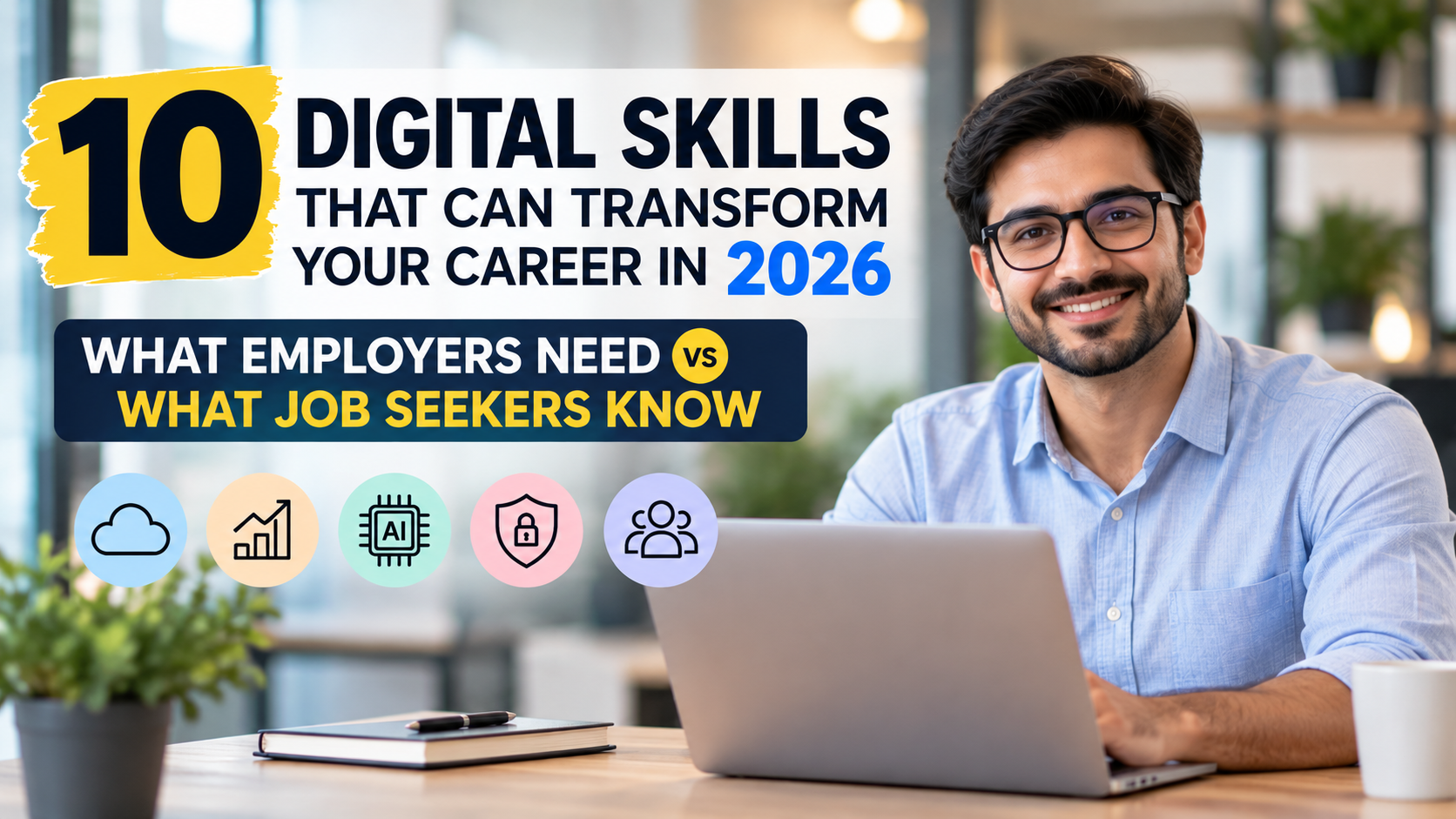
What if the biggest threat to your career in 2026 isn’t AI taking your job, but someone who knows how to use AI better than you? The workplace is changing rapidly, and digital skills are becoming the new career advantage. From AI and automation to data analytics, cloud computing, cybersecurity, and digital collaboration, technology is no longer something only IT professionals need to understand. It is becoming part of how almost every profession works, competes, and grows.
The good news? You don’t need to become a programmer or technology expert to stay ahead. The right digital skills can help you work faster, make smarter decisions, solve problems more creatively, and become more valuable in your current role while opening doors to new career opportunities. Whether you’re a student preparing for your first job, a professional looking to move into a new role, or someone trying to future-proof an established career, knowing which skills to build can make a significant difference.
But with hundreds of tools, technologies, and new AI capabilities appearing every year, where should you actually focus your time? This guide explores the 10 digital skills that can transform your career in 2026, why they matter, where they are being used, and how developing them can help you turn changing technology from a career challenge into a career opportunity.

10 Digital Skills That Can Transform Your Career in 2026
The digital skills gap is changing shape. Employers are asking for people who can work with AI, data, cloud platforms, automation and digital workflows — but knowing a tool by name is not the same as being able to use it at work. This guide breaks the gap into 10 practical skill areas and shows what to learn, what to prove and where a certification can fit.
Why the Digital Skills Gap Looks Different in 2026
The biggest career risk in 2026 is not being “non-technical.” It is being technically familiar but commercially unprepared.
A job seeker can list AI, Excel, cloud, cybersecurity, automation and digital marketing on a resume and still struggle to show how those skills change an actual business outcome. At the same time, employers are increasingly navigating work that blends human judgment with AI-assisted execution.
The World Economic Forum reports that employers expect 39% of workers’ core skills to change by 2030. It also identifies AI and big data, networks and cybersecurity, and technological literacy among the fastest-growing skill areas. WEF Coursera’s 2026 Job Skills Report similarly points to rapid growth in GenAI learning and identifies skills such as multimodal prompting, critical thinking, AI personalization, prompt engineering and Excel formulas within its data-skills analysis. Coursera
Knowing what a platform does is increasingly less useful than completing a real workflow with it.
AI can create faster outputs. People still need to define the task, check quality and own the result.
A credential becomes more useful when it sits beside projects, examples and clearly demonstrated skill.
The career lesson
Do not build a “skills list.” Build a skills stack: digital capability + business context + evidence of use. That combination is far easier to explain in interviews and applications.
Employer Need vs Job-Search Reality
There is a subtle but important difference between learning a skill and being employable with that skill. The first is about exposure. The second is about using the skill to make decisions, improve a process, create an output or solve a problem.
Employers increasingly need
- People who can use AI responsibly inside real workflows
- Employees who can interpret data, not only collect it
- Digital workers who understand security and privacy basics
- People who can automate repetitive work and document processes
- Adaptable learners who can move across digital tools
Common application weakness
- Skill names appear without examples
- Certificates are listed without context
- AI is described as a generic productivity skill
- Projects show outputs but not decisions or impact
- Technical skills are disconnected from the target job
What closes the gap
- One practical project per priority skill
- Short, specific evidence in the resume
- A clear “before → after” process story
- Role-specific certification and practice
- Ability to explain trade-offs and limitations
What you may already have
- Comfort with everyday digital tools
- Some AI experimentation
- Basic spreadsheets or dashboards
- Online collaboration experience
- Informal experience solving digital problems
What may still be missing
- Structured knowledge of a skill area
- Depth beyond one tool or interface
- Security, governance and quality awareness
- Portfolio evidence
- A credential that supports the story you are telling
The practical fix
- Choose 2–3 priority skills, not all 10 at once
- Learn the concept and the workflow together
- Create a small, repeatable project
- Document the result
- Use certification to structure and validate the learning journey
The question in 2026 is becoming less “Have you used this tool?” and more “What can you accomplish with it?”
Microsoft’s 2026 Work Trend Index adds an important layer to this shift. In its survey of 20,000 AI-using workers across 10 markets, 86% said they treat AI output as a starting point rather than the final answer. Quality control of AI output and critical thinking were among the human skills respondents said become more important as AI takes on more work. Microsoft
The 10 Digital Skills to Build
Think of these as a portfolio, not a checklist. You do not need expert-level depth in all ten. You need the right combination for your role.
Explore the 10 skills below: one skill stays open so you can read without losing your place. Select another skill to switch the focus instantly.
AI Literacy & Prompting
Every roleWhy employers value it
AI literacy is no longer simply knowing what ChatGPT or another generative AI tool can do. Workplace AI fluency means understanding how to frame a task, provide useful context, choose the right tool, work with structured prompts, review the output and decide when human judgment must override automation. The gap often appears when a candidate can generate an answer but cannot explain whether the answer is reliable, complete, safe or appropriate for the business context.
What to learn
Build capability around prompt design, context setting, role and task instructions, output formatting, iterative prompting, fact-checking, source checking, privacy awareness and responsible use. Learn to treat AI as a work assistant rather than an answer machine. Practise using it for research, documentation, analysis, ideation, reporting and workflow support.
How to apply it at work
Apply the skill to a real process. Take a repetitive activity such as preparing a report, summarising research, creating a customer-response draft or analysing a meeting transcript. Document the original process, the AI-assisted process, the checks you introduced and the final human decision. That turns generic AI familiarity into a repeatable workplace method.
How to build proof
Create an AI workflow case study with four parts: task, prompt strategy, quality-control checklist and final result. A strong portfolio example should show both what AI produced and how you evaluated or improved it. A Vskills certification can provide structured learning around the relevant skill, while the project demonstrates that you can apply it.
Data Literacy & Analytics
Cross-functionalWhy employers value it
Data literacy is the ability to move from numbers to meaning. Employers need people who can understand what a metric represents, question the quality of the data, identify patterns and explain what those patterns mean for a business decision. You do not need to be a data scientist to benefit from this skill. Sales, HR, finance, marketing, operations and project teams all increasingly work with dashboards, spreadsheets and business data.
What to learn
Build a foundation in spreadsheets, data cleaning, descriptive statistics, charts, dashboards and basic query logic. Learn to distinguish correlation from causation, identify outliers and missing values, define useful metrics and ask better questions before opening a dashboard. For advanced roles, add SQL, BI tools or a programming language used for analysis.
How to apply it at work
Take a practical business question such as declining sales, high employee attrition, campaign performance or delayed delivery. Gather a small dataset, clean it, analyse the drivers, visualise the key findings and write a short recommendation. The important shift is to explain not just what the data says, but what someone should do because of it.
How to build proof
Build one dashboard or analytical report that includes the business question, data preparation, analysis, visualisation and recommendation. Add a short section called ‘What the data cannot tell us’ to demonstrate analytical judgment. That final step is often what separates tool usage from real decision support.
Cybersecurity Awareness
Every organisationWhy employers value it
Cybersecurity has moved beyond the IT department because everyday employees interact with identity systems, cloud applications, files, links, customer data and AI tools. A digitally capable employee should recognise common threats, understand why access controls matter and know how seemingly small behaviours can create organisational risk.
What to learn
Learn the fundamentals of identity and access, authentication, least privilege, phishing, malware, secure passwords, data protection, device security, safe sharing and incident reporting. For technical or security-focused roles, progress into vulnerability management, security monitoring, governance or cloud security. The foundation is knowing what risk looks like before trying to manage it.
How to apply it at work
Practise with realistic scenarios. Examine a suspicious email, review a hypothetical access list, assess a file-sharing setup or create a simple security-awareness checklist for a small team. Explain the threat, the likely impact, the control that reduces the risk and the action an employee should take.
How to build proof
Create a security scenario pack or mini risk assessment. Show three to five common workplace situations and document the recommended response. This provides concrete evidence that you understand security as a business responsibility rather than a collection of technical terms.
Cloud & SaaS Fluency
Modern operationsWhy employers value it
Cloud fluency means understanding how modern digital services are delivered and managed. You should be able to explain the difference between using a cloud service and managing one, understand shared responsibility at a basic level, and recognise how identity, storage, availability, security and cost affect a cloud-based solution.
What to learn
Build knowledge around cloud service models, core compute and storage concepts, identity and access, networking basics, backups, monitoring, collaboration platforms and SaaS administration. You do not need to memorise every provider-specific service. Focus first on the underlying concepts that transfer across platforms.
How to apply it at work
Choose a business workload such as document management, a customer portal, a small analytics environment or an internal collaboration solution. Map its requirements to cloud services. Then explain the trade-offs around security, user access, availability, scalability and cost. A simple architecture diagram can make the reasoning visible.
How to build proof
Create a one-page cloud solution brief. Include the business need, proposed services, access model, data location, security considerations, backup approach and major cost drivers. This demonstrates architectural thinking even when the project is small.
Automation & No-Code Workflows
ProductivityWhy employers value it
Automation skill is really process skill plus technology. The useful professional is not the person who automates everything, but the person who can identify work that is repetitive and rules-based, decide whether automation is appropriate and build a reliable workflow with sensible checks and exception handling.
What to learn
Learn process mapping, triggers, actions, conditions, approvals, notifications, integrations and basic error handling. Depending on your role, explore no-code or low-code tools, spreadsheet automation, scripts, APIs or workflow platforms. Also learn when not to automate, especially where human judgment, sensitive data or unusual exceptions matter.
How to apply it at work
Pick a recurring process such as weekly reporting, lead follow-up, invoice reminders, approval routing, data consolidation or content publishing. Map the current process first. Then automate the predictable steps, test edge cases and compare the new workflow with the old one.
How to build proof
Show the before-and-after process. Quantify time saved, number of manual steps removed, error opportunities reduced or turnaround improved. A process diagram plus a working automation is much stronger evidence than simply listing an automation platform on a resume.
Digital Marketing & Analytics
Growth rolesWhy employers value it
Modern digital marketing is a measurement discipline as much as a content discipline. Employers need people who can understand an audience, choose relevant channels, use AI and digital tools productively, and connect activity to metrics such as reach, engagement, conversion, retention or revenue-related outcomes.
What to learn
Build capability in content strategy, search, social media, campaign planning, audience segmentation, analytics, experimentation and basic conversion thinking. Learn how to interpret performance rather than treating metrics as a reporting exercise. AI can accelerate ideation and production, but strategy still requires audience understanding and judgment.
How to apply it at work
Create a small campaign around a realistic business objective. Define the audience, message, channel mix, content plan, conversion point and measurement framework. Then create sample content or a landing-page concept and explain what you would test first and why.
How to build proof
Build a campaign case study that includes objective, audience, assets, channel choices, KPIs, test plan and results or simulated results. The value is in the reasoning that connects marketing activity with business intent.
Digital Collaboration & Productivity
Hybrid workWhy employers value it
Digital collaboration is more than knowing how to use chat, video meetings or shared documents. Strong digital workers know how to structure information so another person can find it, understand it and act on it without unnecessary back-and-forth. This becomes especially important when teams work across locations, time zones and asynchronous schedules.
What to learn
Develop habits around shared drives, documentation, digital meeting practices, project boards, task ownership, version control, naming conventions, knowledge bases and asynchronous updates. Learn to distinguish information that needs a meeting from information that should be documented and discoverable.
How to apply it at work
Design a simple digital workspace for a team project. Decide where tasks live, where documents belong, how decisions are captured, how deadlines are tracked and how stakeholders receive updates. The goal is to create a system that reduces confusion rather than adding another tool.
How to build proof
Show a workspace blueprint with screenshots, information architecture, workflow rules and examples of updates. Explain how your design reduces duplicate work, improves visibility or makes handoffs easier. That demonstrates operational value rather than software familiarity.
UX & Customer Experience
Customer-facingWhy employers value it
A technically successful product can still fail if users cannot understand it, navigate it or complete what they came to do. UX and customer experience skills help professionals look at digital work from the user’s perspective and identify friction before it becomes a business problem.
What to learn
Learn user journeys, personas at a practical level, task flows, usability principles, accessibility basics, feedback collection and experience measurement. You do not need to become a specialist UX designer to benefit. The transferable skill is learning to observe where users struggle and connect that friction to a product or process decision.
How to apply it at work
Audit a website, app, internal portal or digital form. Walk through a specific task from the user’s point of view. Record confusing steps, unnecessary fields, unclear messages or accessibility barriers, then propose improvements and explain why they should make the experience easier.
How to build proof
Create a short UX audit with evidence, screenshots, friction points, recommendations and prioritisation. Tie each recommendation to a user problem and a potential business effect such as reduced abandonment, faster completion or fewer support requests.
Digital Project & Process Skills
ExecutionWhy employers value it
Digital projects fail as often from unclear scope and ownership as from technical problems. Professionals with project and process skills can turn a goal into a structured plan, clarify dependencies, identify risks and keep work moving when priorities change.
What to learn
Learn project scoping, task decomposition, milestones, dependencies, stakeholder communication, risk tracking, process mapping and basic metrics. Agile or traditional methods can both be useful. The transferable capability is knowing how to make work visible and manageable.
How to apply it at work
Take an ambiguous goal such as launching a certification campaign, implementing a reporting dashboard or improving an onboarding process. Break it into deliverables, owners, dependencies and milestones. Add risks, assumptions and a simple definition of done for each major output.
How to build proof
Build a project plan or process map that another person could actually use. Include the original problem, your structure, risks and measures of success. Explain one example of how you would handle a missed dependency or changing requirement.
Digital Communication & Critical Thinking
Human edgeWhy employers value it
As digital tools make information faster to produce, the ability to question, interpret and communicate that information becomes more valuable. Critical digital communication means knowing what evidence supports a conclusion, where uncertainty remains and how to communicate a decision clearly to different audiences.
What to learn
Practise concise business writing, executive summaries, structured reasoning, source evaluation, assumption testing, AI-output review and stakeholder communication. Learn to separate facts, interpretations and recommendations. When using AI, verify important claims and retain responsibility for the final output.
How to apply it at work
Take a complex analysis, report or project update and convert it into a one-page decision note. Start with the problem, present the relevant evidence, explain the options, state the recommendation and identify any unresolved risks or assumptions.
How to build proof
Keep before-and-after examples that show how you made information clearer. Add a short rationale for your recommendation and identify the evidence you relied on. This creates a practical demonstration of judgment that complements technical skills.
Why these ten?
They combine the technology-heavy areas highlighted in recent employer and workforce research with the human capabilities needed to apply them well. The WEF identifies AI and big data, networks and cybersecurity, and technological literacy among the fastest-growing skills, while also highlighting analytical thinking, creative thinking, resilience and lifelong learning. WEF
From Skill to Workplace Value
A digital skill becomes commercially useful when it changes something that matters: time, quality, cost, risk, customer experience, revenue, decision speed or team capacity. This is the step many learning journeys miss. People finish a course, add a tool to their resume and move on without ever translating the capability into workplace language.
Think of workplace value as a chain rather than a single outcome. First, you understand the skill. Then you recognise a problem that the skill can improve. Next, you apply the capability in a controlled workflow. After that, you measure or observe the change, communicate what happened and decide whether the new approach should become part of the normal process.
Spot the friction
Look for work that is slow, repetitive, error-prone, difficult to measure, difficult for users or dependent on too much manual coordination.
Frame the business problem
Define what is happening now, who is affected, what the cost or risk is and what a better outcome would look like.
Choose the digital capability
Select the smallest combination of skills and tools that can address the problem. Do not automate or add technology simply because it is available.
Build and test
Create the workflow, dashboard, campaign, analysis, security control, digital workspace or user improvement. Test normal cases and exceptions.
Measure and improve
Compare the new approach with the old one using time, accuracy, quality, adoption, cost, customer feedback or another meaningful indicator.
The simplest formula to remember
Skill + Problem + Action + Evidence = Workplace Value. A recruiter does not need to know every feature of the tool you used. They need to understand what problem you solved, what you did, what changed and what you learned from the result.
| Skill | Business problem | What you do with the skill | Evidence of workplace value |
|---|---|---|---|
| AI literacy | Research or drafting takes too long and output quality varies. | Design a repeatable AI-assisted workflow with prompts, source checks and human review. | Documented workflow, quality checklist, turnaround comparison and final output. |
| Data analytics | Teams have data but struggle to identify what requires action. | Clean, analyse and visualise the relevant information around a defined business question. | Dashboard or report plus a decision note explaining the recommendation. |
| Cybersecurity | Employees or workflows expose avoidable access and data risks. | Identify threats, review controls and recommend safer behaviour or access practices. | Mini risk assessment, control checklist or security-awareness scenario. |
| Cloud & SaaS | A team needs scalable digital services without losing control of security or access. | Map requirements to cloud services and document identity, data, availability and cost considerations. | Solution brief, architecture diagram and trade-off analysis. |
| Automation | Repetitive manual steps consume time and create errors. | Map the process, automate predictable steps and introduce exception handling. | Before/after process map, automation demo and time or error comparison. |
| Digital marketing | Marketing activity generates content but not enough measurable insight. | Connect audience, content, channels, experiments and metrics into a campaign plan. | Campaign case study with KPIs, test logic and performance analysis. |
| Digital collaboration | Teams lose time searching for information or coordinating work. | Create a clear workspace, ownership model, documentation and update rhythm. | Workspace blueprint, sample documentation and improved handoff process. |
| UX / CX | Users struggle to complete tasks or need repeated support. | Map the journey, identify friction and redesign the problem area around user needs. | UX audit, journey map, recommendation set and usability evidence. |
| Digital project skills | Work stalls because priorities, ownership and dependencies are unclear. | Structure scope, tasks, milestones, dependencies, risks and success measures. | Project plan, process map, risk log and example stakeholder update. |
| Critical digital communication | Good analysis is produced but decisions are slow or misunderstood. | Turn complex information into a concise evidence-based decision narrative. | One-page decision note, executive summary or before/after communication sample. |
What workplace value sounds like in an interview
A weak answer starts with the tool: “I know Power BI, ChatGPT, Excel and automation.” A stronger answer starts with the problem: “Our weekly reporting process required several manual exports and checks. I consolidated the data, built a repeatable workflow and created a dashboard that made the key trends visible. I also added validation steps so that unusual values were reviewed before the report went out.”
The second example gives the interviewer several things to evaluate: your understanding of the problem, your technical approach, your quality controls and your ability to explain the outcome. That is why skill development should not stop at tool training. The final stage is learning how to explain the work as a business story.
Save time
Use automation, AI, templates or better collaboration to reduce avoidable manual work.
- Track turnaround time
- Count manual steps removed
- Document repeatability
Improve quality
Use data checks, standardised workflows, UX improvements or clear communication to reduce avoidable mistakes.
- Track rework or errors
- Show quality checks
- Explain what changed
Reduce risk
Use cybersecurity, governance, access controls and critical thinking to prevent avoidable exposure.
- Identify the threat
- Describe the control
- Show how you monitor exceptions
Improve decisions
Use analytics and communication to convert fragmented information into a clear recommendation.
- State the question
- Show the evidence
- Explain the decision
Improve customer experience
Use UX, data and digital marketing to identify friction and make customer interactions easier or more relevant.
- Map the journey
- Identify friction
- Measure the change
Increase team capacity
Use collaboration, documentation, automation and process design to help teams work with less coordination overhead.
- Make work visible
- Clarify ownership
- Standardise repeatable work
The Vskills connection
A Vskills certification can give you a structured path to learn and validate a defined skill area. The strongest career story comes when that credential is paired with an applied example: what you learned, where you used it, what you produced and what changed. Use your learning journey to create evidence that can travel with you across resumes, interviews, projects and internal career conversations.
Do not ask only, “What skill should I learn?” Ask, “What workplace problem will I be able to solve after I learn it?”
Which Skills Matter for Your Career Stage?
Different candidates need different combinations. Use the tabs to build a more focused plan instead of trying to master everything simultaneously.
Build a broad base, then show one clear project
Start with AI literacy, data literacy, collaboration and cybersecurity awareness. Add one role-specific skill such as digital marketing, cloud, automation or UX. Your goal is to graduate from “I learned this” to “Here is what I built with it.”
Translate your existing experience into digital language
Do not throw away your previous career. Add a digital layer to it. A finance professional can add analytics and automation. An HR professional can add people analytics and AI-assisted workflows. A sales professional can add CRM, data and automation skills.
Move from tool user to workflow owner
Pick two adjacent skills that make your current role more valuable. Pair a technical capability with critical thinking or communication. For example, combine data analytics with decision writing, or AI literacy with process automation.
Learn to design work, not just operate tools
Managers need enough digital fluency to choose tools, set quality standards, design controls, measure outcomes and help teams use AI responsibly. Microsoft’s 2026 Work Trend Index specifically points to the role of managers in modelling AI use and creating conditions for experimentation. Microsoft
Digital Skills Gap Check
Rate yourself honestly. Choose the option that best describes what you can do today, not what you have watched or read about.
Where is your digital skills gap?
Each question represents one of the 10 skill areas in this guide. Your result is a planning signal, not a formal assessment.
Your 90-Day Digital Skills Roadmap
A good digital-skills plan should be narrow enough to finish and practical enough to show. Pick 2–3 skills connected to your target role.
| Phase | What to do | What you should have at the end |
|---|---|---|
| Days 1–30 | Choose your target role, map the skills it needs, learn the fundamentals and complete guided exercises. | A personal skill map, learning plan and 1–2 small practice outputs. |
| Days 31–60 | Build one role-relevant project using your priority skills. Add one certification or structured assessment path. | A portfolio project, notes on the process and evidence of what you can do. |
| Days 61–90 | Refine your resume, practise interview explanations and build a second proof point where needed. | A role-specific resume, project story, certification evidence and interview examples. |
Do not wait until you feel “fully ready”
Digital skills improve through cycles of learning, applying, reviewing and rebuilding. The 2026 career advantage comes from creating a habit of continuous learning rather than treating upskilling as a one-time event. The WEF reports that 50% of workers had completed training as part of longer-term learning strategies in its 2025 study. WEF
How to Turn Learning into Proof
A certificate tells someone you completed a structured learning experience. A project shows how you use the skill. Your strongest profile usually connects the two.
Where Vskills Certification can fit
Use a Vskills certification as part of a structured upskilling path when it matches the role and skill area you want to build. The strongest career story is not “I have a certificate.” It is “I built the skill, applied it, and can demonstrate it.”
Build a digital skill that moves your career forward.
Explore Vskills certifications, choose a focused skill path, practise it with intent, and build evidence you can use in your next role, project or career move.
Frequently Asked Questions
No. The better approach is to choose a small stack based on your target role. A digital marketer may prioritize AI, analytics, marketing and automation, while a project professional may prioritize AI, collaboration, process and data skills.
AI literacy is increasingly important, but it works best alongside data judgment, cybersecurity awareness, communication and domain knowledge. The WEF’s employer outlook also highlights analytical thinking, creative thinking, resilience and lifelong learning alongside technology skills. WEF
A certification can provide structure and a way to demonstrate that you completed a defined learning path, but it should not be treated as a substitute for applied evidence. Pair it with hands-on work, projects and examples that show what you can actually do.
Collecting tool names instead of building capability. A resume with twenty applications and platforms can be weaker than a resume that demonstrates three skills through strong, relevant examples.
Keep a continuous learning rhythm. Review your target role every few months, identify changes in tools or expectations, and add one new capability or deeper layer rather than restarting from zero each time.