Future technologies are not something you prepare for “one day.” In 2026, many of them are already driving real hiring because companies are under pressure to do three things at once: automate work, secure digital systems, and build products that scale faster with fewer resources. This is why roles linked to AI, cloud, cybersecurity, data, and next-generation computing are increasingly seen as high-paying. They sit close to business-critical outcomes like productivity, reliability, risk reduction, and speed to market.
However, “high-paying technology” does not mean every job in that area pays high immediately. The highest salaries usually go to roles that combine strong fundamentals with rare, applied skills. In simple terms, companies pay more when you can build something that works, maintain it in real conditions, and explain your decisions clearly. That is why this blog is not only a list of technologies. It is a guide to the highest-paying job roles inside each technology, the core skills you need to enter the field, and how you can start building a strong profile even if you are a fresher.
In this blog, you will find the top 10 future technologies shaping 2026 and the highest-paying jobs linked to them. For each technology, you will see what makes it valuable, which roles pay the most, what skills to learn first, and what kind of projects or proof of work can help you get shortlisted. By the end, you will be able to choose one technology path confidently instead of feeling overwhelmed by too many options.
Selection of Future Technologies 2026
This list is not based on hype or “trending” keywords. It is based on what typically drives higher salaries in technology markets: roles that sit close to business-critical outcomes, have a shortage of job-ready talent, and require skills that are hard to copy quickly. we selected these 10 technologies using four filters:
- Demand and longevity: These technologies are not one-season trends. They are long-cycle areas where companies invest for years because they shape core infrastructure, productivity, and competitiveness.
- Salary ceiling and career progression: Each technology has roles with strong earning potential at mid-to-senior levels, not only at entry level. The aim is to highlight fields where you can grow into high-paying roles over time.
- Cross-industry relevance: Technologies that apply across multiple sectors (finance, healthcare, retail, manufacturing, government, SaaS) usually offer more stable opportunities than niche areas.
- Clear skill roadmap and proof of work: A technology is more practical for readers if you can build measurable skills and create portfolio projects to get shortlisted. Wherever possible, the list favours technologies with learnable entry points.
One important note: salaries vary widely by country, company type, location, and experience level. “Highest paying” here refers to technologies with strong salary potential, especially when you build real skills and proof of work, not just certifications.
Comparison Future Technologies and High-Paying Roles 2026
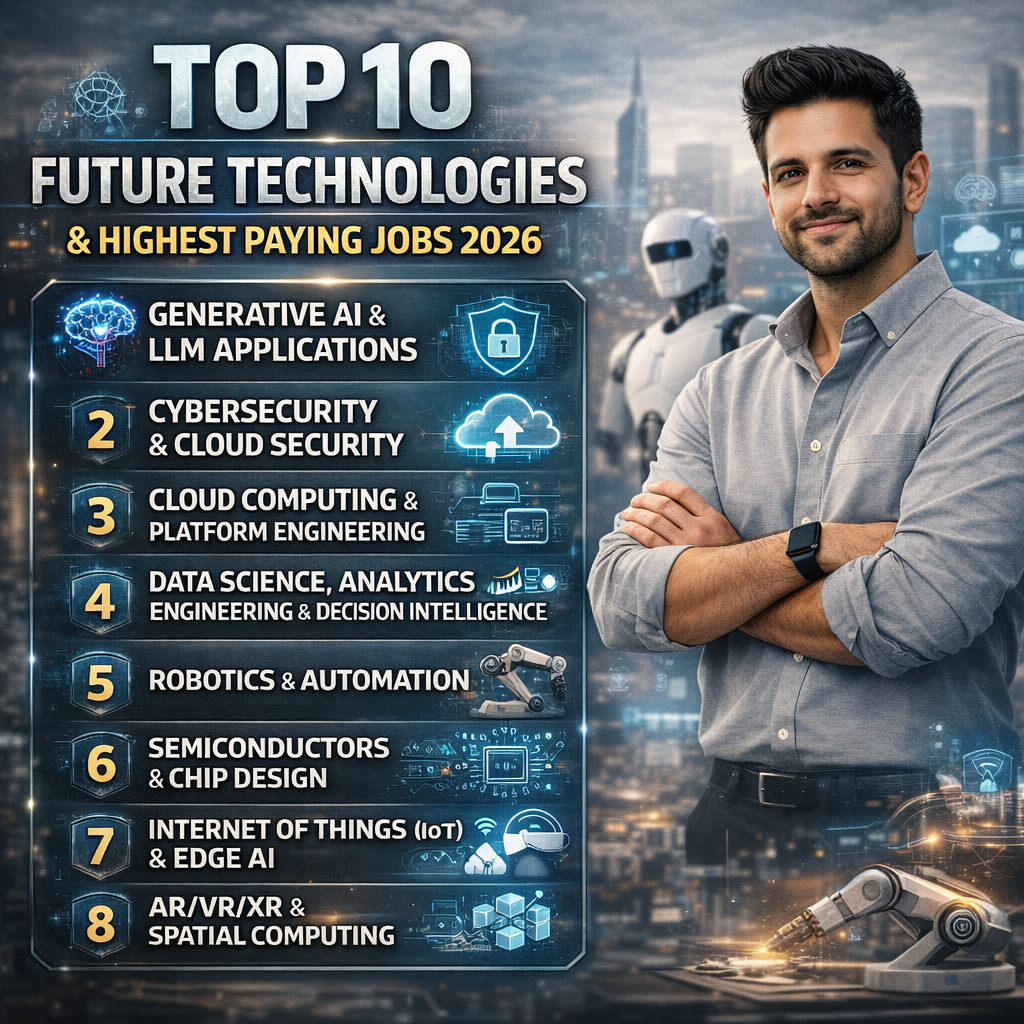
| Future Technology (2026) | Why It Pays Well | Highest-Paying Job Roles (Examples) | Core Skills to Start With |
| Generative AI and LLM Applications | Direct productivity and product impact | LLM App Developer, AI Engineer, AI Product Specialist | Python, APIs, Prompting, RAG basics |
| Cybersecurity and Cloud Security | High risk, high compliance pressure | Cloud Security Engineer, Security Architect, SOC Analyst (advanced) | Networking basics, Security fundamentals, IAM |
| Cloud Computing and Platform Engineering | Core infrastructure for modern companies | Platform Engineer, DevOps Engineer, SRE | Linux, Cloud basics, CI/CD, Containers |
| Data Science and Analytics Engineering | Decisions depend on data quality and speed | Analytics Engineer, Data Scientist, BI Engineer | Excel/Sheets, SQL, Dashboarding, Python basics |
| Robotics and Automation | Productivity gains in manufacturing/logistics | Robotics Engineer, Automation Engineer, PLC/SCADA Specialist | Control basics, Sensors, Automation logic |
| Semiconductors and Chip Design | Strategic tech with deep skill barrier | VLSI Engineer, Verification Engineer, Physical Design Engineer | Digital logic, Verilog, Hardware basics |
| IoT and Edge AI | Smart devices + local intelligence | Embedded/IoT Engineer, Edge AI Engineer | Microcontrollers, Sensors, Protocol basics |
| AR/VR/XR and Spatial Computing | Training and simulation use cases growing | XR Developer, 3D Technical Artist, Simulation Developer | Unity/Unreal basics, 3D pipeline basics |
| Blockchain and Web3 Infrastructure | Specialised roles (but selective market) | Smart Contract Dev, Blockchain Security Auditor | Solidity basics, Security thinking, Testing |
| CleanTech and Energy Tech | Large investment cycles + infrastructure buildout | Battery Engineer, Energy Systems Engineer, Energy Analyst | Power/energy basics, Modelling, Data analysis |
Let’s now look at each career option in detail!
(1) Generative AI and LLM Applications
Generative AI is the technology behind tools that can create text, code, images, and structured outputs. In workplaces, it is being used to automate drafting, summarising, customer support, internal knowledge search, analytics storytelling, and even parts of software development. The most in-demand area in 2026 is not only “using AI tools,” but building useful applications around them: chatbots grounded in company documents, workflow assistants, and AI features inside products.
Why it is high-paying in 2026?
This field pays well because it sits directly on productivity and product differentiation. Companies are competing on who can ship AI features faster, keep them reliable, and control risks like hallucinations and data leakage. People who can build GenAI apps end-to-end (prompt control + RAG + evaluation + deployment) are still relatively scarce compared to demand.
Highest-paying job roles
- LLM Application Developer / GenAI Developer
- AI Engineer (LLM-focused)
- Conversational AI Engineer
- AI Product Specialist / AI Solutions Engineer
- LLMOps / AI Platform Engineer (for scaling and reliability)
Core skills to learn (in the right order)
- Python basics + working with APIs
- Prompting for control and structured output (JSON, checklists, templates)
- Embeddings + semantic search
- RAG (retrieval-augmented generation) to reduce hallucinations
- App building (Streamlit or FastAPI)
- Evaluation basics (test prompts, pass/fail checks) + logging
Portfolio projects that get you shortlisted
- “Chat with your notes” RAG app that answers questions from PDFs with citations
- Customer support assistant that drafts replies using policy snippets and tags tickets
- Meeting notes to action items tool that outputs structured JSON with priorities
Career path (simple)
Intern/Junior GenAI developer → GenAI developer → AI engineer/LLMOps specialist → lead/architect roles or AI product leadership
(2) Cybersecurity and Cloud Security
Cybersecurity is about protecting systems, data, and users from attacks, misuse, and failures. Cloud security focuses specifically on securing cloud infrastructure and identities (who can access what). In 2026, this matters even more because more business systems are online, remote work remains common, and AI increases both productivity and security risk (faster phishing, faster exploitation, faster misinformation).
Why it is high-paying in 2026?
Security is expensive to get wrong. A single breach can cause financial loss, downtime, legal risk, and reputational damage. As companies move more workloads to the cloud, the attack surface expands, and security roles with strong cloud and identity skills become especially valuable. This combination of high risk and talent shortage pushes salaries up.
Highest-paying job roles
- Cloud Security Engineer
- Security Architect (senior path)
- Incident Response / Threat Hunter (experienced)
- Application Security Engineer
- GRC Specialist (governance, risk, compliance) in regulated sectors
Core skills to learn
- Networking fundamentals (IP, DNS, ports, basic troubleshooting)
- Security fundamentals (threats, vulnerabilities, controls)
- Identity and Access Management (IAM) concepts
- Security operations basics (logs, monitoring, incident response)
- Cloud basics (AWS/Azure fundamentals) + cloud security basics
- Security mindset: least privilege, segmentation, backups, secure configuration
Portfolio projects that get you shortlisted
- A home-lab style security write-up: common attacks + how you would detect them (beginner-friendly)
- A simple incident report template + mock incident walkthrough (what happened, impact, action taken)
- A cloud IAM checklist: secure access rules for a sample startup setup (users, roles, permissions)
Career path (simple)
SOC/Support → Security analyst → Cloud security / AppSec specialization → Architect / Lead roles
(3) Cloud Computing and Platform Engineering
Cloud computing is the backbone that runs modern apps, websites, data systems, and AI tools. Platform engineering is the layer that makes cloud infrastructure reliable and easy for teams to use. In simple terms, platform teams build the “internal cloud platform” so developers and analysts can deploy and run systems safely, quickly, and at controlled cost.
Why it is high-paying in 2026?
Cloud is not optional anymore. Companies want speed, reliability, and cost control. The people who can set up infrastructure properly, automate deployments, handle outages, and optimise performance become extremely valuable. Platform engineering and SRE (site reliability engineering) roles pay well because they sit close to uptime and business continuity.
Highest-paying job roles (examples)
- Cloud Engineer (AWS/Azure/GCP)
- DevOps Engineer
- Platform Engineer
- Site Reliability Engineer (SRE)
- Cloud Solutions Architect (senior path)
Core skills to learn (in the right order)
- Linux basics (commands, permissions, processes)
- Networking fundamentals (DNS, IP, ports, load balancers)
- One cloud platform fundamentals (AWS or Azure)
- Containers: Docker basics
- CI/CD basics (how deployments are automated)
- Monitoring and logging basics (detect issues early)
- Infrastructure-as-Code basics (Terraform style thinking, later)
Portfolio projects that get you shortlisted
- Deploy a simple web app on cloud and set up monitoring (even basic)
- Build a CI/CD pipeline that auto-deploys from GitHub to a test environment
- Create an “incident runbook” for a sample app: what to check when things break
Career path (simple)
Junior cloud/devops → DevOps/Platform engineer → SRE/Lead engineer → Architect roles
(4) Data Science, Analytics Engineering, and Decision Intelligence
This is the technology stack that turns raw data into business decisions. Analytics engineering sits between data and dashboards: it focuses on clean, reliable datasets and models that analysts and teams can use repeatedly. Decision intelligence is the broader idea of using data + AI + experimentation to guide strategy and operational decisions.
Why it is high-paying in 2026?
Companies do not pay for “data” in general. They pay for outcomes: better decisions, better forecasting, faster reporting, and fewer mistakes. People who can build reliable pipelines, explain insights clearly, and influence decisions often earn more than people who only create charts.
Highest-paying job roles
- Analytics Engineer
- Data Scientist (mid to senior)
- BI Engineer / Analytics Developer
- Data Product Analyst (advanced)
- Applied Scientist (senior path)
Core skills to learn (in the right order)
- Excel/Google Sheets for fundamentals (cleaning, pivots, logic)
- SQL (non-negotiable for most roles)
- Dashboarding (Power BI or Tableau)
- Python basics for analysis (pandas, basic plotting)
- Statistics basics for business questions (correlation, testing intuition)
- Data storytelling: turning numbers into decisions
Portfolio projects that get you shortlisted
- One KPI dashboard + a 1-page insight memo (what changed, why, what to do)
- A forecasting mini project (even simple) with assumptions and error checks
- A “data cleaning + modelling” project: messy dataset → clean tables → dashboard
Career path (simple)
Junior analyst → Analyst/BI developer → Analytics engineer/Data scientist → Lead roles or specialised expert roles
(5) Robotics and Automation (Industrial + Service)
Robotics and automation focus on using machines, sensors, and control systems to perform tasks with speed, precision, and consistency. This includes industrial robots in manufacturing, automation in warehouses and logistics, and service robots in areas like healthcare and hospitality. Automation also includes PLC/SCADA systems that control and monitor industrial processes.
Why it is high-paying in 2026?
Automation directly improves productivity and reduces operational errors. Industries that run large physical operations pay well for engineers who can design, deploy, maintain, and optimise automation systems because downtime is expensive and efficiency gains translate into measurable cost savings.
Highest-paying job roles
- Robotics Engineer
- Automation Engineer
- Mechatronics Engineer
- PLC/SCADA Engineer
- Controls Engineer
Core skills to learn (in the right order)
Control systems basics, sensors and actuators, basic electronics, programming fundamentals for automation (depends on role), industrial process understanding, safety standards and troubleshooting. If you are going into robotics software, learn simulation and robotics frameworks later, but start with fundamentals first.
Portfolio projects that get you shortlisted
A simple automation workflow simulation or demo (even in a basic environment), a small sensor-based prototype concept with clear documentation, a case study write-up explaining how you would automate a process end-to-end (inputs, sensors, control logic, outputs, safety checks).
Career path
Technician/Junior engineer → Automation/Controls engineer → Robotics specialist or lead engineer roles
(6) Semiconductors and Chip Design Ecosystem
Semiconductors are the foundation of modern computing. Chip design includes designing digital circuits, verifying that designs work correctly, and implementing them physically on silicon. The ecosystem includes VLSI design, verification, physical design, DFT (design for test), and hardware validation.
Why it is high-paying in 2026?
This field has a high skill barrier and long learning curve, which keeps talent supply limited. Chip design roles also sit in strategic industries where precision and expertise are crucial. The combination of complexity, global competition, and specialised tools pushes salaries up, especially as you gain experience.
Highest-paying job roles
- VLSI Design Engineer
- Verification Engineer
- Physical Design Engineer
- DFT Engineer
- Hardware Validation Engineer
Core skills to learn
- Digital logic and computer architecture basics, Verilog/SystemVerilog, timing and constraints fundamentals
- Verification concepts (testbenches, assertions)
- Clear understanding of the chip design flow. Tool exposure matters, but strong fundamentals matter more at entry level.
Portfolio projects that get you shortlisted
Small RTL designs (simple CPU components, controllers, finite state machines), verification testbench examples, a documented mini project showing your design → verification approach and how you tested correctness.
Career path
Intern/Junior VLSI → Design/Verification engineer → Specialist roles → Lead/Architect roles in chip programs
(7) Internet of Things (IoT) and Edge AI
IoT is about connecting physical devices (sensors, machines, wearables, smart meters) to the internet so they can collect data, communicate, and be controlled remotely. Edge AI adds intelligence at or near the device, meaning the AI runs locally (or partly locally) instead of sending everything to the cloud. This is useful when you need low latency, better privacy, or reliable performance even with weak connectivity.
Why it is high-paying in 2026?
IoT pays well because it combines multiple skill areas: hardware, networking, software, and security. Edge AI increases value because it enables smarter systems in manufacturing, energy, mobility, healthcare, and smart infrastructure. Engineers who can make devices reliable, secure, and scalable are hard to find, so salaries rise with experience.
Highest-paying job roles
- Embedded Systems Engineer
- IoT Developer
- Edge AI Engineer
- IoT Solutions Architect
- Firmware Engineer
Core skills to learn
- Embedded fundamentals (microcontrollers, firmware basics), sensors and communication protocols, basic networking concepts, data handling and messaging (how devices send data), and security basics for devices.
- If you want Edge AI, add fundamentals of ML deployment and model efficiency later.
Portfolio projects that get you shortlisted
A sensor-based project that sends data to a dashboard (even a basic one), a device monitoring workflow with alerts (threshold-based), a short write-up on how you would secure an IoT setup (authentication, updates, encryption, access control).
Career path (simple)
Junior embedded/IoT → Embedded/IoT engineer → Edge AI or IoT architect track
(8) AR/VR/XR and Spatial Computing
AR (Augmented Reality) overlays digital objects on the real world. VR (Virtual Reality) creates a fully immersive virtual environment. XR is the umbrella term that includes AR, VR, and mixed reality. Spatial computing is the broader direction where digital content interacts with physical space, enabling training simulations, product visualisation, remote assistance, and immersive experiences.
Why it is high-paying in 2026?
This field pays well when it is linked to high-value applications like enterprise training, industrial simulation, medical training, defence simulation, design reviews, and immersive retail. The skill mix is specialised: 3D workflows, real-time performance, interaction design, and engine knowledge, so strong talent commands higher pay.
Highest-paying job roles
- XR Developer
- Unity/Unreal Developer (XR focus)
- Simulation Developer
- Technical Artist
- 3D Interaction Designer
Core skills to learn (in the right order)
Pick a platform (Unity or Unreal), learn 3D basics (models, lighting, materials), learn interaction and UI in 3D environments, and develop performance thinking (frame rate, optimisation). If you are design-oriented, strengthen storytelling and user experience for immersive environments.
Portfolio projects that get you shortlisted
Two small XR demos (for example: virtual showroom, training simulation, interactive learning module), a short demo reel (screen recording), a documented breakdown explaining what you built and what you optimised.
Career path (simple)
Junior XR dev/3D generalist → XR developer → Simulation lead or specialist roles
(9) Blockchain and Web3 Infrastructure (Selective and Use-Case Driven)
Blockchain is a type of distributed database where records are stored in a way that is hard to tamper with, and transactions can be verified without a single central authority. In practical career terms, the most serious opportunities are usually in infrastructure, enterprise pilots, payments, identity, tokenisation, and security auditing, not in speculative “quick money” projects.
Why it is high-paying in 2026?
This space pays well in pockets because it requires specialised skills (smart contracts, security auditing, protocol understanding) and the cost of mistakes is high. A small bug in a smart contract can cause large financial loss. That is why security-focused blockchain talent often commands higher pay than general developers in this niche.
Highest-paying job roles
- Smart Contract Developer
- Blockchain Security Auditor
- Protocol Engineer
- Web3 Backend Engineer
- Cryptography Engineer (advanced)
Core skills to learn (in the right order)
Programming fundamentals first, then smart contract development basics (Solidity if you are on Ethereum-type ecosystems), testing and debugging, security mindset (common vulnerabilities), and basic cryptography concepts. If you are serious about this track, security and testing discipline are not optional.
Portfolio projects that get you shortlisted
A simple smart contract project with a full test suite, a mini audit-style report explaining risks and fixes for a sample contract, a small dApp demo that shows end-to-end thinking (contract + frontend + testing + documentation).
Career path (simple)
Junior smart contract dev → Smart contract engineer or auditor → Specialist security/protocol roles
(10) CleanTech and Energy Tech (EV, Batteries, Hydrogen, Grid Tech)
CleanTech and energy tech cover technologies that power the energy transition: electric vehicles and charging networks, battery systems, hydrogen value chains, renewable energy integration, smart grids, and energy storage. This is not only an engineering field. It also includes high-paying analytics and systems roles because energy systems are complex and investment-heavy.
Why it is high-paying in 2026?
Energy is becoming a strategic sector globally. Projects are large, infrastructure-heavy, and regulated, which creates demand for specialised talent across engineering, systems design, safety, and optimisation. Pay rises as you gain domain depth because energy systems involve long timelines, high reliability requirements, and high cost of failure.
Highest-paying job roles
- Battery Engineer
- EV Systems Engineer
- Power Systems Engineer
- Grid Integration Engineer
- Energy Analyst (tech + modelling)
- Energy Product Manager (experienced)
Core skills to learn (in the right order)
- Pick your lane first: engineering lane or analytics lane.
- Engineering lane: fundamentals of power systems, electronics basics, safety, and system design thinking.
- Analytics lane: strong data skills (Excel/SQL/Python), energy metrics, basic modelling, and the ability to translate analysis into operational or investment decisions.
- If you target EV/batteries, add basics of battery performance concepts and system-level trade-offs.
Portfolio projects that get you shortlisted
An energy cost and performance model case study (simple but clearly documented), an EV charging rollout analysis for a city (assumptions + sizing + constraints), a grid reliability or renewable integration explainer with a small dataset and visualisations.
Career path (simple)
Graduate/junior engineer or analyst → Domain specialist → Systems lead/architect roles or strategy/product roles in energy tech
How to Choose the Right Technology for You?
If you like building with code and shipping digital products
- Generative AI, Cloud/Platform Engineering, Data/Analytics Engineering, Blockchain (only if you are comfortable with security and depth)
If you like security, investigation, and risk reduction
- Cybersecurity and Cloud Security (strong long-term path with high ceiling)
If you like hardware, systems, and deep technical specialisation
- Semiconductors, IoT/Embedded, Robotics and Automation, Energy Systems
If you like creativity plus technology
- AR/VR/XR, Generative AI (creative workflows), content and product design roles around AI
If you like numbers, business decisions, and measurable impact
- Data/Analytics, Energy analytics, AI product/solutions roles, cloud cost and operations paths
Skills that Increase Salary 2026
No matter which future technology you choose, the highest-paying roles tend to reward the same set of “career multiplier” skills. These skills make you valuable because they help you deliver outcomes reliably, not just knowledge.
1) Strong fundamentals (the real salary foundation)
- If you are in software-heavy tracks: Python (or one language), APIs, data handling, basic system thinking
- If you are in cloud/security: Linux, networking basics, identity concepts
- If you are in data: SQL + clean reporting logic
- If you are in hardware/energy/robotics: core engineering fundamentals and the ability to reason through systems
People who skip fundamentals plateau early. People who build fundamentals get faster promotions and better offers.
2) Proof of work (portfolio beats claims)
High-paying hiring processes in 2026 increasingly use work samples. A portfolio shows you can deliver.
- 2–4 strong projects are usually better than 10 weak projects
- Each project should have a README, screenshots, what you built, what you improved, and what you would do next
3) Reliability thinking (how your work behaves in real life)
This is what separates average candidates from high-paid ones. Employers want people who think about:
- performance and speed
- failure cases and edge cases
- security and privacy
- cost and maintainability
Even if you are a fresher, showing this mindset in interviews raises your value.
4) Communication and documentation (underrated, but highly paid)
High-paying teams are cross-functional. If you can write clearly, explain trade-offs, and document decisions, you reduce friction and improve execution speed. This matters especially in remote and global teams.
5) Business awareness (why the technology exists)
Knowing the “why” boosts salary because it helps you prioritise correctly. Examples:
- In cloud, cost optimisation and reliability affect profit and customer retention
- In cybersecurity, risk reduction protects revenue and trust
- In data: insights influence decisions and strategy
- In GenAI, reliability and adoption determine real value capture
6) Learning speed and adaptability
Tools change quickly, especially in GenAI and cloud. High earners are not those who memorise tools. They are those who can learn a new tool fast because their fundamentals are strong and they build consistently.
Learning Pathways 2026
Path A: Non-Tech Students (High-Paying Tech-Adjacent Roles)
If you are not from a technical background, the fastest route is to choose roles that sit close to technology outcomes but do not require heavy coding on day one. Your advantage is communication, coordination, documentation, analysis, and process discipline.
Best technology areas to start with
- Generative AI (workflow use cases)
- Data and Analytics (Excel → SQL)
- Cybersecurity (GRC/compliance track)
- Cloud fundamentals (business + ops angle)
- Energy analytics (if you like numbers and policy/business)
Skill plan (8–12 weeks)
- Week 1–2: Excel/Sheets + communication + documentation basics
- Week 3–4: Choose one track
- Data track: SQL basics + dashboarding
- GenAI track: prompting + structured outputs + basic API understanding
- Security track: security fundamentals + compliance and risk basics
- Week 5–8: Build 2 portfolio samples aligned to the role
- Week 9–12: Apply with a role-specific resume + case-study style portfolio
Target job roles
- AI workflow specialist
- Junior Analyst
- Operations Analyst
- BI Intern
- GRC analyst (entry)
- Product analyst intern
- Customer success/solutions associate (tech products).
Path B: Freshers (Job-Ready in 3–6 Months With Projects)
If you are a fresher and can commit consistent time, pick one technology and build depth. High-paying tracks for freshers usually require projects, not only certificates.
Pick one based on your interest
- If you like building apps: Generative AI or Cloud/DevOps
- If you like risk and investigation: Cybersecurity
- If you like numbers and insight: Data/Analytics
- If you like hardware: Semiconductors or IoT/Embedded
- If you like creative tech: XR
Skill plan (12–24 weeks)
- Month 1: Fundamentals (Python or SQL or Linux + networking depending on track)
- Month 2: Build 2 small projects (portfolio-ready)
- Month 3: Build 1 stronger project + documentation + interview prep
- Month 4–6: Internships, freelancing, or entry roles + continue building
Target job roles
- Junior data analyst/BI, cloud support → junior cloud engineer, SOC analyst trainee, junior QA, junior GenAI developer (if projects are strong), embedded intern roles.
Path C: Working Professionals (Switch With Minimal Risk)
If you already have a job, the safest approach is to shift into a future technology that is closest to your current skills. You will switch faster and protect your income.
Switch strategy
- Identify overlap: process, domain, tools, communication
- Choose a track with strong adjacency
- Finance/ops → analytics + automation + GenAI workflows
- IT support → cloud + security
- Marketing/content → GenAI + performance analytics
- Engineering roles → automation/robotics/IoT/energy tech
- Build one “work-like” project that matches your current industry problems
Skill plan (10–14 weeks)
- 45–60 minutes daily learning + 2–3 hours on weekends for projects
- One project with clear business impact (before/after, time saved, errors reduced, cost reduced)
- Resume and LinkedIn reframed around outcomes, not tools
Target job roles
Analytics engineer (junior/mid), cloud ops → platform track, security analyst/GRC track, AI solutions associate, automation analyst.
Portfolio Blueprint (What to Build to Get High-Paying Jobs)
A high-paying job in 2026 is rarely given only because you completed a course. Companies want proof that you can deliver real work. Your portfolio is that proof. The best portfolios are not large. They are clear, role-aligned, and well-documented. Below is a simple blueprint, plus examples for each major category.
What a strong portfolio should look like
- 2–4 projects total (quality over quantity)
- Each project has:
- Problem statement (what you were solving)
- Inputs (data, documents, assumptions)
- Approach (steps and decisions)
- Output (demo, screenshots, result)
- Testing or validation (how you checked it works)
- Learnings and next improvements
GenAI portfolio (LLM applications)
Build projects that show control, grounding, and reliability.
- Project 1: RAG assistant that answers questions from PDFs/notes with clear citations
- Project 2: Structured output tool (meeting notes → action items JSON, policy → checklist, JD → interview kit)
- Project 3 (optional): Tool-using chatbot (calculator, simple database, or rules engine integration)
What to document: how you reduced hallucinations, how you tested prompts, edge cases.
Cybersecurity portfolio
Build projects that show security thinking and clear reporting.
- Project 1: Incident response walkthrough (mock incident report, timeline, containment steps
- Project 2: Log analysis exercise (what you observed, what it might mean, next steps
- Project 3 (optional): Cloud IAM security checklist for a sample company (least privilege)
What to document: threat model, assumptions, and clear mitigation steps.
Cloud/DevOps/Platform portfolio
Build projects that show deployment, automation, and reliability.
- Project 1: Deploy a simple app on a cloud platform (with basic monitoring)
- Project 2: CI/CD pipeline that deploys automatically from GitHub
- Project 3 (optional): Infrastructure-as-code starter (repeatable environment setup)
What to document: architecture diagram, runbook for failures, cost awareness.
Data/Analytics portfolio
Build projects that show decision-making, not just charts.
- Project 1: KPI dashboard + 1-page insights memo (what changed, why, what to do)
- Project 2: Data cleaning + modelling pipeline (messy data → clean tables → dashboard)
- Project 3 (optional): Simple forecasting or cohort analysis with clear assumptions
What to document: metrics definition, data quality checks, how you validated results.
XR/Design/Creative tech portfolio
Build projects that show execution and clarity.
- Project 1: One interactive XR demo (training, showroom, walkthrough)
- Project 2: A second demo in a different style (interaction, UI, environment)
- Project 3 (optional): Demo reel + breakdown of assets and optimisation choices
What to document: design goals, performance constraints, what you learned.
Hardware tracks (Semiconductors/IoT/Robotics/Energy)
Build projects that show fundamentals and system thinking.
- Semiconductors: small RTL modules + verification testbenches
- IoT: sensor project + data pipeline to dashboard + security notes
- Robotics/automation: process automation case study + control logic explanation
- Energy: modelling case study + assumptions + visualisations
What to document: diagrams, test cases, and why your design choices make sense.
The simplest portfolio rule (works for every track)
- One project should prove you can build.
- One project should prove you can test and validate.
- One project should prove you can explain and document clearly.
Common Mistakes People Make While Chasing High-Paying Technologies in 2026
1) Trying to learn all 10 technologies at the same time
This is the fastest way to get overwhelmed. High-paying roles reward depth, not curiosity across everything. Pick one track for 8–12 weeks, build proof, then expand.
2) Collecting certifications without building projects
Certificates can help, but they rarely substitute for proof. Employers want to see that you can apply skills, not just study them. Even a small project with clean documentation can beat multiple certificates.
3) Choosing a technology based only on salary videos
Salary depends on role, location, and experience. Choose a technology where you can build real competence and stay consistent. Interest and aptitude matter because these fields require long-term learning.
4) Skipping fundamentals
People jump straight into advanced GenAI tools, cloud services, or security topics without learning basics like networking, Linux, SQL, or Python. That creates gaps that show up in interviews and on the job.
5) Not learning how to communicate your work
Many candidates build projects but cannot explain what they did, why they did it, and what they would improve. High-paying teams expect clear communication and documentation, especially in remote and global work environments.
6) Building random projects with no job alignment
A portfolio must match the role you are applying for. A GenAI chatbot project may not help if you are applying for data analyst roles. Always align projects to the job description and required skills.
7) Ignoring safety, security, and reliability
This is a major differentiator in 2026. For GenAI, it is hallucinations and data leakage. For cloud, it is outages and cost blowouts. For security, it is weak identity and monitoring. If your portfolio shows you thought about these, you stand out.
8) Applying without a system
High-paying roles are competitive. Random applications do not work. You need a tracking sheet, weekly targets, tailored resumes, and follow-ups. Consistency is what creates results.
Expert Corner
Future technologies in 2026 are not only buzzwords. They are skill ecosystems that companies are actively hiring for because they shape productivity, security, infrastructure, and long-term competitiveness. The highest-paying jobs sit where the impact is high and the talent is scarce, such as building reliable GenAI applications, securing cloud systems, running scalable platforms, converting data into decisions, and developing deep hardware and energy capabilities.
The best way to benefit from these opportunities is not to chase all ten technologies. Pick one track that matches your strengths, learn the fundamentals that support it, and build a small portfolio that proves you can deliver real outcomes. Two to four strong, well-documented projects will usually do more for your job prospects than a long list of certificates with no proof of work.
If you choose one path, practice consistently, and apply with a clear system, you can enter a high-growth technology career in 2026 and build toward the higher-paying roles over time.