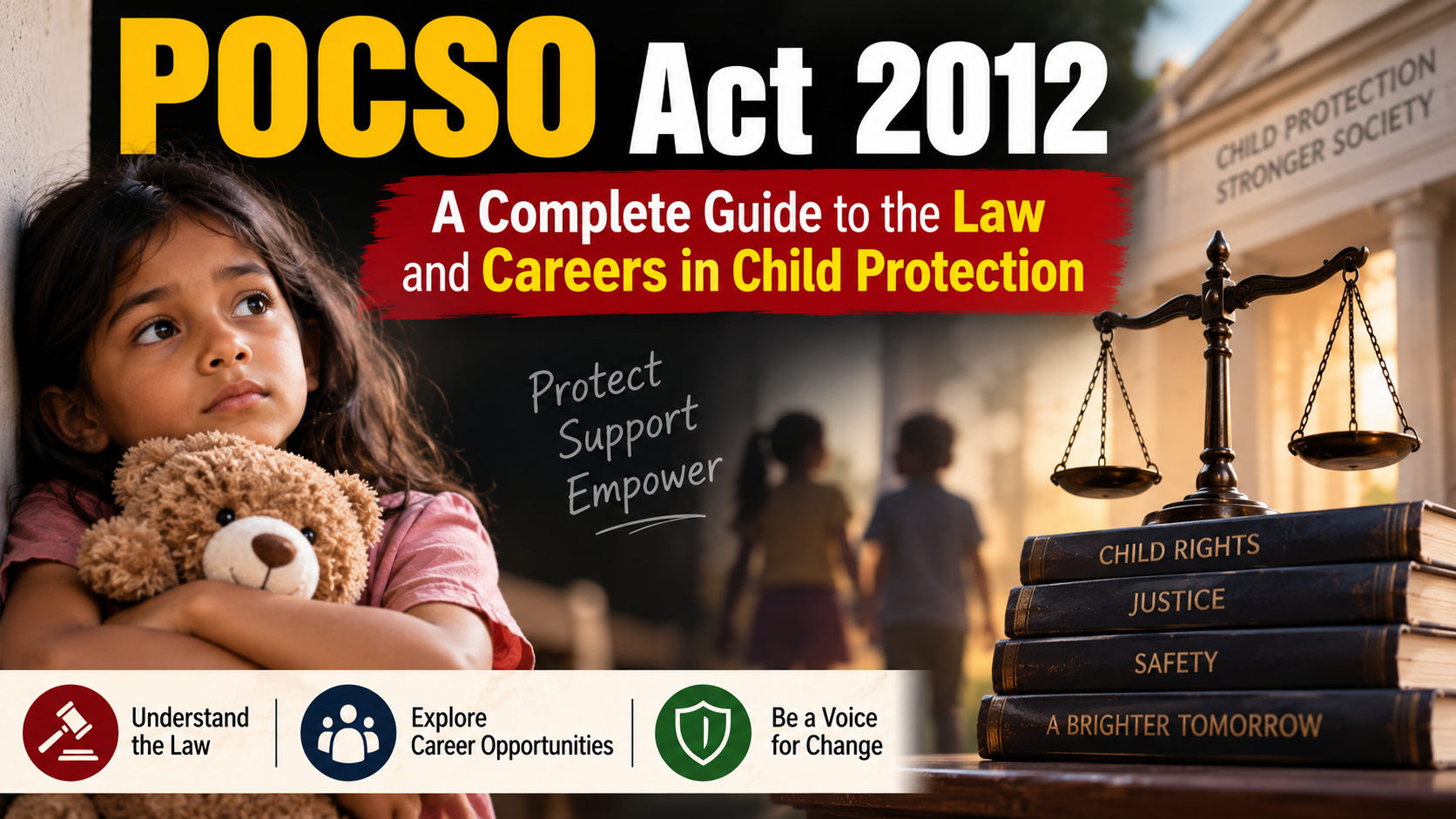
Imagine a child coming home from school one day and suddenly becoming unusually quiet. Nothing seems different at first. The school bag is in its usual place, the books are still on the table, but something has changed. The child is scared, confused, and doesn’t know whom to talk to. Now imagine being the person who notices that change. What would you do? Who would you turn to? And most importantly, what does the law do to protect that child?
Behind every child protection case is a story like this. A story that can involve fear, silence, family, schools, police, courts, counsellors, social workers, and legal professionals. Protecting a child is not simply about punishing the person responsible. It is also about creating a system where a child can report abuse, be heard, receive support, and seek justice without being further traumatised. This is where the Protection of Children from Sexual Offences Act, 2012, commonly known as the POCSO Act, comes into the picture. But what exactly does POCSO cover? What happens when an offence is reported? What protections does the law provide to children? What are the responsibilities of parents, teachers, police officers, and other professionals? And as awareness around child protection grows, could this field also become a meaningful career path for you?
Let’s take a closer look at the POCSO Act 2012, understand the law in simple terms, explore how the child protection system works, and discover the career opportunities available for those who want to make a difference in the lives of children.
Understanding POCSO: The Law, How It Works, and the People Who Make It Work
India’s Protection of Children from Sexual Offences Act touches courts, classrooms, hospitals, police stations, and corporate HR desks alike. This is a complete guide — starting from what the Act actually says, through how a case moves in real life, to who does this work and whether it might be a career worth building.
Most people encounter the word “POCSO” for the first time in a news headline, a school circular, or a corporate compliance email — and rarely with any real explanation of what the law actually says, how it works day to day, or who spends their careers making it work. That gap is worth closing properly. This is a from-scratch, comprehensive guide: what the Act covers, the institutions built around it, the people who staff those institutions, and — because this is genuinely a growing, meaningful field of work — an honest look at whether it might be a career path worth considering.
A note on how this article is written
This piece describes the POCSO Act’s legal structure, institutional framework, and career landscape for educational and professional-development purposes. It is not legal advice, and it deliberately stays at the level of law, policy, and process rather than case narrative. If you or someone you know needs support, India’s Childline helpline (1098) operates nationally and is free to call.
What Is POCSO? Starting From the Beginning
The Protection of Children from Sexual Offences (POCSO) Act, 2012 is India’s dedicated criminal law addressing sexual abuse, harassment, and exploitation of children. It was introduced in Parliament in February 2012, passed by the Lok Sabha on 22 May and the Rajya Sabha on 7 June that year, and came into force on 14 November 2012. Before POCSO, cases involving child sexual abuse were prosecuted under general provisions of the Indian Penal Code — language originally written for adult victims, using vague terms like “outraging modesty” that were never designed to capture the specific dynamics, or protect the specific vulnerabilities, of a child.
The Act’s arrival was also India fulfilling an international commitment: the country ratified the United Nations Convention on the Rights of the Child in 1992, which obligates signatory states to protect children from all forms of sexual exploitation and abuse. It took two more decades of rising documented cases, growing public and legislative pressure, and mounting recognition that existing law simply wasn’t built for this purpose before that international commitment became a dedicated domestic statute.
Two design choices set POCSO apart from ordinary criminal law, and both matter enormously for everything that follows in this article. First, it is gender-neutral: the Act protects every person under the age of 18, regardless of gender — a deliberate departure from earlier frameworks that implicitly or explicitly centred only girl children. Second, it is child-centric by design at every procedural stage, not just in its definitions — from how a complaint is first recorded, to how evidence is gathered, to how a trial is conducted, the Act repeatedly prioritises minimising further distress to the child over the convenience of standard adult-oriented legal procedure.
POCSO didn’t just create new punishments. It rebuilt the entire procedural path a case takes, around the needs of a child rather than the habits of an adult courtroom.
That rebuilding is really the heart of what this article is about. A law is only as strong as the system of people trained to carry it out — police officers who know how to record a child’s statement without causing further harm, doctors who understand child-specific medical examination protocols, judges who conduct in-camera trials, counsellors who support a child through a process that can otherwise feel frightening and impersonal. Understanding POCSO properly means understanding both the statute and the ecosystem of professionals built around it — which is exactly the order this guide follows.
How the Act Is Structured
POCSO organises offences into distinct legal categories, each with its own definition and penalty structure. Understanding these categories — at the level of legal classification, which is how courts, textbooks, and government fact sheets themselves describe them — is essential background for anyone working in or around this field.
| Offence Category | What Distinguishes It |
|---|---|
| Penetrative Sexual Assault | The Act’s foundational offence category, defined broadly and in gender-neutral terms |
| Aggravated Penetrative Sexual Assault | The same offence committed under specific aggravating circumstances — including by a person in a position of trust or authority (a police officer, member of the armed forces, public servant, or staff of an educational or religious institution), by a relative, during a period of unrest, or where it results in grave physical harm |
| Sexual Assault | A separate, distinct offence category under the Act, again defined without reference to the child’s gender |
| Aggravated Sexual Assault | Sexual assault under the same categories of aggravating circumstance described above |
| Sexual Harassment of a Child | A distinct, lower-threshold offence category recognising that harm to a child does not require physical contact to be a crime |
| Use of a Child for Pornographic Purposes | Criminalises using a child in any form of media for sexual gratification, with the 2019 amendment substantially strengthening penalties in this category |
The concept of “aggravation” deserves particular attention because it reflects the Act’s core insight: harm to a child is treated as more severe, not less, when it’s committed by someone the child was taught to trust. A teacher, a police officer, a relative, or anyone in a position of authority over a child faces a substantially harsher legal consequence than a stranger committing an equivalent act — a deliberate legislative recognition that betrayal of trust compounds harm rather than diminishing it.
The 2019 amendment, briefly
Parliament amended the Act in 2019 to introduce the death penalty as an available (not mandatory) sentence for aggravated penetrative sexual assault, and to significantly tighten the legal definition and penalties around child pornography, extending liability to storage and transmission, not only creation. The amendment reflected growing legislative concern about the intersection of digital platforms and child exploitation — a concern that has only grown since.
Two additional structural features matter for how the Act actually functions in practice. First, all POCSO offences are cognizable and non-bailable — meaning police can register a case and begin investigation without prior court permission, and bail is not granted as a matter of routine, reflecting the seriousness Parliament assigned to these offences. Second, the Act builds in a presumption that shifts the ordinary burden of proof in specific circumstances — once the prosecution establishes foundational facts, the accused bears the burden of proving innocence, rather than the child having to conclusively prove every element of the offence from scratch. This is a significant, deliberate departure from ordinary criminal procedure, built specifically around the recognition that children are rarely equipped to meet an adult-standard evidentiary burden.
How a Case Actually Moves Through the System
Understanding POCSO on paper is one thing; understanding how a case actually travels through India’s institutions is what makes the Act real. The process is designed as a chain of specialised, child-friendly steps, each staffed by people trained specifically for this purpose — which is precisely where the career landscape covered later in this article comes from.
| Stage | What Happens | Who’s Involved |
|---|---|---|
| 1. Reporting | Any person who has knowledge of an offence, or a reasonable apprehension one will be committed, has a mandatory legal duty to report it; the Act sets out a specific, active penalty for knowingly failing to do so | Any citizen; specifically, teachers, doctors, and institutional staff who encounter children professionally |
| 2. Recording the complaint | Police must record the child’s statement in a manner appropriate to the child’s age and understanding, generally at the child’s residence or a place of the child’s choice, and preferably by a woman police officer | Special Juvenile Police Units (SJPUs) or designated Child Welfare Police Officers |
| 3. Medical examination | Conducted under a specific statutory protocol designed to be as minimally distressing as possible, in the presence of a person the child trusts | Registered medical practitioners, following child-specific examination guidelines |
| 4. Immediate care | Assessing the child’s need for shelter, medical care, and psychological support, independent of the criminal case’s progress | Child Welfare Committees (CWCs) |
| 5. Trial | Conducted in-camera (closed to the public), on a time-bound basis, before a judge, without the child facing the accused directly wherever possible | Special Courts, Special Public Prosecutors |
| 6. Ongoing support | A trained individual assists the child and family in understanding and navigating the entire process, from reporting through to trial completion and beyond | Support Persons, appointed under the POCSO Rules, 2020 |
Why “in-camera” and “time-bound” matter so much
Chapter VII of the Act mandates that state governments, in consultation with the Chief Justice of the concerned High Court, designate Special Courts specifically for POCSO cases in every district. These courts try cases without public or media presence in the courtroom, aim to complete recording of the child’s evidence within 30 days, and target overall trial completion within roughly a year — a dramatic acceleration compared to the pace of ordinary criminal proceedings in India, and a deliberate recognition that prolonged legal uncertainty is itself a form of ongoing harm to a child.
A digital reporting layer has also been built on top of this framework: the POCSO e-Box, an online complaint mechanism run by the National Commission for Protection of Child Rights (NCPCR), lets a child or a concerned adult file a complaint directly, without necessarily going through a police station first — a channel specifically designed for situations where a child may feel unable to approach law enforcement directly, or where the alleged offender is someone with authority over the reporting process itself.
It’s worth being explicit about what this article will not cover, and why: descriptions of how abuse occurs, warning-sign checklists framed as detailed behavioural inventories, or narrative case examples. Those belong in structured, supervised professional training — delivered by qualified child-protection trainers, in a setting designed for that specific purpose — not in a general-audience article. What this piece focuses on instead is the legal and institutional architecture, and the career landscape built around operating it, which is genuinely the most useful lens for most readers arriving at this topic.
The People Behind the Process
Every stage described in the previous chapter is staffed by a specific kind of professional, and together they make up a career landscape that’s considerably broader than most people realise. Here’s a fuller picture.
⚖️ Special Public Prosecutors
Lawyers specifically designated to prosecute POCSO cases, expected to bring both legal skill and sensitivity to a child witness’s needs throughout trial.
👨⚖️ POCSO Special Court Judges
Preside over in-camera, time-bound trials, balancing procedural rigor with the Act’s child-protective intent at every stage.
👮 Special Juvenile Police Units (SJPU)
Police personnel trained specifically in child-sensitive investigation and statement-recording procedures under the Act.
🏠 Child Welfare Committee Members
Quasi-judicial bodies at the district level responsible for a child’s immediate care, shelter, and rehabilitation needs.
🤝 Support Persons
Trained individuals — often social workers or counsellors — who guide a child and family through the entire legal process from start to finish.
🩺 Medical Examiners
Doctors trained in child-specific forensic examination protocols designed to minimise distress while preserving evidentiary value.
🧑💼 NGO Child Protection Officers
Staff at organisations like Childline India (1098), CRY, and similar bodies, working on prevention, awareness, and case support.
🏢 Institutional Child Protection Officers & Trainers
A fast-growing role: schools, NGOs, and increasingly corporates now designate and train staff to build and run internal Child Protection Policies — a direct parallel to the POSH Internal Committee model many organisations already run.
That last category deserves particular attention, because it’s the fastest-growing and least understood part of this landscape. Just as the POSH Act created a requirement for workplaces to build internal committees and run regular training, a parallel and increasingly formalised expectation has emerged for schools, NGOs, and childcare-adjacent organisations: a documented Child Protection Policy, designated staff responsible for it, and periodic awareness training for anyone who works around children. Corporate training providers, independent consultants, and school administrators are all building this out — often the same professionals who already run POSH training, adding POCSO awareness as a second, closely related specialisation.
The National Commission for Protection of Child Rights (NCPCR)
Sitting above much of this system is NCPCR, the statutory body responsible for monitoring the Act’s implementation nationally — issuing guidance on emerging issues like digital safety, collating implementation data, and coordinating between the many state and district-level bodies described above. State-level counterparts, the State Commissions for Protection of Child Rights (SCPCRs), perform a similar function regionally.
What Protective Training Actually Covers
If you’re considering a role that involves training others on POCSO — for a school, an NGO, or a corporate compliance function — it helps to understand what well-designed protective training actually includes, and just as importantly, the level of detail at which it’s responsibly delivered.
| Training Component | What It Builds |
|---|---|
| Legal literacy | Understanding what the Act covers, mandatory reporting duties, and the penalty for non-reporting |
| Role clarity | Knowing exactly what to do — and who to contact — if a concern arises, without overstepping into an investigator’s role |
| Recognising general behavioural change | Awareness that a child’s sudden change in behaviour, mood, or comfort around a specific person or place can be a signal worth attention — discussed as a general pattern, not a diagnostic checklist |
| Responding to a disclosure | How to listen without judgment, avoid leading questions, maintain confidentiality, and escalate to the appropriate authority promptly |
| Institutional systems | How to build and maintain a documented Child Protection Policy, and how it should connect to reporting, welfare, and legal support |
Why good training stays at this level of generality
The goal of awareness training is confident, correct action — recognise a concern, respond appropriately, escalate promptly — not diagnostic expertise. Detailed clinical or forensic training belongs with specialists (psychologists, forensic examiners, investigators) working under professional supervision, not in a general awareness session. A well-designed programme is explicit about that boundary rather than blurring it.
This is also precisely why “support persons” and trained counsellors occupy such an important place in the system described in Chapter 3. Their role isn’t to investigate or determine facts — that’s the job of police and the courts — but to help a child and family understand what’s happening, feel less alone in an unfamiliar process, and access the practical and emotional support they need throughout. It’s a genuinely distinct professional skill set from legal or investigative work, and one of the clearer entry points into this field for people coming from psychology, social work, or counselling backgrounds.
The Data: Where the System Is Strained
Understanding where this system is under pressure isn’t just a matter of policy interest — it directly explains why demand for trained professionals in this space continues to grow. As with most large-scale justice-system statistics, different sources report somewhat different figures, and it’s worth being upfront about that rather than presenting one number as absolute.
Pendency figures vary meaningfully by source and by year measured — one analysis places pending POCSO cases before Special Courts in the range of hundreds of thousands nationally, while government dashboard figures reported more recently cite tens of thousands of pending cases against the 754 currently operating courts. The variance reflects differences in what’s being counted (cumulative pendency vs. currently active caseload) and when each snapshot was taken, but the direction is consistent across every source: case volume has grown faster than the system’s capacity to resolve it quickly.
What this strain actually means for the career landscape
Every stage of the process described in Chapter 3 — police investigation, medical examination, court capacity, support-person availability, forensic turnaround — is a place where trained personnel are, by multiple accounts, in short supply relative to caseload. That’s not a comfortable statistic, but it is a direct, honest explanation of why demand for qualified professionals across legal, medical, psychosocial, and institutional-compliance roles in this field continues to grow rather than shrink.
Underreporting compounds this picture in the opposite direction: multiple sources note that stigma, lack of awareness, and fear of consequences within a family or community mean that documented case numbers likely understate the true scale of the issue considerably. That gap between recorded cases and actual prevalence is, in itself, one of the strongest arguments for expanding awareness training and institutional Child Protection Policies well beyond schools and NGOs — into corporates, community organisations, and any setting where adults and children regularly interact.
Is This Career Right for You?
Work in and around child protection is meaningful, but it isn’t for everyone, and it’s worth thinking honestly about temperament before committing to it — the same way anyone would before entering any emotionally demanding field like healthcare, crisis counselling, or frontline social work.
| Quality | Why It Matters Here |
|---|---|
| Empathy paired with professional boundaries | Genuine care for a child’s wellbeing has to coexist with the objectivity a legal or investigative process requires |
| Emotional resilience and self-care discipline | This work carries a real risk of secondary or vicarious trauma; professionals who last in this field build deliberate self-care and supervision practices, not just good intentions |
| Comfort with process and patience | Legal and institutional processes move step by step, sometimes slowly; effective professionals stay steady through that pace rather than becoming discouraged by it |
| Clear communication, including with children | Whether the role is legal, medical, or psychosocial, being understood by a child — and understanding what a child is communicating — is a specific, learnable skill, not an innate talent everyone starts with |
| Ethical grounding and integrity | Roles in this field frequently carry real authority over vulnerable people’s outcomes; that responsibility requires a strong, consistent ethical foundation |
This work is also genuinely sustaining for the right person
Professionals across this field — from Special Public Prosecutors to Support Persons to school Child Protection Officers — consistently describe the work as some of the most purposeful of their careers, precisely because the stakes and the impact are so direct. The honesty in this chapter isn’t a discouragement; it’s the same clear-eyed self-assessment any meaningful, emotionally demanding profession deserves before someone commits to it.
It’s also worth noting that this field doesn’t require every professional to work in its most emotionally intensive corners. A corporate Child Protection Policy officer running annual awareness training for staff, a school administrator maintaining reporting protocols, or a researcher working on child-rights policy all contribute meaningfully to this ecosystem without necessarily sitting in a courtroom or a crisis-response role day to day. Part of finding the right fit — covered in the next two chapters — is recognising just how wide this landscape actually is.
Common Myths, Corrected
A law this significant, discussed this widely, accumulates a fair amount of confusion. A few misconceptions are worth addressing directly.
| The Myth | The Reality |
|---|---|
| “POCSO only protects girls.” | The Act is explicitly gender-neutral — it protects every child under 18, regardless of gender. |
| “Only lawyers and police work in this field.” | The ecosystem includes medical professionals, counsellors, social workers, NGO staff, school administrators, corporate compliance officers, and trainers — a far broader range of career entry points than most people realise. |
| “Reporting means only going to the police.” | Multiple channels exist, including the NCPCR-run POCSO e-Box, Childline (1098), and Child Welfare Committees — designed specifically for situations where approaching police directly feels difficult. |
| “POCSO training is only relevant for schools.” | Any organisation where adults and children interact — NGOs, coaching centres, sports academies, and increasingly corporates with family events or CSR programmes — benefits from a documented Child Protection Policy and trained staff. |
| “The law leaves no room for judicial nuance in close-in-age adolescent cases.” | This is a genuine, ongoing area of judicial and policy debate in India, with courts and commentators actively discussing how the law should treat consensual relationships between adolescents close in age — a live discussion, not a settled question, and one this article intentionally doesn’t take a position on. |
Which Child Protection Path Fits You?
“Working in child protection” can mean genuinely different day-to-day work depending on your background and interests. Here’s a rough map across four common entry tracks.
For those drawn to law, advocacy, and the courtroom
This track suits people who want to work directly within the justice system — as a prosecutor, in legal aid, or eventually on the bench.
- A law degree is the foundational requirement, followed by specialisation in criminal or child-rights law
- Special Public Prosecutor roles are typically built on several years of criminal litigation experience before specialising in POCSO matters
- Legal aid organisations and NGOs running litigation support are strong, accessible entry points for newer lawyers
For those drawn to counselling, social work, and direct support
This track suits people whose strength is connecting with and supporting people through a difficult process.
- A background in psychology, social work, or counselling is the typical foundation
- Support Person roles under the POCSO Rules, 2020 are a direct, structured entry point into this track
- NGOs like Childline India and CRY offer both direct-service roles and structured training pathways into this space
For those drawn to HR, training, and institutional policy
This track suits people building on an HR, training, or compliance background — often alongside existing POSH expertise.
- Schools, NGOs, and corporates increasingly need a designated Child Protection Officer and a documented policy — genuinely new roles being formalised right now
- POCSO awareness trainer is a fast-growing specialisation, frequently paired with existing POSH training expertise
- A recognised POCSO certification is often the fastest, most credible way to establish this expertise formally
For those drawn to investigation, forensics, or medicine
This track suits people from a law-enforcement or medical background looking to specialise in child-sensitive practice.
- Police officers can pursue specialised training and assignment to a Special Juvenile Police Unit (SJPU)
- Medical professionals can specialise in child-specific forensic examination protocols under the Act
- Both paths require dedicated, structured training beyond general policing or medical qualification, given the Act’s specific procedural requirements
Assessment: Finding Your Path
Answer five quick questions honestly, and this will point toward the track from Chapter 9 most likely to suit your background and interests — along with the reasoning behind it.
Child protection career-fit assessment
5 questions · your result updates and explains itself as you answer
Certifications & The Career Case
Whichever track from Chapter 9 resonates most, a recognised certification plays a similar role across all of them: it converts genuine interest and general awareness into demonstrable, verifiable expertise — the kind an employer, a school, or an NGO can trust without having to independently assess your knowledge themselves.
| Certification Type | Best Fit |
|---|---|
| POCSO Awareness Certification | Teachers, HR professionals, NGO staff, and anyone regularly interacting with children professionally |
| POCSO Train-the-Trainer Certification | Professionals building a training or consulting practice, often alongside existing POSH trainer experience |
| Specialised legal / judicial training | Lawyers and judicial officers pursuing formal specialisation in child-rights and criminal law |
| Vskills Child Protection & Compliance Certification | HR professionals, educators, and institutional compliance officers seeking a structured, verifiable credential |
Build credible child-protection expertise, one certification at a time
Vskills’ Child Protection & Compliance certification covers the legal framework, institutional roles, and training fundamentals this article has walked through — self-paced, online, with a verifiable credential at the end.
Frequently Asked Questions
The bottom line
POCSO is a genuinely comprehensive piece of protective legislation, and the ecosystem built to carry it out is considerably larger and more varied than most people realise — spanning law, medicine, counselling, and institutional compliance alike. Whether you’re drawn to the courtroom, direct support work, or building policy and training programmes, this is a field where real, structured expertise is both genuinely needed and, for the right person, genuinely meaningful work.