
Goods and Services Tax has become one of the most important parts of India’s tax system, and with that, the demand for professionals who understand GST compliance has grown steadily. Businesses of all sizes now need help with registration, return filing, record maintenance, tax notices, and day-to-day compliance work. This has made the role of a GST Practitioner a practical and promising career option for commerce students, tax aspirants, accountants, finance professionals, and even working individuals who want to build a specialised skill in taxation.
If you are wondering how to become a GST Practitioner in India in 2026, the process is more structured than many people think. It is not only about having an interest in tax. You also need to understand the eligibility rules, registration process, examination requirements, and the practical skills needed to work with clients confidently. The good part is that this career path is accessible to many people and does not always require becoming a Chartered Accountant to enter the taxation field.
In this step-by-step guide, we will explain everything in a clear and practical way. You will learn who can become a GST Practitioner, what qualifications are needed, how the registration process works, and what kind of career opportunities this path can offer in 2026. If you want to build a stable career in taxation and compliance, this guide will help you understand where to begin and how to move forward.
What is the role of a GST Practitioner in India?
A GST Practitioner is a tax professional authorised to carry out GST-related work on behalf of registered taxpayers. In simple terms, this person helps businesses manage their GST compliance properly and on time. As GST rules, return filing, and reconciliations can often become confusing for business owners, GST Practitioners act as a support system that makes the process easier and more accurate.
This role has become especially important for small businesses, traders, service providers, start-ups, and even medium-sized firms that do not always have a full in-house tax team. Instead of handling everything on their own, they often depend on a GST Practitioner for regular compliance and professional guidance.
What does a GST Practitioner do?
A GST Practitioner can assist clients with a range of compliance-related tasks, such as:
- GST registration
- Amendment or cancellation of GST registration
- Filing GST returns
- Maintaining and updating GST records
- Preparing details of outward and inward supplies
- Handling tax payments and reconciliations
- Assisting in responding to notices and queries
- Advising clients on basic GST procedures and compliance requirements
In practice, their work often goes beyond just uploading returns. They may also help businesses understand filing timelines, avoid penalties, organise invoices, and keep their tax records in better shape.
Why is this role important?
Many businesses in India struggle with GST because the system requires regular filing, accurate data entry, and proper invoice matching. Even a small mistake can lead to notices, late fees, or blocked input tax credit. A GST Practitioner helps reduce these risks by bringing tax knowledge and process discipline into the business.
This is why the role is valuable in 2026. As compliance expectations rise and digital filing becomes more central to business operations, trained GST professionals continue to stay relevant in the market.
GST Practitioner vs Accountant vs Chartered Accountant
Many people confuse these roles, but they are not exactly the same.
- GST Practitioner – A GST Practitioner mainly focuses on GST compliance and related filing work. This is a specialised role within indirect taxation.
- Accountant – An accountant usually handles day-to-day bookkeeping, entries, invoices, expenses, payroll, and general financial records. They may know GST, but GST is not always their only or main area.
- Chartered Accountant – A Chartered Accountant has a much broader qualification and can handle auditing, direct tax, financial reporting, advisory, and more complex legal and tax matters. A GST Practitioner has a narrower and more compliance-focused role.
Who usually becomes a GST Practitioner?
This path is often suitable for:
- Commerce graduates
- Accountancy and taxation students
- People already working in billing or accounts
- Tax return preparers who want to specialise
- Freelancers looking to offer compliance services
- Small consultants who want to expand into GST work
For many people, becoming a GST Practitioner is also a good way to enter the taxation field without waiting to complete a much longer professional route. Overall, a GST Practitioner is a practical, in-demand professional who helps businesses stay GST-compliant while also building a stable career in taxation and compliance services.
Eligibility Criteria to Become a GST Practitioner
Before you decide to enter this field, it is important to understand who can actually become a GST Practitioner in India. This is not an open role for everyone without any conditions. There are specific eligibility requirements, and knowing them early can save you time and confusion.
The good thing is that the entry route is still accessible for many people, especially those from commerce, taxation, law, or accounting backgrounds. If you already have some education or work experience in finance or tax, this path can be quite suitable.
GST Practitioner: Basic eligibility requirements
To become a GST Practitioner, a person generally needs to meet certain conditions such as:
- Being a citizen of India
- Being of sound mind
- Not being adjudicated as insolvent
- Not having been convicted by a competent court for an offence involving imprisonment of two years or more
These are the basic legal and professional conditions that help ensure that only fit and responsible individuals are allowed to work in this role.
Educational and Professional Qualification
A person can become eligible through different qualification routes. Usually, eligibility applies to people who fall into categories such as:
- A graduate or postgraduate in Commerce, Law, Banking, Business Administration, or Business Management
- A degree holder from a recognised foreign university with equivalent qualifications
- A retired officer of the Commercial Tax Department, Central Board of Indirect Taxes and Customs, or Board of Excise and Customs who has worked in a relevant post for a prescribed period
- A person who has passed certain recognised professional examinations, depending on the applicable rules
This means you do not always need to be a Chartered Accountant to enter this field. A relevant graduation background can be enough to move forward.
Is work experience necessary?
In many cases, formal work experience is not the first requirement for applying. However, practical understanding of taxation, accounting software, billing systems, and return filing can make a major difference once you begin working. So while experience may not always be mandatory for registration, it is highly useful for career growth and client trust.
Do you need to pass an exam?
Yes, in most cases, becoming a GST Practitioner does not end with registration alone. Eligible applicants may also need to pass the GST Practitioner examination within the prescribed time period to continue practising.
This is an important point because many people assume that registration is the final step. In reality, qualification and examination both matter.
Who should check eligibility carefully?
You should pay special attention to the eligibility rules if you are:
- A student planning this as a future career
- A commerce graduate exploring tax roles
- An accountant shifting into GST specialisation
- A freelancer wanting to offer compliance services
- A working professional changing career direction
If your academic background is related to commerce, finance, law, or business, you are already in a strong position to consider this career.
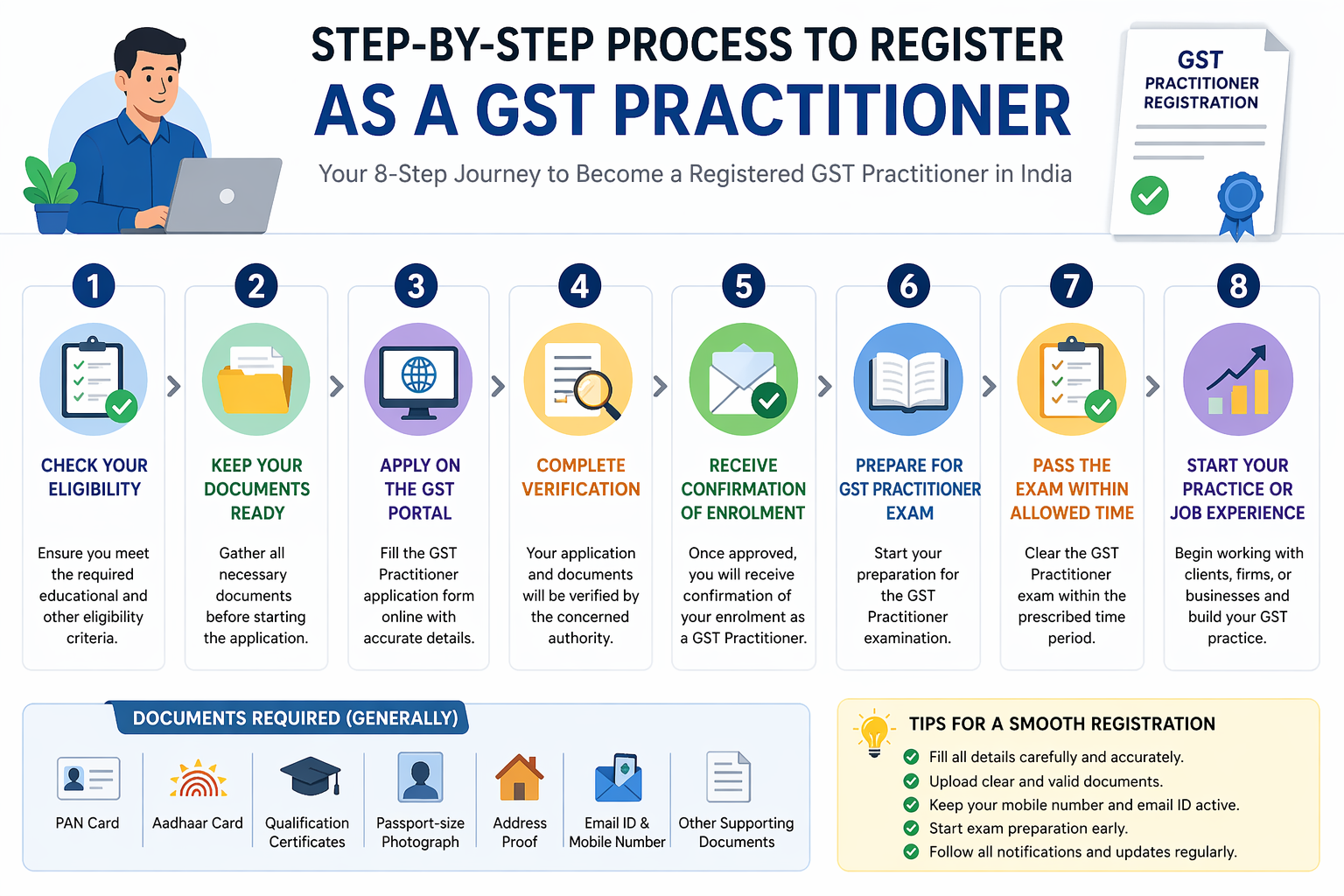
Step-by-Step Process to Register as a GST Practitioner
Once you meet the eligibility criteria, the next step is to understand how the registration process actually works. Many people assume that becoming a GST Practitioner is very complicated, but when broken into steps, the process is quite manageable. What matters most is that you follow the sequence properly and keep your documents ready.
This stage is important because your official registration is what allows you to start the process of becoming recognised under the GST system. If you miss a detail or submit incomplete information, your application may get delayed.
Step 1: Check your eligibility carefully
Before doing anything else, make sure you qualify under the required educational or professional categories. This is the foundation of the entire process.
You should confirm:
- Your educational qualification
- Your identity and legal status
- Whether you fall under an accepted category for registration
- Whether you have the necessary supporting documents
This step may look basic, but it is where many applicants make avoidable mistakes.
Step 2: Keep your documents ready
You will generally need to keep your essential documents prepared before applying. These may include:
- PAN card
- Aadhaar card
- Educational qualification documents
- Passport-size photograph
- Address proof
- Email ID and mobile number
- Any other supporting records required for verification
Having everything ready in advance makes the registration process much smoother.
Step 3: Apply on the GST portal
The registration process is done online through the GST system. You need to fill in the required application form meant for GST Practitioner enrolment.
At this stage, you will usually be asked to enter:
- Personal details
- Contact details
- Professional qualification details
- Identity information
- Supporting document uploads
You should fill in every field carefully because even a small mismatch in name, date, or qualification details can create problems later.
Step 4: Complete verification
After submitting the application, the details are verified by the concerned authority. This may include document verification and validation of the information you have entered.
You should make sure that:
- Your mobile number is active
- Your email ID is correct
- Uploaded documents are clear and readable
- Your information matches your official records
If there is any discrepancy, you may be asked to correct or resubmit part of the application.
Step 5: Receive confirmation of enrolment
If your application is accepted, you will receive confirmation of enrolment as a GST Practitioner. This means you have officially entered the system, but your journey is still not fully complete.
This is because registration and long-term practice may also depend on clearing the required examination within the prescribed rules.
Step 6: Prepare for the GST Practitioner exam
After enrolment, the next practical step is to start preparing for the examination if applicable in your case. This exam is important because it validates that you understand GST law, rules, procedures, and compliance requirements. At this stage, serious preparation becomes necessary. You should not wait until the last moment.
Step 7: Pass the examination within the allowed time
Eligible enrolled practitioners are expected to clear the GST Practitioner exam within the prescribed time frame. Passing this exam is what helps you continue and strengthen your standing as a GST Practitioner.
This step turns your registration into a more complete professional pathway.
Step 8: Start building practice or job experience
Once you are registered and qualified as required, you can begin working with clients, accounting firms, tax consultants, or businesses.
You may start by offering services such as:
- GST registration support
- Return filing
- Invoice and record review
- Reconciliation work
- Basic compliance advisory
- Notice handling support
At the beginning, many people work under a senior professional or firm to gain confidence and practical exposure.
Common mistakes to avoid during registration
To make the process easier, avoid these common errors:
- Applying without checking eligibility properly
- Uploading incomplete or unclear documents
- Entering wrong personal details
- Ignoring follow-up communication
- Delaying exam preparation after enrolment
Even though the registration process is online, it should still be treated like a professional application process that requires accuracy and seriousness.
Overall, the registration journey becomes much easier when you look at it as a sequence of simple steps: check eligibility, gather documents, apply online, complete verification, qualify through the exam, and then begin building your career in GST practice.
Skills You Need to Succeed as a GST Practitioner
Clearing the eligibility and examination requirements is only one part of the journey. To actually do well as a GST Practitioner, you need a strong mix of technical knowledge, practical accuracy, and professional behaviour. This role is not only about understanding tax law on paper. It is also about handling real client work, meeting deadlines, avoiding errors, and explaining compliance matters in a simple way.
In 2026, businesses expect GST professionals to be both knowledgeable and dependable. That means the more job-ready your skills are, the easier it becomes to build trust, get hired, or grow your own practice.
1. Strong understanding of GST basics
This is the most important skill of all. You should be comfortable with concepts such as:
- GST registration
- Return filing
- Input tax credit
- Tax invoices
- Composition scheme
- Time and place of supply
- Payment of tax
- Notices and compliance requirements
Without a clear understanding of these areas, it becomes difficult to work confidently with clients.
2. Attention to detail
GST work leaves very little room for careless mistakes. A small error in invoice details, return values, filing dates, or tax classification can create penalties or notices for the client.
That is why a successful GST Practitioner must be:
- Careful with numbers
- Accurate with data entry
- Alert while reviewing documents
- Consistent in checking details before submission
In this field, accuracy builds your reputation.
3. Knowledge of accounting and business records
Even though a GST Practitioner is not the same as a full accountant, you still need a basic understanding of accounting records and financial documents. You should know how to read:
- Sales records
- Purchase records
- Invoices
- Credit and debit notes
- Expense records
- Tax summaries
This helps you understand the business properly and file returns more accurately.
4. Familiarity with the GST portal and digital tools
A large part of GST work happens online. So you should be comfortable using digital systems and compliance tools.
This includes:
- Working on the GST portal
- Uploading and checking return data
- Downloading reports
- Tracking filing status
- Managing client records digitally
- Using spreadsheets and accounting software
A GST Practitioner who is fast and organised with digital tools has a clear practical advantage.
5. Time management and deadline discipline
GST compliance is deadline-driven. Missing due dates can lead to late fees, interest, and unhappy clients. That is why time management is a must.
You should be able to:
- Track multiple filing dates
- Prioritise urgent work
- Follow up with clients on time
- Maintain a compliance calendar
- Avoid last-minute filing pressure
In this profession, reliability often matters as much as knowledge.
6. Communication skills
Many clients do not understand tax language well. If you can explain GST matters in simple terms, clients will trust you more.
Good communication helps you:
- Collect correct documents from clients
- Explain return filing status clearly
- Answer basic compliance questions
- Handle follow-ups professionally
- Build long-term relationships
A good GST Practitioner is not only technically sound but also easy to work with.
7. Problem-solving ability
Real client work is rarely perfect. You may face missing invoices, mismatched entries, portal issues, delayed records, or confusion around compliance steps. This is where problem-solving becomes important.
You should be able to stay calm, understand the issue, and find the most practical next step instead of getting stuck.
8. Professional ethics and confidentiality
GST Practitioners often work with sensitive business information such as turnover, invoices, tax liability, vendor details, and financial records. That means professionalism and confidentiality are extremely important.
Clients trust professionals who are:
- Honest in their advice
- Careful with records
- Ethical in compliance work
- Responsible with confidential information
A strong reputation in this field is built not only on skill, but also on trust.
9. Willingness to keep learning
GST is a practical field where rules, procedures, and interpretations can evolve. A successful practitioner must keep learning through regular reading, practice, and staying updated.
This habit helps you:
- Improve accuracy
- Avoid outdated practices
- Serve clients better
- Become more confident over time
Why do these skills matter in the long run?
Many people can learn how to file a return. But not everyone can become a dependable professional that businesses want to keep working with. The difference usually comes down to skills like accuracy, communication, time management, and practical understanding. So if you want to succeed as a GST Practitioner, focus not only on qualifying for the role but also on becoming someone who can handle real compliance work with confidence, discipline, and professionalism.
GST Practitioner: Career, Job Opportunities, and Income 2026
A GST Practitioner can build a career in more than one way. This is one of the biggest strengths of the field. You can work with a CA firm, join an accounting or tax consultancy, support the finance team of a company, or build an independent client base over time. The GST portal also makes one important point clear: a single GST Practitioner enrolment is sufficient for practising on an all-India basis, which means your long-term scope is not limited to only one city or one state.
Where can a GST Practitioner work?
In practical terms, job opportunities usually come from areas such as:
- CA and tax firms
- Accounting and compliance consultancies
- Small and medium businesses that need regular GST support
- E-commerce, retail, logistics, and trading businesses
- Freelance and remote compliance support work
This career remains relevant because GST compliance is ongoing, not one-time. Businesses need help with registration, filing, reconciliations, notices, annual returns, and changing procedural requirements, and GST Council and GSTN updates in late 2025 and early 2026 show that the compliance system is still evolving through registration changes, return-related updates, and portal advisories.
What kind of roles are common?
After learning GST properly, you may find opportunities under titles such as:
- GST Executive
- Tax Associate
- Indirect Tax Executive
- Accounts Executive with GST responsibilities
- GST Consultant
- Compliance Associate
Recent Indeed results in April 2026 show GST-related openings in multiple formats, including Delhi-area accounting roles with GST work, GST consultant positions in Jaipur, GST executive roles in Chennai and Kerala, and remote roles where GST knowledge is part of the finance profile.
GST Practitioner: Income potential in 2026
Income in this field depends heavily on three things: your city, your practical experience, and whether you work in a salaried role or build your own client base. For beginners, posted salaries in current job listings suggest that entry-level and early-career GST-related roles often sit in the broad range of about ₹18,000 to ₹35,000 per month, while some roles that combine stronger finance, consulting, or remote capability can go higher. For example, recent April 2026 listings include a Delhi role at ₹18,000–₹25,000 per month, a Jaipur GST consultant listing at ₹25,000–₹30,000 per month, a Kerala GST-related role at ₹25,000–₹35,000 per month, and some remote finance roles that mention GST skills at roughly ₹30,000–₹60,000 per month. These are job-posted examples, not official salary averages, so they should be treated as indicative rather than fixed benchmarks.
Freelance income can grow differently
The salaried route gives stability, but the freelance route can scale better over time. Since GST compliance is recurring, many practitioners earn by handling monthly filings, registrations, amendment work, annual returns, and notice support for multiple clients. The all-India enrolment feature can also help in building a wider client base over time instead of depending only on local walk-in work.
A simple way to think about career growth
A useful career path may look like this:
- Beginner stage: work in a CA firm, consultancy, or accounts role and learn filing, reconciliations, and documentation
- Growth stage: handle client communication, notices, annual returns, and more independent compliance work
- Advanced stage: move into consulting, indirect tax specialisation, litigation support, or build an independent GST practice
This route is realistic because GST work often grows through experience and trust rather than title alone. Employers and clients usually value people who are accurate, deadline-oriented, and comfortable with real compliance work. Recent job listings also repeatedly mention practical skills such as Excel, Tally, filings, reconciliations, and compliance handling along with GST knowledge.
Is it a good career option in 2026?
Yes, especially for people who want a practical entry into taxation without waiting for a much longer professional route. It is a good option for commerce graduates, accountants, finance support professionals, and freelancers who want a specialised and service-based career. The strongest long-term advantage is that GST is tied to regular business compliance, which means the demand is usually recurring rather than occasional.
Overall, GST practice in 2026 offers a realistic mix of employability, freelance potential, and career growth. It may begin with modest pay in some roles, but with experience, accuracy, and client trust, it can grow into a stable and respected taxation career.
| Career Path / Role Type | Where You Can Work | Typical Work Involved | Indicative Income Potential in 2026 |
| Entry-level GST / Accounts Role | Small firms, accounting offices, local businesses | GST filing support, invoice checking, data entry, reconciliations | ₹18,000–₹25,000 per month |
| GST Consultant | Tax firms, compliance consultancies, independent practice | Registration, return filing, advisory, client handling | ₹25,000–₹30,000 per month |
| GST Executive / Indirect Tax Executive | Companies, finance teams, professional firms | GST compliance, notices, documentation, monthly filing work | ₹25,000–₹35,000 per month |
| Remote Finance / Compliance Role with GST Work | Remote companies, outsourced finance teams | GST-related compliance along with broader finance support | ₹30,000–₹60,000 per month |
| Freelance GST Practitioner | Self-employed, multiple clients across locations | Monthly filings, registration, amendments, annual returns, notice support | Varies by client base and experience |
| Growth Opportunity Over Time | All-India client base possible through one enrolment | Build recurring compliance practice and long-term client relationships | Higher earning potential with experience |
Conclusion
Becoming a GST Practitioner in India in 2026 can be a smart and practical career choice for anyone who wants to build a future in taxation and compliance. It offers a clear entry path, does not always require a long professional qualification route, and gives you the chance to work with businesses across industries. From understanding the eligibility rules to completing registration, preparing for the examination, and building the right skills, every step contributes to creating a strong professional foundation.
What makes this path especially valuable is that it combines stability with growth. Businesses will continue to need support with GST registration, return filing, reconciliations, notices, and ongoing compliance. This means a GST Practitioner is not only learning a technical skill but also building a service that remains relevant in the real market. Whether you want to start with a job, work under a firm, or later build your own client base, this career can grow steadily with experience and credibility.