Let’s picture two candidates sitting in the same waiting room. Rahul has a degree from a well-regarded university, a clean GPA, and a resume that reads like it was assembled by committee. Priya has no degree. What they have instead is a GitHub profile full of shipped projects, three cloud certifications, a portfolio site that actually works, and a habit of solving problems in public.
If it were ten years ago, Rahul would have won this before either of them said a word.
But in 2026? It’s not that simple anymore, and if you are still preparing for the old version of the interview, you are preparing for a hiring system that no longer fully exists.
This is not a hot take. It’s what’s actually showing up in hiring data right now. In 2025, 26% of paid job posts on LinkedIn no longer required a degree — a 16-percentage-point jump from 2020. A recent LinkedIn survey found that 88% of hiring managers admit they are filtering out highly skilled candidates simply because those candidates lack a traditional credential like a past job title or a degree, and increasingly, companies are trying to fix that, not defend it.
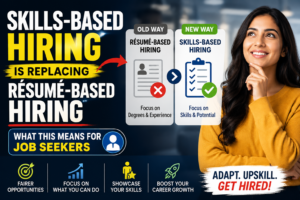
So no, the degree is not dead. But the idea that a degree is the ticket — the single, sufficient proof that you are hireable — that idea is on life support. What’s replaced it is messier, more interesting, and honestly more fair to more people: a hiring system that’s obsessed with what you can actually do.
Let’s unpack exactly what that means, why it happened, and — most importantly — what you should be doing about it starting this week.
Reality Check: If your entire employability strategy is “I got the degree, now what,” you are not late. But you are relying on 2015’s playbook in a 2026 game.
Introduction: Why This Debate Existed — and Why 2026 Broke It
For most of the 20th century, the degree was a reasonably good proxy for competence. It signaled discipline, baseline literacy, subject knowledge, and — let’s be honest — access to money and time. Employers used it as a filter because sorting through thousands of resumes by hand for actual ability was expensive and slow. A degree was a shortcut.
The problem is that shortcuts calcify. By the 2010s, “degree required” had crept onto job postings that had nothing to do with the content of any degree — administrative roles, sales jobs, entry-level marketing positions. This is what economists call degree inflation: employers demanding a credential not because the job needs it, but because it’s an easy way to shrink a big applicant pool.
Then three things happened almost at once, and the old shortcut stopped working.
- First, the skills economy caught up with the degree economy – Coding bootcamps, MOOCs, and certification bodies made it possible to learn job-ready skills in months, not years, often for a fraction of the cost.
- Second, remote work opened up the talent pool – When you can hire someone in another city — or another country — you stop caring where they went to school and start caring whether they can do the work, because you’ll never bump into them at the campus career fair anyway.
- Third, and most disruptive: AI changed what “knowing things” is even worth – When a language model can recall facts, summarize research, and draft code faster than any graduate, the premium shifts hard toward the things AI can’t do well on its own — judgment, taste, communication, and the ability to direct and verify AI’s work. That’s not a skill you get automatically from a diploma. It’s a skill you build by doing.
Did You Know? The World Economic Forum’s Future of Jobs Report 2025 — based on surveys of over 1,000 employers representing more than 14 million workers across 55 economies — found that 63% of employers now name the skills gap as the single biggest barrier to their business transformation, ahead of outdated regulation, culture, or lack of capital.
None of this means degrees became worthless. It means they became one input among several — and for the first time in decades, not always the most important one.
A Brief History: How We Got Here?
Understanding 2026 hiring requires understanding the road that led to it.
- The credential era (1950s–1990s). A degree was rare enough to be a genuine differentiator. Fewer people had one, so having one said something. Hiring was largely: resume in, interview, offer, done.
- Degree inflation (2000s–2010s). College enrollment exploded. A bachelor’s degree became the new high school diploma — necessary but no longer sufficient to stand out. Employers responded by demanding master’s degrees for roles that used to need none, and by requiring degrees for jobs that plainly didn’t need them.
- The MOOC disruption (2012 onward). Coursera, edX, Udacity, and eventually cohort-based bootcamps proved that rigorous, job-relevant learning could happen outside a four-year campus. Suddenly, a self-taught developer could learn what a CS student learns — minus the electives, minus the debt, minus the four years.
- Remote work and the portfolio economy (2020–2023). The pandemic forced a mass experiment: could people who’d never met their managers in person still do great work? The answer was an emphatic yes, and it permanently shifted evaluation toward outputs — code shipped, campaigns run, designs delivered — over pedigree.
- Digital portfolios go mainstream (2021–2024). GitHub contributions, Behance boards, personal websites, and LinkedIn “Featured” sections became the new transcript. Recruiters started checking them before they checked your education line.
- The AI revolution (2023–2026). Generative AI didn’t just change what jobs exist — it changed how candidates are found, screened, and interviewed, and it accelerated demand for AI literacy across nearly every role, not just technical ones.
- Skills-first hiring goes institutional (2024–2026). What began as a scrappy alternative became formal policy at major employers, some of whom now publicly report the share of their job postings that no longer list a degree requirement.
Expert Tip: If you want a quick gut-check on where a company stands, search their careers page for the phrase “or equivalent experience.” Its presence — or its growing frequency — is one of the cleanest public signals of a skills-first shift.
What Employers Actually Want in 2026?
Strip away the buzzwords, and hiring managers in 2026 are optimizing for roughly ten things. Here’s why each one matters more than your GPA.
Problem Solving
Employers don’t hire you to execute a fixed checklist — they hire you because problems will show up that nobody wrote a procedure for. Your ability to break down an ambiguous mess into a workable plan is worth more than knowing the “textbook” answer, because the textbook answer usually doesn’t exist yet for the problem you’ll actually face.
AI Literacy
Not “can you use ChatGPT,” but can you direct AI tools intelligently, verify their output, and know when not to trust them. This has become a baseline expectation across marketing, finance, law, HR, and engineering — not just tech roles.
Communication
The best idea in the world is worthless if you can’t get a team, a client, or a board to understand and act on it. In a world where AI drafts the first version of everything, the human job increasingly becomes clarifying, persuading, and translating between people.
Adaptability
Roles are being redefined faster than job descriptions can be rewritten. Employers want people who can absorb a new tool, a new process, or a new team structure without needing a six-month onboarding cycle every time.
Continuous Learning
This is less a skill and more a habit — but it’s the habit that predicts everything else on this list. 85% of employers surveyed by the World Economic Forum plan to prioritize upskilling their workforce through 2030, which tells you they’re not looking for a finished product; they’re looking for someone who will keep growing on the job.
Technical Skills
Still essential — just redefined. “Technical” in 2026 covers everything from prompt engineering to cloud architecture to data visualization, and increasingly it’s demonstrated through projects and certifications rather than a transcript.
Business Understanding
Employers are tired of hiring brilliant specialists who can’t connect their work to revenue, retention, or cost. Understanding why a task matters to the business, not just how to do it, is what separates a contributor from someone who gets handed bigger decisions.
Critical Thinking
With AI generating more first drafts, more content, and more “answers” than ever, the scarce skill is knowing which of those answers to trust, challenge, or throw out entirely.
Collaboration
Cross-functional work is the norm now, not the exception. Being easy — and valuable — to work with is a measurable career asset, and recruiters actively probe for it in behavioral interviews.
Leadership Potential
Even in individual-contributor roles, employers are scouting for people who can eventually own a project, mentor a junior hire, or make a judgment call without hand-holding. You don’t need a title to demonstrate this — you need a track record of taking ownership.
Quick Challenge: Pull up your resume right now. Circle every bullet point that proves one of these ten qualities with a specific result, not just a duty. If you circle fewer than three, that’s your homework for this week.
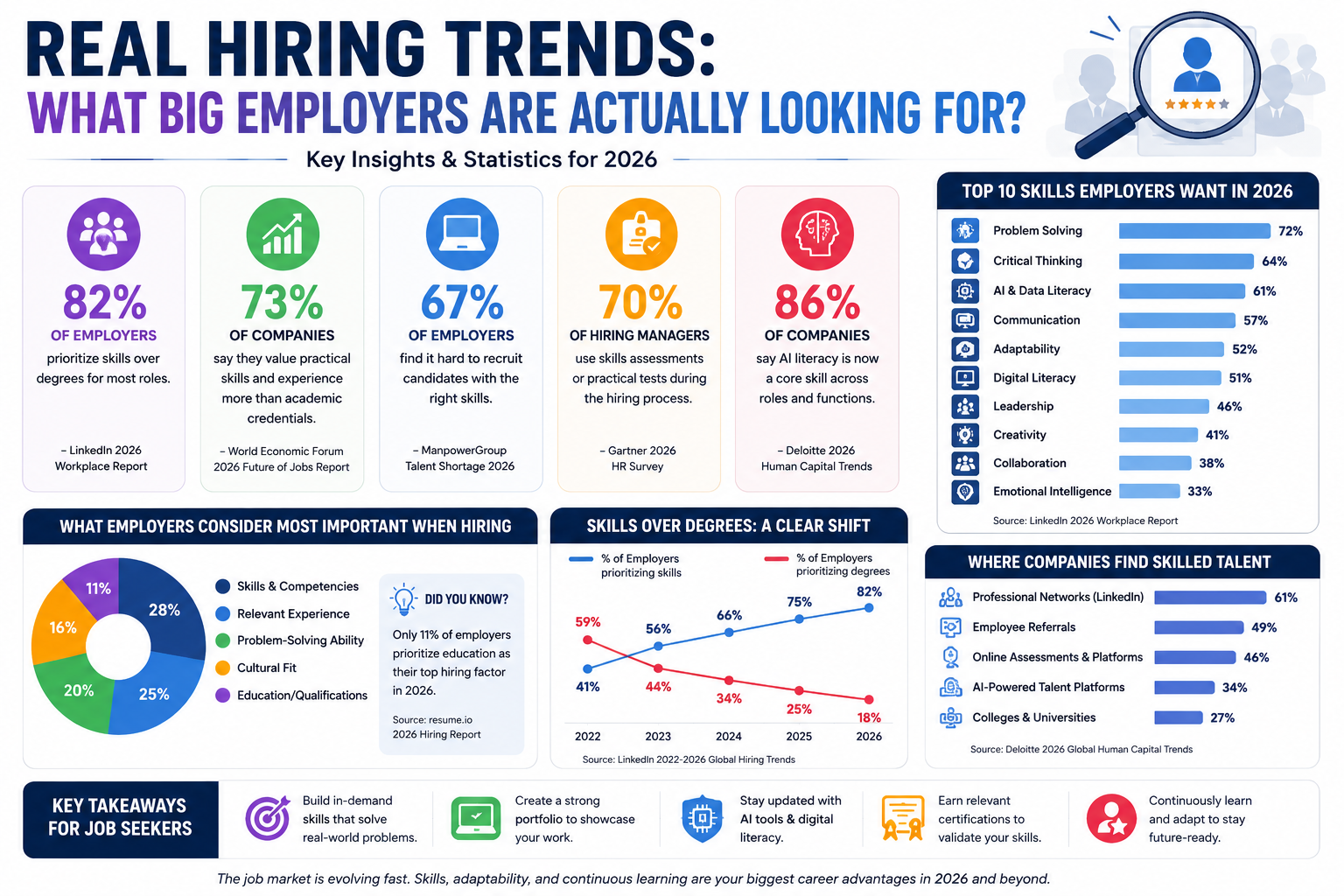
Real Hiring Trends: What Big Employers Are Actually Looking for?
Talk is cheap. Here’s what’s actually changing inside hiring pipelines at major employers, based on current reporting and company disclosures.
Skills-first hiring is now a stated strategy, not a PR line
- Companies including Google, IBM, Apple, and Accenture have publicly reduced degree requirements for large categories of roles over the past several years, favoring demonstrated skills, certifications, or apprenticeship pathways instead. IBM in particular, has been vocal about the concept of “new collar” jobs — roles evaluated on skill rather than credentials.
Portfolio hiring is standard in tech, design, and marketing.
- At companies like Meta, Adobe, Netflix, and Salesforce, a strong body of shipped work — an app in production, a design system, a campaign with real metrics — routinely outweighs where a candidate studied, especially for mid-level and senior individual-contributor roles.
Certification-based hiring has real teeth now
- There are many certification programs that recruiters at partner companies actively screen for, particularly in cloud, AI infrastructure, and cybersecurity roles, where the skill is narrow enough to verify with an exam.
Apprenticeships are scaling
- Tesla, Microsoft, and IBM run apprenticeship and returnship pipelines that hire people with zero degree and limited experience, then train them into full-time technical roles — a direct bet that trainable skill beats credentialed inexperience.
Internal mobility is being prioritized over external hiring
- 50% of employers surveyed by the WEF plan to transition existing staff from declining roles into growing ones, and 70% plan to hire specifically for new skills rather than relying purely on tenure, which means your next promotion may increasingly depend on what you can learn on the job, not just what you were hired to do.
AI-assisted recruitment has gone mainstream.
- 93% of recruiters surveyed by LinkedIn say they plan to increase their use of AI in 2026, and 59% already report that AI is surfacing candidates they wouldn’t otherwise have found. OpenAI, Meta, and Microsoft’s own hiring pipelines increasingly use AI-assisted screening to evaluate skills demonstrated in take-home projects and technical assessments rather than relying solely on resume keywords.
The numbers back all of this up
- The WEF’s Future of Jobs Report 2025 found that nearly 40% of core job skills are expected to change by 2030, with 63% of employers citing the resulting skills gap as their top barrier to transformation. Separately, 50% of workers globally report having already gone through some form of training, reskilling, or upskilling — up from 41% just two years earlier, which shows the shift isn’t theoretical; it’s already happening inside real workforces.
Statistics Highlight
- 26% of paid LinkedIn job posts dropped degree requirements in 2024, up from about 10% in 2020
- 88% of hiring managers admit skilled candidates get filtered out over missing credentials — a problem companies are actively trying to solve
- 63% of employers name skills gaps as their top transformation barrier through 2030
- 85% of employers plan to prioritize upskilling their existing workforce
- 93% of recruiters plan to expand their use of AI in hiring during 2026
Poll Question: Before reading this article, did you think a degree was still the #1 factor in getting hired? (Keep your honest answer in mind — we'll circle back to it in the conclusion.)
Degree vs. Skills: The Comparison Table
| Factor | 🎓 Degree | 🛠️ Skills |
|---|---|---|
| Hiring Value | Strong for regulated fields (medicine, law, engineering) and as an initial filter | Strong for tech, creative, and fast-moving fields; increasingly decisive at mid-to-senior level |
| Learning Speed | Slow — typically 2 to 4+ years | Fast — weeks to months per skill |
| Cost | High — tuition, housing, opportunity cost | Low to moderate — courses, certifications, self-teaching |
| Time Investment | Fixed, front-loaded | Flexible, ongoing throughout career |
| Career Growth | Opens doors to credential-gated fields | Opens doors tied to demonstrated results |
| Practical Experience | Often theoretical, campus-based | Built directly through projects and real work |
| Global Recognition | Varies significantly by country and institution | Certifications (AWS, Google, Microsoft, PMI) often globally standardized |
| Salary Impact | Higher average starting salary in some fields | Comparable or higher in high-demand tech and specialist roles |
| Career Flexibility | Less flexible — tied to field of study | Highly flexible — skills transfer across industries |
| AI Readiness | Rarely covers current AI tools directly | Directly buildable and constantly updatable |
| Recruiter Preference | Still valued, especially at large, traditional employers | Increasingly the deciding factor at tech-forward and mid-sized companies |
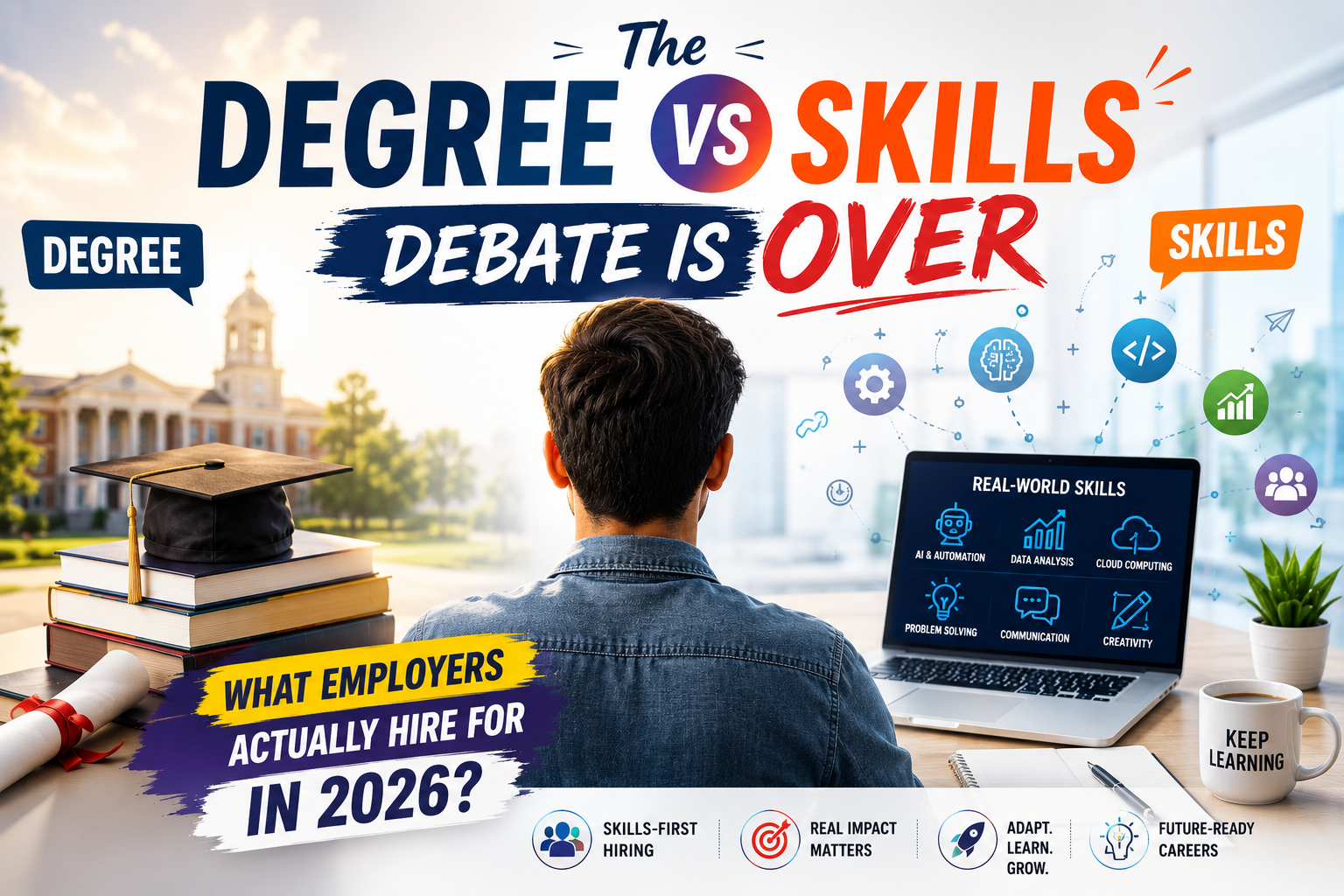
It’s no longer Degree OR Skills. It’s Degree PLUS Skills.
The candidates winning in 2026 aren’t choosing a side. They’re using whichever credential they have — degree, bootcamp, self-taught portfolio — as a foundation, then stacking visible, provable skills on top of it.
Myth vs. Reality
❌ Myth 1: Companies only hire graduates.
✅ Reality: A meaningful and growing share of paid job postings no longer require a degree at all, and that share has been climbing for years.
❌ Myth 2: A degree guarantees a good salary.
✅ Reality: Salary now correlates more tightly with demonstrated, in-demand skills — AI, cloud, cybersecurity — than with the subject or prestige of a degree.
❌ Myth 3: Self-taught professionals aren’t taken seriously.
✅ Reality: Portfolio-first hiring in tech, design, and marketing routinely favors demonstrated ability over formal education, especially once a candidate has any track record at all.
❌ Myth 4: Certifications are just resume filler.
✅ Reality: Cloud and AI certifications from AWS, Microsoft, and Google Cloud are actively screened for by recruiters in technical hiring pipelines, because they verify a specific, testable skill.
❌ Myth 5: You need a computer science degree to work in tech.
✅ Reality: Bootcamp graduates, self-taught developers, and career changers fill a substantial and growing share of software roles at companies with skills-first hiring practices.
❌ Myth 6: Older workers can’t compete with AI-savvy young grads.
✅ Reality: Experience combined with newly acquired AI literacy is a strong combination — judgment and domain expertise don’t expire, and many companies are actively investing in reskilling workers over 50.
❌ Myth 7: Once you’re hired, learning stops.
✅ Reality: 85% of employers plan to prioritize workforce upskilling by 2030 — continuous learning is now a job requirement, not a bonus activity.
❌ Myth 8: Soft skills don’t really get evaluated.
✅ Reality: Communication, adaptability, and collaboration are explicitly assessed in structured behavioral interviews at nearly every major employer today.
❌ Myth 9: An MBA guarantees leadership roles.
✅ Reality: MBAs help, but employers increasingly want evidence of actual leadership — a project led, a team built, a decision owned — not just the credential.
❌ Myth 10: AI will replace entry-level jobs entirely.
✅ Reality: AI is reshaping entry-level work, not erasing it — it’s raising the bar on what “entry-level competence” means, favoring candidates who can already use AI tools productively.
❌ Myth 11: Freelance or gig work doesn’t count as “real” experience.
✅ Reality: Recruiters increasingly treat freelance projects, especially with visible outcomes, as legitimate proof of skill — sometimes more convincing than a bullet point from a large-company internship.
❌ Myth 12: Networking matters less than qualifications.
✅ Reality: Referrals and professional networks remain one of the strongest predictors of hiring quality — recruiters consistently report higher-quality hires through platforms that surface professional relationships and trajectories, meaning your network is itself a skill worth building.
Interactive Quiz: Are You Job Ready for 2026?
Answer each question honestly with Yes (2 points), Somewhat (1 point), or No (0 points). Add up your score at the end.
- Can you clearly explain, in one sentence, the biggest problem you’ve solved in the past year?
- Have you used an AI tool to genuinely improve your output — not just to save time, but to raise the quality?
- Do you have at least one project, portfolio piece, or work sample a stranger could review in under five minutes?
- Can you name three skills that are currently in high demand in your target field?
- Have you completed a course, certification, or self-directed learning project in the last six months?
- Do you know how to read a job description and identify the skills behind the buzzwords?
- Can you describe a time you adapted quickly to an unexpected change at work or school?
- Is your LinkedIn (or equivalent) profile updated with specific, measurable achievements — not just job titles?
- Have you ever given or received structured feedback that changed how you approached a task?
- Can you hold a basic conversation about how your industry is being affected by AI?
- Do you have at least one example of leading, mentoring, or taking ownership of something — even informally?
- Do you have a habit (weekly or monthly) of learning something new related to your career?
Score Interpretation:
- 20–24: Future-Ready. You’re operating exactly the way 2026 hiring rewards. Focus now on visibility — make sure recruiters can actually see this work.
- 13–19: Solid Foundation. You have real substance; you likely need sharper storytelling and a couple of targeted skill upgrades.
- 6–12: Building Momentum. You’re not behind — you’re early. Pick two or three gaps from this quiz and turn them into a 90-day plan.
- 0–5: Time to Start. No judgment — everyone starts here. Use Section 15’s checklist as your literal to-do list this month.
Case Studies: Five Paths and Five Outcomes
- The Computer Science Graduate. Riya graduated with a strong CS degree but a resume full of coursework and no shipped projects. She struggled for three months until she built two small AI-powered apps and published them publicly. The degree got her past initial filters; the projects got her the offer. Lesson: A degree opens the door, but it rarely closes the deal alone anymore.
- The Mechanical Engineer. Dev spent a decade in traditional manufacturing and worried AI would make his experience irrelevant. Instead, he paired his domain expertise with a certification in industrial automation and data analytics. His interviews weren’t about defending his age or his degree — they were about how uniquely valuable it is to combine 10 years of real-world mechanical judgment with new digital fluency. Lesson: deep experience plus new skills beats either alone.
- The Marketing Professional. Aanya had a marketing degree and five years of experience, but was applying to jobs with the same tired resume for months. She rebuilt her LinkedIn around measurable campaign results and added a certification in AI-driven marketing analytics. Callbacks tripled within six weeks. Lesson: existing experience often just needs better proof, not a bigger credential.
- The Self-Taught Developer. Marcus never finished college. He learned to code through free resources, contributed to open-source projects, and built a portfolio site that doubled as a live demo of his skills. He got hired at a mid-sized tech company that explicitly doesn’t require a degree for engineering roles. Lesson: in skills-first companies, a portfolio can fully substitute for a diploma.
- The MBA Graduate. Sana finished her MBA expecting recruiters to be impressed by the degree alone. They were — for about one interview round. What actually got her the offer was a case competition project she’d led that produced a real, measurable business recommendation. Lesson: even prestigious credentials now need a demonstrated results follow-up act.
Top Skills Employers Pay Premium Salaries For
- AI (ML engineering, applied AI, prompt/agent design): roughly $90K–$220K+
- Cybersecurity (analysts, security engineers): roughly $80K–$180K+
- Cloud (AWS/Azure/GCP architecture and administration): roughly $85K–$180K+
- Data Analytics (data analysts, analytics engineers): roughly $65K–$140K, with average data analyst salaries reported around $111,000 in the U.S. as of 2025
- Product Management: roughly $90K–$170K+
- UX/UI Design: roughly $70K–$140K
- Software Development: roughly $75K–$180K+
- Digital Marketing: roughly $55K–$120K
- Sales (technical/enterprise): roughly $60K–$150K+ with commission upside
- Finance (FP&A, financial analysis): roughly $65K–$140K
- Project/Program Management: roughly $70K–$140K
- Business Analysis: roughly $65K–$130K
(Approximate ranges; actual compensation varies significantly by country, city, company size, and seniority)
Fun Fact: Even as entry-level roles in some technical fields soften due to automation of basic tasks, mid-career roles requiring the ability to translate data into business strategy are commanding premium pay — the “translator” role between technical output and business decisions is one of the fastest-growing pay categories across industries.
What Recruiters Actually Notice?
In order of how often recruiters report checking them:
- Resume — still the front door, but increasingly scanned for specific, measurable results rather than job titles.
- LinkedIn — your de facto second resume, and often the first thing checked before a resume is even opened.
- Portfolio/Projects — the single strongest tiebreaker for technical, creative, and marketing roles.
- GitHub — for technical roles, commit history and real code often matter more than a transcript.
- Internships — still valuable, especially for early-career candidates with limited other proof.
- Freelancing — increasingly respected as legitimate experience, particularly with client outcomes attached.
- Open Source Contributions — a visible, verifiable way to demonstrate collaboration and technical skill simultaneously.
- Hackathons — compressed, high-signal proof of problem-solving under pressure.
- Certifications — fast credibility checks for specific technical claims.
- Communication — assessed live, in every interview, often more heavily weighted than technical answers alone.
- Personal Branding — a consistent, thoughtful online presence (posts, articles, talks) increasingly influences recruiter first impressions before a conversation even starts.
Reflection Question: If a recruiter Googled you right now, what would the first page of results say about your skills?
The AI Hiring Revolution
Hiring itself has become an AI-powered process, on both sides of the table.
- AI resumes: Tools now help candidates tailor resumes to specific job descriptions in seconds — meaning generic resumes stand out for the wrong reasons.
- AI interviews: Some early-stage screening now happens through AI-conducted or AI-assisted interviews that evaluate responses for relevance, clarity, and keyword alignment.
- AI screening: A meaningful share of organizations are now integrating generative AI directly into their recruitment workflows, particularly for outreach and initial candidate analysis.
- AI recruiters: The majority of recruiters plan to expand AI use in 2026, with many already crediting it for surfacing candidates they’d otherwise have missed.
- AI skill assessments: Coding challenges, case studies, and simulations increasingly get scored partly or fully by AI before a human ever reviews them.
- AI-powered career coaching: Tools that analyze your skills gaps against target roles and recommend specific learning paths are becoming a normal part of job searching.
- Digital credentials & verified skill badges: Employers are increasingly accepting blockchain-backed or platform-verified skill badges as faster, harder-to-fake proof of ability than a resume claim.
Decision Tree: Should You Trust an AI Screening Result?
- Did the tool evaluate a real work sample (code, writing, a case response)? → Reasonably trustworthy signal.
- Did the tool only scan keywords in a resume? → Low signal; optimize your resume language, but don’t over-interpret rejection.
- Are you unsure which type it was? → Ask the recruiter directly. It’s a completely normal question in 2026.

Career Roadmaps
For Students
- First 30 days: Audit your current skills against three real job postings you’d want in two years.
- First 90 days: Complete one certification or online course directly tied to a target role.
- First 6 months: Build one small public project — even a simple one — and publish it.
- One year: Land an internship, freelance gig, or open-source contribution that gives you a real, citable result.
For Freshers (Recent Graduates)
- First 30 days: Rebuild your resume and LinkedIn around results, not responsibilities.
- First 90 days: Apply broadly while completing one skills-gap certification you identified from job postings.
- First 6 months: Build a portfolio piece that directly answers “prove you can do this job.”
- One year: Aim for one meaningful outcome — a job, a strong freelance track record, or a clear skill specialization.
For Experienced Professionals
- First 30 days: Identify which of your current skills are becoming less relevant, honestly.
- First 90 days: Start one certification or structured upskilling path in an adjacent, high-demand skill.
- First 6 months: Take visible ownership of a project that showcases the new skill combined with your existing experience.
- One year: Position yourself for internal mobility or an external move that reflects your upgraded skill set.
For Career Changers
- First 30 days: Map your transferable skills explicitly — don’t assume they’re obvious to a new industry.
- First 90 days: Complete a recognized certification or bootcamp in your target field.
- First 6 months: Build two to three portfolio pieces or case studies that stand in for the experience you don’t yet have.
- One year: Land a foothold role — even a lateral or slightly junior one — that gets you real experience in the new field.
For Managers
- First 30 days: Audit your team’s skills against where your industry is heading, not just current workload.
- First 90 days: Build a lightweight upskilling plan for your team, prioritizing AI literacy and adaptability.
- First 6 months: Pilot skills-based evaluation in your own hiring — try one role without a degree requirement.
- One year: Measure whether skills-based hires and upskilled team members are outperforming traditional hires, and adjust your hiring criteria accordingly.
Future Predictions: 2027, 2028, 2030
By 2027: Expect “AI coworkers” — persistent AI agents assigned to specific workflows — to become common in mid-size and large companies, meaning much of the interview process will explicitly test how well you collaborate with AI systems, not just your standalone skill.
By 2028: Agentic AI — systems that plan and execute multi-step tasks with minimal supervision — will likely reshape entry-level work further, pushing hiring criteria even more firmly toward judgment, oversight, and quality control rather than raw task execution.
By 2030: The World Economic Forum projects 170 million new jobs created and 92 million displaced, a net gain of 78 million jobs globally — but many of those new roles won’t map cleanly onto today’s degree programs. Expect wider adoption of skills passports and digital skills wallets: portable, verifiable records of what you can actually do, potentially secured with blockchain credentials, that travel with you between employers the way a resume does today — except much harder to fake.
Did You Know? The concept of “digital twins” — AI-driven simulations of workflows or even individual skill profiles — is already being piloted in some large enterprises to test how a role might evolve before hiring for it. By 2030, this kind of simulation could routinely shape which skills get prioritized in job postings before a human recruiter ever writes one.
The Ultimate Employability Checklist
Foundational
- Update your resume to lead with results, not duties.
- Rewrite your LinkedIn headline to state what you do, not just your title.
- Add measurable outcomes to every major bullet point.
- Remove outdated or irrelevant experience that dilutes your story.
- Get a professional (or at least clean, well-lit) profile photo.
Skills 6. Identify three in-demand skills for your target role from real job postings. 7. Enroll in one certification tied directly to a job you want. 8. Finish that certification within 90 days — set a hard deadline. 9. Learn to use at least one AI tool relevant to your field, deeply, not superficially. 10. Practice explaining technical work to a non-technical audience.
Proof of Work 11. Build one portfolio piece, even a small one. 12. Publish it somewhere public — GitHub, a personal site, Behance, Medium. 13. Contribute to one open-source project or community initiative. 14. Take on one freelance or volunteer project for real-world practice. 15. Document the measurable outcome of every project you complete.
Visibility 16. Post one piece of original insight on LinkedIn per week for a month. 17. Comment thoughtfully on posts in your industry to build visibility. 18. Reach out to five people in your target field for informational conversations. 19. Attend one industry event, meetup, or webinar this quarter. 20. Ask two colleagues or mentors for specific, honest feedback on your profile.
Interview Readiness 21. Prepare three stories that demonstrate problem-solving using a clear structure (situation, action, result). 22. Practice explaining a failure and what you learned from it. 23. Prepare thoughtful questions to ask every interviewer. 24. Research the company’s actual hiring trends, not just their mission statement. 25. Do one mock interview with a friend, mentor, or AI tool.
Long-Term Habits 26. Set a recurring monthly “skills audit” reminder on your calendar. 27. Follow two or three credible sources for hiring and industry trend updates. 28. Keep a running document of every achievement, the moment it happens. 29. Revisit your career roadmap every quarter and adjust it honestly. 30. Commit to learning one new tool, concept, or skill every single quarter, indefinitely.
Frequently Asked Questions
1. Is a degree still worth getting in 2026?
Yes, especially for regulated fields like medicine, law, and engineering, and for the structure, network, and foundational knowledge it provides — but it should not be your only employability strategy.
2. Can I get a good job with no degree at all?
Increasingly yes, particularly in tech, design, marketing, and sales, especially at companies with explicit skills-first hiring policies.
3. Do certifications actually help without a degree?
Yes — certifications from recognized providers like AWS, Microsoft, and Google Cloud carry real weight, especially when paired with a project that demonstrates the skill in practice.
4. What matters more: GPA or projects?
Projects, almost always, especially once you’re past your first job search.
5. Should I list my GPA on my resume?
Only if it’s strong and you’re early-career; drop it once you have real work experience to point to instead.
6. How important is AI literacy really?
Very — it’s becoming a baseline expectation across most white-collar roles, not just technical ones.
7. Are bootcamps a legitimate alternative to a CS degree?
For many roles, yes, particularly when paired with a strong portfolio; for research-heavy or highly specialized technical roles, a degree may still be preferred.
8. How do I prove skills if I have no formal experience?
Build public projects, contribute to open source, freelance, or volunteer — anything that produces a verifiable, visible result.
9. Does an MBA still matter?
It still opens doors, particularly for leadership tracks at large companies, but it increasingly needs to be paired with demonstrated results, not treated as sufficient alone.
10. What’s the single most in-demand skill right now?
Applied AI literacy — the ability to use AI tools effectively within your specific field — is currently one of the fastest-growing demands across nearly every industry.
11. How often should I be learning new skills?
Continuously — treat it as a quarterly habit, not an occasional event.
12. Do recruiters really check GitHub and portfolios?
Yes, especially for technical, design, and marketing roles, often before they even open your resume.
13. Is networking still important in a skills-first world?
Extremely — referrals and professional relationships remain one of the strongest predictors of a successful hire.
14. How do I know which certification to pursue?
Look at job postings for your target role and note which certifications appear repeatedly — that’s your answer.
15. Will AI take my job?
AI is more likely to change what your job looks like than eliminate it entirely, especially if you actively build skill in directing and verifying AI output.
16. What if I’m switching careers with zero relevant experience?
Focus on transferable skills, complete a targeted certification, and build two or three portfolio pieces that substitute for direct experience.
17. Are internal promotions easier to get than external jobs right now?
Often yes, especially at companies actively prioritizing internal mobility and reskilling over external hiring.
18. How do I stand out in a flooded job market?
Specific, measurable proof of skill beats generic qualifications every time — specificity is your competitive edge.
19. Should older professionals worry about being replaced by younger, AI-savvy grads?
Not if they pair their experience with new AI and digital skills — that combination is often more valuable than either alone.
20. What’s the biggest mistake job seekers make in 2026?
Treating their resume as a static document instead of continuously updating it with fresh, measurable proof of growth.
Conclusion: A Final Thought
Here’s the truth underneath all the statistics: the degree-vs-skills debate was never really about degrees or skills at all. It was about proof. Employers have always just wanted evidence that you can do the job — degrees were simply the easiest proof available for a long time. Now there’s better proof available, and smart employers are using it.
That’s not bad news. That’s an opening.
It means the pharmacist’s kid without a family connection, the career changer starting over at 35, the self-taught developer who never finished college — all of them now have real, credible paths to prove their worth that didn’t exist a generation ago.
The future doesn’t belong to the longest resume in the pile.
It belongs to the person who never stops proving — and never stops learning — what they’re capable of.

People Also Ask Questions:
- Do companies still require a college degree in 2026?
- What skills are most in demand for jobs in 2026?
- Can you get a tech job without a degree?
- What certifications increase your salary the most?
- How is AI changing the hiring process?