Artificial intelligence has become one of the most discussed forces in the world of work. Every few weeks, a new headline appears warning that AI is replacing employees, disrupting careers, and making many job roles uncertain. It is no surprise that professionals across industries are feeling anxious. Students worry about whether their degrees will still matter. Working professionals wonder whether their current skills will remain relevant. Job seekers fear they may be entering a market that is changing faster than they can keep up with.
But the real story is more nuanced than the panic suggests.
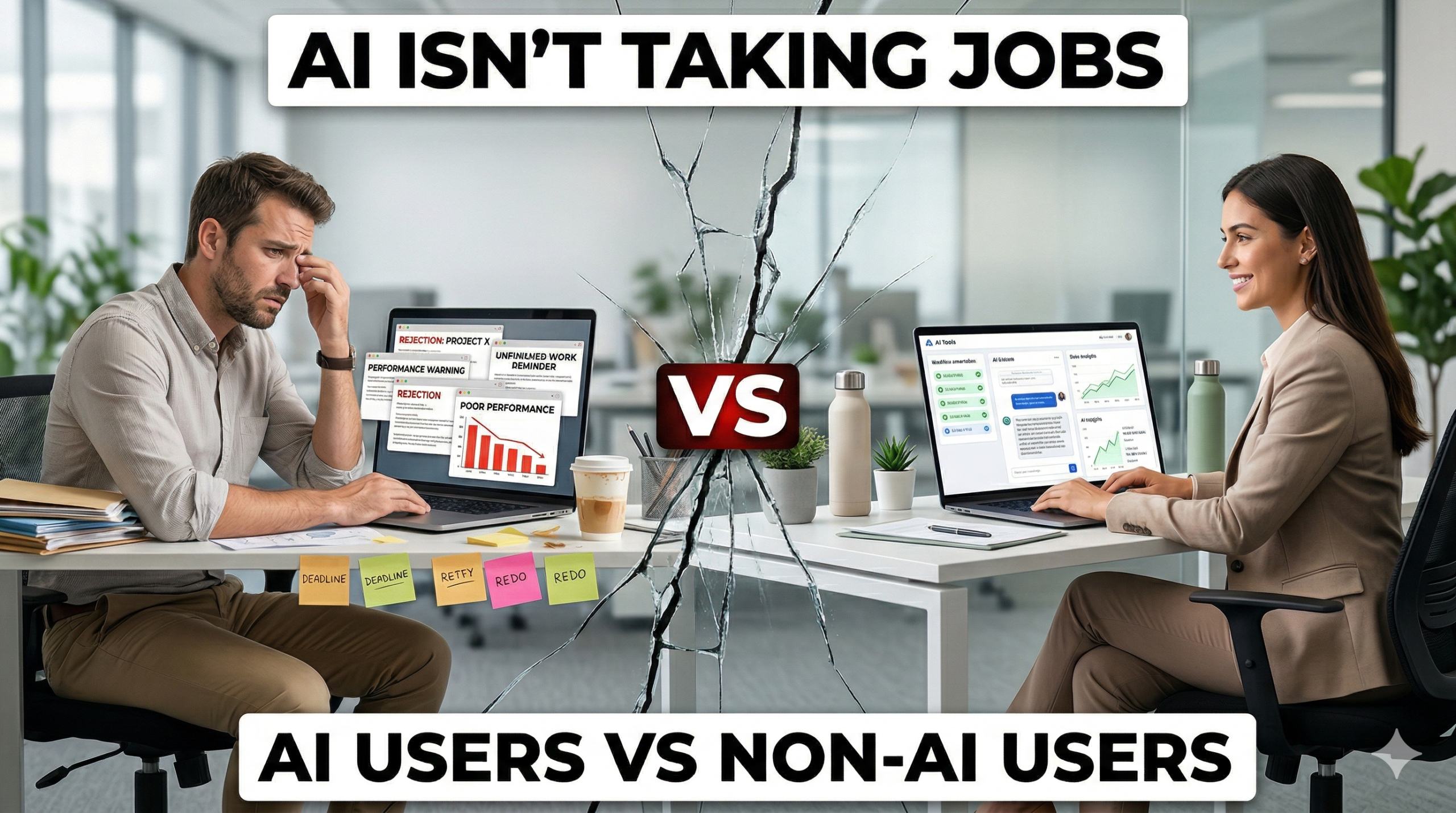
AI is not simply taking jobs from people. In many cases, it takes opportunities away from those who do not know how to use them. The workplace is not divided into humans versus machines. It is divided into people who can work effectively with AI and people who cannot. That shift matters because employers are no longer only looking for qualifications, experience, or technical knowledge. They increasingly value productivity, adaptability, and the ability to use modern tools to work faster and more effectively.
Why does everyone think AI is a Threat?
The fear around artificial intelligence did not emerge without reason. People are now seeing AI write content, answer queries, generate code, summarize reports, and automate tasks that once required human effort. When a tool can complete in seconds what used to take hours, it is easy to assume that jobs themselves are under direct threat. Still, this fear becomes stronger because of how AI is discussed in public. Why does the fear feel real?
Several developments make AI seem like an immediate danger to workers:
- AI can now handle many routine tasks quickly
- Companies are actively experimenting with automation
- News headlines often focus on job loss rather than job transformation
- Workers are unsure which skills will remain valuable
- The pace of change feels faster than previous technology shifts
Because of this, many professionals feel that AI is not just another tool. They feel it may become a direct competitor.
What headlines often get wrong?
A major reason for the panic is that AI is often presented in a very simplified way. The common message is that if AI can do a task, it will replace the person doing that task. But jobs do not usually consist of just one task.
Most roles include a mix of responsibilities such as:
- repetitive work
- decision-making
- communication
- problem-solving
- coordination
- judgment
- creativity
AI may take over some parts of a job, especially repetitive and time-consuming ones, but that does not automatically mean the whole role disappears.
What is actually changing in the workplace?
In many cases, AI is not removing jobs completely. It is changing how those jobs are performed.
This shift is showing up in several ways:
- Employees are expected to work faster
- Teams are expected to do more with fewer resources
- Employers increasingly value efficiency and adaptability
- Output quality is becoming more important
- Digital and AI tool usage is becoming part of normal work
So the real change is not always replacement. It is a rise in performance expectations. The problem is often not that AI will take your role overnight. The problem is that someone using AI may start performing the same role faster, better, and more efficiently than someone who refuses to adapt.
That means the competition is changing from:
- Human vs Machine
to:
- Humans using AI vs Human not using AI
This is a very important difference, and it changes how people should respond.
The Real Shift: AI Is Changing Who Stays Competitive
The biggest change AI is bringing to the workplace is not just automation. It is a competition.
For years, professionals were judged mainly by their qualifications, experience, and ability to do the work manually. Today, that is starting to change. Employers still value knowledge and experience, but they are also paying close attention to how efficiently a person can work, how quickly they can adapt, and whether they can use modern tools to improve output.
That is where AI is reshaping the market.
AI is raising the standard of performance. In many roles, AI is helping people complete tasks faster, reduce repetitive work, and improve productivity. This means the benchmark for what counts as strong performance is rising.
A worker who uses AI well may be able to:
- finish reports more quickly
- summarize large amounts of information in less time
- draft emails, presentations, or content faster
- automate repetitive tasks
- improve research and analysis
- handle a larger workload without compromising quality
As a result, employers may start expecting this level of efficiency more often.
The real competition is changing
The common fear is that AI will compete against humans. In reality, the more immediate competition is often between two types of workers:
- professionals who know how to use AI effectively
- professionals who continue working without it
This difference can become very visible in the workplace. Two people may have similar experiences and similar qualifications, but the one who knows how to use AI may deliver work faster, respond more quickly, and contribute more value in the same amount of time.
That makes AI literacy a competitive advantage.
This shift affects more than just productivity. It can influence hiring, promotions, freelance opportunities, and salary growth.
Employers are increasingly drawn to candidates who can show that they are:
- adaptable
- comfortable with new tools
- able to improve workflows
- capable of learning continuously
- ready for a changing workplace
In this environment, knowing how to work with AI can make a person look more future-ready than someone who relies only on traditional methods.
This is not only about tech jobs
A common mistake is to think this shift only matters in software or data roles. But AI is affecting work across many industries.
Today, people in areas such as the following are already using AI in practical ways:
- marketing
- finance
- customer service
- education
- human resources
- design
- writing and content
- operations
- administration
This means competitiveness is no longer based only on domain knowledge. It is increasingly based on how well a person combines domain knowledge with AI-supported productivity. AI is not simply changing how work gets done. It is changing who appears more valuable in the workplace.
The professionals who stay competitive will not always be the ones who work the hardest manually. More often, they will be the ones who know how to combine human judgment with AI tools to work smarter, faster, and better.
AI is a Workplace Skill, Not Just a Tech Skill
One of the biggest misconceptions about artificial intelligence is that it only matters for software engineers, data scientists, or people working in highly technical roles. That is no longer true. AI is quickly becoming a general workplace skill, which means its value now extends far beyond the technology industry.
Just as basic computer knowledge once shifted from being a specialist skill to a standard professional expectation, AI is moving in the same direction. More workplaces now expect employees to know how to use digital tools not just to complete tasks, but to complete them more efficiently. In that environment, AI is becoming part of everyday work.
AI is no longer limited to technical teams
Many people still assume that AI belongs only in coding, automation, or machine learning. But the reality is much broader. Employees across departments are already using AI tools in practical and accessible ways.
For example:
- Content writers use AI to brainstorm ideas, draft outlines, and improve content flow
- Marketers use AI to generate campaign ideas, ad copies, audience insights, and social media variations
- Finance professionals use AI to summarize reports, organize data, and support analysis
- HR teams use AI for drafting job descriptions, screening support, employee communication, and training material
- Customer service teams use AI for faster response handling, query categorization, and knowledge assistance
- Teachers and trainers use AI to create lesson plans, explain concepts, and prepare learning resources
- Analysts use AI to summarize information, identify patterns, and speed up research work
This shows that AI is not staying inside technical departments. It is spreading into the daily workflow of almost every function.
AI literacy is becoming the new digital literacy
A few years ago, being comfortable with email, spreadsheets, online research, and presentation tools became essential for most jobs. Today, AI is beginning to enter that same category.
Employers increasingly value people who can:
- Use AI tools to save time
- Write clear prompts and instructions
- Review AI output critically
- Improve the quality of work with AI support
- Understand where AI helps and where human judgment is still necessary
In other words, AI literacy is not about becoming an engineer. It is about becoming effective in a modern workplace.
Why does this matter across industries?
The rise of AI as a workplace skill means that people in almost every industry may need to adapt. Whether someone works in business, education, media, operations, healthcare administration, finance, or consulting, the ability to use AI productively can now improve performance and employability.
This matters because companies are not only hiring for knowledge anymore. They are hiring for capability. A person who understands their field and also knows how to use AI well may contribute more value than someone with the same domain knowledge but lower adaptability.
Human skill still matters, but AI strengthens it.
AI is not replacing the need for communication, judgment, creativity, or expertise. Instead, it is changing how these strengths are applied. A professional who already has strong human skills can often become even more effective when AI reduces routine workload and frees up time for higher-value thinking.
That is why AI should not be seen as a threat only. It should also be seen as an amplifier for professionals who are willing to learn.
AI is no longer just a technical skill for a small group of specialists. It is becoming a workplace skill for everyone. The earlier professionals understand this, the easier it becomes to stay relevant, productive, and confident in a changing job market.
Jobs Are Not Always Disappearing — They Are Being Redefined
One of the biggest misunderstandings about AI is the idea that it simply removes jobs. In reality, that is not always what happens. In many cases, jobs do not disappear completely. Instead, they begin to change.
This is an important distinction because most roles are made up of many different tasks. Some of those tasks are repetitive, routine, and time-consuming. Others require judgment, communication, creativity, accountability, and human understanding. AI is often strongest at handling the first category, while people remain essential for the second.
A job is more than one task
When people hear that AI can write, analyze, summarize, or automate, they often assume the full role is at risk. But most professions involve a mix of responsibilities.
A typical role may include:
- routine administrative work
- research and information gathering
- communication with clients or teams
- problem-solving
- decision-making
- quality control
- planning and coordination
- creative or strategic thinking
AI may be able to assist with some of these tasks, but it rarely replaces all of them equally well.
What AI is most likely to change?
In many workplaces, AI is reducing the amount of time spent on low-value and repetitive work. This can include activities such as:
- drafting first versions of emails or reports
- summarizing long documents
- organizing information
- generating ideas or templates
- answering standard customer queries
- automating data entry or repetitive workflows
As these tasks become easier or faster, the human role starts shifting toward the parts of the job that require more responsibility and deeper thinking.
How are roles being redefined?
Instead of removing workers entirely, AI often changes what employers expect from them. People may now be expected to spend less time on routine execution and more time on:
- reviewing and refining AI-generated work
- making decisions based on context
- managing relationships and communication
- solving non-standard problems
- ensuring quality and accuracy
- adding creativity, empathy, and judgment
- overseeing tools and workflows
This means the role itself evolves. The worker is still needed, but the value they bring begins to look different.
Why can this shift actually increase human value?
When repetitive work is reduced, professionals can focus more on tasks that are harder to automate and more valuable to organizations. In many cases, this can make a role more strategic rather than less important.
For example:
- A writer may spend less time drafting basic text and more time shaping ideas and tone
- A marketer may spend less time creating variations manually and more time on campaign strategy
- A finance professional may spend less time compiling data and more time interpreting it
- A teacher may spend less time preparing basic material and more time supporting student understanding
- A manager may spend less time on routine coordination and more time on decisions and leadership
So the job may change, but it can also become more focused on higher-value contributions.
The risk for workers who do not adapt
This redefinition of roles creates a challenge for people who continue working as if nothing is changing. If the repetitive part of a role becomes easier through AI, employers may expect employees to contribute more in other areas.
That means workers who do not learn to use AI may struggle because:
- They spend more time on tasks that others complete faster
- They may appear less efficient
- They may contribute less strategic value
- They may find it harder to keep up with changing expectations
The issue is not always job loss in the traditional sense. Sometimes it is role stagnation.
AI is not always erasing jobs. Very often, it is redesigning them. The professionals who understand this early will be better prepared to shift from routine execution to higher-value work. That is why the future of work is not only about protecting jobs. It is also about learning how your role is evolving and how you can evolve with it.
What happens to People Who Do Not Learn AI?
The biggest career risk in the AI era is not always sudden job loss. In many cases, it is a slow professional decline.
People who choose not to learn AI may still keep working for some time, but the gap between them and AI-enabled professionals can grow quickly. As more companies adopt AI tools, workers who rely only on traditional methods may begin to look slower, less efficient, and less adaptable. This does not always lead to immediate replacement, but it can reduce opportunities over time.
| Area | What happens if someone does not learn AI | Likely impact |
| Work speed | Takes longer to complete routine tasks manually | May appear slower than peers |
| Productivity | Produces less output in the same amount of time | Lower perceived efficiency |
| Job competition | Competes against candidates who use AI tools effectively | Higher risk of losing jobs or projects |
| Promotions | May struggle to match rising workplace expectations | Slower career growth |
| Salary growth | Adds less visible productivity value to the organization | Weaker salary progression |
| Freelance opportunities | May deliver slower and less scalable work | Harder to win clients |
| Adaptability | Appears less open to change and new tools | Reduced employer confidence |
| Team value | Contributes less to faster, AI-enabled workflows | Lower strategic importance |
| Long-term relevance | Skills may start looking outdated | Greater career vulnerability |
| Recovery gap | Delays learning until change becomes unavoidable | Catching up becomes harder later |
How People Who Use AI Are Gaining an Edge?
Professionals who know how to use AI are not just saving time. They are improving the way they work. In many roles, AI is helping people become faster, more organized, more productive, and more confident in handling complex workloads. This is why AI users are increasingly gaining an advantage in the workplace.
They finish work faster
One of the most obvious benefits of AI is speed. Tasks that once required a great deal of manual effort can now be completed much more quickly with the right tools and prompts.
AI can help professionals:
- Draft emails and reports faster
- Summarize long documents in minutes
- Create first drafts of presentations or content
- Organize large amounts of information quickly
- Reduce time spent on repetitive tasks
This gives workers more time to focus on the parts of the job that require judgment and decision-making.
They can handle more work without losing quality
AI also helps people manage a higher volume of work. When routine tasks become easier, professionals can take on more responsibilities without becoming overwhelmed.
This can help them:
- Respond to tasks more quickly
- Manage multiple deadlines better
- Support more projects at once
- Improve consistency in output
- Reduce mental load from repetitive work
As a result, they often appear more capable and dependable in fast-moving work environments.
They improve the quality of their output
AI is not only about speed. It can also help improve clarity, structure, and completeness when used carefully. Professionals who use AI well often combine its support with their own expertise to produce stronger results.
For example, AI can help with:
- improving writing flow and structure
- generating alternative ideas or approaches
- spotting gaps in drafts or plans
- refining communication
- assisting with research and analysis
The final quality still depends on human review, but AI can strengthen the process.
They become better at solving practical work problems
People who use AI effectively often begin thinking differently about work. Instead of doing every step manually, they start looking for smarter ways to complete tasks, streamline workflows, and improve efficiency.
This makes them more valuable because they can:
- Automate repetitive processes
- Simplify complicated workflows
- Find information faster
- Make meetings and reporting more efficient
- Create systems that save time for the whole team
In many workplaces, this kind of problem-solving ability is highly valued.
They look more adaptable to employers
Employers increasingly prefer people who are comfortable learning new tools and adjusting to change. AI users often stand out because they show a willingness to evolve with the workplace.
This creates a stronger impression that they are:
- future-ready
- efficient
- proactive
- resourceful
- open to innovation
That can improve their chances in hiring, promotions, and project selection.
Their advantage is not only technical
The strongest AI users are not always the most technical people. Often, they are the ones who know their job well and use AI as a support tool. Their real advantage comes from combining domain knowledge with smart tool usage.
That is what makes the difference. AI alone is not the edge. The edge comes from knowing how to use AI in a way that improves real work. People who use AI are gaining an advantage because they can work faster, manage more, improve quality, and adapt more easily to changing expectations. In a competitive job market, that can make a major difference.
The Human Skills Still Cannot Be Easily Replaced
As AI becomes more capable, many professionals begin to wonder what will still remain uniquely human. This is an important question because while AI can improve speed and automate many routine tasks, it still struggles with several qualities that are central to effective work and leadership.
That is why the future does not belong only to people who know how to use AI. It belongs to people who can combine AI skills with strong human abilities.
| Human skill | Why AI cannot replace it easily | Where it matters most | What AI can do | What humans still must do | Why this gives professionals an edge |
| Judgment | AI can generate answers, but it does not truly understand consequences, priorities, or real-world trade-offs in the way humans do | Strategy, finance, management, education, legal work, policy, healthcare, business decisions | Suggest options, summarize choices, provide patterns, generate possible recommendations | Decide what is right, practical, safe, and context-appropriate | Professionals with strong judgment can prevent costly mistakes and make better final decisions |
| Critical thinking | AI may produce convincing output, but it can still be incomplete, misleading, or wrong | Research, analysis, consulting, academic work, business planning, reporting | Gather information quickly, organize points, create drafts, and compare ideas | Question assumptions, verify logic, test evidence, and identify weak arguments | Critical thinkers do not accept output blindly, which improves quality and trust |
| Communication | Real communication depends on tone, timing, emotional awareness, and audience understanding | Leadership, team management, HR, sales, teaching, customer interaction, client-facing roles | Draft emails, improve grammar, suggest phrasing, summarize conversations | Build trust, persuade people, manage difficult conversations, communicate with empathy | Strong communicators create clarity and connection that AI-generated text alone cannot deliver |
| Emotional intelligence | AI can imitate empathy in language, but it does not actually feel, understand, or respond as a human does | Leadership, mentoring, customer service, people management, teaching, and conflict resolution | Suggest polite wording, draft supportive messages, and provide communication templates | Understand emotions, respond sensitively, build relationships, and calm tension | Emotional intelligence helps teams function better and makes professionals more effective with people |
| Creativity | AI can remix existing patterns, but human creativity often comes from lived experience, intuition, culture, and original vision | Writing, branding, design, product thinking, campaign strategy, teaching, innovation | Generate ideas, suggest outlines, create variations, support brainstorming | Choose the best idea, shape meaning, create originality, and understand audience’s nuance | Human creativity produces work that feels purposeful, distinctive, and relevant |
| Ethical reasoning | AI does not take moral responsibility for outcomes and may not reliably judge fairness or harm | Policy, law, HR, healthcare, education, public services, management | Flag patterns, summarize guidelines, and generate alternatives | Decide what is ethical, fair, safe, and responsible | Ethical professionals reduce risk and protect people, organizations, and reputation |
| Accountability | AI can produce output, but it cannot be held responsible for the consequences | Every professional setting, especially regulated or decision-heavy environments | Assist with drafting, analysis, forecasting, and recommendations | Own the decision, defend the action, correct mistakes, take responsibility | Employers still need humans who can stand behind the work and its outcomes |
| Leadership | Leadership involves influence, trust, motivation, judgment, and people management, not just information sharing | Team management, project leadership, founder roles, operations, senior roles | Prepare summaries, suggest plans, help with communication, track tasks | Inspire teams, resolve conflicts, guide people, make tough calls, create direction | Strong leaders remain valuable because organizations need human guidance, not only task automation |
| Relationship-building | Long-term professional relationships depend on trust, reliability, personal understanding, and consistent human interaction | Client management, partnerships, sales, networking, consulting, internal collaboration | Help draft follow-ups, organize notes, suggest talking points | Build rapport, understand people deeply, maintain trust over time | Relationships often drive opportunity, and this remains deeply human |
| Adaptability in ambiguity | AI works best when the task is clear, but many real situations are messy, incomplete, and uncertain | Startups, policy work, management, consulting, operations, crisis response | Process available information, suggest possible paths, structure uncertainty | Interpret messy realities, make decisions with incomplete data, adapt in real time | Professionals who perform well under ambiguity remain highly valuable |
| Contextual understanding | AI may miss cultural, organizational, social, or political nuance behind a situation | Cross-functional roles, public-facing roles, global teams, strategy, writing, negotiation | Provide general answers, summarize background, identify patterns | Understand subtle context, read the room, interpret hidden meaning, apply nuance | Context-aware professionals make better decisions and avoid inappropriate responses |
| Problem-solving in non-routine situations | AI is useful for common patterns, but unusual or novel problems often require human reasoning | Operations, consulting, entrepreneurship, research, management, crisis handling | Offer frameworks, suggest known solutions, generate alternatives | Diagnose the real issue, combine ideas creatively, act under uncertainty | Human problem-solvers remain essential when standard answers do not work |
| Domain expertise | AI can assist only as well as the user understands the subject | Finance, law, economics, medicine, engineering, education, policy, research | Summarize concepts, generate drafts, explain basics, surface information | Ask better questions, check accuracy, apply subject knowledge correctly | Experts use AI well because they know what matters and what is wrong |
| Decision-making under risk | AI cannot fully understand risk appetite, consequences, reputation, or stakeholder priorities | Finance, business operations, policy, leadership, investments, compliance | Model possibilities, compare scenarios, support forecasting | Assess risk, choose acceptable trade-offs, own consequences | Good decision-makers protect organizations from poor choices |
| Collaboration | Teamwork involves listening, compromise, shared ownership, and interpersonal adjustment | Offices, project teams, remote teams, research teams, cross-functional environments | Help coordinate information, summarize meetings, create task lists | Align people, resolve disagreements, motivate collaboration, build consensus | Collaborative professionals make teams more effective, which AI alone cannot do |
| Teaching and mentoring | Teaching is not just delivering information. It involves encouragement, adaptation, and reading learner needs | Education, training, management, onboarding, coaching | Create learning material, quizzes, summaries, examples | Motivate learners, explain based on individual need, guide growth, give human feedback | Great mentors help others improve in ways that go beyond information delivery |
| Persuasion and negotiation | Negotiation depends on reading intent, emotions, priorities, and timing | Sales, leadership, partnerships, procurement, diplomacy, management | Draft talking points, suggest alternatives, summarize positions | Influence people, judge tone, make concessions, read reactions, close agreements | Persuasive professionals create outcomes that require trust and real-time judgment |
| Taste and quality judgment | AI can produce many options, but it cannot reliably know what is truly strong, elegant, or appropriate in a given context | Design, writing, branding, product development, communication, media | Generate variations, provide drafts, offer quick alternatives | Select the best option, refine it, judge what fits the purpose and audience | Taste separates average work from excellent work |
| Cultural and social nuance | Human environments are shaped by values, identity, language, norms, and unspoken expectations | Global teams, media, public communication, HR, education, policy | Translate, summarize, suggest neutral wording | Recognize sensitivity, avoid cultural mistakes, communicate appropriately | This becomes especially important in diverse workplaces and public communication |
| Trust-building | People trust people who show reliability, honesty, empathy, and consistent conduct over time | Leadership, consulting, therapy, education, law, sales, partnerships | Support communication and reminders | Earn trust through behavior, credibility, responsiveness, and judgment | Trust often determines who gets hired, promoted, retained, or followed |
How to Stay Safe in the AI Era?
The best way to stay safe in the age of AI is not to panic and not to ignore it. The smarter response is to learn how to use it in a practical and balanced way. Professionals who remain valuable will usually not be those who fight every change, but those who understand how to adapt without losing their human strengths.
The good news is that staying relevant does not require becoming a technical expert. It requires becoming more aware, more adaptable, and more intentional about how you work.
Start by understanding the basics
The first step is simple: stop seeing AI as something distant or highly technical. For most professionals, AI is becoming a workplace tool, just like email, spreadsheets, search engines, or presentation software once were.
You should at least understand:
- What AI tools can do well
- Where AI makes mistakes
- How AI is being used in your industry
- Which tasks in your work can be supported by AI
- Why human review is still necessary
This basic understanding helps remove fear and replaces it with clarity.
Learn to use AI in everyday work
You do not need to change your entire career overnight. A better approach is to start using AI in small, practical ways within your existing work.
For example, you can use AI to:
- draft emails and reports
- summarize long documents
- brainstorm ideas
- improve writing clarity
- organize notes
- prepare meeting summaries
- generate first drafts for presentations or plans
This builds comfort and helps you understand where AI genuinely saves time.
Build prompt-writing as a core skill
One of the most useful skills in the AI era is knowing how to ask well. The quality of AI output often depends on the clarity of the instruction.
Good prompt-writing usually means being clear about:
- the task
- the format
- the audience
- the tone
- the level of detail
- the goal of the output
Professionals who learn this skill often get much better results and use AI more effectively than those who give vague instructions.
Always verify before you trust
AI can sound confident even when it is wrong. That is why blind dependence on AI can be risky. Staying safe means using AI as support, not as an unquestioned authority.
You should always review AI output for:
- Factual accuracy
- Logic and consistency
- Relevance to the task
- Tone and clarity
- Bias or inappropriate suggestions
- Missing context
This is especially important in roles involving finance, research, education, law, healthcare, or public communication.
Strengthen the skills that cannot be replaced easily
The more AI handles routine tasks, the more valuable human strengths become. That means professionals should not only learn AI tools, but also strengthen the abilities that make them harder to replace.
These include:
- critical thinking
- communication
- judgment
- creativity
- emotional intelligence
- ethical reasoning
- domain expertise
AI may improve speed, but these skills improve value.
Stay updated as your industry changes
AI will not affect every field in exactly the same way. Some industries will change faster than others, and some roles will be reshaped more deeply than others. That is why it is important to track how AI is entering your own profession.
A good habit is to keep watching:
- What employers are asking for
- Which tools are becoming common in your sector
- Which tasks are being automated
- What new roles are emerging
- What skills are becoming more valuable
This helps you respond early rather than react late.
Treat AI as a tool, not an identity
Some people fear AI so much that they avoid it completely. Others rely on it so heavily that they stop thinking independently. Both extremes can be dangerous.
The better approach is balanced:
- Use AI where it improves speed and efficiency
- Do not let AI replace your thinking
- Combine AI support with your own expertise
- Keep learning, but stay critical
- Remain responsible for the final output
This approach protects both your relevance and your judgment.
Staying safe in the AI era is not about beating the technology. It is about learning how to work with it intelligently. The professionals who remain secure will often be the ones who understand AI, use it practically, verify it carefully, and continue building the human skills that machines still struggle to match.
Industries Where AI Skills Are Becoming Especially Valuable
AI is no longer creating impact in only one corner of the economy. It is becoming useful across a wide range of industries because almost every sector has repetitive tasks, data-heavy processes, communication workflows, and decision-support needs. This means professionals in many fields can now gain a real advantage by knowing how to use AI well.
| Industry | How AI is being used | What professionals gain | What still needs human input |
| Marketing and content | Generating blog outlines, ad copy ideas, social media captions, campaign drafts, and audience insights | Faster content production, more idea generation, quicker campaign execution | Brand judgment, audience understanding, creativity, strategy |
| Finance and accounting | Summarizing reports, organizing financial data, supporting forecasting, drafting notes and presentations | Better efficiency, faster reporting support, and easier information handling | Accuracy checks, financial judgment, risk assessment, and compliance awareness |
| Customer service and support | Summarizing reports, organizing financial data, supporting forecasting, drafting notes, and presentations | Faster response time, better consistency, reduced repetitive workload | Empathy, conflict handling, complex issue resolution, and relationship management |
| Human resources | Drafting job descriptions, onboarding documents, internal communication, training material, and candidate summaries | Time savings, smoother documentation, improved communication support | Hiring judgment, culture fit assessment, employee relations, and sensitive conversations |
| Education and training | Creating lesson plans, generating practice questions, simplifying concepts, and preparing teaching resources | Less preparation time, faster resource creation, and more teaching support | Student understanding, motivation, mentorship, and classroom judgment |
| Data analysis and research | Summarizing reports, extracting themes, organizing notes, comparing sources, drafting analysis | Faster research support, easier information synthesis, improved productivity | Interpretation, validation, reasoning, final conclusions |
| Operations and administration | Drafting routine communication, preparing meeting notes, organizing tasks, automating repetitive documentation | Better workflow efficiency, lower manual workload, faster coordination | Prioritization, exception handling, decision-making, and people coordination |
| Sales and business development | Drafting outreach messages, personalizing follow-ups, summarizing client information, and preparing pitch support | Faster outreach, better preparation, improved follow-up consistency | Persuasion, negotiation, trust-building, and closing decisions |
| Software and IT | Assisting with code generation, debugging support, documentation, testing help, and workflow automation | Faster development support, reduced routine effort, improved productivity | Architecture decisions, security judgment, system design, problem-solving |
| Healthcare administration | Managing documentation, summarizing records, scheduling support, and handling routine communication | Faster administrative work, better process support, and less paperwork burden | Drafting content, summarizing information, generating headline options, and supporting research |
| Media and communications | Organizing information, drafting presentations, summarizing findings, and supporting market research | Faster turnaround, more content options, improved workflow speed | Editorial judgment, narrative quality, tone, credibility checks |
| Consulting and business analysis | Organizing information, drafting presentations, summarizing findings, supporting market research | Better productivity, faster first drafts, improved analysis support | Strategic thinking, client understanding, recommendations, and decision-making |
Common Myth: “AI Will Replace Everyone Anyway”
One of the most common beliefs in today’s job market is that AI will eventually replace almost everyone, no matter what they do. This idea spreads quickly because it is dramatic, simple, and frightening. But it is also misleading.
The reality is more complex. AI will certainly replace some tasks. It may even reduce demand for certain types of roles, especially those built heavily around routine and repetitive work. But that is very different from saying it will replace everyone. Most jobs are not made up of one single task, and most organizations still need people for decision-making, communication, accountability, strategy, and human connection.
Why does this myth spread so easily?
This myth has become popular for several reasons:
- AI tools are improving very quickly
- Many people can see automation happening in real time
- Headlines often focus on extreme predictions
- Fear spreads faster than nuance
- Workers are unsure how far AI will go
Because of this, people often move from a reasonable concern to an exaggerated conclusion.
What AI is actually replacing?
In most cases, AI is not replacing entire professions at once. It is replacing or reducing specific kinds of work, especially tasks that are:
- repetitive
- rules-based
- easy to standardize
- heavily administrative
- time-consuming but low in judgment
This means the impact of AI is often strongest at the task level first, not the full job level.
Why is “everyone will be replaced” too simplistic?
The idea that all workers will become unnecessary ignores several realities of how work actually functions.
Most organizations still need humans for:
- making final decisions
- handling ambiguity
- managing people
- building trust with clients and teams
- solving unusual problems
- taking responsibility for outcomes
- applying context and ethics
Even if AI becomes far more advanced, these parts of work do not disappear easily.
The bigger risk is uneven adaptation
The more realistic concern is not universal replacement. It is an unequal adaptation. Some professionals, teams, and companies will learn how to use AI productively. Others will resist it, misunderstand it, or fail to build new skills. That creates a divide between those who become more valuable and those who become easier to overlook.
So the real future is less likely to be:
- everyone replaced by AI
and more likely to be:
- Some workers are becoming far more effective with AI
- Some tasks are becoming automated
- Some roles are being redesigned
- Some people are falling behind because they do not adapt
This is a much more practical way to understand the change.
Why does human value not disappear?
As AI takes over more routine work, human contribution may actually become more visible in other areas. The ability to think clearly, communicate well, lead others, use judgment, and apply domain expertise becomes even more important when machines are handling the easier parts.
In that sense, AI does not automatically erase human value. It often shifts value toward higher-level human contribution.
What professionals should believe instead?
A healthier and more accurate belief is this:
- AI will change many jobs
- AI will automate many tasks
- Some roles will shrink or evolve
- New expectations and new roles will emerge
- People who learn to work with AI will usually be in a stronger position than those who ignore it
This outlook is more useful because it encourages preparation rather than panic.
The myth that AI will replace everyone is too broad to be useful. AI will certainly reshape work, but the future is more likely to reward adaptation than punish humanity itself. The people most at risk are usually not those who work in a world with AI. They are those who refuse to learn how to work in that world.
Expert Corner
Artificial Intelligence is changing the world of work, but not in the simplistic way many people fear. It is not only removing jobs. It is changing how work is done, what employers expect, and which professionals remain competitive. The real divide is no longer just between people with different degrees or years of experience. It is increasingly between those who know how to use AI well and those who do not.
That is why the right response to AI is neither panic nor denial. It is an adaptation.