Skills-based hiring is changing how employers discover talent, shifting the focus from impressive résumés to proven abilities. Picture this. Priya has a two-year gap on her résumé. She left a marketing job to care for a parent, picked up freelance data analysis on the side, and taught herself SQL and Python from YouTube tutorials at midnight. On paper, she looks like a risk — no degree in analytics, no “official” job title that matches the role she’s applying for. Then the hiring manager does something unusual. Instead of scanning her résumé for keywords, he sends her a 45-minute real-world case study: clean this messy dataset, find the insight, and present it in five slides. Priya finishes in 30 minutes and nails the insight nobody else on the shortlist caught. She gets the job over three candidates with “better” résumés. This isn’t a feel-good anomaly anymore. It’s becoming the new normal as skills-based hiring replaces résumé-first recruitment.
Nearly 70% of employers now use skills-based hiring practices, up from 65% in 2024, and only about 18% of U.S. job postings still list formal degree requirements. Meanwhile, skills-based hiring can expand a company’s talent pool by as much as 15.9 times. If you’re a job seeker still polishing a traditional résumé and hoping a degree does the talking, you’re optimizing for a hiring system that’s rapidly disappearing.
So what’s actually happening, why now, and — most importantly — what should you do about it? Let’s break it down.
Skill Focus
- Skills-based hiring evaluates what you can do, not just where you studied or worked.
- Roughly 85% of employers now use some form of skills-based hiring, though implementation depth varies widely.
- AI-powered assessments, skills taxonomies, and micro-credentials are the technologies driving this shift.
- Tech, healthcare, retail, and hospitality are leading adopters.
- Job seekers who build a visible “skills portfolio” — certifications, projects, assessments — will outcompete those who rely on résumés alone.
- Skills-based hiring isn’t perfect: unclear skill definitions and inconsistent assessment quality remain real challenges.
What is Skills-Based Hiring?
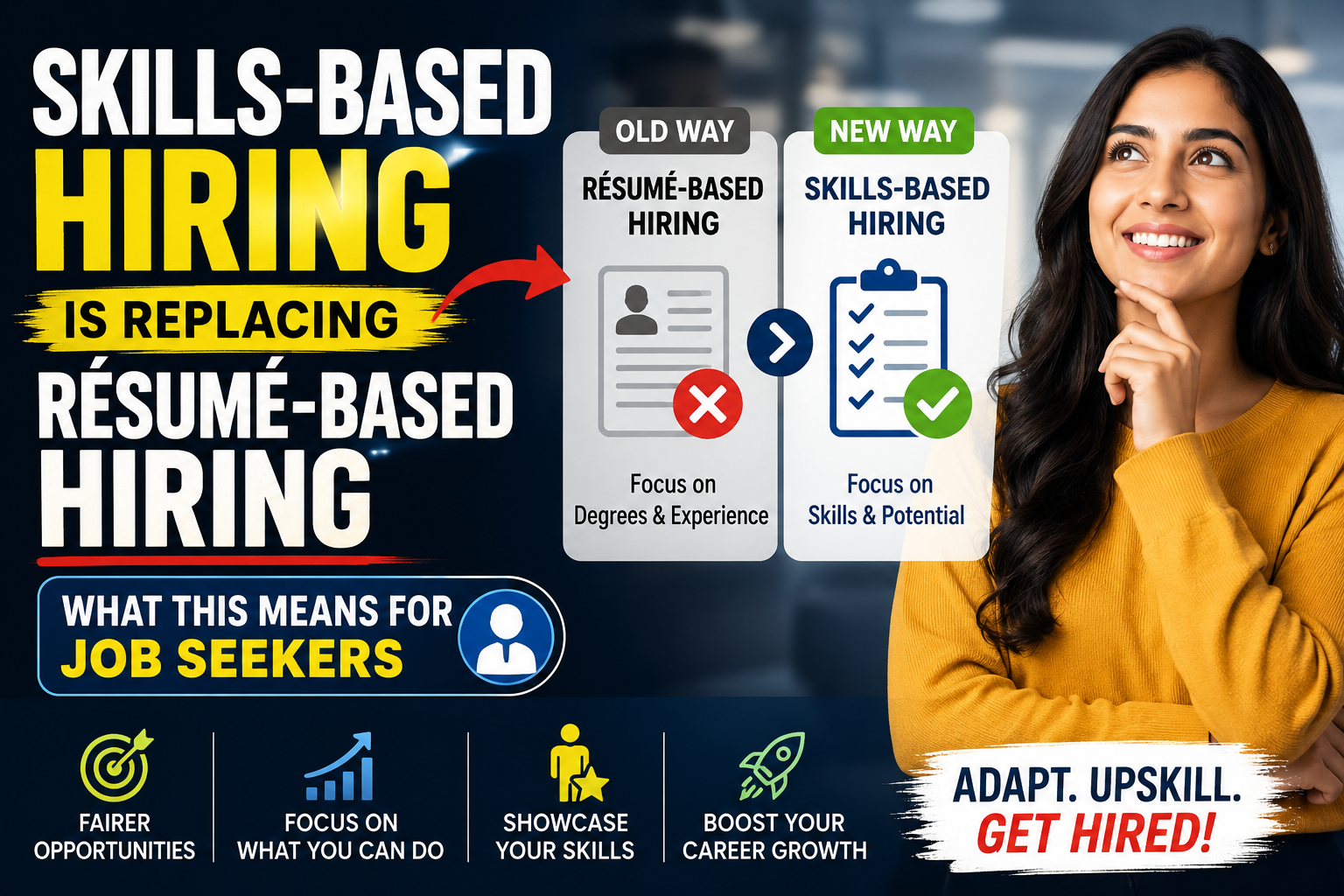
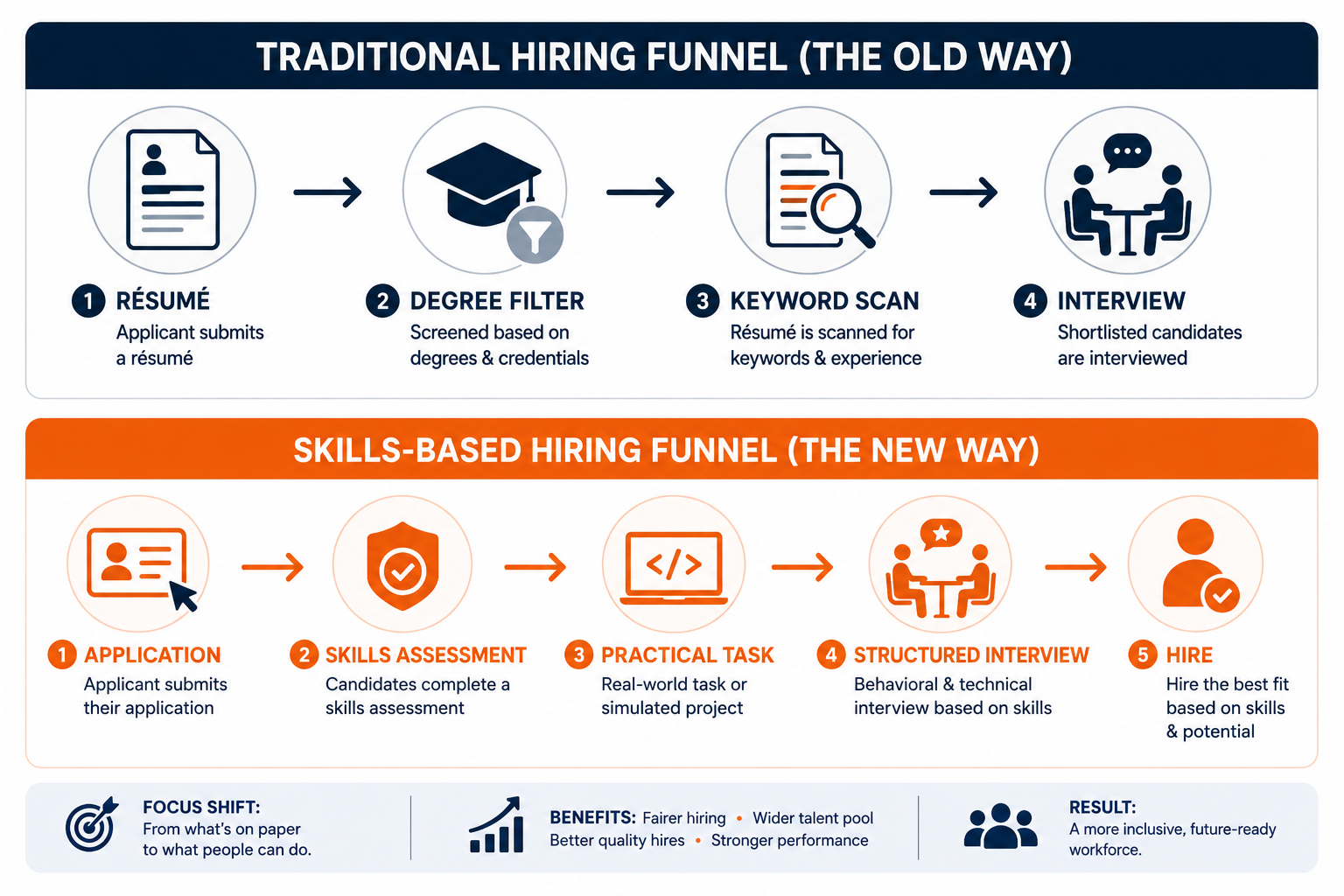
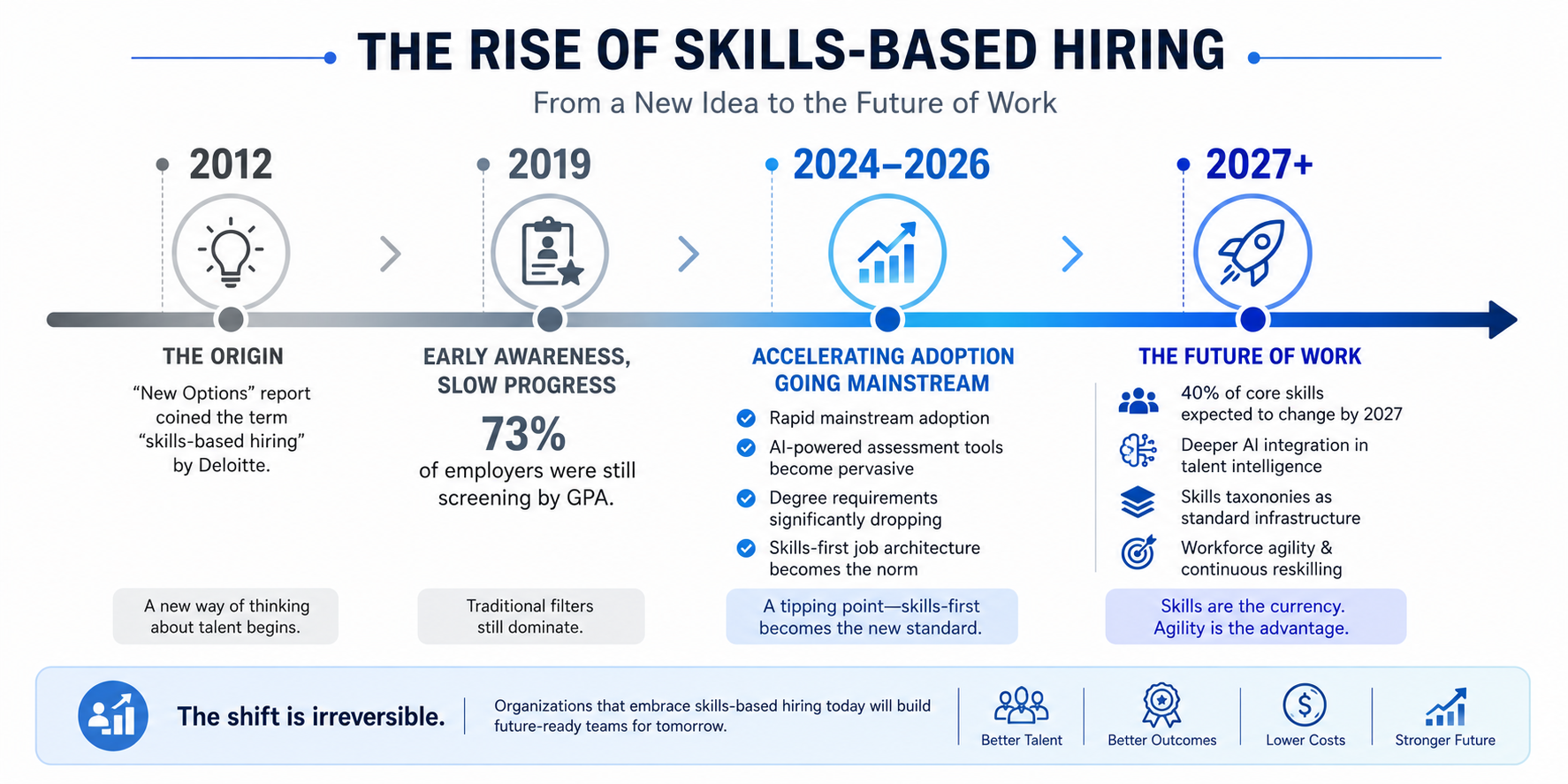
Skills-based hiring is a recruitment approach where employers evaluate candidates primarily on demonstrated abilities and competencies rather than degrees, job titles, or years of experience. Instead of asking “Where did you go to school?” the question becomes “Can you actually do the job?” This isn’t a brand-new idea — the concept traces back to the “New Options” project in 2012 — but it has moved from a niche HR experiment to a mainstream hiring strategy over the last five years.
Résumé-Based Hiring vs. Skills-Based Hiring: A Side-by-Side Comparison
| Dimension | Résumé-Based Hiring | Skills-Based Hiring |
|---|---|---|
| Primary screening signal | Degree, job titles, years of experience | Demonstrated competencies, assessments, portfolios |
| Entry barrier | High — often requires a specific credential | Lower — open to non-traditional paths |
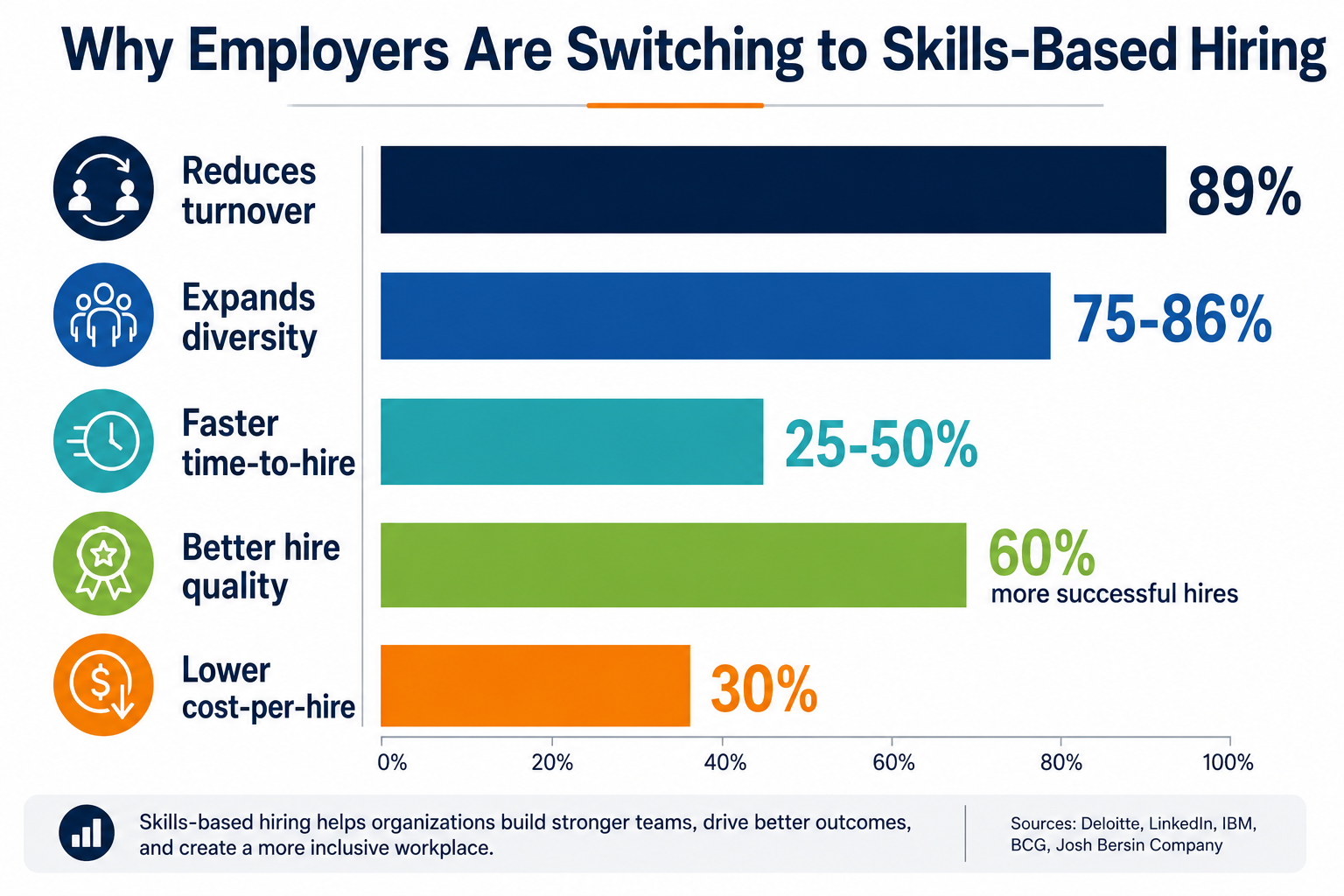
| Speed of hiring | Slower, more subjective interview rounds | Up to 25% faster time-to-hire |
| Diversity impact | Can unintentionally filter out qualified non-degree candidates | 86% of employers using skills-based hiring reported improved workforce diversity |
| Predictive accuracy | Relies on proxies (school prestige, title inflation) | 60% more likely to result in a successful hire, per LinkedIn data |
| Candidate pool size | Narrower | Up to 15.9× larger talent pool |
| Best suited for | Highly regulated professions (law, medicine) requiring licensure | Tech, creative, operations, sales, and evolving skill-based roles |
Why are Organizations Making This Shift?
It’s not just idealism — it’s business necessity. Here’s what’s driving the change:
1. The Skills Gap Is Real and Growing
The World Economic Forum projects a 40% skills gap by 2027, and 63% of employers already view skill shortages as their top barrier to transformation. Degrees earned five or ten years ago often don’t reflect what a role actually requires today — especially in tech, data, and digital marketing, where tools change every 18 months.
2. Résumés Are Getting Harder to Trust
With generative AI now able to polish (or fabricate) résumé language in seconds, employers can no longer assume a well-written résumé reflects real ability. Employers are increasingly leaning on objective skills tests to separate genuine ability from surface-level presentation, especially as application volumes have exploded.
3. Better Hires, Lower Turnover
89% of businesses report that skills-based hiring reduces employee turnover, and employees hired without a four-year degree requirement tend to stay 34% longer than degree-hired peers in comparable roles.
4. Bigger, More Diverse Talent Pools
75% of companies say skills-based hiring expands their candidate pool from a diversity standpoint, and research from the Burning Glass Institute has found that degree requirements disproportionately screen out capable Black, Hispanic, and lower-income candidates who may lack a four-year degree but not the relevant ability.
5. Speed and Cost Savings
Skills-based hiring can reduce cost-per-hire by up to 30% and pre-hire assessments can cut time-to-hire by as much as 50% by filtering out mismatched applicants earlier in the pipeline.
The Technology Powering the Shift
Skills-based hiring isn’t just a philosophy change — it’s enabled by real technological infrastructure:
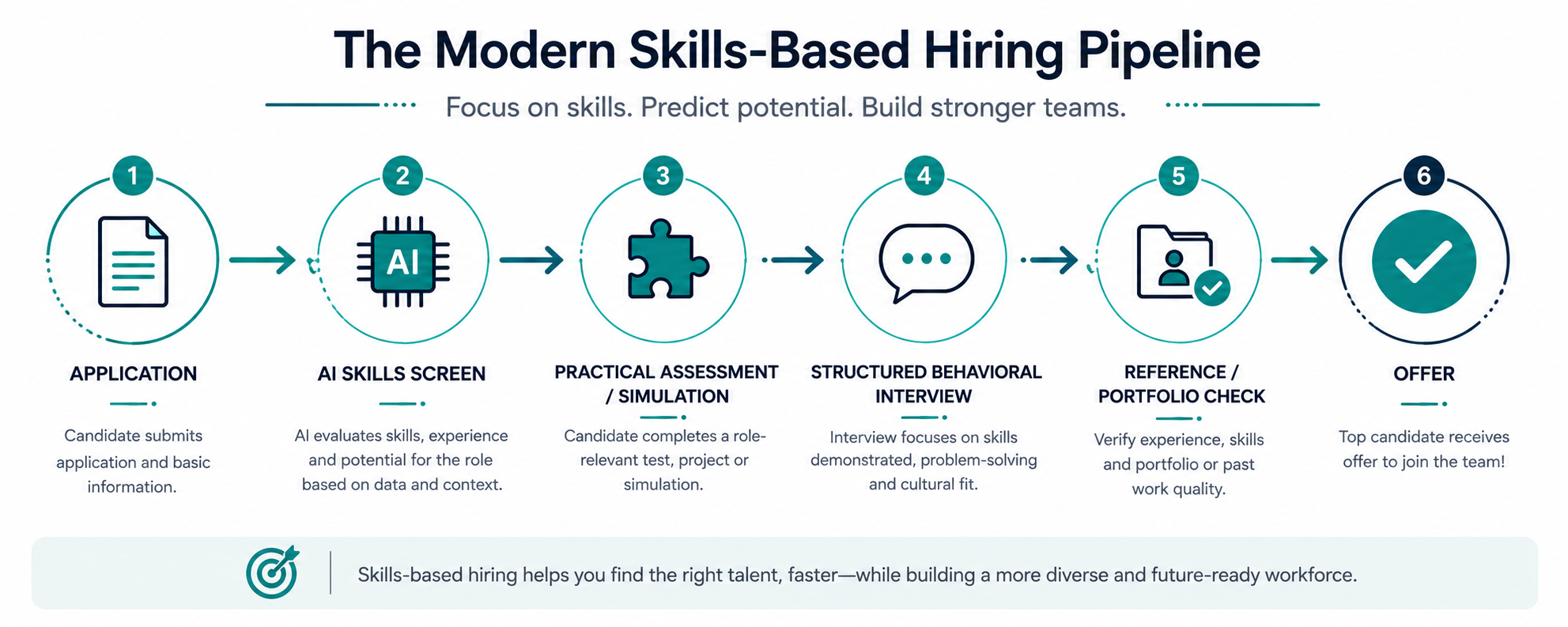
- AI-powered skills assessments — platforms that simulate real job tasks (coding challenges, case studies, writing samples) and score them objectively.
- Skills taxonomies and registries — structured databases that map specific skills to specific roles, replacing vague job titles with precise competency requirements.
- Applicant tracking systems (ATS) with skills-matching algorithms — instead of keyword-matching résumés, modern ATS tools now match candidate skill profiles to role requirements.
- Digital badges and micro-credentials — verifiable, stackable proof of specific competencies (think Google Career Certificates, AWS badges, or Coursera specializations).
- Video and asynchronous skills interviews — allowing candidates to demonstrate problem-solving in real time rather than talk about it abstractly.
- AI-assisted candidate matching — one hospitality-sector case study reported a 126% increase in candidates accepting their first job match after adopting AI-assisted skill matching, along with reduced drop-out during the hiring process.
Which industries are leading the Charge?
Skills-based hiring isn’t spreading evenly — some sectors are moving much faster than others.
| Industry | Adoption Pattern |
|---|---|
| Technology | Coding assessments and portfolio reviews have replaced degree screens for years; GitHub contributions often matter more than a CS degree. |
| Healthcare (non-clinical roles) | Administrative, tech, and support roles increasingly hire on certifications and demonstrated competency rather than degree pedigree. |
| Retail & Hospitality | High-volume hiring has pushed heavy adoption of AI-assisted skill matching to speed up staffing. |
| Financial Services | Growing use of case-study assessments for analyst and associate roles, especially at firms competing for non-traditional talent. |
| Government & Public Sector | Programs like IBM’s early “New Collar” initiative and public-sector skills-first mandates in the U.S. and India are formalizing degree-optional hiring paths. |
| Manufacturing & Skilled Trades | Certification-based hiring has long been the norm here and is now being formalized with digital credentialing. |
- Case Study Spotlight — IBM’s “New Collar” Program: IBM was among the first major employers to systematically hire technicians and support staff without four-year degrees, training them in-house instead. The program became a model widely cited across the skills-based hiring movement and helped normalize degree-optional hiring paths at scale for large enterprises.
- Case Study Spotlight — OneTen Coalition: This U.S. coalition of major employers has set out to hire or promote one million Black Americans without four-year degrees into family-sustaining roles over a decade, explicitly shifting job requirements toward skills-first criteria and pairing that shift with training pathways.
Benefits: What Each Side Gains
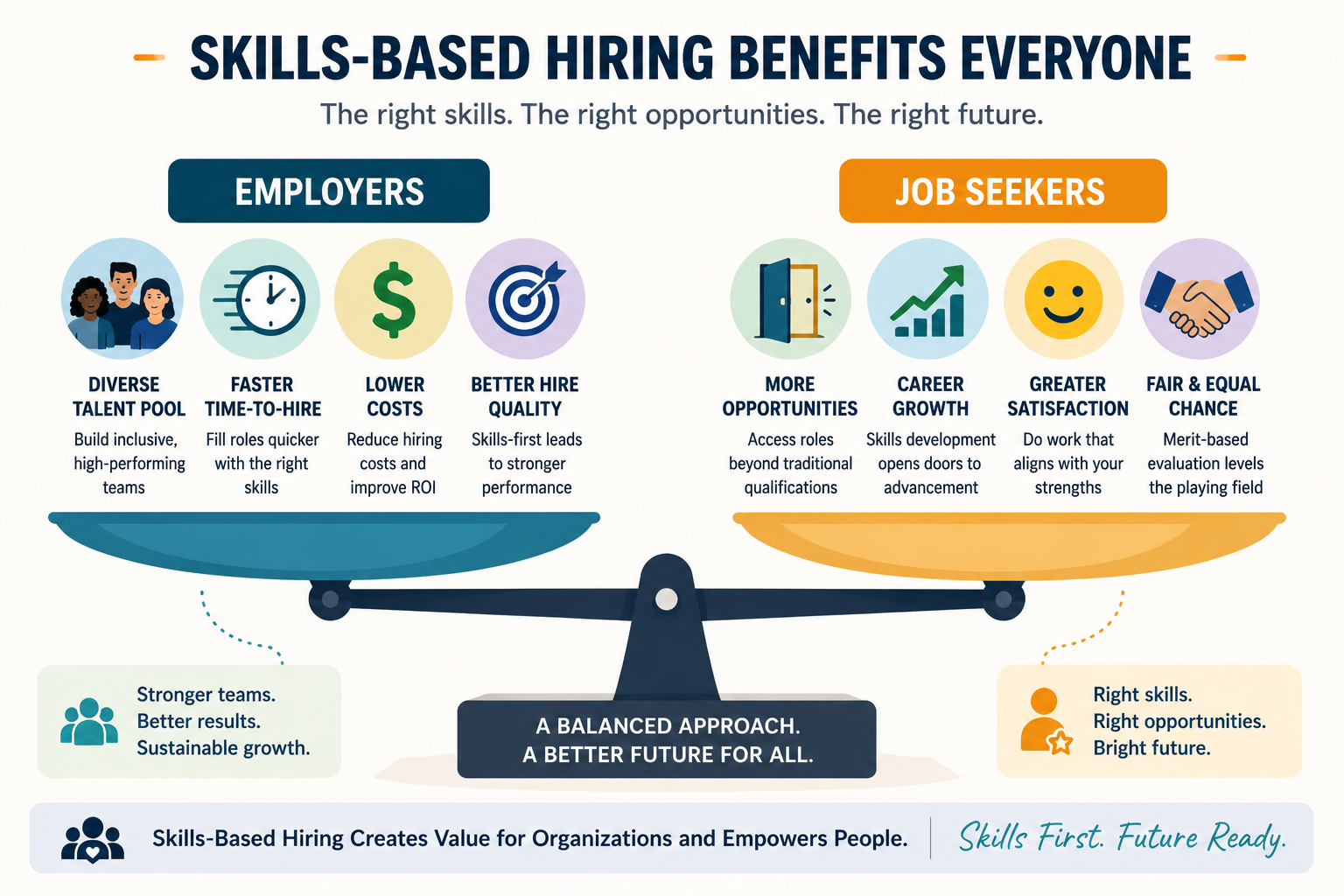
For Employers
- Access to a dramatically larger, more diverse talent pool
- Fewer mis-hires and lower turnover
- Faster, cheaper hiring cycles
- Better alignment between hiring and actual business needs
- Reduced unconscious bias in early screening stages — 79% of HR leaders say skills-based hiring reduces unconscious hiring bias
For Job Seekers
- A fair shot without a “traditional” background – 75% of job seekers say skills-based positions give them a fair opportunity regardless of educational background.
- Career changers get a real chance – Career changers are 50% more likely to get hired by companies using skills-based hiring.
- Faster career growth – 76% of employees in skills-based roles report growing their careers faster and being promoted more often.
- Higher job satisfaction – 38% of skills-based hires report being “very happy” in their roles, compared to 28% of those hired on experience alone.
- More confidence in applying. 59% of workers say they feel more confident applying for skills-based roles than for roles gated by a specific degree.
The Challenges Nobody’s Sugarcoating
Skills-based hiring isn’t a magic fix. Here’s where it gets messy:
- Policy doesn’t equal practice – A joint study by the Burning Glass Institute and Harvard Business School found that at some large firms, fewer than 1 in 700 new hires were non-college graduates — even after the companies had officially dropped degree requirements. Removing a line from a job posting doesn’t change hiring behavior unless sourcing, assessments, and manager incentives change too.
- Unclear skill definitions – Companies often struggle to define what a “skill” actually means for a given role in a consistent, measurable way.
- Inconsistent assessment quality – Not all skills tests are created equal — a poorly designed assessment can be just as biased as a degree filter.
- Manager skepticism. Hiring managers accustomed to résumé screening can be slow to trust new evaluation methods, creating friction even after HR adopts a skills-first policy.
- Disconnect between hiring and L&D – Skills-based hiring works best when connected to internal learning and development systems, but many organizations run these as separate silos.
- Candidate confusion – Many job seekers — especially recent graduates — don’t fully understand what skills-based hiring means or how to demonstrate their abilities in this new format, according to NACE’s own research on college students.
Reality check: Skills-based hiring is a spectrum, not a light switch. Some companies have gone all-in with structured assessments and skills taxonomies; others have simply removed a degree requirement from a job posting and changed nothing else. As a job seeker, you need to read the signals (see the strategy section below) to figure out which kind of employer you’re dealing with.
The Future Outlook
Where is this heading? A few clear signals:
- AI will get deeper, not just wider – Expect more sophisticated simulations — real-time coding sandboxes, AI-scored writing samples, and situational judgment tests — replacing generic multiple-choice assessments.
- Skills taxonomies will become standard infrastructure – More organizations are building internal “skills registries” that map every role to specific, trackable competencies, tying hiring directly to internal mobility and reskilling.
- Credentialing will keep expanding – Digital badges and micro-credentials from providers like Google, Coursera, and industry bodies will carry increasing weight, especially as standards for these credentials mature.
- Soft skills will get equal billing with technical skills – 92% of hiring professionals now believe soft skills are equally or more important than hard skills, and 89% of bad hires are linked to a lack of critical soft skills — expect more structured behavioral and situational assessments.
- The gap between “stated” and “actual” adoption will narrow — slowly – Expect continued scrutiny (and some backlash) as companies are pressed to prove their skills-first hiring claims translate into real outcomes, not just policy language.
Practical Strategies: How Job Seekers Can Stay Competitive
This is the part that matters most for you. Here’s how to adapt.
Build a Visible “Skills Portfolio”
Don’t just list skills — prove them.
- Publish real projects (GitHub, Behance, a personal site, a writing portfolio).
- Earn recognized micro-credentials relevant to your target role.
- Keep a running list of quantified outcomes (“Reduced report generation time by 40% using Python automation”) rather than vague duties.
Reframe Your Résumé Around Skills, Not Just Titles
- Lead bullet points with the skill demonstrated, then the result.
- Use language that mirrors the skill taxonomies employers are using (check the actual job posting’s skill list, not just the job title).
- If you have a non-linear career path or employment gap, don’t hide it — reframe it around what you built or learned during that time.
Prepare Differently for Interviews
- Expect practical tasks, case studies, or live problem-solving exercises — practice explaining your thinking process out loud, not just your final answer.
- Prepare specific stories (the STAR method: Situation, Task, Action, Result) that demonstrate both technical and soft skills.
- Ask recruiters directly: “Does this process include a skills assessment or practical exercise?” It signals preparedness and helps you calibrate.
Invest in Credentials Strategically
Not all certificates are equal. Prioritize:
- Credentials tied to specific, in-demand tools or platforms in your field.
- Programs with employer partnerships or recognized industry backing.
- Anything that lets you build something real as part of earning it (a project-based certificate beats a passive video course).
Target Companies and Roles Signaling Real Adoption
Look for these signals in job postings:
- Skills explicitly listed instead of a degree requirement
- Mention of a practical assessment or work-sample test in the process
- Language like “equivalent experience welcome” or “demonstrated ability”
Job Seeker Checklist
- Audit your résumé for skill-based language, not just job titles
- Build or update a portfolio with 2–3 concrete work samples
- Identify 1–2 relevant, credible micro-credentials to pursue this quarter
- Practice explaining your problem-solving process, not just outcomes
- Research whether target companies use skills assessments (check Glassdoor, LinkedIn, or company careers pages)
- Prepare 3–5 STAR-method stories covering both technical and soft skills
- Follow up after assessments with a thank-you note referencing specific parts of the task
Mockup suggestion: A simple “before and after” résumé mockup — left side a traditional bullet list (“Marketing Coordinator, 2019–2022, responsible for social media”), right side reframed with skill and outcome framing (“Grew organic social engagement 45% by designing and running a content strategy — skills: analytics, content strategy, campaign management”). AI image prompt: “Split-screen resume mockup comparison, left labeled ‘Traditional’ in muted gray tones, right labeled ‘Skills-Based’ in vibrant highlighted text with skill tags, clean flat UI design”
Frequently Asked Questions
Q: Does skills-based hiring mean degrees no longer matter at all?
No. Degrees still matter for regulated professions (medicine, law, engineering licensure) and for some employers as one signal among many. What’s changing is that a degree is no longer treated as the primary or only gatekeeper for most roles.
Q: How do I prove skills if I don’t have formal work experience in a field?
Build demonstrable proof: personal projects, freelance work, open-source contributions, volunteer work, or credentialed courses with practical components. Skills-based employers care about evidence of ability, not the label on your job history.
Q: Are skills assessments during hiring fair?
It depends on design quality. Well-built assessments tied directly to job tasks tend to be more objective and less biased than resume screening. Poorly designed ones can still introduce bias, so it’s reasonable to ask employers about how their assessments were validated.
Q: Will AI resume-screening tools become obsolete?
Not obsolete, but they’re evolving. Many ATS platforms are shifting from keyword-matching résumés to matching structured skill profiles, meaning how you describe your skills matters more than resume formatting tricks.
Q: Is skills-based hiring only relevant for tech jobs?
No — while tech has led adoption, retail, hospitality, healthcare support roles, financial services, manufacturing, and government are all expanding skills-first practices, according to multiple 2026 industry surveys.
Q: What’s the single best thing I can do right now?
Build one concrete, verifiable proof-of-skill this month — a project, a certificate with a real deliverable, or a documented outcome from your current role — and rewrite your résumé’s top three bullet points around it.
Conclusion: The Résumé isn’t Dead, But It’s No Longer the Whole Story
Here’s the honest takeaway: the résumé isn’t disappearing overnight, but it’s losing its role as the single gatekeeper to opportunity. Employers increasingly want proof, not paper. That’s genuinely good news if you’ve taken an unconventional path, changed careers, or built real ability without a matching credential to show for it.
The job seekers who will thrive in this shift are the ones who stop asking “How do I make my résumé look better?” and start asking “How do I make my skills visible, verifiable, and easy to evaluate?”
Your next step –> Pick one item from the checklist above and do it this week — not someday. Update one section of your résumé to lead with a skill and a result. Start one project you can point to in your next interview. The hiring system has changed; make sure your job search strategy changes with it.