In 2026, applying for jobs on Naukri is not just about uploading your resume and waiting for recruiter calls. The platform has become highly competitive, and thousands of candidates apply for the same roles every day. Recruiters do not have enough time to read every resume in detail, so they usually search, filter, and shortlist candidates based on specific keywords, skills, experience, job titles, location, and other profile details.
This means your resume must do two things at the same time. First, it should be clear and professional enough for recruiters to understand your experience quickly. Second, it should include the right keywords so that your profile appears in recruiter searches. A resume that looks good but does not match the job description may still get ignored. Similarly, a resume full of keywords but poorly written may not impress the recruiter.
The good news is that you do not need an overly designed or complicated resume to get shortlisted on Naukri. What you need is a simple, well-structured, and role-focused resume that clearly shows who you are, what skills you have, and why you are suitable for the job. Whether you are a fresher, a mid-level professional, or someone planning a career switch, writing your resume correctly can improve your chances of getting noticed.
How Recruiters Search for Candidates on Naukri?
Before writing your resume, it is important to understand how recruiters actually find candidates on Naukri. Many job seekers think that once they upload their resume, recruiters will automatically read it and call them. But in reality, recruiters usually use search filters to find the most relevant candidates. For example, if a company is hiring a data analyst, the recruiter may search for keywords like “Data Analyst,” “Excel,” “SQL,” “Power BI,” “MIS Reporting,” or “Dashboard.” If these words are missing from your resume or Naukri profile, your chances of appearing in recruiter searches may become lower, even if you have the right skills.
Recruiters also filter candidates based on experience, current location, preferred location, salary range, notice period, education, industry, and job role. This is why your resume should clearly mention your role, skills, tools, work experience, and career focus. A vague resume that only says “hardworking professional looking for growth opportunities” will not help much on a platform like Naukri.
Your resume should be written in a way that matches the type of job you want. If you are applying for HR roles, your resume should highlight recruitment, payroll, onboarding, employee engagement, HRMS, and compliance-related skills. If you are applying for finance roles, it should include accounting, GST, Tally, financial reporting, reconciliation, budgeting, and MIS. If you are applying for IT or data roles, it should mention tools, programming languages, databases, dashboards, and project experience.
The goal is not to add random keywords. The goal is to include the exact skills and responsibilities that are relevant to your target job. When your resume matches the language used in job descriptions, recruiters can understand your profile faster, and your chances of getting shortlisted improve.A good way to do this is to open 5 to 10 job descriptions for the role you want and note the common skills mentioned in them. Then, add the skills that genuinely match your experience to your resume. This makes your resume more focused, searchable, and recruiter-friendly.
Step 1 – Start with a Strong Resume Headline
Your resume headline is one of the first things a recruiter notices on Naukri. It is a short line that tells the recruiter what kind of professional you are. A good headline can quickly show your experience, skills, job role, and industry focus. A weak headline, on the other hand, can make your profile look unclear or generic. Many candidates write very basic headlines such as “Looking for a good opportunity” or “Hardworking and dedicated professional.” These lines do not tell the recruiter anything specific. Recruiters are usually searching for candidates with particular skills and job titles, so your headline should clearly match the role you want.
A strong resume headline should include three things: your job role, your experience level, and your key skills or domain. For example, instead of writing “Seeking job in finance,” you can write “Finance Executive with Experience in GST, Tally and Bank Reconciliation.” This immediately tells the recruiter what you do and where your skills are.
Here are a few examples of good resume headlines:
| Career Field | Strong Resume Headline |
| Data Analytics | Data Analyst with 2 Years of Experience in Excel, SQL and Power BI |
| HR | HR Executive Skilled in Recruitment, Payroll and Employee Engagement |
| Finance | Finance Executive with Knowledge of GST, Tally and Financial Reporting |
| Digital Marketing | Digital Marketing Executive Skilled in SEO, Google Ads and Social Media Marketing |
| Software Development | Java Developer with Experience in Spring Boot, MySQL and REST APIs |
| Fresher | B.Com Graduate with Knowledge of Accounting, GST and Tally |
Your headline should not be too long. Try to keep it clear, direct, and job-focused. Avoid using too many buzzwords such as “dynamic,” “passionate,” or “goal-oriented” unless they are supported by real skills. Recruiters are more interested in knowing what you can actually do.
For freshers, the headline should focus on education, skills, internships, projects, or certifications. For experienced professionals, it should focus on current job role, years of experience, tools, industry, and achievements. For career switchers, the headline should connect your past experience with the new role you are targeting.
A good headline improves your chances of being noticed because it makes your profile easier to understand in just a few seconds. On Naukri, where recruiters may go through hundreds of profiles, this small line can create a strong first impression.
Step 2 – Write a Profile Summary That Matches the Job You Want
After your resume headline, the next important part is your profile summary. This is a short paragraph at the top of your resume that tells recruiters who you are, what you can do, and what kind of role you are looking for. A good profile summary should not sound like a generic career objective. Lines like “I want to work in a reputed organisation where I can grow and use my skills” are very common and do not help much. Instead, your summary should clearly show your skills, experience, domain knowledge, and career direction. Think of your profile summary as your 30-second introduction to the recruiter.
What Should a Good Profile Summary Include?
A strong profile summary should include:
- Your current role or educational background
- Years of experience, if any
- Your main skills and tools
- Your industry or domain knowledge
- Your major strengths related to the job
- The type of role you are targeting
For example, if you are applying for a data analyst role, your summary should mention skills like Excel, SQL, Power BI, data cleaning, reporting, and dashboarding. If you are applying for an HR role, it should include recruitment, onboarding, payroll, HR operations, employee engagement, and HRMS.
Example for a Fresher
A B.Com graduate with knowledge of accounting, GST, Tally, and MS Excel. Skilled in preparing basic financial reports, maintaining records, and understanding business transactions. Looking for an entry-level finance or accounts role where I can apply my academic knowledge and build practical industry experience.
Example for an Experienced Candidate
Data Analyst with 2 years of experience in preparing dashboards, cleaning data, and generating business reports using Excel, SQL, and Power BI. Experienced in working with large datasets, identifying trends, and supporting decision-making through clear reports. Seeking opportunities in data analytics, MIS reporting, or business intelligence roles.
Example for a Career Switcher
Marketing professional with 3 years of experience in campaign management, customer analysis, and performance tracking. Skilled in Excel, Google Analytics, and basic SQL, with a strong interest in data-driven decision-making. Looking to transition into a data analyst role by combining business understanding with analytical skills.
Tips to Write a Better Profile Summary
- Keep your profile summary short and focused. Ideally, it should be 3 to 5 lines only. Do not write your entire career story here. The purpose is to give recruiters a quick reason to continue reading your resume.
- Use keywords from the job description, but only if they genuinely match your skills. For example, if job descriptions for your target role commonly mention “Power BI,” “SQL,” and “MIS reporting,” include them only if you have working knowledge of these skills.
- Also, avoid emotional or vague phrases such as “very hardworking,” “quick learner,” or “ready to take challenges.” These lines are not wrong, but they are overused. It is better to show your value through real skills, tools, projects, and achievements.
Simple Formula You Can Follow
You can use this simple formula to write your profile summary:
Your role/background + years of experience + key skills/tools + domain knowledge + target role
For example:
Finance professional with 2 years of experience in accounting, GST filing, bank reconciliation, and financial reporting. Skilled in Tally, Excel, invoice management, and monthly MIS preparation. Looking for finance and accounts roles where I can contribute to accurate reporting and smooth financial operations.
A well-written profile summary makes your resume look focused and professional. It helps recruiters quickly understand whether your profile matches the job opening. On Naukri, where recruiters often scan profiles quickly, this section can make a strong difference in getting shortlisted.
Step 3 – Add the Right Key Skills for Better Visibility
The Key Skills section is one of the most important parts of your resume and Naukri profile. Recruiters often search for candidates using specific skills, tools, software, and job-related keywords. If your key skills are missing or written poorly, your profile may not appear in relevant searches. For example, if a recruiter is hiring for an MIS Executive role, they may search for words like Excel, Advanced Excel, VLOOKUP, Pivot Table, MIS Reporting, Dashboard, Data Analysis, and Power BI. If you have these skills but have not mentioned them clearly, you may miss out on good opportunities. Your key skills should be specific, relevant, and connected to the job you want.
Why Key Skills Matter on Naukri
On platforms like Naukri, recruiters do not always search for your full resume. Many times, they search by skill keywords. This means your skills section should clearly include the terms recruiters are likely to use. A strong skills section can help you in three ways:
- It makes your profile easier to find.
- It helps recruiters quickly understand your suitability.
- It improves the match between your resume and job descriptions.
However, this does not mean you should add every trending skill. Adding random skills can make your resume look confusing. Only include skills that you actually know and can explain in an interview.
How to Choose the Right Skills
The best way to choose key skills is to study job descriptions. Open 5 to 10 job postings for your target role and look at the skills that appear repeatedly. These repeated words are important because they show what recruiters are actively looking for. For example, if you are applying for finance roles, you may commonly see skills like GST, Tally, accounting, bank reconciliation, invoice processing, financial reporting, and MIS. If you are applying for HR roles, you may see recruitment, onboarding, payroll, HRMS, employee engagement, attendance management, and compliance. Once you identify the common skills, add the ones that match your real knowledge and experience.
Examples of Key Skills for Different Roles
| Job Role | Key Skills to Add |
| Data Analyst | Excel, SQL, Power BI, Data Cleaning, Dashboarding, Data Visualization, Reporting |
| HR Executive | Recruitment, Payroll, Onboarding, HRMS, Employee Engagement, Attendance Management |
| Finance Executive | Tally, GST, Bank Reconciliation, Financial Reporting, Invoice Processing, MIS |
| Digital Marketing Executive | SEO, Google Ads, Social Media Marketing, Google Analytics, Content Marketing |
| Software Developer | Java, Python, MySQL, APIs, Git, React, Spring Boot |
| Sales Executive | Lead Generation, CRM, Client Handling, Negotiation, Business Development |
Avoid Writing Skills Too Generally
Many candidates write skills in a very broad way, such as “computer knowledge,” “communication,” “management,” or “MS Office.” These words are too general and do not help recruiters understand your exact ability.
- Instead of writing “MS Office,” write “MS Excel, PowerPoint, Word, Pivot Tables, VLOOKUP.”
- Instead of writing “digital marketing,” write “SEO, Google Ads, Meta Ads, Google Analytics, Keyword Research.”
- Instead of writing “finance,” write “GST, Tally, Bank Reconciliation, Financial Reporting, Accounts Payable.”
The more specific your skills are, the easier it becomes for recruiters to match your profile with the job.
Do Not Overload Your Resume with Keywords
While keywords are important, your resume should still sound natural. Do not repeat the same skill again and again just to improve visibility. Recruiters can easily identify keyword stuffing, and it may create a negative impression. A good skills section should have around 8 to 15 strong and relevant skills. For freshers, 6 to 10 skills are enough if they are genuine. For experienced candidates, the skills should reflect both technical ability and domain experience.
Finally, keep updating your Key Skills section whenever you learn something new or start targeting a different role. For example, if you are moving from Excel-based reporting to Power BI dashboards, add Power BI, data visualisation, dashboarding, and business reporting to your skills section. A well-written Key Skills section makes your resume more searchable, relevant, and recruiter-friendly. On Naukri, this small section can directly influence whether your profile appears in recruiter searches or gets ignored.
Step 4 – Focus on Work Experience Achievement
Your work experience section is the main part of your resume, especially if you are not a fresher. This is where recruiters check what you have actually done in your previous or current job. Many candidates make the mistake of only listing daily responsibilities, but a strong resume should also show achievements, results, and impact.
For example, writing “Handled customer calls” is very basic. It only tells the recruiter what your duty was. But writing “Handled 50+ customer calls daily and resolved queries related to billing, service issues, and account updates” gives a much clearer picture of your work. Your goal should be to show not just what you did, but how well you did it.
Why Achievements Matter More Than Duties
Recruiters already know the basic responsibilities of most job roles. For example, they know that an HR executive may work on recruitment, a finance executive may work on accounts, and a digital marketer may work on campaigns. What they want to know is how much responsibility you handled and what value you added. Achievement-based points make your resume stronger because they show:
- The scale of your work
- The tools or processes you used
- The results you helped achieve
- Your ability to take responsibility
- Your contribution to the team or business
This makes your resume more convincing and professional.
Weak vs Strong Resume Points
| Weak Resume Point | Strong Resume Point |
| Handled recruitment work | Managed end-to-end recruitment for junior and mid-level roles, including screening, interview coordination, and offer follow-ups |
| Prepared reports | Prepared weekly MIS reports using Excel to track sales performance, pending tasks, and team productivity |
| Worked on social media | Created and scheduled social media posts, tracked engagement, and supported campaign performance analysis |
| Managed accounts | Maintained daily accounting entries, supported GST filing, and assisted in monthly bank reconciliation |
| Handled customers | Resolved customer queries through calls and emails while maintaining service quality and response timelines |
Use Numbers Wherever Possible
Numbers make your resume more specific and believable. You do not need very big achievements. Even simple numbers can make your experience look clearer. For example:
- Processed 100+ invoices per month
- Managed recruitment for 5 to 8 positions at a time
- Prepared weekly reports for 3 business teams
- Handled 40+ customer queries daily
- Improved social media engagement by 20%
- Created dashboards for monthly sales tracking
These numbers help recruiters understand the size and seriousness of your work.
Use Action Words at the Start
Start your bullet points with strong action words. This makes your resume sound more active and professional. Some good action words are:
- Managed
- Prepared
- Created
- Analysed
- Coordinated
- Improved
- Supported
- Tracked
- Developed
- Maintained
- Assisted
- Executed
For example, instead of writing “Responsible for making reports,” write “Prepared monthly performance reports using Excel and PowerPoint for internal review meetings.”
Keep Bullet Points Clear and Short
Your work experience section should be easy to scan. Recruiters may not read long paragraphs, so write your experience in bullet points. Each bullet should ideally be one to two lines only. A good structure can be:
- Job Title
- Company Name
- Duration
Key Responsibilities and Achievements:
- Prepared monthly MIS reports using Excel, Pivot Tables, and VLOOKUP for tracking business performance.
- Coordinated with internal teams to collect data, verify entries, and update weekly dashboards.
- Assisted in process improvement by identifying repeated reporting errors and correcting data gaps.
- Supported management with presentation-ready reports for review meetings.
Step 5 – Keep the Resume Format Clean and ATS-Friendly
A good resume is not the one with the most design. A good resume is one that recruiters can read quickly and hiring systems can understand easily. On Naukri, your resume should look professional, simple, and well-arranged so that important details are not missed.
Many candidates use heavy designs, colourful templates, icons, photos, graphics, and complicated tables. These may look attractive, but they can make the resume difficult to read. Some systems may also fail to read information correctly if the formatting is too complex. That is why a clean and ATS-friendly format is always safer.
What is an ATS-Friendly Resume?
- ATS stands for Applicant Tracking System. Many companies use such systems to filter resumes before recruiters manually review them. These systems scan your resume for job titles, skills, qualifications, work experience, keywords, and other important details.
- An ATS-friendly resume is a resume that is easy for both software and humans to read. It uses simple formatting, clear headings, and relevant keywords.
Use Simple and Clear Headings
Your resume should have proper section headings so that recruiters can quickly find the information they need. Use common headings such as:
- Profile Summary
- Key Skills
- Work Experience
- Education
- Certifications
- Projects
- Internships
- Achievements
- Contact Details
Avoid creative headings like “My Journey,” “What I Bring,” or “Things I Know.” These may sound interesting, but they can confuse both recruiters and automated systems.
Choose a Professional Layout
Your resume should follow a neat structure. For most candidates, the best order is:
- Name and contact details
- Resume headline
- Profile summary
- Key skills
- Work experience
- Education
- Certifications
- Projects or achievements
For freshers, education, internships, certifications, and projects can come before work experience. For experienced professionals, work experience should come before education because recruiters are more interested in your practical exposure.

Avoid Unnecessary Design Elements
Do not use too many colours, images, icons, borders, or fancy fonts. These elements can distract the recruiter and reduce readability. A resume should look clean, not crowded. Avoid using:
- Photos, unless specifically required
- Multiple font styles
- Bright colours
- Heavy borders
- Complicated tables
- Charts or graphics
- Text boxes
- Unusual symbols
Instead, use simple bullet points, proper spacing, and consistent formatting.
Keep the Resume Length Under Control
- For freshers, a one-page resume is usually enough. For candidates with 2 to 7 years of experience, one to two pages are ideal. Senior professionals may need two pages, but the content should still be focused.
- Do not add unnecessary details just to make the resume longer. Recruiters prefer resumes that are clear, relevant, and easy to scan.
Use the Right File Name
Your resume file name also matters. Avoid names like “resume final latest new 2.pdf” or “my cv updated.docx.” These look unprofessional. Use a clean file name such as:
- Anandita_Doda_Resume.pdf
- Rahul_Sharma_Data_Analyst_Resume.pdf
- Priya_Mehta_HR_Executive_Resume.pdf
This makes your resume look more organised and easier for recruiters to save or share internally.
Save the Resume in the Correct Format
- PDF is usually the safest format because it keeps the layout fixed. However, some employers may ask for a Word document. In that case, follow the employer’s instructions.
- Before uploading your resume on Naukri, open the file once and check whether the formatting, alignment, spacing, and bullet points are appearing properly.
Step 6 – Final Naukri Resume Checklist Before Applying
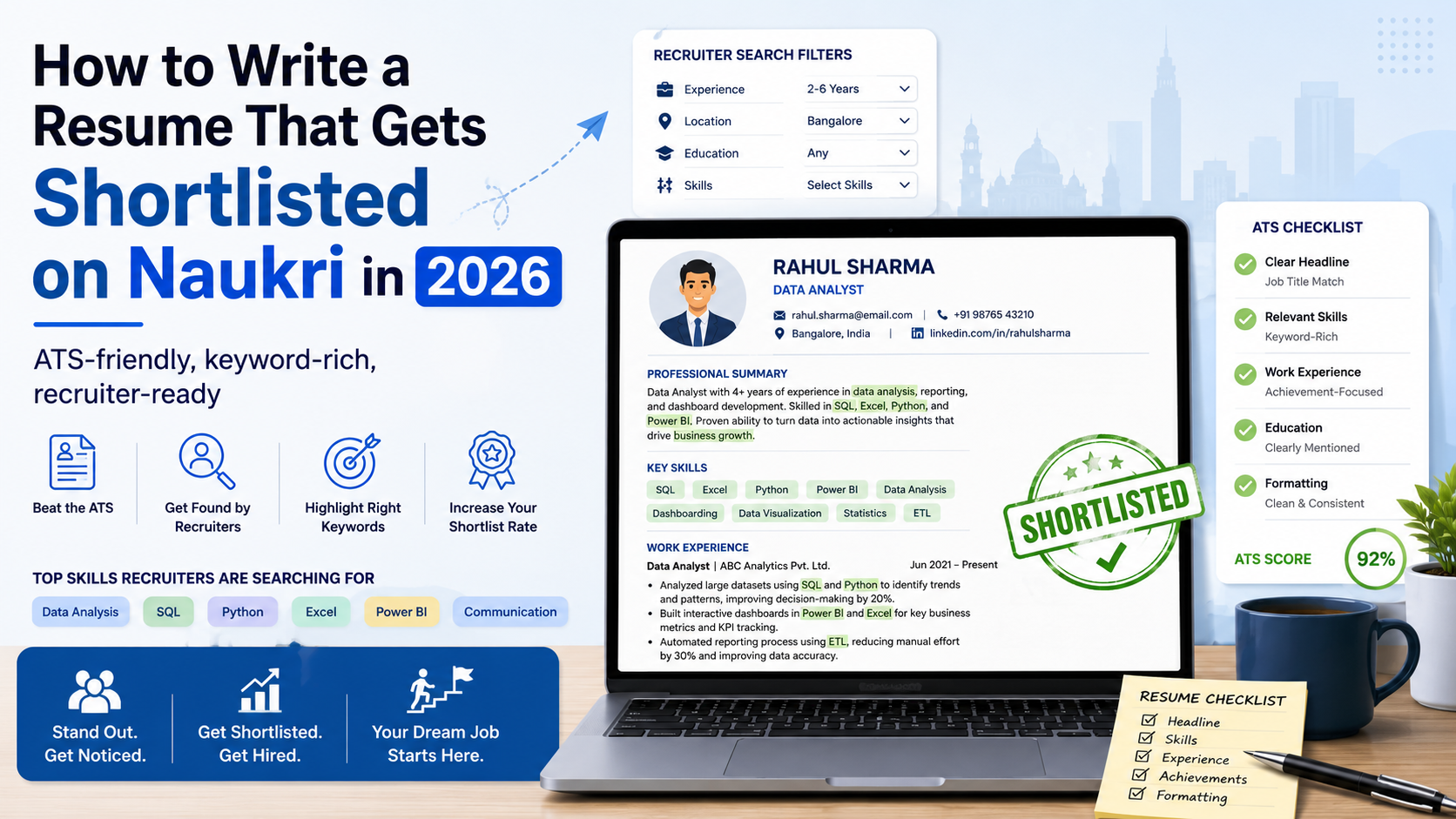
Before you start applying for jobs on Naukri, take a few minutes to review your resume properly. Many candidates lose good opportunities because of small mistakes such as missing keywords, outdated contact details, poor formatting, or a weak profile summary. A final checklist can help you avoid these mistakes and make your resume more recruiter-friendly.
1. Check Your Resume Headline
Your resume headline should clearly mention your target role and main skills. It should not be vague or too general.
Example: Data Analyst with Skills in Excel, SQL, Power BI and Dashboard Reporting
Avoid lines like:
- Looking for a challenging opportunity in a reputed company
- A specific headline helps recruiters understand your profile quickly.
2. Review Your Profile Summary
Your profile summary should be short, clear, and relevant to the job you want. It should include your experience, skills, tools, and career focus.
Make sure your summary answers three simple questions:
- Who are you?
- What skills do you have?
- What kind of role are you looking for?
Do not make this section too long. A 3 to 5 line summary is enough.
3. Match Your Key Skills with Job Descriptions
Before applying, open a few job postings related to your target role and compare their skill requirements with your resume. Add relevant skills only if you genuinely know them.
For example, if most jobs mention Excel, Power BI, MIS Reporting, and SQL, and you know these tools, include them clearly in your Key Skills section.
This improves your chances of appearing in recruiter searches.
4. Update Your Work Experience
Your work experience should not read like a job description copied from the internet. It should show your actual work, responsibilities, tools used, and achievements.
Check whether your bullet points include:
- Action words
- Role-specific tasks
- Tools or software used
- Numbers wherever possible
- Results or impact
For example:
- Prepared monthly MIS reports using Excel and Power BI to track sales performance across regional teams.
- This sounds stronger than simply writing:
- Prepared reports.
5. Check Education, Certifications and Projects
Make sure your education details are correct and updated. If you have done any certification related to your target job, add it clearly. For freshers, internships, academic projects, online courses, and certifications are very important. They help show practical interest even if you do not have full-time work experience.
For example:
- Excel for Business Analysis
- Power BI Dashboard Project
- GST and Tally Certification
- Digital Marketing Internship
- HR Recruitment Internship
6. Keep Contact Details Updated
This is a basic step, but many candidates make mistakes here. Check your mobile number, email ID, city, and LinkedIn profile if added. Use a professional email ID. Avoid email IDs that look too casual or unprofessional.
- Good example: rahul.sharma@gmail.com
- Avoid: coolrahul123@gmail.com
Make sure Recruiters should be able to contact you easily.
7. Update Your Naukri Profile Regularly
Only uploading your resume is not enough. Your Naukri profile should also be updated. Recruiters may check your profile details before downloading your resume. Make sure these details are correct:
| Naukri Profile Field | What to Check |
| Current location | Add your correct city |
| Preferred location | Add cities where you are open to work |
| Notice period | Keep it accurate |
| Current salary | Update if required |
| Expected salary | Keep it realistic |
| Key skills | Match them with your resume |
| Resume upload date | Update your resume regularly |
Updating your profile regularly can improve visibility because recruiters often prefer active candidates.
8. Proofread Before Uploading
A resume with spelling mistakes, grammar errors, wrong dates, or poor alignment can create a bad impression. Read your resume carefully before uploading it. Check for:
- Spelling mistakes
- Grammar errors
- Incorrect job titles
- Wrong dates
- Inconsistent font size
- Poor spacing
- Repeated information
- Missing keywords
You can also ask a friend or mentor to review it once.
Conclusion
Getting shortlisted on Naukri in 2026 is not about making a fancy resume. It is about making a resume that is clear, searchable, relevant, and easy to understand. Recruiters should be able to quickly see your job role, skills, experience, and suitability for the position. A strong resume headline, focused profile summary, relevant key skills, achievement-based work experience, and clean formatting can make a big difference. Along with this, your Naukri profile should be updated regularly so that recruiters can find you easily. In simple words, your resume should not just tell recruiters that you need a job. It should clearly show them why you are the right candidate for the job.