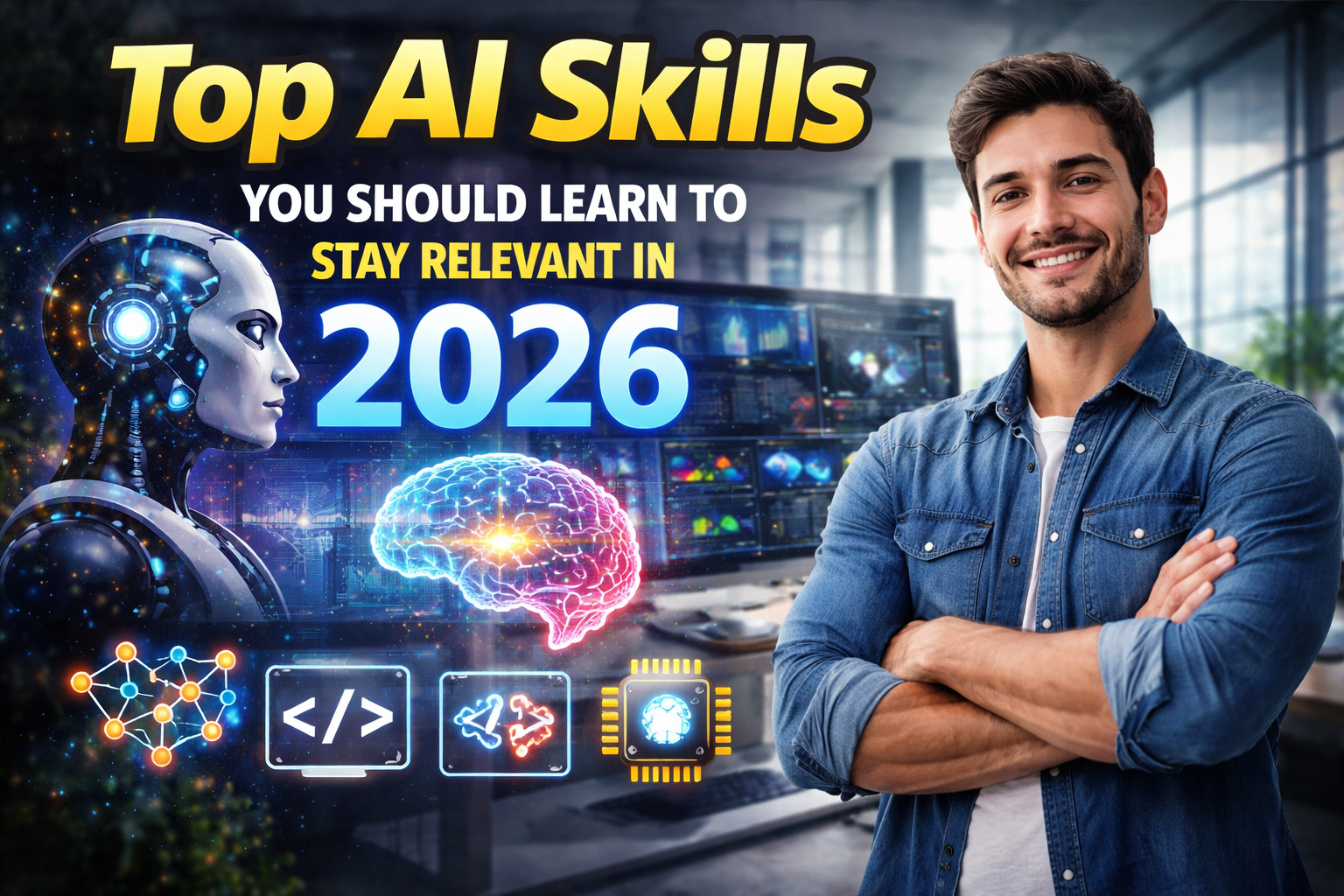
Artificial Intelligence is no longer a niche technology used only by data scientists. Today it is embedded in everyday tools such as search engines, productivity software, analytics platforms, and enterprise systems. Professionals across industries now need at least a basic understanding of AI to remain competitive in the job market.
Companies are increasingly looking for employees who can work alongside AI systems, interpret data, and apply AI tools to solve business problems. As AI adoption accelerates, developing the right set of AI skills has become essential for long-term career growth. In this guide, we explore the most important AI skills professionals should learn in 2026 and why these capabilities are becoming critical for modern careers.
1. AI Literacy and Understanding AI Fundamentals
AI literacy is the starting point for anyone entering the world of artificial intelligence. It focuses on understanding how AI works, the different types of AI systems, and how organizations use AI technologies to solve real business problems.
Having a strong grasp of AI fundamentals helps professionals understand the capabilities and limitations of AI systems and use them responsibly in business environments.
Who Should Learn This Skill?
- Business professionals working with AI tools
- Managers involved in digital transformation
- IT professionals exploring AI technologies
- Students and fresh graduates entering tech roles
- Professionals from marketing, finance, and operations
Skills Required
- Basic computer literacy
- Analytical thinking
- Curiosity about emerging technologies
- Understanding of digital systems
Knowledge Gained
- Basics of artificial intelligence and machine learning
- Understanding AI applications across industries
- Difference between AI, machine learning, and deep learning
- Practical use cases of AI in business
Career Opportunities
- AI Business Analyst
- AI Strategy Consultant
- Digital Transformation Specialist
- AI Product Specialist
Companies Hiring for These Roles
- Accenture
- Deloitte
- IBM
- Microsoft
- Infosys
2. Prompt Engineering
Prompt engineering is the ability to effectively communicate with AI systems by crafting well-structured instructions that generate useful and accurate responses.
With the rise of generative AI tools, prompt engineering has become a valuable skill for professionals who want to maximize the potential of AI technologies.
Who Should Learn This Skill?
- Content creators and marketers
- Product managers
- AI enthusiasts and researchers
- Software developers
- Business professionals using generative AI tools
Skills Required
- Logical thinking
- Creativity in structuring prompts
- Understanding AI tools and language models
- Problem-solving abilities
Knowledge Gained
- Techniques for creating effective AI prompts
- Methods for refining and optimizing prompts
- Understanding how AI interprets instructions
- Using AI tools for productivity and automation
Career Opportunities
- AI Content Strategist
- Prompt Engineer
- AI Solutions Consultant
- Generative AI Specialist
Companies Hiring for These Roles
- OpenAI
- Adobe
- Amazon
- Meta
3. Data Literacy and Data Awareness
Data literacy is the ability to read, analyze, and interpret data effectively. Since AI systems rely heavily on data, professionals must understand how data is collected, cleaned, and used to train models.
Organizations increasingly value professionals who can interpret data insights and use them to guide decision-making.
Who Should Learn This Skill?
- Business analysts
- Marketing professionals
- Operations managers
- Data enthusiasts
- Decision-makers in organizations
Skills Required
- Analytical thinking
- Basic statistics knowledge
- Data interpretation skills
- Familiarity with spreadsheets or data tools
Knowledge Gained
- Understanding datasets and data structures
- Identifying trends and patterns in data
- Importance of data quality and data governance
- Data-driven decision-making
Career Opportunities
- Data Analyst
- Business Intelligence Analyst
- Data Consultant
- Marketing Analyst
Companies Hiring for These Roles
- Amazon
- Flipkart
- TCS
- Wipro
- Deloitte
4. Machine Learning Fundamentals
Machine learning enables computers to learn patterns from data and make predictions without explicit programming. Understanding machine learning fundamentals helps professionals build intelligent systems and automate complex tasks.
Who Should Learn This Skill?
- Software developers
- Data scientists
- AI engineers
- Data analysts looking to advance their careers
- Tech professionals interested in AI development
Skills Required
- Programming basics
- Mathematics and statistics
- Data analysis skills
- Logical reasoning
Knowledge Gained
- Supervised and unsupervised learning
- Model training and evaluation
- Feature engineering
- Predictive analytics
Career Opportunities
- Machine Learning Engineer
- AI Engineer
- Data Scientist
- AI Researcher
Companies Hiring for These Roles
- Microsoft
- NVIDIA
- Amazon
- IBM
5. Programming Skills for AI (Python)
Programming is one of the most important technical skills for working with AI systems. Python has become the most widely used language for artificial intelligence due to its extensive libraries and ease of use.
Learning Python allows professionals to build AI models, automate workflows, and work with data efficiently.
Who Should Learn This Skill?
- Aspiring AI engineers
- Data scientists
- Software developers
- Students pursuing careers in technology
Skills Required
- Basic programming understanding
- Logical thinking
- Interest in coding and development
- Familiarity with algorithms
Knowledge Gained
- Python programming for AI applications
- Working with AI libraries such as TensorFlow and PyTorch
- Data processing using Pandas and NumPy
- Building machine learning models
Career Opportunities
- AI Developer
- Machine Learning Engineer
- Data Scientist
- Software Engineer
Companies Hiring for These Roles
- Microsoft
- Amazon
- Uber
6. AI Tool Integration and Automation
Organizations increasingly rely on AI tools to automate repetitive tasks, improve efficiency, and optimize business processes. Professionals who can integrate AI tools into workflows help companies streamline operations and increase productivity.
Who Should Learn This Skill?
- IT professionals
- Operations managers
- Business analysts
- Automation specialists
- Digital transformation professionals
Skills Required
- Understanding automation tools
- Workflow design
- Process optimization
- Basic programming or scripting
Knowledge Gained
- Integrating AI tools into business systems
- Automating repetitive tasks using AI platforms
- AI-powered workflow design
- Business process optimization
Career Opportunities
- Automation Engineer
- AI Solutions Architect
- Process Automation Specialist
- Digital Transformation Consultant
Companies Hiring for These Roles
- UiPath
- Automation Anywhere
- Accenture
- IBM
- Capgemini
7. Critical Thinking and AI Evaluation
AI tools generate insights, but humans must evaluate whether those insights are accurate and reliable. Critical thinking ensures AI systems are used responsibly and effectively. Professionals must learn how to validate AI outputs and interpret results carefully.
Who Should Learn This Skill?
- Business leaders
- Data analysts
- AI professionals
- Decision-makers using AI tools
Skills Required
- Analytical reasoning
- Decision-making ability
- Problem-solving mindset
- Risk assessment
Knowledge Gained
- Evaluating AI outputs and predictions
- Identifying bias and errors in AI models
- Interpreting probabilistic outcomes
- Applying human judgment in AI-driven decisions
Career Opportunities
- AI Governance Specialist
- Risk Analyst
- AI Compliance Analyst
- AI Consultant
Companies Hiring for These Roles
- PwC
- KPMG
- EY
- Deloitte
- IBM
8. AI Ethics and Responsible AI
As AI systems become more powerful, ethical considerations are becoming increasingly important. Responsible AI ensures that AI technologies are developed and used in a fair, transparent, and ethical manner.
Organizations are actively seeking professionals who understand ethical AI practices.
Who Should Learn This Skill?
- AI developers
- policy professionals
- compliance officers
- researchers
- technology leaders
Skills Required
- Understanding of AI systems
- knowledge of data privacy laws
- ethical reasoning
- risk management skills
Knowledge Gained
- fairness and bias in AI models
- ethical AI development practices
- transparency and accountability in AI
- regulatory frameworks for AI
Career Opportunities
- AI Ethics Specialist
- Responsible AI Consultant
- AI Governance Manager
- Compliance Analyst
Companies Hiring for These Roles
- Microsoft
- IBM
- Meta
- OpenAI
Why AI Skills Matter for Career Growth?
Artificial Intelligence is quickly becoming a core part of how modern businesses operate. From automating repetitive tasks to analyzing large datasets and improving customer experiences, AI is transforming industries across the world. As a result, professionals who understand AI technologies and can work with AI-driven tools are becoming increasingly valuable in the job market.
Developing AI skills is no longer limited to researchers or data scientists. Today, professionals in marketing, finance, operations, product management, and IT are expected to understand how AI can improve decision-making and productivity. Those who invest time in learning AI skills position themselves ahead of others in a rapidly evolving workplace.
Below are some of the key reasons why learning AI skills can significantly support long-term career growth.
Expanding Job Opportunities
Organizations across sectors such as healthcare, finance, retail, manufacturing, and technology are investing heavily in AI-driven solutions. As businesses integrate AI into their operations, the demand for professionals with AI knowledge continues to rise.
Roles such as AI engineer, data scientist, machine learning engineer, AI product manager, and AI consultant are becoming increasingly common. Even traditional roles like business analysts, marketing professionals, and operations managers now require familiarity with AI tools and data-driven technologies.
Professionals with AI skills therefore gain access to a wider range of job opportunities across multiple industries.
Higher Salary Potential
AI-related roles are among the highest-paying jobs in the technology sector. Companies are willing to offer competitive salaries to professionals who can build AI models, analyze data, and implement intelligent systems.
For example, roles such as machine learning engineers, data scientists, and AI specialists often command higher compensation due to the specialized knowledge required. Even professionals who add AI skills to existing roles often experience faster career progression and improved earning potential.
Staying Relevant in a Rapidly Changing Workplace
Technology evolves rapidly, and many traditional roles are being reshaped by automation and digital transformation. Professionals who continuously upgrade their skills are better equipped to adapt to these changes.
Learning AI skills allows individuals to stay relevant in the job market and remain competitive as organizations adopt new technologies. Instead of being replaced by automation, professionals who understand AI can learn how to work alongside intelligent systems and leverage them to enhance productivity.
Increased Productivity and Efficiency
AI tools can automate repetitive tasks such as data processing, content generation, reporting, and customer support. Professionals who understand how to use these tools effectively can save time and focus on higher-value activities such as strategy, creativity, and decision-making.
By integrating AI tools into daily workflows, professionals can improve efficiency and deliver better results in their roles.
Opportunities to Work on Cutting-Edge Technologies
AI is at the center of many technological innovations, including autonomous systems, advanced robotics, predictive analytics, and intelligent digital assistants. Professionals who develop AI expertise gain the opportunity to work on these cutting-edge technologies and contribute to innovative projects.
Working with emerging technologies also helps professionals build strong technical credibility and opens doors to leadership roles in technology-driven organizations.
Future-Proofing Your Career
Perhaps the most important benefit of learning AI skills is the ability to future-proof your career. As AI adoption continues to grow, professionals who understand AI will be better prepared to adapt to changing industry demands.
Instead of reacting to technological disruption, individuals with AI skills can actively participate in shaping how AI technologies are used in their organizations. Investing in AI skills today not only improves current job prospects but also prepares professionals for the evolving workplace of the future.
Expert Corner
Artificial intelligence is reshaping the future of work. Professionals who want to remain relevant in the coming years must learn how to work alongside AI systems rather than compete with them. Developing skills such as AI literacy, prompt engineering, machine learning fundamentals, data awareness, and ethical AI practices will help professionals stay competitive in the rapidly evolving digital economy. By investing in these AI skills today, individuals can future-proof their careers and unlock new opportunities in the technology-driven workplace of tomorrow.