What is POSH Certification?
Sexual harassment at the workplace is any form of unwelcome physical, verbal, or non-verbal conduct of a sexual nature that is offensive, humiliating, or intimidating to the recipient. Under the Sexual Harassment of Women at Workplace (Prevention, Prohibition and Redressal) Act, 2013 — commonly known as the PoSH Act — every employer in India is legally required to create a safe, respectful, and harassment-free work environment.
The Vskills Certificate in POSH (Prevention of Sexual Harassment) is a government-recognised online certification programme designed to build comprehensive awareness of the PoSH Act 2013, its legal provisions, and the organisational responsibilities it mandates. This certification is grounded in the Vishaka Guidelines laid down by the Supreme Court of India and the subsequent legislative framework that replaced them.
Did you know?
As per the PoSH Act 2013, any organisation with 10 or more employees is legally required to constitute an Internal Complaints Committee (ICC) and conduct regular employee sensitisation programmes. Non-compliance can attract penalties of up to ₹50,000.
Whether you are an HR professional, a manager, a legal practitioner, or an aspiring POSH trainer, this certification equips you with the knowledge and credentials to champion workplace safety and compliance within your organisation.
Note: The course having online content, no hard copy book material.
Is POSH Training Mandatory in India?
Yes — POSH training is a legal obligation for all organisations with 10 or more employees operating in India, irrespective of the sector (private, public, or unorganised). The Sexual Harassment of Women at Workplace Act, 2013 makes it mandatory for employers to:
- Constitute an Internal Complaints Committee (ICC) at every office or branch with 10 or more employees.
- Organise regular awareness workshops and sensitisation programmes for employees.
- Display the penal consequences of sexual harassment at conspicuous places.
- File an annual report on the number of cases received and disposed of with the District Officer.
✓ Vskills POSH Certification helps you fulfil this legal training requirement – it is a structured, self-paced online programme that satisfies an employee's educational requirement under the PoSH Act and is backed by the government.
Why Should You Take This POSH Certification?
Participation of women in the Indian workforce has grown significantly over the last decade. With this growth comes an increased responsibility for organisations to ensure that workplaces are safe, inclusive, and legally compliant. The Vskills POSH certification addresses this need directly.
- For Employees & Supervisors: This course builds your ability to identify, respond to, and prevent sexual harassment. It clarifies what constitutes harassment under Indian law, how to report a complaint, and what rights and protections are available to you as an employee or supervisor.
- For HR Professionals & Managers: HR professionals and people managers are on the front line of PoSH compliance. This certification gives you the legal literacy to draft an effective Anti-Sexual Harassment Policy, constitute a proper Internal Complaints Committee, and run sensitisation workshops across your organisation.
- For Aspiring POSH Trainers & IC Members: The certification formally validates your PoSH expertise, making you eligible to serve as an External Member of the ICC in corporate organisations or MNCs, or to work independently as a certified POSH trainer and compliance consultant — a growing and well-compensated field in India.
Who Will Benefit from This Certification?
This course is relevant to a wide range of professionals:
- HR Managers & HR Business Partners responsible for compliance and employee welfare
- Senior Management & Executives who need to understand employer duties under the Act
- Line Managers & Team Leads who must respond correctly to harassment disclosures
- Legal Officers & Compliance Teams who handle policy drafting and regulatory reporting
- Internal Committee (IC) Members who need training to conduct fair inquiries
- Independent Trainers & Consultants building a career in POSH advisory services
- Students & Freshers entering the corporate world and wanting workplace awareness
Career Scope After POSH Certification
Demand for POSH-certified professionals in India has grown sharply as organisations face regulatory scrutiny and reputational risks tied to workplace harassment. Here are the key career paths this certification opens:
1. External Member of the Internal Complaints Committee (ICC): The PoSH Act mandates that every ICC include at least one external member — a third-party expert with expertise in sexual harassment issues. Certified professionals are routinely empanelled by companies such as Accenture, Infosys, TCS, Capgemini, and IBM at a consultation fee ranging from ₹5,000 to ₹25,000 per case or per quarter.
2. POSH Trainer & Sensitisation Facilitator: Companies are required to run regular sensitisation workshops. Certified POSH trainers are hired by HR consultancies, law firms, and directly by corporates to deliver these mandatory programmes.
3. POSH Compliance Officer / HR Specialist: Mid to large organisations increasingly employ dedicated compliance officers responsible for PoSH policy management, ICC administration, annual reporting, and audit support. This role typically sits within the HR or Legal function.
4. POSH Consultant & Policy Advisor: Independent POSH consultants help organisations draft compliant anti-harassment policies, conduct audits, prepare annual reports, and train leadership teams. This is a strong freelance or boutique practice opportunity in metros like Delhi, Mumbai, and Bengaluru.
| Feature |
Vskills POSH Certification |
Udemy POSH Course |
| Course Structure |
9 comprehensive modules |
Varies by instructor/course |
| Learning Hours |
20+ hours structured learning |
Usually 30 mins to 2 hours |
| Certification Value |
Government certified / industry-recognized credential |
Course completion certificate |
| Curriculum Focus |
POSH Act 2013, compliance, IC roles, employer duties, grievance handling |
Awareness-based learning, basics, case studies |
| Industry Recognition |
Stronger for job profiles / resume enhancement in India |
Useful for self-learning and awareness |
| Updates & Standards |
Structured to Indian workplace compliance needs |
Depends on course creator |
| Best For |
HR professionals, managers, compliance officers, job seekers |
Employees needing quick awareness training |
| Support |
Dedicated certification ecosystem |
Marketplace support model |
| Assessment |
Exam-based certification |
Usually quizzes / completion based |
What you will learn in POSH Certification
The programme covers 9 comprehensive modules across 20+ hours of structured online learning. Every module is aligned with the POSH Act, 2013, workplace compliance requirements, employer obligations, Internal Committee guidelines, and industry best practices for prevention, awareness, and grievance redressal.
Chapter 1. Introduction to Sexual Harassment
- What is Sexual Harassment
- Forms of Sexual Harassment: Quid Pro Quo vs Hostile Work Environment — with Examples
- Causes of Sexual Harassment
- Impact of Sexual Harassment (Psychological Impact on Survivors, Organisational Impact (Attrition, Culture, Reputation, Legal Liability), Economic Cost)
- Principles for Sexual Harassment Determination
- PoSH Act 2013: Legislative Journey and Key Milestones
- Gender, Power & Workplace Dynamics: Understanding the Context of Harassment
- Third-Party Harassment: Vendors, Clients, Customers — Who is Covered?
- Digital & Online Sexual Harassment: WhatsApp, Email, Social Media in the Workplace Context
Chapter 2. Legal Framework in India
- The Constitution of India (Articles 14, 15, 19 & 21 — Right to Equality, Non-Discrimination & Right to Life with Dignity as POSH foundations)
- Bharatiya Nyaya Sanhita (BNS) 2023
- Bharatiya Sakshya Adhiniyam (BSA) 2023
- Sexual Harassment of Women at Workplace Act, 2013 (PoSH Act)
- Bharatiya Nyaya Sanhita (BNS) 2023: Relevant Sections on Sexual Harassment, Assault & Stalking
- IT Act 2000 & Cyber Laws: Online Harassment, Obscene Material, Voyeurism at Workplace
- Maternity Benefit Act & Equal Remuneration Act: Intersecting Protections for Women at Work
Chapter 3. PoSH Act 2013 — Introduction
- Act Enactment and Functioning
- Features of the Act
- Basics of the Act
- Definitions and Terminologies
- Consequences (for the accused and the employer)
- Scope & Applicability: Who is Covered — Aggrieved Woman, Respondent, Employer, Extended Workplace
- Unorganised Sector Coverage: Domestic Workers, Agricultural Workers, Home-Based Workers
Chapter 4. Prevention and Prohibition in the PoSH Act 2013
- Strategies for Prevention
- Who is Responsible for Prevention?
- Preventive Measures of Sexual Harassment
- Internal Complaints Committee (ICC) [Presiding Officer, Internal Members, External Member), Quorum, Term, Reconstitution, Vacancy provisions under Section 4
- Local Committee (LC)" under the Act
- Duties of the Employer (Section 19 duties — policy display, orientation, training, filing Annual Report, facilitating ICC, assisting in proceedings)
- Duties and Powers of District Officer
- Other Responsibilities
- Penalty for Non-compliance (Section 26 penalties — ₹50,000 fine (first offence), doubled on second offence, cancellation of licence/registration; recent case law on employer liability)
- ICC Member Training & Capacity Building: Legal Obligations and Best Practices
- Employer Obligations Under Section 19: Comprehensive Checklist
- Remote & Hybrid Workplace: Extending POSH Compliance to Work-from-Home Environments
Chapter 5. Redressal of Sexual Harassment in the PoSH Act 2013
- Complaint Mechanism Legal Provisions
- Complaints Registration Process (Written complaint within 3 months (Section 9), extension provisions, complaints by third parties, complaints on behalf of incapacitated complainants)
- Responsibilities for Complaint Redressal
- Inquiry Process (Full inquiry lifecycle: Notice to respondent, 7-day reply window, conciliation (Section 10), inquiry timelines (60 days), interim relief options (Section 12), findings report (Section 13), action recommendations)
- Conciliation vs Formal Inquiry: When Each is Appropriate, Conditions and Limitations
- Interim Relief Measures (Section 12): Transfer, Leave, Special Seating Arrangements
- False & Malicious Complaints (Section 14): Procedure, Safeguards & Proportionate Action
- Confidentiality Obligations (Section 16): Who Can Know What, Penalties for Breach
- Appeals: Aggrieved Party's Right to Appeal (Section 18) — Court of Session, Timelines
- Trauma-Informed Inquiry: Principles for ICC Members Conducting Sensitive Investigations
Chapter 6. Process of Monitoring PoSH Act 2013
- Monitoring Sexual Harassment
- Steps to Prevent Sexual Harassment
- Annual Report Filing (Section 21 & 22 — what the Annual Report must contain (no. of complaints received, disposed, pending), submission to Employer and District Officer, format prescribed by MoWCD)
- Reporting Obligations: Internal Report to Management, External Report to District Officer, Government Returns
- POSH Compliance Audit: Annual Checklist — Policy, ICC, Training, Annual Report, Display Obligations
- POSH Dashboard & Metrics: Tracking Complaint Trends, Resolution Rate, Training Coverage
- MoWCD SHe-Box Portal: Filing, Tracking & Escalating Complaints Online
Chapter 7. Anti-Sexual Harassment Policy
- Main Elements of the Policy
- Legal Requirements
- Policy Formation
- Policy Drafting Guidelines
- Policy Checklist
- Policy Implementation Steps
- Policy Implementation Challenges
- Publicising the Policy
- Policy Adherence
- Auditing Anti-Sexual Harassment Policy
- Upgrading Anti-Harassment Policy
- Policy for Remote, Hybrid & Multi-Location Workplaces: Adapting for Distributed Teams
- Multi-Lingual Policy Communication: Reaching Blue-Collar, Contract & Field Workforce
- Sample Policy Template with Annotated Clauses
Chapter 8. Communication and Training of Employees
- Communicating the Right Policy
- Implementing a Sensitisation Program (Mandatory vs Voluntary Training, Frequency (annual minimum), Target Audiences (all employees, managers, ICC members separately)
- Conducting Workshops
- Training Design for Different Audiences: Employees, Managers, ICC Members, Senior Leadership
- Best Practices
- Bystander Intervention Training: Recognising, Responding & Reporting as a Witness
- Manager-Specific Training: Receiving Disclosures, Avoiding Retaliation, Escalation Duty
- Measuring Training Effectiveness: Pre/Post Assessments, Awareness Surveys, Compliance Tracking
Chapter 9. Miscellaneous
- Global POSH Frameworks: US Title IX/Title VII, UK Equality Act 2010, EU Directive, #MeToo Movement's Legal Impact)
- Sample Audit Report
- Sample PoSH Policy
- Landmark POSH Case Law: Vishaka v. State of Rajasthan (1997), Apparel Export Promotion Council v. A.K. Chopra (1999), recent HC/SC judgements post-2013
- Sample ICC Inquiry Report Template with Annotated Sections
- Sample Complaint Letter, Acknowledgement & Inquiry Notice Templates
Chapter 10. ICC Member Toolkit
- Role, Responsibilities & Ethics of ICC Members
- Conducting a POSH Inquiry: Step-by-Step Process, Principles of Natural Justice
- Interviewing Complainant, Respondent & Witnesses: Trauma-Informed Techniques
- Drafting the Inquiry Report & Findings: Legal Standards, Proportionality of Punishment
- Conflicts of Interest in ICC: Recusal, Replacement & Maintaining Impartiality
- External Member's Role: Qualification Criteria, Responsibilities, Engagement Terms
Chapter 11. Survivor Support & Organisational Culture
- Supporting Survivors: Immediate Response, Counselling Referrals, No-Retaliation Assurance
- Anti-Retaliation Policy: Definition, Monitoring, Consequences for Retaliatory Acts
- Building a Speak-Up Culture: Psychological Safety, Anonymous Reporting Channels, Trust
- Post-Inquiry Workplace Restoration: Rebuilding Team Dynamics After a POSH Case
Companies That Hire POSH Certified Professionals
Top-tier Indian and multinational corporations regularly seek POSH-certified professionals — both as employees and as external IC members and trainers. Leading employers include Accenture, IBM, Infosys, TCS, Wipro, Capgemini, Mphasis, Mindtree, EY, Flipkart, Randstad — and most organisations with 10+ employees operating under Indian law.

POSH Table of Contents
https://www.vskills.in/certification/sexual-harassment-awareness-professional-table-of-contents
POSH Sample Questions
https://www.vskills.in/certification/sexual-harassment-awareness-professional-sample-questions
POSH Interview Questions
https://www.vskills.in/interview-questions/prevention-of-sexual-harassment-posh-interview-questions
POSH Tutorials
https://www.vskills.in/certification/tutorial/certificate-in-posh-prevention-of-sexual-harassment-tutorials/
POSH Practice Test
https://www.vskills.in/practice/prevention-of-sexual-harassment
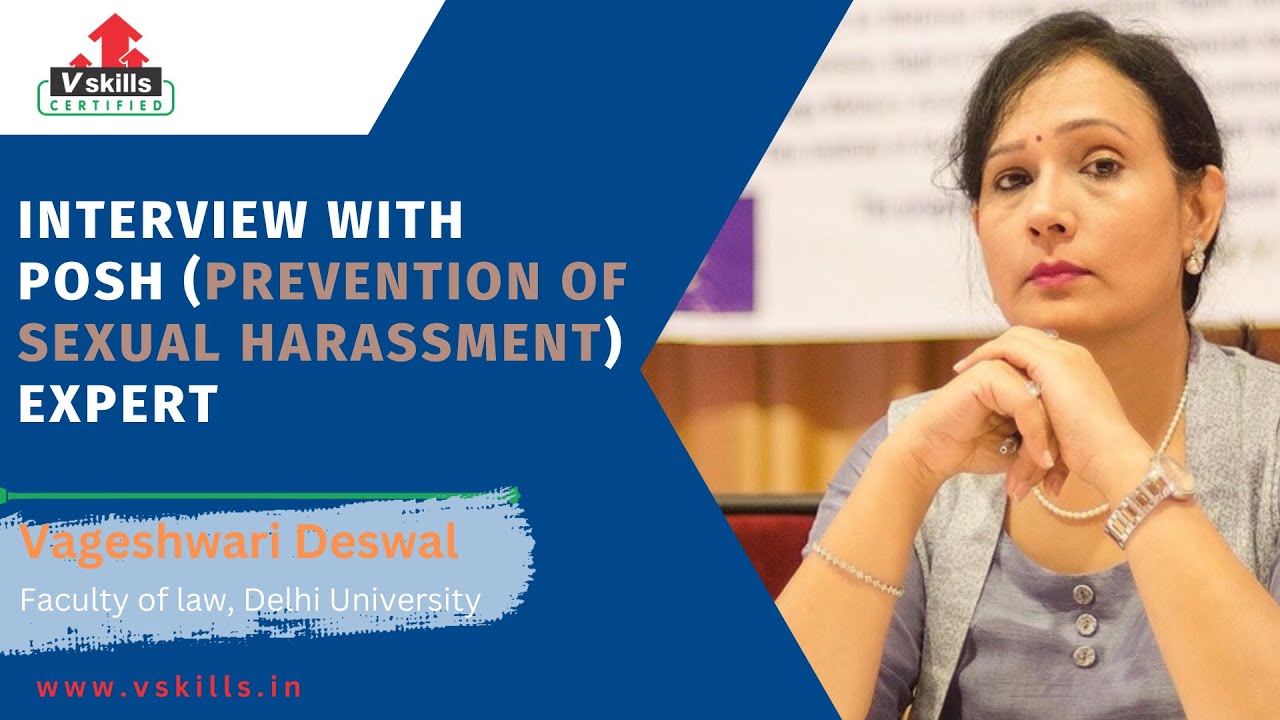
Domain Expert Interview Series


POSH Related Blogs
POSH Related jobs
Checkout the various job openings in the field of POSH, click here..
Internships in POSH
Vskills runs its flagship internship programme where bright interns work with academic council, click to know more details.