Python has become one of the most in-demand programming languages across web development, data science, automation, and artificial intelligence. The Vskills Certified Python Developer certification validates your ability to write clean, efficient Python code and apply core programming concepts to real-world problems. This govt. certification is designed to help developers, students, and IT professionals demonstrate their Python proficiency to employers and stand out in a competitive job market.
Why choose Vskills Certified Python Developer Certification?
- Industry-Recognized Credential: As a govt. certified credential, it adds credibility to your resume and signals verified, job-ready Python skills to employers.
- Comprehensive Curriculum: The course covers Python fundamentals through advanced topics — syntax, data structures, OOP concepts, file handling, exception handling, modules, and libraries — giving you a well-rounded skill set.
- Hands-On Learning: Practical examples and coding exercises ensure you can apply Python concepts to actual development scenarios, not just theory.
- Career Advancement: Python developers are sought after across industries like fintech, e-commerce, healthcare, and IT services, and this certification helps you qualify for these growing opportunities.
- Access to Vskills Job Portal: Certified candidates get access to job listings and hiring opportunities tailored to their certification.
- Lifetime Validity: The certification does not expire, so it remains a permanent addition to your professional profile.
- Affordable and Flexible: Compared to long-format bootcamps, this certification offers a cost-effective way to validate skills, with self-paced study material and online exam access.
Who should Enroll?
- Freshers and students from computer science, IT, or related backgrounds looking to start a career in software development
- Working professionals aiming to transition into Python-based roles such as backend development, automation, or data analysis
- Software developers who already use Python and want a formal, govt. certified validation of their skills
- Data analysts and aspiring data scientists who need strong Python fundamentals as a foundation for advanced tools and libraries
- IT professionals looking to upskill and stay competitive in a rapidly evolving tech landscape
- Freelancers and consultants who want a recognized credential to build client trust
- Anyone preparing for technical interviews that require demonstrable Python programming knowledge
What will you learn?
This certification covers Python programming from the basics through advanced concepts, including installation and setup, language fundamentals, control structures, data structures, object-oriented programming, exception handling, file and module handling, and working with XML.
Table of Contents
Module 1. Introduction to Python
- Welcome to this Course!
- Overview of the Course Curriculum
- Our Python Coding Environment
- Writing the First Code! Variables and Printing
- Numbers in Python
- Calculating the Remainder of a Division
- Python Strings
- Python String Formatting
- Getting a User Input in Python
- Booleans and Comparisons in Python
- AND and OR in Python
- Lists in Python
- Tuples in Python
- Sets in Python
- Advanced Set Operations
- Python Dictionaries
- Length and Sum
- Joining a list
Module 2. Python Fundamentals
- If Statements in Python
- While Loops in Python
- For Loops in Python
- Destructuring Syntax
- Iterating over Dictionaries
- Break and Continue
- The Else Keyword with Loops
- Finding Prime Numbers with For Loops
- List Slicing in Python
- List Comprehension in Python
- Comprehensions with Conditional Statements
- Set and Dictionary Comprehensions
- The Zip Function
- Functions in Python
- Arguments and Parameters
- Functions and Return Values in Python
- Default Parameter Values
- Lambda Functions in Python
- First Class and Higher Order Functions
Module 3. Milestone Project 1
- Installing Python on your Computer
- Installing PyCharm on your Computer
- Creating the First PyCharm Project
- Setting up the PyCharm Font and Display Settings
- Milestone Project Brief
- Milestone Project Implementation
- Showing the User Movies
- Finding Movies and Retrieving Details
Module 4. Object-Oriented Programming with Python
- Intro to Object-Oriented Programming with Python
- More about Classes and Objects
- Parameter Naming in Python
- Magic Methods in Python
- Inheritance in Python
- The @property Decorator
- The @classmethod and @staticmethod Decorators in Python
- More @classmethod and @staticmethod Examples
Module 5. Errors in Python
- Intro to Errors in Python
- Built-in Errors in Python
- Raising Errors in Python
- Creating Errors in Python
- Dealing with Python Errors
- The On-success Block and Re-raising Exceptions
- Debugging with PyCharm
Module 6. Files in Python
- Files in Python
- Python Exercise: Copying Files
- CSV Files with Python
- JSON Files with Python
- Using the “with” Syntax in Python
- Importing Files
- Python Relative Imports: Children
- Python Relative Imports: Parents
- Importing Errors and Running as a Python Script
Module 7. Databases in Python and Milestone Project 2
- Intro to Milestone Project 2
- Milestone Project with Lists
- Storing Books in Files
- Using JSON instead of CSV
- Intro to Databases in Python
- Using SQLite in Python
- Some Database Jargons
- Creating Books Table Using Python
- Inserting Books Using Python
- SELECT Examples
- Getting All Books
- UPDATE and DELETE Statements
- Filtering using the WHERE Clause
- Finishing the Milestone Project
- Ordering and Limiting
- Developing the Context Manager in Python
- Errors in Context Managers
Module 8. Type Hinting in Python
- Typing in Python
- Further Reading
Module 9. Advanced Built-in Functions in Python
- Generators in Python
- Python Generator Classes and Iterators
- Iterables in Python
- The Filter() Function in Python
- The Map() Function in Python
- Any() and All() Functions in Python
- The enumerate() function
Module 10. Advanced Python Development
- Mutability in Python
- Argument mutability in Python
- Default values for parameters
- Mutable default arguments (bad idea)
- Argument unpacking in Python
- Queues in Python
- Some interesting Python collections
- Timezones
- Dates and time in Python
- Timing your code with Python
- Regular expressions
- Regex examples
- Regex in Python
- Introduction to logging in Python
- Logging to a File and Other Features
Module 11. Web Scraping with Python
- Understanding HTML with BeautifulSoup
- More Complex HTML Parsing
- Structuring Parsing Program Better
- Splitting HTML Locators out of the Python Class
- Understanding HTML with the Browser
- Scraping the First Website with Python
- Milestone Project 3: A Quote Scraper
- Quotes Project 2: Structuring a Scraping App in Python
- Quotes Project 3: Getting Locators
- Quotes Project 4: Crafting a Quote Parser
- Quotes Project 5: The Quotes Page
- Quotes Project 6: Recap of the Project
- Milestone Project 4: A Book Scraper + Application
- Books Project 2: Recap of HTML Locators
- Books Project 3: Creating Locators in Python
- Books Project 4: Creating a Page
- Books Project 5: Creating a Book Parser
- Books Project 6: Writing an App File
- Books Project 7: Sorting the Books
- Books Project 8: Constructing a Menu
- ASIDE: The Best Way to Write User Menus
- Books Project 9: Getting Multiple Pages
- Books Project 10: Multiple Pages in Python
- Books Project 11: Getting the Page Count in Python
- Books Project 12: Adding the Logging Module to a Python Project
- A Word on Scraping Pages with JavaScript
Module 12. Browser Automation with Selenium
- Introduction to this Section
- Review of Quotes Scraping Code
- Downloading ChromeDriver
- Using Chrome in Scraping Code
- New Page Locators
- Interacting with Drop-downs
- Selecting Tags
- Searching for Quotes
- Encapsulating Logic More Simply
- Adding Error Handling
- Implicit and Explicit Waits in Selenium
- Adding Waits to a Program Code
Module 13. Asynchronous Python Development
- The Dining Philosophers Problem
- Processes and Threads
- The Python Global Interpreter Lock (GIL)
- Example: Threads in Python
- Using Python concurrent.futures with the ThreadPoolExecutor
- Don't Kill Threads
- Multiprocessing in Python
- Using Python concurrent.futures and the ProcessPoolExecutor
- Dealing with Shared State in Threads
- Queuing in Threads with Shared State
- Using Python Generators Instead of Threads
- First Single-threaded Task Scheduler in Python
- Yielding from Another Iterator in Python
- Receiving Data Through Yield
- The Async and Await Keywords
- More explanations and examples
- Asynchronous Scraper
- Making the First Async Request in Python
- Retrieving Multiple Pages Efficiently
- Using the async_timeout for Security
- Turning our Book Scraping Project async
- HTTPS with Python and Mac OS X
Module 14. Python on the Console and Managing Project Dependencies
- Running Python in the Console
- Running Python
- What is a virtualenv?
- Navigating the Terminal and Using virtualenv
- Using pipenv
- pipenv and virtualenv
Module 15. Web Development with Flask
- Setting up Project with Pipenv
- First Flask Endpoint
- Returning Information with Flask and Pythons
- Rendering HTML with Flask and Python
- Error Pages and Jinja2 Inheritance
- Rendering Forms with Flask and Python
- Accessing POST Form Data with Flask
- Adding a Form in a Single Endpoint
- Using Jinja2 For Loops to Create a Nice Homepage
- Adding Website Navigation
Module 16. Interacting with APIs with Python
- Signing up for Openexchangerates
- Getting All Exchange Rates from the API
- Creating a Currency Exchange Library
- Caching Functions with Functools
- Performing TTLCache with Cachetools
Module 17. Decorators in Python
- A Simple Decorator in Python
- Using Syntax
- Functools Wraps in Python
- Decorating Functions with Parameters
- Decorators with Parameters
- Functions that Accept Multiple Arguments
- Using Generic Decorators for any Function
Module 18. Advanced Object-Oriented Programming
- Introduction to Multiple Inheritance with Python
- Introduction to Abstract Base Classes (ABCs) in Python
- The Usefulness of ABCs
- The Relationship Between Abstract Base Classes (ABCs) and Interfaces
- The Property Setter in Python
Module 19. Graphical User Interface (GUI) Development with Tkinter
- Setting up Tkinter
- Hello World in Tkinter
- Labels and Fields
- Packing Components
- Using Frames for Different Layouts
- Starting the Text Editor Project
- Tkinter Notebooks and Creating Files
- Adding a Menu to an Application
- Saving Files to a Disk
- Opening Files
- Binding Shortcuts in Tkinter
- Checking Tabs for Unsaved Changes
- Confirming Exit with Unsaved Changes
- Closing Individual Tabs
- Adding Another Menu
- Adding a Permanent Scrollbar to the Text Area
Module 20. Unit Testing with Python
- Introduction to this Section
- Testing Functions
- Testing for Errors
- Testing the Multiplication Function
- Writing a Printer Class for Testing
- Testing Classes
- More Printer Tests
- Testing External Libraries
- Conclusion of this Section
Module 21. Algorithms and Data Structures
- Presentation: Queues, Stacks, and Complexity
- Presentation: Binary Search
- Presentation: Binary Trees
- Presentation: Traversal of Binary Trees
- Presentation: Adding Elements to a Binary Tree
- Adding Elements to a Binary Tree in Python
- Recursion and In order Traversal in Python
- Finding Nodes in a Tree with Python
- Deleting Nodes from a Binary Tree
- Deleting Nodes in Code with Python
- Deleting Nodes with Two Children in a Code
- Testing a Binary Tree
Module 22. Python Libraries
- Python Libraries Overview
- Using Pylint
- Using Yapf
- Sending E-mails with smtplib
- Sending E-mails with Mailgun
- Creating a Re-usable Mailgun Library
- Sneak Peek: Integrated Development Environment (IDE) Setup
Module 23. Python Reference/Refresher
- Variables in Python
- String Formatting in Python
- Getting the User Input
- Lists, Tuples, and Sets
- Advanced Set Operations
- Booleans in Python
- If Statements in Python
- The “in” Keyword
- If Statements with the “in” Keyword
- Loops in Python
- List Comprehensions
- Dictionaries
- Destructuring Variables
- Functions in Python
- Function Arguments and Parameters
- Default Parameter Values
- Functions Returning Values
- Lambda Functions in Python
- Dictionary Comprehensions
- Unpacking Arguments
- Unpacking Keyword Arguments
- Object-Oriented Programming in Python
- Magic methods: __str__ and __repr__
- Class Methods and Static Methods
- Class Inheritance
- Class Composition
- Type Hinting
- Importing Files in Python
- Relative Imports in Python
- Errors in Python
- Custom Error Classes
- First-class Functions
- Simple Decorators in Python
- The “at” Syntax for Decorators
- Decorating Functions with Parameters
- Decorators with Parameters
- Mutability in Python
- Mutable Default Parameters
Exam and Certification Details
| Detail | Information |
|---|
| Exam Format | Online — attempt from anywhere, anytime |
| Number of Questions | 50 multiple-choice questions |
| Duration | 60 minutes |
| Passing Score | 25 out of 50 (50%) — no negative marking |
| Certificate Validity | Lifetime — no renewal required |
| e-Learning Access | Lifetime access to LMS and future content updates |
| Result | Instant — available immediately after exam completion |
| Language | English
|
Companies that hire Python Developer
Vskills certified Python Developers find employment opportunities with leading organizations across IT, product, and e-commerce sectors, including Hewlett Packard, Adecco, Capgemini, Accenture, TCS, HCL, Cognizant, IBM, Infosys, Dell, Wipro, Amazon, and Flipkart, among others.

Career Outcome for Certified Professional
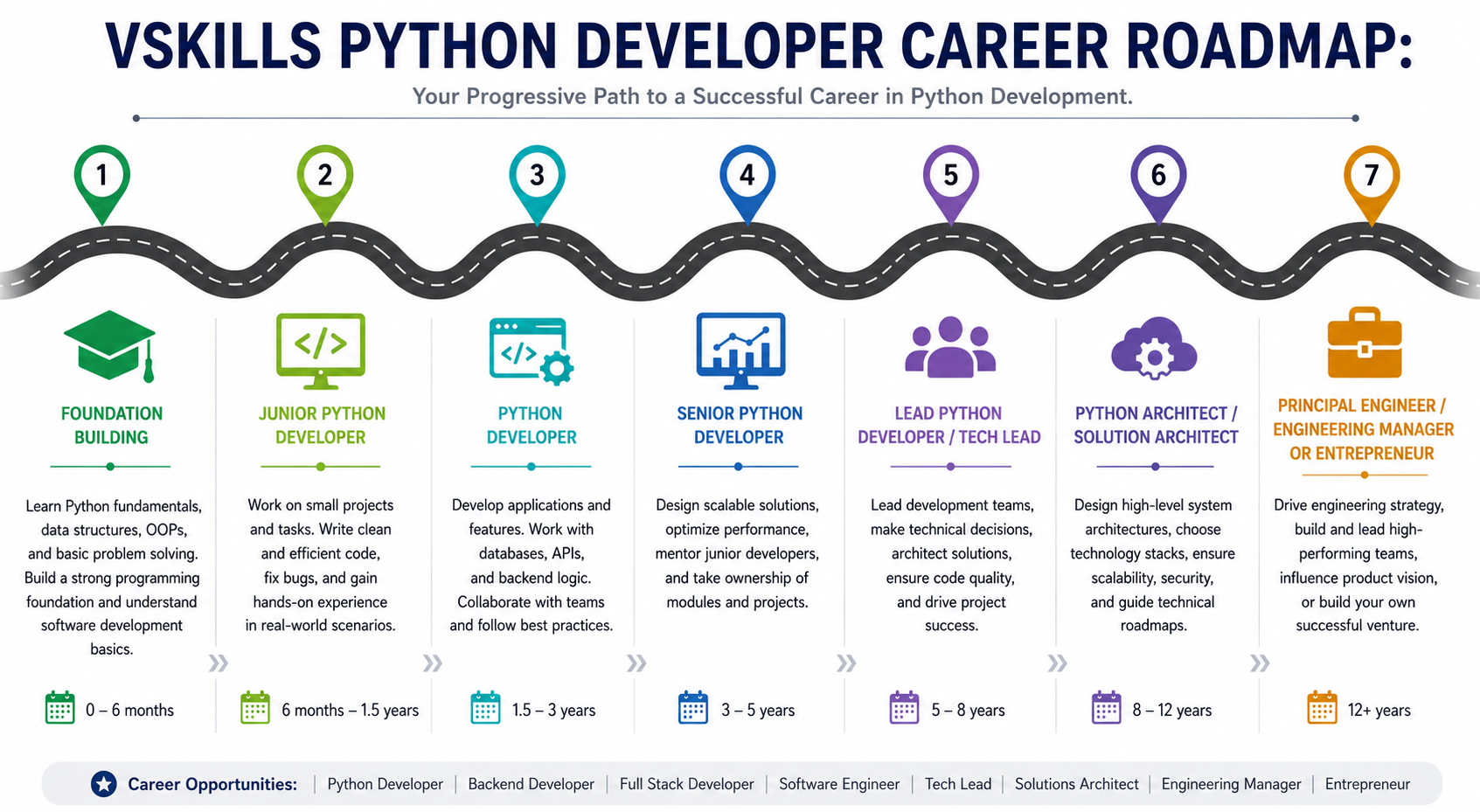
Certified Python Developers are equipped for a range of in-demand roles across web development, data analytics, automation, and backend engineering, with strong salary growth potential as Python continues to see the fastest job demand growth among programming languages.
| Job Role |
Industry |
Avg. Salary (India) |
Experience Level |
| Junior Python Developer |
IT, Software Services |
₹3.5 – ₹6 LPA |
Fresher – 2 years |
| Python Developer |
IT, Product, E-commerce |
₹5 – ₹9 LPA |
2 – 4 years |
| Backend Developer (Python) |
SaaS, Fintech |
₹6 – ₹11 LPA |
3 – 5 years |
| Python Data Analyst |
Analytics, Consulting |
₹6 – ₹10 LPA |
2 – 5 years |
| Automation/Scripting Engineer |
IT, DevOps, QA |
₹5 – ₹9 LPA |
2 – 4 years |
| Senior/Lead Python Developer |
IT, Product, MNC |
₹12 – ₹22 LPA |
6+ years |
Career Roadmap for Python Developer