Artificial Intelligence is transforming the way modern organisations operate, make decisions, and deliver services. From finance and healthcare to human resources, governance, customer experience, and public policy, AI is now being used in areas where accuracy, fairness, transparency, and accountability are extremely important. However, as AI becomes more powerful and widely adopted, organisations also face new risks related to bias, data privacy, regulatory compliance, security, explainability, and ethical decision-making.
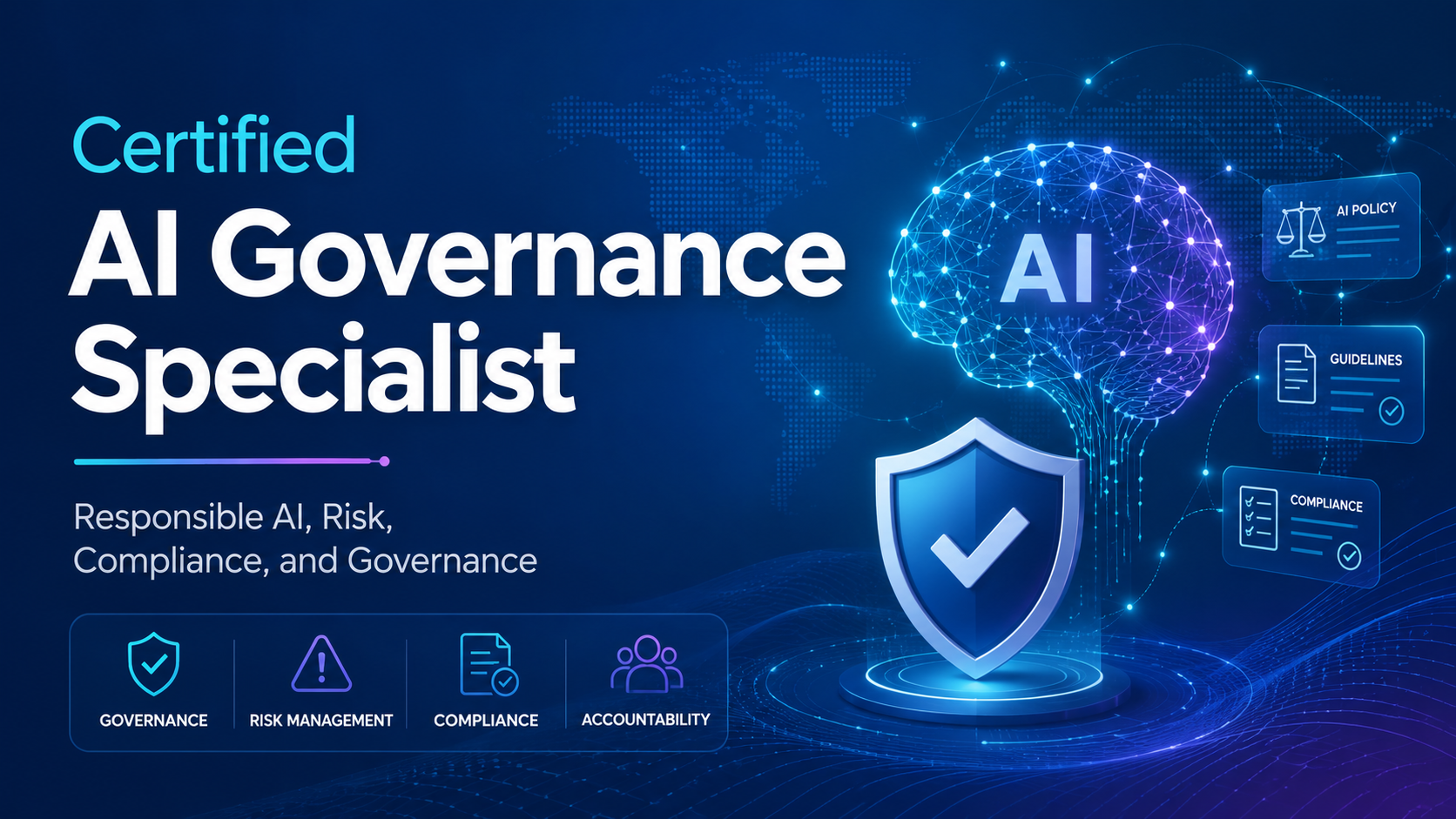
Certified AI Governance Specialist
The Vskills Certified AI Governance Specialist programme is designed to help professionals understand how AI systems can be governed responsibly across the full AI lifecycle. This certification provides practical knowledge of how to design, implement, monitor, and audit AI governance frameworks within complex organisational environments.
The course introduces learners to important AI governance concepts such as responsible AI, fairness, accountability, transparency, risk management, compliance, human oversight, and ethical AI deployment. It also helps professionals understand major governance frameworks and regulatory developments, including the EU AI Act and the NIST AI Risk Management Framework.
By completing this certification, learners can develop the skills needed to support responsible AI adoption in their organisations. The programme is especially useful for professionals who want to lead AI governance initiatives, reduce AI-related risks, strengthen compliance readiness, and ensure that AI systems are used in a trustworthy and responsible manner.
About AI Governance
AI governance refers to the set of policies, processes, standards, and control mechanisms that guide how artificial intelligence systems are designed, developed, deployed, monitored, and audited. It ensures that AI is not only technically efficient but also ethical, transparent, secure, fair, and compliant with applicable regulations.
As organisations increasingly use AI for decision-making, automation, customer interaction, fraud detection, hiring, credit scoring, healthcare support, and business intelligence, the need for strong governance becomes essential. Without proper governance, AI systems can create serious risks such as biased outcomes, privacy violations, lack of accountability, regulatory non-compliance, and reputational damage.
AI governance helps organisations answer important questions such as:
- Who is responsible for an AI system’s decisions?
- How can bias in AI models be identified and reduced?
- Is the AI system compliant with relevant laws and regulations?
- Can users understand how an AI-driven decision was made?
- How is sensitive data being protected?
- What controls are in place if the AI system fails or causes harm?
A Certified AI Governance Specialist learns how to address these questions through structured frameworks, risk assessment methods, policy controls, audit practices, and responsible AI principles. The role is especially important in industries where AI decisions can directly affect people’s rights, opportunities, finances, health, or access to services.
In simple terms, AI governance ensures that organisations can innovate with AI while maintaining trust, responsibility, and compliance.
What you will learn in Vskills Course
1. Foundations of AI Ethics and Governance
- What is AI Governance and why it matters
- Core ethical principles: fairness, accountability, transparency
- The AI governance landscape and global context
- Historical evolution of AI ethics frameworks
- Stakeholders and their roles in AI governance
2. Regulatory and Compliance Frameworks
- EU AI Act: scope, risk tiers, and obligations
- NIST AI Risk Management Framework (RMF)
- ISO/IEC 42001: AI Management System Standard
- GDPR and data protection in AI contexts
- Regional regulations: US, UK, India, ASEAN
3. AI Risk Identification and Assessment
- Types of AI risk: technical, ethical, legal, operational
- AI risk classification and tiering
- Risk assessment methodologies and tools
- Emergent risks: algorithmic discrimination, deepfakes
- Risk registers and documentation best practices
4. Algorithmic Bias and Fairness
- Sources of bias in AI systems and data pipelines
- Fairness definitions: group, individual, counterfactual
- Bias detection tools: FairLearn, AI Fairness 360, Aequitas
- Bias mitigation strategies: pre-, in-, and post-processing
- Case studies: biased hiring, credit scoring, facial recognition
5. Transparency, Explainability, and Accountability
- Explainable AI (XAI): LIME, SHAP, and interpretability toolkits
- Model cards and datasheets for AI systems
- Black-box vs. glass-box models in enterprise contexts
- Designing audit trails and logging for AI decisions
- Accountability structures: roles and responsibilities
6. Data Governance and Privacy in AI
- Data quality, provenance, and lineage for AI
- Privacy-by-design and privacy-by-default principles
- Data minimisation, anonymisation, and synthetic data
- GDPR compliance in AI model training and deployment
- Data governance policies and stewardship models
7. Building an Enterprise AI Governance Framework
- Governance structure: AI Ethics Committees and CoEs
- AI policy development and enforcement mechanisms
- Governance across the full AI lifecycle (MLOps)
- Aligning AI governance with enterprise risk management
- Governance for third-party and vendor AI solutions
8. Responsible Generative AI Governance
- Unique governance challenges of large language models
- Hallucination, misinformation, and content safety
- IP, copyright, and AI-generated content ownership
- Agentic AI and autonomous systems governance
- GenAI policies for enterprise employees and developers
9. AI Governance in High-Stakes Industries
- Financial services: credit, fraud detection, SR 11-7
- Healthcare: clinical AI, FDA guidance, patient safety
- Human resources: hiring algorithms, discrimination law
- Public sector: government AI, democratic accountability
- Cross-industry lessons and best practices
10. AI Auditing, Monitoring, and Incident Response
- AI audit methodologies and third-party assessments
- Continuous model monitoring and drift detection
- AI incident response protocols and crisis management
- Red-teaming and adversarial testing for AI systems
- Regulatory reporting and disclosure obligations
11. Ethical AI Culture and Organisational Change
- Building an ethical AI culture across the enterprise
- Training and upskilling AI teams on governance
- Engaging boards, leadership, and non-technical stakeholders
- Change management for AI governance adoption
- Measuring and reporting on ethical AI maturity
12. The Future of AI Governance
- Emerging AI technologies and new governance frontiers
- Global AI governance convergence and divergence
- Sustainable and environmentally responsible AI
- Next-generation ethical frameworks for AGI
- Building a career in AI governance and ethics
Key Principles of Responsible AI
Responsible AI is the foundation of effective AI governance. It ensures that artificial intelligence systems are developed and used in a way that is ethical, fair, transparent, secure, and accountable. As AI systems influence important decisions in areas such as hiring, lending, healthcare, insurance, education, and public services, organisations must ensure that these systems do not create harm or unfair outcomes.
A Certified AI Governance Specialist must understand the major principles that guide responsible AI practices across the full AI lifecycle.
Fairness
Fairness means that AI systems should not discriminate against individuals or groups based on factors such as gender, age, race, income, location, disability, or social background. Since AI models learn from data, they may repeat or even increase existing biases if the data is not properly checked.
For example, if an AI hiring tool is trained on past recruitment data where certain groups were underrepresented, it may unfairly reject qualified candidates from those groups. AI governance helps organisations detect such risks early and take corrective action.
Accountability
Accountability means that humans must remain responsible for AI decisions. Even if an AI system makes a recommendation or prediction, the organisation must clearly define who is responsible for approving, monitoring, and correcting the system.
This includes assigning responsibility to teams such as data science, compliance, legal, business leadership, and internal audit. A strong governance framework ensures that AI decisions are not treated as “black box” outputs with no human ownership.
Transparency
Transparency means that organisations should clearly communicate when AI is being used, what purpose it serves, and how it affects users or stakeholders. This is especially important when AI is used in customer-facing or high-impact decisions.
For instance, if a bank uses AI to assess loan applications, customers should have a reasonable understanding of how their information is being used and what factors may influence the decision.
Explainability
Explainability refers to the ability to understand and explain how an AI system arrived at a particular output. This is important for building trust, especially in regulated sectors such as finance, healthcare, insurance, and public administration.
An explainable AI system helps users, auditors, regulators, and decision-makers understand why a model made a specific recommendation. It also helps organisations identify errors, bias, or unexpected behaviour in the system.
Privacy and Data Protection
AI systems often depend on large volumes of data, including personal and sensitive information. Responsible AI requires organisations to collect, store, process, and use data in a lawful and secure manner.
This includes following data protection principles such as consent, purpose limitation, data minimisation, secure storage, and controlled access. AI governance ensures that data is not misused and that privacy risks are managed properly.
Safety and Reliability
AI systems must be tested and monitored to ensure that they work safely and reliably in real-world conditions. A model that performs well during development may behave differently when exposed to new data, changing user behaviour, or unexpected situations.
Responsible AI requires regular testing, performance monitoring, error detection, and fallback mechanisms. This helps reduce the risk of system failure, inaccurate predictions, or harmful outcomes.
Human Oversight
Human oversight ensures that important decisions are not left entirely to machines. In high-risk areas, humans should be able to review, challenge, override, or stop AI-driven decisions when necessary.
This principle is especially important in cases where AI affects people’s rights, access to services, financial opportunities, medical outcomes, or legal status.
Security
AI systems can be vulnerable to cyberattacks, data poisoning, model manipulation, and misuse. Responsible AI governance includes security controls to protect AI models, training data, outputs, and system infrastructure.
Security is not only a technical issue but also a governance concern. Organisations must ensure that AI systems are protected from both internal and external threats.
Ethical Use
Ethical AI means using artificial intelligence in ways that respect human dignity, social values, and public trust. Not every technically possible AI use case is ethically acceptable.
A Certified AI Governance Specialist helps organisations evaluate whether an AI system should be built, how it should be used, and what safeguards are needed before deployment.
Responsible AI principles help organisations move beyond simple AI adoption and towards trustworthy AI implementation. These principles form the core of AI governance and guide every stage of the AI lifecycle, from data collection and model development to deployment, monitoring, auditing, and improvement.
AI Risk Management and Compliance
AI risk management is one of the most important parts of AI governance. As organisations use AI systems for decision-making, automation, prediction, recommendation, and customer interaction, they must understand the risks that can arise from these systems. These risks are not limited to technical errors. They can also include ethical, legal, operational, reputational, privacy, and security-related concerns.
A Certified AI Governance Specialist must know how to identify, assess, control, and monitor AI-related risks across the complete AI lifecycle. This includes the stages of data collection, model design, training, testing, deployment, monitoring, and auditing.
Understanding AI Risks
AI systems can create different types of risks depending on how they are built and where they are used. For example, an AI model used for movie recommendations may have limited impact, but an AI model used for loan approval, medical diagnosis, hiring, or fraud detection can directly affect people’s lives and opportunities.
Common AI risks include:
- Bias and discrimination in AI decisions
- Use of poor-quality or incomplete data
- Lack of transparency in model outputs
- Privacy violations due to misuse of personal data
- Cybersecurity threats and model manipulation
- Incorrect predictions or unreliable results
- Lack of human oversight
- Non-compliance with AI regulations
- Reputational damage due to unethical AI use
AI Risk Assessment
AI risk assessment helps organisations understand how risky an AI system is before it is deployed. It also helps decide what level of control, documentation, monitoring, and human review is required.
A basic AI risk assessment usually examines:
- The purpose of the AI system
- The type of data being used
- The people or groups affected by the AI system
- The possible harm caused by wrong or biased decisions
- The level of human involvement in the decision-making process
- The explainability of the model
- The legal and regulatory requirements linked to the use case
- The security controls protecting the system
For example, an AI chatbot used for general customer queries may need basic governance controls. However, an AI system used for credit scoring or healthcare diagnosis requires much stronger risk assessment, documentation, compliance checks, and human supervision.
Bias and Fairness Risk
Bias is one of the most common AI risks. It occurs when an AI system produces unfair outcomes for certain individuals or groups. This may happen because the training data reflects past discrimination, excludes certain groups, or contains hidden patterns that lead to unfair results.
A Certified AI Governance Specialist helps organisations reduce bias by encouraging:
- Regular data quality checks
- Fairness testing before deployment
- Bias detection across different user groups
- Documentation of model assumptions
- Human review of high-impact decisions
- Continuous monitoring after deployment
Privacy and Data Protection Risk
AI systems often require large datasets, and these datasets may include personal, sensitive, or confidential information. If this data is collected, stored, or used without proper safeguards, it can create serious privacy risks.
AI governance ensures that organisations follow responsible data practices, such as:
- Collecting only necessary data
- Using data for clearly defined purposes
- Protecting user consent
- Securing sensitive information
- Limiting access to authorised users
- Following applicable data protection laws
Compliance with AI Regulations
AI compliance means ensuring that AI systems follow relevant laws, standards, and regulatory expectations. As governments and regulators become more active in this area, organisations must be prepared to show that their AI systems are safe, fair, transparent, and accountable.
Important compliance areas include:
- AI risk classification
- Data protection and privacy
- Documentation and record keeping
- Human oversight requirements
- Explainability and transparency
- Bias testing and fairness checks
- Security and incident reporting
- Audit readiness
Frameworks such as the EU AI Act and the NIST AI Risk Management Framework have made AI compliance an important priority for organisations. These frameworks encourage businesses to identify high-risk AI systems, apply proper controls, maintain documentation, and ensure continuous monitoring.
AI Monitoring and Control
AI risk management does not end after deployment. Once an AI system is live, it must be continuously monitored to ensure that it continues to perform correctly and responsibly.
Ongoing monitoring may include:
- Checking model accuracy over time
- Detecting changes in data patterns
- Reviewing complaints or user feedback
- Testing for bias after deployment
- Monitoring system security
- Reviewing unexpected or harmful outputs
- Updating the model when required
This is important because AI models can become less accurate over time if real-world conditions change. This is known as model drift. Strong governance helps organisations detect such issues early and take corrective action.
Role of an AI Governance Specialist in Risk and Compliance
An AI Governance Specialist plays a key role in connecting technical teams, legal teams, compliance teams, business leaders, and risk managers. Their responsibility is to ensure that AI systems are not only useful but also responsible, lawful, and trustworthy.
The specialist may support tasks such as:
- Creating AI risk assessment templates
- Reviewing AI use cases before deployment
- Preparing governance documentation
- Supporting compliance audits
- Monitoring responsible AI practices
- Coordinating with data science and legal teams
- Ensuring human oversight in high-risk AI systems
- Helping organisations prepare for AI regulations
AI risk management and compliance help organisations use AI with confidence while reducing the chances of harm, legal issues, and reputational damage. For any professional entering the field of AI governance, understanding risk and compliance is essential because it forms the foundation of responsible and trustworthy AI adoption.
AI Governance Frameworks and Policies
AI governance frameworks provide a structured approach for managing artificial intelligence responsibly within an organisation. They help define how AI systems should be developed, approved, monitored, documented, and audited. Without a clear framework, AI adoption can become fragmented, risky, and difficult to control.
A Certified AI Governance Specialist must understand how governance frameworks work and how they can be applied across different business functions. These frameworks ensure that AI systems are aligned with ethical principles, business objectives, legal requirements, and risk management standards.
What is an AI Governance Framework?
An AI governance framework is a set of rules, processes, roles, and controls that guide the responsible use of AI. It gives organisations a clear structure for deciding which AI systems can be used, what risks must be checked, who is responsible for approval, and how the system should be monitored after deployment.
A strong AI governance framework usually includes:
- AI policy and governance principles
- AI risk classification process
- Data governance rules
- Model development and validation standards
- Human oversight requirements
- Bias and fairness testing
- Privacy and security controls
- Documentation and audit process
- Incident reporting system
- Ongoing monitoring mechanism
Importance of AI Policies
AI policies act as the foundation of an organisation’s AI governance system. They define what is acceptable and unacceptable when using artificial intelligence. These policies help employees, developers, managers, and leadership teams understand how AI should be used responsibly.
An AI policy may include guidance on:
- Approved use cases for AI
- Restrictions on high-risk AI applications
- Data privacy and data usage rules
- Human review requirements
- Transparency and disclosure expectations
- Vendor and third-party AI tool usage
- Documentation standards
- Compliance and reporting responsibilities
For example, an organisation may create a policy that requires all AI systems used in hiring, credit approval, healthcare support, or employee monitoring to go through a formal risk review before deployment.
Key Components of an AI Governance Framework
A well-designed AI governance framework should cover the full AI lifecycle, from planning and development to deployment and post-deployment monitoring.
AI Use Case Review
Before an AI system is developed or purchased, the organisation should review its purpose, expected benefits, risks, and possible impact on users. This helps identify whether the system is low-risk, medium-risk, or high-risk.
High-risk AI use cases usually require stronger controls, detailed documentation, legal review, and human oversight.
Data Governance
AI systems depend heavily on data. Therefore, data governance is a core part of AI governance. It ensures that data used for AI is accurate, relevant, secure, lawful, and free from avoidable bias.
Data governance includes:
- Data quality checks
- Data source verification
- Consent and privacy review
- Data minimisation
- Access control
- Data retention rules
- Bias detection in datasets
Model Governance
Model governance focuses on how AI models are built, tested, validated, deployed, and updated. It ensures that models are reliable, explainable, secure, and fit for their intended purpose.
This may include:
- Model documentation
- Performance testing
- Validation before deployment
- Bias and fairness testing
- Explainability review
- Version control
- Approval before release
- Monitoring after deployment
Human Oversight and Accountability
A strong AI governance framework clearly defines who is responsible for the AI system. It ensures that humans remain involved in important decisions, especially when AI affects people’s rights, opportunities, finances, health, or safety.
Human oversight may include:
- Manual review of high-risk decisions
- Escalation process for disputed outputs
- Ability to override AI recommendations
- Clear responsibility for business teams
- Regular review by governance committees
AI Audit and Documentation
Documentation is essential for proving that AI systems are being governed responsibly. It helps organisations explain how an AI system was developed, what data was used, what risks were identified, and what controls were applied.
Important documentation may include:
- AI system purpose
- Data sources used
- Risk assessment reports
- Bias testing results
- Model validation records
- Human oversight process
- Compliance checklist
- Monitoring reports
- Incident logs
This documentation is useful for internal audits, regulatory reviews, legal defence, and stakeholder trust.
Popular AI Governance Frameworks
Several global frameworks guide organisations in building responsible AI systems. A Certified AI Governance Specialist should be familiar with these frameworks and understand how they can be adapted to organisational needs.
NIST AI Risk Management Framework
The NIST AI Risk Management Framework helps organisations identify, measure, manage, and monitor AI risks. It focuses on building trustworthy AI systems by addressing fairness, accountability, transparency, safety, security, and privacy.
EU AI Act
The EU AI Act is one of the most important regulatory developments in AI governance. It classifies AI systems based on risk levels and places stricter requirements on high-risk AI applications. It focuses on transparency, human oversight, documentation, risk management, and compliance.
OECD AI Principles
The OECD AI Principles promote human-centred, trustworthy, and responsible AI. They focus on inclusive growth, transparency, robustness, safety, accountability, and respect for human rights.
ISO Standards for AI Management
ISO standards help organisations create structured systems for managing AI quality, risk, safety, and governance. These standards support consistency, documentation, accountability, and continuous improvement.
Role of Governance Committees
Many organisations create AI governance committees or responsible AI boards to oversee AI adoption. These committees usually include members from technology, legal, compliance, risk, business, cybersecurity, data privacy, and senior leadership teams.
Their responsibilities may include:
- Reviewing high-risk AI use cases
- Approving AI policies
- Monitoring compliance
- Resolving ethical concerns
- Reviewing audit findings
- Updating governance practices
- Ensuring board-level accountability
Building an Effective AI Governance Policy
An effective AI governance policy should be clear, practical, and easy to apply. It should not remain only a formal document. It should guide daily decision-making across teams that design, buy, deploy, or monitor AI systems.
A good AI governance policy should:
- Define responsible AI principles
- Classify AI systems by risk level
- Set rules for data usage
- Require documentation and testing
- Assign ownership and accountability
- Include human oversight requirements
- Define monitoring and audit procedures
- Provide an incident response process
- Be updated regularly as regulations evolve
In summary, AI governance frameworks and policies help organisations move from uncontrolled AI adoption to responsible AI management. They provide the structure needed to reduce risk, improve trust, support compliance, and ensure that AI systems are used in a fair, transparent, and accountable manner.
Roles and Responsibilities of an AI Governance Specialist
An AI Governance Specialist plays an important role in helping organisations use artificial intelligence in a responsible, ethical, and compliant manner. As AI systems become more deeply involved in business decisions, customer interactions, risk assessment, automation, and data analysis, organisations need professionals who can ensure that these systems are properly reviewed, monitored, and controlled.
The role is not limited to technical knowledge. An AI Governance Specialist works at the intersection of technology, law, ethics, compliance, risk management, data privacy, and business strategy. Their main responsibility is to make sure that AI systems are useful for the organisation while also being fair, transparent, secure, and accountable.
Designing AI Governance Policies
One of the key responsibilities of an AI Governance Specialist is to help create internal AI policies. These policies define how AI should be developed, purchased, deployed, and monitored within the organisation.
This may include rules related to:
- Responsible AI use
- Human oversight
- Data privacy
- Bias testing
- Model documentation
- Third-party AI tools
- Risk approval processes
- Compliance requirements
A clear policy helps employees understand what is allowed, what needs approval, and what safeguards must be followed before using AI.
Conducting AI Risk Assessments
AI Governance Specialists assess the risks linked to different AI systems. They review the purpose of the AI system, the type of data used, the people affected, and the possible consequences of wrong or biased decisions.
For example, an AI system used for product recommendations may have lower risk, while an AI system used for loan approval, hiring, medical support, or fraud detection may require stronger governance controls.
The specialist helps classify AI systems based on their risk level and recommends suitable safeguards.
Ensuring Regulatory Compliance
AI governance is closely linked to compliance. Organisations must ensure that their AI systems follow relevant laws, regulations, and standards. This may include AI-specific regulations, data protection laws, sectoral compliance rules, and internal governance standards.
An AI Governance Specialist helps the organisation prepare for compliance by maintaining documentation, supporting audits, reviewing regulatory requirements, and ensuring that AI systems meet expected standards.
Promoting Fairness and Reducing Bias
AI systems can produce unfair outcomes if they are trained on biased or incomplete data. One of the major responsibilities of an AI Governance Specialist is to support fairness testing and bias mitigation.
This involves working with data science and business teams to check whether an AI system treats different groups fairly. If bias is detected, the specialist helps recommend corrective actions, such as improving data quality, adjusting model design, or adding human review.
Supporting Transparency and Explainability
AI systems should not operate in a completely unclear manner, especially when they are used for important decisions. An AI Governance Specialist helps ensure that AI decisions can be explained to users, management, auditors, and regulators.
This may involve:
- Preparing model documentation
- Explaining decision logic in simple terms
- Creating transparency notices
- Supporting explainability reviews
- Ensuring users know when AI is being used
Transparency helps build trust and makes it easier to detect errors or unfair outcomes.
Managing AI Documentation and Audit Readiness
Documentation is a central part of AI governance. Organisations must maintain proper records of how AI systems are developed, tested, approved, deployed, and monitored.
An AI Governance Specialist may help prepare and maintain:
- AI use case registers
- Risk assessment reports
- Model validation records
- Bias testing results
- Data usage documentation
- Human oversight records
- Audit checklists
- Incident reports
This documentation helps the organisation prove that its AI systems are being managed responsibly.
Coordinating Across Teams
AI governance requires collaboration across multiple departments. An AI Governance Specialist acts as a bridge between technical and non-technical teams.
They may work with:
- Data scientists
- AI and ML engineers
- Legal teams
- Compliance officers
- Risk managers
- Cybersecurity teams
- Business leaders
- Internal auditors
- Data protection officers
This coordination ensures that AI governance is not treated as only a technical issue, but as an organisation-wide responsibility.
Monitoring AI Systems After Deployment
AI governance does not end once an AI system goes live. AI models must be monitored regularly to ensure that they continue to perform accurately, fairly, and safely.
The specialist may help track:
- Model accuracy
- Bias patterns
- User complaints
- Unexpected outputs
- Data drift
- Security incidents
- Compliance issues
- Need for model updates
Continuous monitoring helps organisations identify problems early and take corrective action before serious harm occurs.
Advising Leadership on Responsible AI Strategy
AI Governance Specialists also support senior leaders in making responsible AI decisions. They help leadership understand the risks, benefits, compliance duties, and ethical concerns linked to AI adoption.
This role becomes especially important when organisations are planning large-scale AI deployment or using AI in sensitive areas such as finance, healthcare, hiring, public services, or customer profiling.
In summary, an AI Governance Specialist ensures that AI systems are not only innovative but also responsible, compliant, and trustworthy. Their role is becoming increasingly important as organisations move from experimenting with AI to using it in real business and decision-making environments.
Career Scope and Salary Expectations
AI governance is becoming an important career area as organisations increase their use of artificial intelligence across business operations, customer service, finance, healthcare, hiring, cybersecurity, and decision-making. As AI adoption grows, companies need professionals who can ensure that AI systems are ethical, compliant, transparent, and properly monitored.
A Certified AI Governance Specialist can work in roles that combine technology, risk management, compliance, data protection, policy, and business strategy. This makes the certification useful for both technical and non-technical professionals who want to build a career in the responsible AI space.
Career Opportunities in AI Governance
Professionals with AI governance skills can explore roles such as:
- AI Governance Specialist
- Responsible AI Analyst
- AI Risk Analyst
- AI Compliance Officer
- AI Policy Analyst
- AI Ethics Consultant
- Model Risk Analyst
- Data Governance Specialist
- AI Audit Specialist
- GRC Analyst for AI Systems
- AI Regulatory Compliance Consultant
- Responsible AI Program Manager
These roles are especially relevant in organisations where AI systems are used for high-impact decisions, such as loan approvals, medical support, fraud detection, hiring, insurance, customer profiling, and public services.
Industries Hiring AI Governance Professionals
AI governance skills are useful across a wide range of industries. Any sector using AI for decision-making, automation, risk analysis, or customer interaction will need professionals who can oversee AI responsibly.
Major industries include:
- Information technology
- Banking and financial services
- Insurance
- Healthcare
- Consulting
- Cybersecurity
- Legal and compliance services
- Government and public sector
- Education technology
- Human resources technology
- Retail and e-commerce
- Telecommunications
In highly regulated industries such as finance, healthcare, and insurance, the demand for AI governance professionals is expected to be stronger because AI decisions can directly affect people’s rights, safety, access, and financial opportunities.
Why AI Governance Has Strong Career Potential
AI governance is gaining importance because businesses can no longer focus only on AI innovation. They must also manage the risks that come with AI adoption. Organisations need professionals who can help them answer questions such as:
- Is the AI system legally compliant?
- Is the model producing fair outcomes?
- Can the decision be explained?
- Is personal data being used responsibly?
- Who is accountable if the AI system causes harm?
- Is the system being monitored after deployment?
Professionals who can answer these questions are becoming valuable because they help organisations adopt AI with confidence while reducing legal, ethical, and reputational risks.
Salary Expectations
Salary in AI governance depends on factors such as experience, industry, location, technical knowledge, regulatory understanding, and the size of the organisation. Professionals with a combination of AI knowledge, compliance experience, data governance skills, and risk management expertise may receive better career opportunities.
| Experience Level | India Salary Range | Global Salary Range |
|---|---|---|
| Entry-Level | ₹4 LPA – ₹8 LPA | $55,000 – $80,000 |
| Mid-Level | ₹8 LPA – ₹18 LPA | $80,000 – $130,000 |
| Senior-Level | ₹18 LPA – ₹35 LPA+ | $130,000 – $180,000+ |
Skills That Can Improve Salary Potential
Professionals can improve their salary prospects by building strong knowledge in:
- AI governance frameworks
- EU AI Act and global AI regulations
- NIST AI Risk Management Framework
- Data privacy and protection
- Bias detection and fairness testing
- Model risk management
- AI audit and documentation
- Responsible AI policy development
- Cybersecurity basics
- Business risk assessment
Career Growth Path
A beginner may start as an AI Governance Associate, Responsible AI Analyst, Compliance Analyst, or Data Governance Executive. With experience, they can move into roles such as AI Governance Specialist, AI Risk Manager, AI Compliance Lead, Responsible AI Manager, or AI Policy Consultant.
At senior levels, professionals may move into leadership roles such as Head of Responsible AI, AI Governance Program Manager, Chief AI Ethics Officer, or AI Risk and Compliance Director.
In summary, AI governance offers strong career potential for professionals who want to work in a future-focused field. As AI becomes more common in business and public systems, the need for trained specialists who can manage AI responsibly will continue to grow.
Why Pursue a Certified AI Governance Specialist Certification?
Pursuing a Certified AI Governance Specialist certification is valuable for professionals who want to build expertise in one of the most important emerging areas of artificial intelligence. As AI adoption increases across industries, organisations are no longer asking only how to use AI, but also how to use it responsibly, legally, ethically, and safely.
This certification helps learners understand the practical side of AI governance, including risk management, regulatory compliance, responsible AI principles, audit readiness, fairness, transparency, and accountability.
Builds Expertise in a High-Demand AI Field
AI governance is becoming a priority for organisations because AI systems are now being used in sensitive business areas. Companies need professionals who can guide responsible AI adoption and ensure that AI systems do not create legal, ethical, or reputational risks.
This certification helps learners gain structured knowledge in a field that is expected to grow as AI regulations and governance requirements become stronger.
Validates Your Responsible AI Knowledge
A certification gives formal recognition to your understanding of AI governance concepts. It shows that you are familiar with responsible AI principles, risk assessment, compliance requirements, governance frameworks, and ethical AI practices.
This can be especially useful for professionals working in compliance, risk, legal, data science, cybersecurity, business analysis, and technology roles.
Helps You Understand AI Regulations and Frameworks
AI governance is closely connected to regulations and global frameworks. This certification helps learners understand important developments such as the EU AI Act, NIST AI Risk Management Framework, responsible AI principles, and AI audit practices.
Understanding these frameworks helps professionals support organisations in building AI systems that are better prepared for regulatory review and internal governance checks.
Strengthens Career Opportunities
AI governance is useful across many roles and industries. Certified professionals can explore opportunities in AI compliance, responsible AI, AI risk management, data governance, AI policy, model risk, and AI auditing.
As organisations adopt AI at a larger scale, professionals who can combine AI understanding with governance and compliance knowledge will become more valuable.
Supports Both Technical and Non-Technical Professionals
One of the biggest advantages of AI governance is that it is not limited to programmers or AI engineers. Professionals from legal, compliance, risk management, business, policy, healthcare, finance, and public sector backgrounds can also benefit from this certification.
It helps non-technical professionals understand how AI systems should be governed, while helping technical professionals build models that are more responsible, transparent, and compliant.
Improves Organisational Decision-Making
Professionals trained in AI governance can help organisations make better decisions about which AI systems to use, how to assess risks, when human oversight is needed, and what documentation should be maintained.
This improves trust, reduces uncertainty, and supports safer AI adoption across departments.
Prepares You for the Future of AI Compliance
AI regulations are evolving quickly across the world. Organisations will increasingly need professionals who can understand these changes and translate them into practical governance processes.
A Certified AI Governance Specialist certification prepares learners for this future by building knowledge of AI risk, compliance, documentation, monitoring, and accountability.
In summary, this certification is useful for anyone who wants to work at the intersection of artificial intelligence, ethics, risk, compliance, and business strategy. It helps professionals move beyond basic AI awareness and develop the skills needed to support responsible and trustworthy AI adoption.
Preparation Methods and Strategies for the Certification Exam
Preparing for the Certified AI Governance Specialist exam requires a clear understanding of both theory and practical application. Since AI governance is a multidisciplinary field, learners should focus on concepts related to artificial intelligence, risk management, compliance, ethics, data privacy, transparency, accountability, and regulatory frameworks.
This certification is not only about memorising definitions. It is about understanding how AI governance works in real organisational settings and how different teams can manage AI responsibly.
Understand the Exam Objectives and Syllabus
The first step is to carefully go through the certification syllabus. This helps you understand what topics are important and how much time should be given to each area.
Key topics usually include:
- Foundations of AI Ethics and Governance
- Regulatory and Compliance Frameworks
- AI Risk Identification and Assessment
- Algorithmic Bias and Fairness
- Transparency, Explainability, and Accountability
- Data Governance and Privacy in AI
- Building an Enterprise AI Governance Framework
- Responsible Generative AI Governance
- AI Governance in High-Stakes Industries
- AI Auditing, Monitoring, and Incident Response
- Ethical AI Culture and Organisational Change
- The Future of AI Governance
Once you understand the syllabus, divide it into smaller sections and prepare each topic one by one.
Build Strong Conceptual Clarity
AI governance includes several concepts that are connected to each other. For example, fairness is linked with bias testing, transparency is linked with explainability, and compliance is linked with documentation and audit readiness.
Learners should focus on understanding the meaning, purpose, and practical use of each concept. Instead of only learning definitions, try to understand how these ideas apply in real cases such as AI-based hiring, credit scoring, healthcare diagnosis, fraud detection, or customer profiling.
Study Important Frameworks and Regulations
A major part of AI governance preparation involves understanding key frameworks and regulatory developments. Learners should pay special attention to the EU AI Act and the NIST AI Risk Management Framework because these are widely discussed in the field of responsible AI.
While studying these frameworks, focus on:
- Risk classification of AI systems
- Requirements for high-risk AI applications
- Human oversight
- Transparency obligations
- Documentation requirements
- Bias and fairness controls
- Risk monitoring and mitigation
- Accountability mechanisms
You do not need to become a legal expert, but you should understand how these frameworks guide responsible AI implementation.
Practice Scenario-Based Questions
AI governance exams often test your ability to apply concepts in practical situations. Scenario-based questions may describe an AI system and ask what risk, control, or governance action is most appropriate.
For example, a question may describe an AI tool used for hiring and ask how bias should be reduced. Another question may describe an AI model used in healthcare and ask what type of documentation or human oversight is required.
To prepare well, practice questions based on:
- Bias in AI models
- Privacy risks
- High-risk AI use cases
- AI audit requirements
- Model explainability
- Human oversight
- Compliance failures
- Data quality issues
Create Short Notes and Revision Sheets
Since AI governance includes many terms and frameworks, short notes can be very helpful during revision. Prepare simple notes for important topics such as fairness, accountability, explainability, model drift, data privacy, risk assessment, governance committee, audit trail, and compliance checklist.
You can also prepare quick comparison tables for topics like:
| Topic | Focus Area |
|---|---|
| Fairness | Avoiding biased or discriminatory outcomes |
| Explainability | Understanding how AI decisions are made |
| Accountability | Defining who is responsible for AI outcomes |
| Privacy | Protecting personal and sensitive data |
| Compliance | Meeting legal and regulatory requirements |
| Monitoring | Checking AI performance after deployment |
Understand Real-World Use Cases
AI governance becomes easier to understand when connected with real-world examples. Learners should study how AI is used in different sectors and what risks may arise in each case.
Useful examples include:
- AI in loan approval
- AI in recruitment
- AI in healthcare diagnosis
- AI in insurance pricing
- AI in fraud detection
- AI in customer service chatbots
- AI in public sector decision-making
For each example, try to identify the possible risks, required safeguards, compliance requirements, and role of human oversight.
Focus on Documentation and Audit Readiness
Documentation is a central part of AI governance. Many learners focus only on ethics and fairness but forget the importance of proper records. In real organisations, documentation helps prove that an AI system has been reviewed, tested, approved, and monitored responsibly.
Important documents to understand include:
- AI use case register
- Risk assessment report
- Data source documentation
- Bias testing report
- Model validation record
- Human oversight process
- Compliance checklist
- Audit trail
- Incident report
Take Mock Tests and Review Mistakes
Mock tests are useful because they help you understand the exam pattern, improve speed, and identify weak areas. After every mock test, review your mistakes carefully instead of only checking the score.
Pay attention to questions where you confused similar terms, such as transparency and explainability, risk management and compliance, or monitoring and auditing. Revising these areas will improve your final performance.
Exam-Taking Tips
During the exam, read every question carefully. Many AI governance questions may include practical situations where more than one option seems correct. In such cases, choose the answer that best supports responsible, compliant, transparent, and risk-aware AI use.
Useful exam strategies include:
- Read the full question before selecting an answer
- Identify keywords such as bias, privacy, risk, audit, compliance, and oversight
- Eliminate clearly incorrect options
- Apply practical judgement in scenario-based questions
- Do not rush through framework-related questions
- Keep time for final review
In summary, successful preparation for the Certified AI Governance Specialist exam requires a mix of conceptual study, framework understanding, practical examples, and regular revision. Learners who understand how AI governance works in real organisational situations will be better prepared to clear the exam and apply the knowledge in their professional roles.
Conclusion
The Certified AI Governance Specialist tutorial provides a complete learning pathway for professionals who want to understand how artificial intelligence can be managed responsibly, ethically, and in compliance with evolving regulations. As AI becomes a core part of business operations, organisations need skilled professionals who can ensure that AI systems are fair, transparent, accountable, secure, and properly monitored.
This certification helps learners build knowledge of responsible AI principles, AI risk management, governance frameworks, regulatory compliance, data privacy, model monitoring, and audit readiness. It is especially useful for professionals working in compliance, risk, legal, technology, data science, cybersecurity, healthcare, finance, public policy, and leadership roles.